Data Center Grid Interconnection Equipment Market Size & Share Analysis - Trends, Drivers, Competitive Landscape, and Forecasts (2025 - 2032)
This Report Provides In-Depth Analysis of the Data Center Grid Interconnection Equipment Market Report Prepared by P&S Intelligence, Segmented by Equipment Type (Switchgear & Circuit Breakers, Transformers, Protection & Relay Systems, Power Control & Distribution Panels), Voltage Level (Medium Voltage (below 35 kV), High Voltage (35-230 kV), Extra-High Voltage (above 230 kV)), Data Center Type (Hyperscale Data Centers, Colocation Data Centers, Enterprise Data Centers, Edge/Micro Data Centers), Deployment Type (Greenfield New Builds, Brownfield Upgrades & Expansions), and Geographical Outlook for the Period of 2021 to 2032
Data Center Grid Interconnection Equipment Market Size Estimation
Key Highlights
Study Period
2021 - 2032
Market Size in 2025
USD 4.04 Billion
Market Size in 2026
USD 4.41 Billion
Market Size by 2032
USD 7.48 Billion
Projected CAGR
9.2%
Largest Region
North America
Fastest Growing Region
Asia-Pacific
Market Structure
Moderately Fragmented
Market Size
Explore the market potential with our data-driven report
Data Center Grid Interconnection Equipment Market Overview
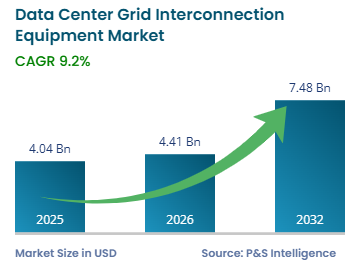
The data center grid interconnection equipment market was valued at USD 4.04 billion in 2025 and is estimated at USD 4.41 billion in 2026. The market is projected to reach USD 7.48 billion by 2032, growing at a CAGR of 9.2% during 2026-2032. Hyperscale operators and colocation developers are buying transformers, switchgear, and protection systems at the point where their campuses tie into the utility grid, since a new data hall cannot draw power until that connection equipment is specified, procured, and energized.
Demand is rising because data centers are pulling far more power off the grid than they did even two years ago. The International Energy Agency reported that global data center electricity demand rose 17% in 2025, nearly six times the 3% growth in overall electricity demand that year. Each new gigawatt of data center load needs its own step-up transformers, high-voltage switchgear, and protection relays at the interconnection point, so developers are ordering more grid interconnection equipment simply to keep pace with load growth already underway.
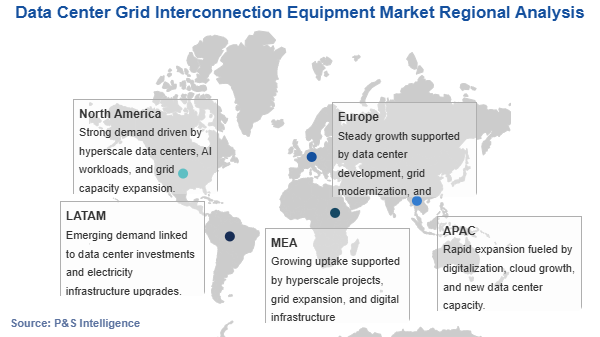
North America accounted for 38% of 2025 revenue, led by hyperscale build-outs across the U.S., where utilities are racing to connect new data halls to an already congested transmission network. Asia-Pacific is set to outpace every other region in growth, expanding at a 10.5% CAGR during 2026-2032, as China, India, and Japan add data center capacity that needs interconnection equipment installed from scratch rather than swapped into an existing campus. That contrast, replacement-driven demand in mature markets against new-build demand in Asia-Pacific, shapes how vendors plan production and inventory.
Key market insights
By equipment type, transformers held 37% share in 2025, while switchgear & circuit breakers is projected to grow at a 9.9% CAGR during 2026-2032.
By voltage level, high voltage (35-230 kV) held 46% share in 2025, while extra-high voltage (above 230 kV) is projected to grow at an 11.0% CAGR during 2026-2032.
By data center type, hyperscale Data Centers held 46% share in 2025, while edge/micro data centers is set to post the fastest growth during 2026-2032.
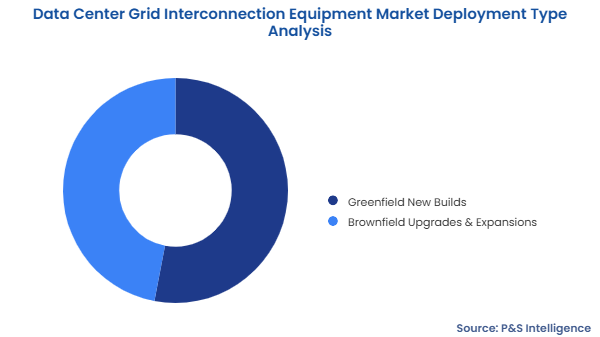
By deployment type, Greenfield new builds held 53% share in 2025, while Brownfield upgrades & expansions is expected to grow the quickest during 2026-2032.
By geography, North America held 38% share in 2025, while Asia-Pacific is projected to grow at a 10.5% CAGR during 2026-2032.
Data Center Grid Interconnection Equipment Market Trends and Growth Drivers
Large-load interconnection reform is accelerating point-of-interconnection equipment orders
Grid operators across the U.S. handled data center interconnection requests case by case for much of the past two years, with no standard tariff language covering a campus that co-locates with its own generation. That ambiguity delayed the point at which a developer could sign firm equipment contracts, because commercial terms for the connection itself were still being negotiated alongside the engineering study. Regulators are now closing that gap.
The Federal Energy Regulatory Commission ordered PJM Interconnection in December 2025 to rewrite its tariff with explicit rules for co-located load, including provisional service options that let a project begin construction before every study is complete. Once a grid operator publishes defined connection terms, developers can lock in equipment specifications and issue purchase orders months earlier than under the previous ad hoc process. Transformer and switchgear vendors offering pre-engineered, standardized designs are best placed to capture orders released on this faster timeline.
Transmission network expansion is opening a broader pipeline for interconnection equipment
Utilities in several countries are approving new high-voltage transmission lines and substations specifically to reach data center clusters, and each new line segment ends in a fresh point of interconnection that needs its own switchgear, transformers, and protection equipment. That build-out is not confined to campuses already under construction, since it also creates orders tied to the transmission backbone feeding them. Some of this capacity is being built ahead of confirmed demand, as utilities anticipate further data center announcements rather than react to signed contracts one at a time.
The North American Electric Reliability Corporation's 2025 reliability assessment found 41,000 miles of transmission above 100 kV under construction or in planning over the next decade, well above the prior year's projection, with data center-driven load growth cited as the main cause. Each mile of new transmission eventually terminates at a substation, giving equipment suppliers a demand pipeline that extends beyond individual data center campuses and into utility-side interconnection projects tied to this buildout.
Direct-to-transmission campus connections are reshaping equipment specification
Hyperscale campuses that once tied into the grid at local distribution voltage increasingly connect straight to the transmission network, because a single AI training campus can draw several hundred megawatts, more than a distribution feeder can carry. That shift pushes the point of interconnection to a higher voltage class and changes what equipment a campus needs at that connection, well before the facility itself is finished.
The U.S. Department of Energy's 2026 draft National Transmission Needs Study points to Texas' commitment of USD 33 billion to its first 765-kV transmission backbone as evidence that planners are building at a higher voltage class specifically for large new loads. Campuses connecting at these higher tiers need extra-high-voltage transformers, gas-insulated switchgear, and dedicated protection relay systems rather than the distribution-class equipment older campuses used, lifting the average equipment order per connection. Suppliers without an extra-high-voltage product line risk being excluded from these larger, higher-value connection projects entirely.
Interconnection queue backlogs are constraining the pace of new campus connections
Not every developer that wants a grid connection gets one quickly, because utility interconnection studies process large-load and generation requests in the order they arrive. A campus that clears site selection and financing can still wait years before its connection equipment order is confirmed, since utilities will not finalize transformer and switchgear specifications until the interconnection study and system-impact assessment are both complete. That wait applies even to well-financed hyperscale projects, not only smaller developers.
Lawrence Berkeley National Laboratory's Queued Up research found that projects above 100 megawatts now take a median of more than four years from interconnection request to commercial operation, roughly double the wait recorded for projects built in the early 2000s. That lag pushes equipment orders later into a project's timeline than developers plan for, and it rewards suppliers who can compress lead times once a connection agreement is finally signed.
Data Center Grid Interconnection Equipment Market Segmentation Analysis
Equipment Type
Transformers held 37% of data center grid interconnection equipment revenue in 2025, the largest share of any equipment category. Every point of interconnection needs at least one purpose-built step-up or step-down transformer sized to the campus's contracted load, and that single unit typically represents the largest capital line item at the connection point. Transformer lead times also run far longer than other equipment categories, so campuses lock in this spending earliest in the design cycle, ahead of switchgear, protection, and control system awards.
Switchgear & circuit breakers is projected to expand at a 9.9% CAGR during 2026-2032, the fastest pace among equipment categories. Rising interconnection voltages and tighter fault-protection requirements are pushing campuses toward more circuit breaker positions per connection, since utilities increasingly require redundant protection paths before they will energize a large new load. Growth also follows from retrofit activity, as older interconnections replace aging breakers to meet current utility protection standards.
Voltage Level
High voltage (35-230 kV) equipment accounted for 46% of 2025 revenue, the largest share by voltage class. Large data center campuses typically draw more power than a local distribution feeder can supply, so utilities route them to sub-transmission or transmission-class connections instead of medium-voltage service. Equipment rated for this tier, larger transformers, higher-rated circuit breakers, and more elaborate protection schemes, costs substantially more per connection than medium-voltage gear, which lifts this category's revenue share above its share of connection count.
Extra-high voltage (above 230 kV) equipment is projected to grow at an 11.0% CAGR during 2026-2032, the fastest of the three voltage tiers. Campuses drawing several hundred megawatts of continuous load are increasingly connecting directly to transmission backbones above 230 kV rather than stepping down through an intermediate substation. That shift adds a category of equipment, extra-high-voltage transformers and gas-insulated switchgear, that smaller campuses never needed, and it concentrates spending in fewer, larger-ticket connection projects.
Data Center Type
Hyperscale data centers accounted for 46% of 2025 revenue, the largest share by facility type. Hyperscale campuses draw the most continuous power of any facility class, and that scale requires dedicated, campus-specific interconnection equipment rather than a shared or metered utility service. Hyperscale operators also self-fund the interconnection equipment on their side of the meter, giving them direct purchasing control that colocation and enterprise operators, who more often depend on a landlord or a standard utility tariff, do not have to the same degree.
Edge and micro data centers are set to post the fastest growth of any facility type over 2026-2032. Edge sites are proliferating in far greater numbers than hyperscale or colocation campuses because each one serves a smaller local footprint, and every new site still needs its own protection and interconnection equipment even at a fraction of hyperscale's per-site spend. That multiplies the number of purchase points faster than it lifts spending per site, favoring vendors with compact, standardized equipment packages built for repeat deployment.
Deployment Type
Greenfield new builds accounted for 53% of 2025 revenue, the largest share by deployment type. A new campus needs its interconnection equipment specified and installed before the site can draw any power at all, so the full transformer, switchgear, and protection package gets ordered in a single, large procurement event. Brownfield sites, by contrast, typically replace or add equipment piecemeal as capacity needs grow, spreading spending across smaller, incremental orders rather than one upfront package.
Brownfield upgrades and expansions are set to grow faster than greenfield builds through 2026-2032. Many campuses built five to ten years ago were sized for lower power densities than current AI workloads require, and raising a site's contracted load means requalifying or replacing the original interconnection equipment to handle higher fault currents and capacity. That upgrade cycle is starting to run alongside new construction rather than behind it, giving equipment vendors a second, recurring revenue stream tied to existing campuses rather than only new ones.
The following segments are analysed in this report.
Equipment Type
Switchgear & Circuit Breakers
Transformers
Protection & Relay Systems
Power Control & Distribution Panels
Voltage Level
Medium Voltage (below 35 kV)
High Voltage (35-230 kV)
Extra-High Voltage (above 230 kV)
Data Center Type
Hyperscale Data Centers
Colocation Data Centers
Enterprise Data Centers
Edge/Micro Data Centers
Deployment Type
Greenfield New Builds
Brownfield Upgrades & Expansions
Drive strategic growth with comprehensive market analysis
Data Center Grid Interconnection Equipment Market Geographical Analysis
North America Data Center Grid Interconnection Equipment Market outlook
North America accounted for 38% of 2025 revenue, the largest regional share in the Data Center Grid Interconnection Equipment Market. Hyperscale operators have concentrated new campuses around a handful of established data center hubs, where utilities have already built out much of the high-voltage backbone that a new connection can tie into, shortening the equipment list needed between a new campus and an existing substation. Congestion around those same hubs is now pushing utilities to expand and upgrade equipment at existing interconnection points rather than only building new ones, keeping replacement demand elevated alongside new-build activity.
The U.S. accounts for most of this installed base as the region's largest market, with hyperscale campuses concentrated in northern Virginia, Texas, and the Pacific Northwest. The U.S. Energy Information Administration projected commercial-sector electricity use, a category it says data centers are increasingly driving, to climb 5% in 2026, more than double the agency's typical annual forecast for that sector. North America's lead should hold through the forecast period as existing campuses upgrade aging switchgear and transformers even as growth outpaces it elsewhere.
Asia-Pacific is on track to post the quickest growth in the market, expanding at a 10.5% CAGR during 2026-2032. Data center capacity across the region is being added largely on greenfield sites rather than retrofitted onto an established grid, so almost every new campus needs its interconnection equipment installed from scratch. Governments in China, Japan, and Singapore have opened new industrial and digital-infrastructure zones built around purpose-made substations, giving equipment vendors a defined connection-point pipeline that should keep expanding faster than in North America or Europe.
India, among the fastest-growing markets within the region, illustrates how quickly this pipeline is expanding. India's Central Electricity Authority is now directing states and distribution utilities to fold projected data center demand into resource adequacy and transmission planning, formalizing a process that previously ran on an ad hoc, project-by-project basis. That planning mandate shortens the gap between a data center's financial close and its grid connection, pulling equipment orders earlier into each project's timeline.
Europe contributes a smaller, steadily rising share of global demand as more countries add dedicated licensing and planning tracks for large-load connections. Grid capacity, rather than land or capital, has become the main constraint on new data center campuses in the region's established hubs, pushing some operators toward markets with more available transmission headroom. Germany's automotive and industrial base continues to anchor a large part of regional demand, while operators in the Nordics and Poland benefit from comparatively available transmission capacity.
The European Network of Transmission System Operators for Electricity found that European data center electricity demand is on course to grow more than 50% between 2025 and 2030, and it named connection lead times, ranging from a few years to more than a decade in the most congested hubs, as the sector's most frequently cited constraint. That backlog is prompting national transmission operators to prioritize new interconnection studies for data center campuses ahead of other large industrial loads, a shift that should gradually shorten the region's connection timelines relative to today's queue lengths.
Latin America's grid interconnection equipment orders stay small next to the other regions, with most of the activity clustered around Brazil's colocation and hyperscale campuses near Sao Paulo and Rio de Janeiro. A second, smaller cluster of demand sits along Mexico's export-manufacturing corridor near the U.S. border, where nearshoring investment is pulling new industrial and data center loads onto the grid.
Brazil's national grid operator, the Operador Nacional do Sistema Eletrico, authorized 300 megawatts of grid access for a single Campinas-area data center campus in December 2025, and it has reported that data center demand on the national grid is on pace to rise tenfold within four years, with 22 contracts already signed. That kind of concentrated growth from a small number of large accounts gives equipment vendors clear, sizeable projects to bid for, even though the region's overall order volume remains small next to North America or Asia-Pacific.
Giga-project and AI-campus development in Saudi Arabia anchors what is otherwise a modest slice of global demand across the Middle East and Africa. State-backed developers there are building data center capacity as part of broader economic diversification programs, giving interconnection equipment vendors access to nationally coordinated projects instead of the fragmented, developer-by-developer market common elsewhere.
Saudi Electricity Company is building a 605-kilometer, 525-kilovolt high-voltage direct-current transmission line to supply NEOM's giga-projects, including its planned AI data center campus, illustrating the scale of interconnection infrastructure being built to serve a single development zone. South Africa's mining and financial-services sectors add a smaller, steadier source of regional demand. Vendors already qualified on Gulf state utility panels have a clearer path into this market than new entrants without an existing relationship with a national utility.
The following geographies are analysed in this report.
North America
U.S.
Canada
Asia-Pacific
China
India
Japan
Singapore
Australia
South Korea
Indonesia
Malaysia
Rest of Asia-Pacific
Europe
Germany
U.K.
France
Netherlands
Finland
Poland
Spain
Italy
Rest of Europe
Latin America
Brazil
Mexico
Chile
Argentina
Colombia
Peru
Rest of Latin America
Middle East and Africa
Saudi Arabia
U.A.E.
South Africa
Egypt
Nigeria
Qatar
Israel
Turkey
Rest of Middle East and Africa
Data Center Grid Interconnection Equipment Market Competitive Landscape
The Data Center Grid Interconnection Equipment Market is moderately fragmented, with 11 established suppliers holding qualified positions and no single company holding a dominant share. Utilities that own the point of interconnection require equipment to pass type testing and factory qualification specific to each voltage class, a process that often takes years and keeps new entrants out even though the underlying transformer and switchgear technology itself is well established. Qualification runs utility by utility and country by country, so a supplier that leads in one region often competes as a smaller player elsewhere.
Diversified electrical-equipment manufacturers, including ABB Ltd, Schneider Electric SE, Eaton Corporation plc, Siemens Energy AG, Hitachi Energy Ltd., GE Vernova Inc., and Mitsubishi Electric Corporation, compete on the breadth of their point-of-interconnection portfolio, bundling transformers, switchgear, protection relays, and long-term service contracts into a single package that a utility or hyperscale developer can source from one vendor. Vertiv Holdings Co., Toshiba Corporation, Powell Industries, Inc., and Hyosung Heavy Industries Corporation compete instead on faster delivery and regional manufacturing footprint, positioning themselves as suppliers that can fill orders ahead of the diversified conglomerates' longer backlogs.
Supply constraints across the transformer and switchgear industry have stretched lead times industry-wide over the past two years, pushing utilities and campus developers to qualify a wider bench of suppliers rather than concentrate orders with one or two incumbents. That shift is gradually loosening the grip of the long-established qualified vendors, favoring regional and mid-size manufacturers able to expand capacity quickly, and it gives buyers more negotiating leverage on price and delivery than a more concentrated market would allow.
Leading Companies in Data Center Grid Interconnection Equipment Market:
ABB Ltd.
Schneider Electric SE
Eaton Corporation plc
Siemens Energy AG
Hitachi Energy Ltd.
GE Vernova Inc.
Mitsubishi Electric Corporation
Vertiv Holdings Co.
Toshiba Corporation
Powell Industries Inc.
Hyosung Heavy Industries Corporation
Data Center Grid Interconnection Equipment Market Developments
In September 2026, Hitachi Energy Ltd. committed USD 528 million to build a power transformer plant in Gallman, Mississippi, doubling output versus its existing nearby site and adding over 700 jobs. The plant targets transformer lead times that have stretched toward four years industry-wide, easing a bottleneck for utility-scale interconnection hardware.
In September 2026, Vertiv Holdings Co. agreed to acquire UtilityInnovation Group for up to USD 2.6 billion, adding microgrid switchgear and behind-the-meter power architecture used to tie on-site generation into a data center's grid interface. The deal extends Vertiv further into the utility-and-substation interface it had left to equipment specialists.
In May 2026, Powell Industries Inc. secured a data center switchgear order exceeding USD 400 million, its largest ever, covering behind-the-meter equipment for a multi-gigawatt campus through fiscal 2028. The award lifted Powell's backlog to USD 1.8 billion, with data centers now accounting for roughly a third of it.
In April 2026, GE Vernova Inc.'s electrification segment booked USD 2.4 billion in equipment orders tied to data centers in the first quarter, more than it recorded for all of 2025, as segment-wide orders climbed 86% to USD 7.1 billion. The surge spans substations, switchgear, and high-voltage transformers, the core equipment categories at a data center's grid interconnection point.
In April 2026, Eaton Corporation plc committed USD 30 million to build a 370,000-square-foot medium-voltage switchgear plant at the former Blue Buffalo site in Bellevue, Nebraska, adding more than 200 jobs to meet data center-driven demand. The plant will produce air-insulated and gas-insulated switchgear once production begins in 2027.
Frequently Asked Questions About This Report
What are the key market segments for grid interconnection equipment?+
By equipment type, transformers held 37% share in 2025, while switchgear & circuit breakers is projected to grow at a 9.9% CAGR during 2026-2032.
How does the market break down by voltage levels?+
By voltage level, high voltage (35-230 kV) held 46% share in 2025, while extra-high voltage (above 230 kV) is projected to grow at an 11.0% CAGR during 2026-2032.
Which data center types dominate the grid interconnection equipment market?+
By data center type, hyperscale data centers held 46% share in 2025, while edge/micro data centers is set to post the fastest growth during 2026-2032.
What is the difference between greenfield and brownfield deployment?+
By deployment type, Greenfield new builds held 53% share in 2025, while Brownfield upgrades & expansions is expected to grow the quickest during 2026-2032.
Which geographic region leads the market?+
North America accounted for 38% of 2025 revenue, the largest regional share in the data center grid interconnection equipment market.
Which region is growing fastest?+
Asia-Pacific is on track to post the quickest growth in the market, expanding at a 10.5% CAGR during 2026-2032.
Why is transformer equipment crucial for data center interconnection?+
Every point of interconnection needs at least one purpose-built step-up or step-down transformer sized to the campus's contracted load, and that single unit typically represents the largest capital line item at the connection point.
How rapidly is switchgear equipment growing?+
Switchgear & circuit breakers is projected to expand at a 9.9% CAGR during 2026-2032, the fastest pace among equipment categories.
Want a report tailored exactly to your business need?
Leading companies across industries trust us to deliver data-driven insights and innovative solutions for their most critical decisions. From data-driven strategies to actionable insights, we empower the decision-makers who shape industries and define the future. From Fortune 500 companies to innovative startups, we are proud to partner with organisations that drive progress in their industries.
Client Testimonials
Working with P&S Intelligence and their team was an absolute pleasure – their awareness of timelines and commitment to value greatly contributed to our project's success. Eagerly anticipating future collaborations.
McKinsey & Company
India
Unmatched Standards
Our insights into the minutest levels of the markets, including the latest trends and competitive landscape, give you all the answers you need to take your business to new heights
Complete Data Security
We take a cautious approach to protecting your personal and confidential information. Trust is the strongest bond that connects us and our clients, and trust we build by complying with all international and domestic data protection and privacy laws