Cyber-Physical Systems Market Size & Share Analysis - Trends, Drivers, Competitive Landscape, and Forecasts (2026 - 2032)
This Report Provides In-Depth Analysis of the Cyber-Physical Systems Market Report Prepared by P&S Intelligence, Segmented by Component (Hardware, Software, Services), Type (Open-Loop, Closed-Loop), Technology (Industrial Management, Smart Operations, Robotics), End Use (Manufacturing, Healthcare, Agriculture, Automotive & Transportation, Aerospace & Defense, Energy & Utilities, Consumer Electronics, Oil & Gas), and Geographical Outlook for the Period of 2021 to 2032
Explore the market potential with our data-driven report
Cyber-Physical Systems Market Overview
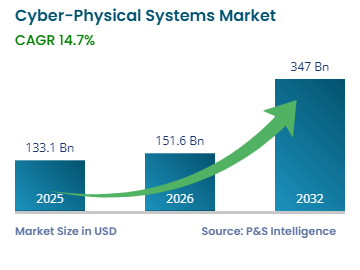
The cyber-physical systems market size was USD 133.1 billion for 2025, and it will grow by 14.7% during 2026–2032, to reach USD 347.0 billion by 2032.
The market growth is supported by the increasing convergence of operational technology, information technology, and advanced communication networks across industrial and critical infrastructure environments. Widespread adoption of artificial intelligence, edge computing, and digital twin technologies is enabling real-time monitoring, predictive maintenance, and autonomous decision-making across manufacturing, energy, healthcare, and transportation sectors. As organizations accelerate Industry 4.0 initiatives and smart infrastructure development, closed-loop CPS architectures are becoming integral to operational efficiency. These architectures also strengthen system resilience and extend automation across industrial and infrastructure environments.
The U.S. National Institute of Standards and Technology (NIST) reports that its Cyber-Physical Systems and Internet of Things Program is advancing a formal CPS Framework and a reconfigurable CPS/IoT testbed. This framework and testbed strengthen measurement science, interoperability, and validation across domains including manufacturing, energy, transportation, healthcare, and smart cities. The U.S. National Science Foundation (NSF) supports Frontier Cyber-Physical Systems research projects with funding ranging from USD 1.2 million to USD 7.0 million over four to five years. These projects address critical challenges in CPS science, engineering, and technology through multidisciplinary research and prototype validation.
Key Market Insights
The hardware category holds the largest market share of 60% in 2025, driven by the extensive deployment of sensors, controllers, and embedded devices across critical industries.
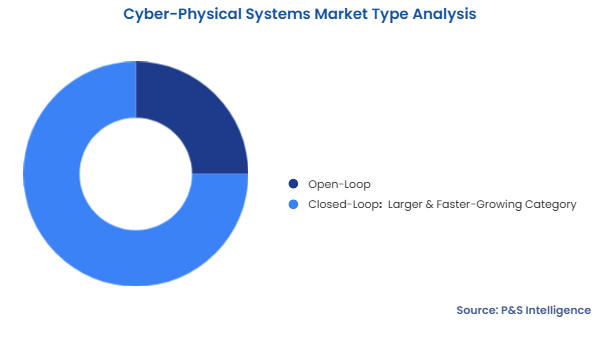
The closed-loop category holds the larger market share of 75% in 2025 and will witness the higher CAGR of approximately 14.8%, driven by the growing adoption of autonomous systems with continuous sensor feedback and real-time control.
The smart operations category holds the largest market share of 55% in 2025, driven by the growing deployment of smart grids, intelligent transportation, and smart building systems.
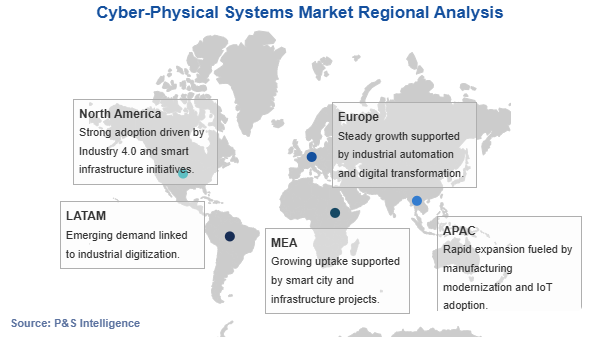
North America holds the largest market share of 40% in 2025, driven by advanced industrial infrastructure and rapid digital transformation.
Asia-Pacific will have the highest CAGR of approximately 15.6%, driven by rapid industrialization and expanding smart manufacturing adoption.
Cyber-Physical Systems Market Trends and Drivers
Digital Twin and Model-Based Enterprise Integration Are Key Trends
The integration of digital twin technology and Model-Based Enterprise (MBE) practices is emerging as a key trend in the Cyber-Physical Systems (CPS) Market as manufacturers increasingly adopt digital engineering and data-driven manufacturing practices. Digital twins enable real-time synchronization between physical assets and their virtual counterparts. This synchronization allows continuous monitoring, predictive maintenance, process optimization, and simulation before physical implementation. This capability reduces equipment downtime, improves production efficiency, lowers operational costs, and accelerates product development cycles. As enterprises continue investing in data-driven operations, demand for advanced CPS platforms capable of supporting digital twins, model-based engineering, and interoperable industrial systems is increasing. This demand is driving market growth.
The U.S. National Institute of Standards and Technology (NIST) reports that its Digital Twins for Advanced Manufacturing initiative is developing measurement science and technical standards to support reliable and interoperable digital twins across manufacturing. NIST estimates that widespread adoption of digital twins could generate approximately USD 37.9 billion in annual benefits for the U.S. manufacturing industry through improved production efficiency, product quality, predictive maintenance, and operational performance. This projected benefit reinforces the growing adoption of cyber-physical systems in industrial environments.
Industrial Robotics and IIoT Convergence Are Biggest Drivers
The accelerating deployment of industrial robotics is directly expanding demand for closed-loop cyber-physical architectures. Robotic systems require continuous sensor feedback, real-time data processing, and autonomous control loops to operate safely and efficiently alongside human workers and connected machinery. As manufacturers scale automated production lines, they increasingly integrate robotic actuators with Industrial Internet of Things (IIoT) sensors, embedded controllers, edge computing platforms, and artificial intelligence (AI)-enabled analytics that process operational feedback within milliseconds. This growing convergence of industrial robotics and IIoT is accelerating the adoption of closed-loop CPS solutions across electronics, automotive, metal processing, and other precision manufacturing industries, where real-time responsiveness, operational efficiency, and production quality are critical.
According to the International Federation of Robotics (IFR), 542,000 industrial robots were installed worldwide in 2024, more than double the number recorded a decade earlier, with Asia accounting for approximately 74% of new installations. The expansion of industrial robotics is increasing demand for advanced cyber-physical systems capable of delivering real-time monitoring, autonomous control, predictive maintenance, and seamless machine-to-machine communication across modern manufacturing environments.
Industrial Control System Vulnerabilities Are Key Restraints
The expanding attack surface created by connecting previously isolated industrial control systems (ICS) to enterprise networks and the broader internet is constraining the pace at which organizations deploy or upgrade cyber-physical systems, as each additional connected sensor, controller, edge device, or remote-access gateway introduces potential cybersecurity risks. Many operational technology (OT) environments continue to rely on legacy equipment that cannot be patched or upgraded without disrupting production. Consequently, manufacturers, utilities, and other critical infrastructure operators often delay CPS implementation until robust cybersecurity controls, network segmentation, and risk mitigation measures are established. This delay slows deployment timelines despite the operational benefits of digital transformation.
The U.S. Cybersecurity and Infrastructure Security Agency (CISA) continued to publish Industrial Control Systems (ICS) advisories throughout 2025 addressing cybersecurity vulnerabilities affecting products from industrial automation vendors, including Schneider Electric. These recurring advisories highlight the persistent cybersecurity risks associated with connected industrial environments. Organizations must undertake additional security assessments, vulnerability remediation, and compliance measures before expanding cyber-physical system deployments.
Precision Agriculture and Underpenetrated Verticals Are Biggest Opportunities
Sectors outside traditional manufacturing, particularly agriculture, represent a growth opportunity for the CPS market due to the relatively low adoption of connected automation technologies compared with the scale of addressable operations. Precision agriculture increasingly relies on CPS-enabled solutions such as smart sensors, autonomous machinery, automated irrigation systems, drone-based monitoring, and real-time data analytics to optimize resource utilization and improve farm productivity. As rising input costs, labor shortages, and climate variability place greater pressure on agricultural operations, farmers are increasingly investing in connected sensing and automated control technologies. This investment is creating new deployment opportunities for CPS vendors and solution providers.
According to the U.S. Government Accountability Office (GAO), only approximately 27% of U.S. farms and ranches used precision agriculture technologies to manage crops or livestock, based on 2023 U.S. Department of Agriculture data. This relatively low adoption rate highlights untapped market potential, as continued digitalization of agricultural operations is expected to accelerate demand for cyber-physical systems supporting real-time monitoring, automated decision-making, and precision farm management.
Cyber-Physical Systems Market Segmentation Analysis
Component Analysis
The hardware category holds the largest market share of 60% in 2025, driven by the widespread adoption of sensors, embedded processors, controllers, communication modules, and actuators across industrial automation, manufacturing, automotive, energy, healthcare, and other critical infrastructure applications. These components form the physical layer connecting digital control systems to real-world operations, making hardware the foundation of every cyber-physical system deployment. According to the Semiconductor Industry Association (SIA), global semiconductor sales reached USD 791.7 billion in 2025, representing a 25.6% increase over the previous year. Demand for logic, sensor, and embedded semiconductor products used across industrial, automotive, and connected electronic applications is driving this growth.
The software category will have the highest CAGR of approximately 14.9%, driven by the increasing adoption of embedded artificial intelligence (AI), predictive analytics, digital twins, edge computing, and cloud-based management platforms that enhance the intelligence, automation, and operational efficiency of cyber-physical systems. According to the European Commission, AI adoption among EU enterprises increased by 48% in 2025 compared with the previous year, reflecting accelerating enterprise investment in intelligent software platforms, predictive analytics, and AI-enabled automation that are increasingly integrated into cyber-physical systems.
The components analyzed in this report are:
Hardware (Largest Category)
Software (Fastest-Growing Category)
Services
Type Analysis
The closed-loop category holds the larger market share of 75% in 2025, and it will have the higher CAGR, driven by the increasing adoption of autonomous and semi-autonomous industrial equipment that relies on continuous sensor feedback and real-time control to operate safely and efficiently. Closed-loop architectures continuously monitor operating conditions and automatically adjust system performance, making them essential for industrial robotics, automated manufacturing, autonomous vehicles, smart energy systems, and other mission-critical applications. As organizations continue investing in Industry 4.0, intelligent automation, and Industrial Internet of Things (IIoT) technologies, demand for closed-loop CPS architectures is expected to accelerate throughout the forecast period.
According to the International Federation of Robotics (IFR), the global operational stock of industrial robots reached 4.664 million units in 2024, representing a 9% increase over the previous year. The continued expansion of industrial robotics is driving demand for closed-loop cyber-physical systems capable of delivering real-time sensing, adaptive control, and autonomous decision-making across modern industrial environments.
The types analyzed in this report are:
Open-Loop
Closed-Loop (Larger & Faster-Growing Category)
Technology Analysis
The smart operations category holds the largest market share in 2025, driven by the growing deployment of smart grids, intelligent transportation systems, and smart building applications that rely on continuous monitoring, real-time data exchange, and automated control of large-scale physical infrastructure. These critical infrastructure applications depend extensively on cyber-physical systems to integrate sensors, embedded controllers, communication networks, and intelligent software for efficient, reliable, and autonomous operations. According to the International Energy Agency (IEA), annual global grid investment needs to increase by approximately 50% by 2030, from around USD 400 billion annually, with a significant share directed toward digitalizing and expanding electricity distribution infrastructure, reinforcing demand for cyber-physical systems supporting smart grid operations.
The robotics category will have the highest CAGR of approximately 15.1%, driven by the increasing deployment of collaborative robots, autonomous mobile robots, and AI-enabled industrial automation across manufacturing, warehousing, and logistics environments. Rising demand for flexible automation, real-time sensing, and intelligent machine control is accelerating the adoption of robotics-enabled cyber-physical systems across industrial operations.
The technologies analyzed in this report are:
Industrial Management
Smart Operations (Largest Category)
Robotics (Fastest-Growing Category)
End Use Analysis
The manufacturing category holds the largest market share of 25% in 2025, driven by sustained industrial output and capacity utilization that continue to support investment in real-time monitoring, automation, and process optimization technologies. Discrete and process manufacturers rely on cyber-physical systems to coordinate machinery, reduce unplanned downtime, improve operational efficiency, and maintain consistent product quality across production lines. According to the U.S. Federal Reserve Board, manufacturing capacity utilization stood at 75.7% in 2025, while the industrial production index was 1.7% above its year-earlier level. This sustained manufacturing activity continues to support investments in industrial automation and cyber-physical systems.
The healthcare category will have the highest CAGR, driven by the expanding integration of connected sensors, actuators, AI-enabled monitoring systems, and intelligent medical devices across hospitals, diagnostic centers, and remote patient monitoring environments. Growing adoption of digital healthcare technologies is increasing demand for cyber-physical systems that enable real-time monitoring, automated clinical workflows, predictive diagnostics, and data-driven decision-making.
According to the U.S. Food and Drug Administration (FDA), more than 1,400 AI-enabled medical devices have been authorized since 1995, including a record 331 devices in 2025 alone. This surge in authorizations reflects the accelerating adoption of AI-enabled medical technologies that rely on cyber-physical systems for connected monitoring, diagnostics, and clinical decision support.
The end uses analyzed in this report are:
Manufacturing (Largest Category)
Healthcare (Fastest-Growing Category)
Agriculture
Automotive & Transportation
Aerospace & Defense
Energy & Utilities
Consumer Electronics
Oil & Gas
Others
Drive strategic growth with comprehensive market analysis
Cyber-Physical Systems Market Regional Outlook
North America Cyber-Physical Systems Market Size
North America holds the largest market share of 40% in 2025, driven by its mature industrial automation infrastructure, advanced digital transformation initiatives, and strong presence of leading CPS technology providers. The region benefits from an established ecosystem of automation, control, embedded systems, and enterprise software companies, coupled with widespread adoption of Industry 4.0 technologies across manufacturing, healthcare, energy, aerospace, and transportation sectors. Continued investments in smart infrastructure, industrial modernization, and connected control systems support market growth.
The U.S. National Institute of Standards and Technology (NIST) administers the Manufacturing Extension Partnership (MEP), a nationwide network comprising nearly 1,400 manufacturing advisors and experts operating through more than 450 MEP service locations across the United States and Puerto Rico. The program supports manufacturers in adopting advanced manufacturing technologies, automation, digital transformation, and cybersecurity capabilities, reinforcing the region's leadership in cyber-physical systems deployment.
U.S. Cyber-Physical Systems Market Size
The U.S. is the largest country market within North America, driven by its advanced industrial automation ecosystem, widespread digital transformation initiatives, and early adoption of industry 4.0 technologies across manufacturing, aerospace, healthcare, energy, and transportation sectors. Investments in Industrial Internet of Things (IIoT), artificial intelligence (AI), robotics, edge computing, and smart infrastructure continue to accelerate the deployment of cyber-physical systems across critical industries.
According to the U.S. Census Bureau's Annual Business Survey, manufacturers are increasingly adopting advanced technologies, including robotics, artificial intelligence, Internet of Things (IoT), and cloud-based systems, to improve operational efficiency and productivity. This adoption is supporting the continued growth of cyber-physical systems across industrial applications.
Asia-Pacific Cyber-Physical Systems Market Size
Asia-Pacific will have the highest CAGR of approximately 15.6%, supported by the large-scale government-backed smart manufacturing initiatives and rapid industrialization across China, India, Japan, and South Korea. Expanding electronics, automotive, semiconductor, and energy manufacturing industries are accelerating the adoption of Industrial Internet of Things (IIoT), digital twins, embedded control systems, and intelligent automation technologies. India is expected to be the fastest-growing country market in the region. National initiatives that foster cyber-physical systems research, innovation, and commercialization across manufacturing, healthcare, agriculture, and smart infrastructure support this trajectory.
According to the Department of Science and Technology (DST), Government of India, the National Mission on Interdisciplinary Cyber-Physical Systems (NM-ICPS) has established 25 Technology Innovation Hubs (TIHs) across the country. These hubs promote research, technology development, entrepreneurship, and technology commercialization in areas such as artificial intelligence, robotics, autonomous systems, quantum technologies, and smart manufacturing.
China Cyber-Physical Systems Market Size
China is the largest country market within Asia-Pacific, driven by the scale of its industrial base and sustained investments in smart manufacturing and industrial digitalization. Government initiatives promoting intelligent manufacturing have supported the large-scale deployment of connected production systems, positioning the country among the world's leading intelligent manufacturing markets. Domestic capabilities in industrial automation, embedded systems, sensors, controllers, and industrial software, together with integrated manufacturing supply chains, continue to reinforce market growth.
According to China's Ministry of Industry and Information Technology (MIIT), the country has built more than 7,000 advanced smart factories, while the total industrial scale of intelligent manufacturing equipment, industrial software, and system solutions has exceeded 4.5 trillion yuan.
These regions and countries are analysed:
North America (Largest Region)
U.S. (Larger and Faster-Growing Country)
Canada
Europe
Germany (Largest and Fastest-Growing Country)
France
U.K.
Italy
Spain
Rest of Europe
Asia-Pacific (Fastest-Growing Region)
China (Largest Country)
India (Fastest-Growing Country)
Japan
South Korea
Australia
Rest of APAC
Latin America
Brazil (Largest Country)
Mexico (Fastest-Growing Country)
Rest of LATAM
Middle East & Africa
Saudi Arabia (Largest and Fastest-Growing Country)
South Africa
U.A.E.
Rest of MEA
Cyber-Physical Systems Market Share Analysis
The cyber-physical systems market is fragmented because no single vendor provides all the technologies required to deliver end-to-end CPS solutions. Cyber-physical systems integrate hardware, software, communication networks, cybersecurity, cloud platforms, edge computing, and system integration services that are typically supplied by different specialized vendors. CPS adoption varies across industries, including manufacturing, healthcare, automotive, energy, aerospace, agriculture, and smart infrastructure, each requiring customized architectures, regulatory compliance, and application-specific engineering expertise.
The diversity of technologies and deployment requirements encourages customers to procure solutions from multiple specialized providers rather than relying on a single vendor. Moreover, rapid advancements in artificial intelligence, Industrial Internet of Things (IIoT), digital twins, robotics, and edge computing continue to enable new entrants and niche technology companies to compete alongside established industrial automation vendors, sustaining the market's fragmented competitive landscape.
Leading Companies in the Cyber-Physical Systems Market:
Siemens AG
ABB Ltd.
Schneider Electric SE
Honeywell International Inc.
Rockwell Automation, Inc.
Emerson Electric Co.
Mitsubishi Electric Corporation
Hitachi, Ltd.
GE Vernova Inc.
Cisco Systems, Inc.
IBM Corporation
Bosch Rexroth AG
Cyber-Physical Systems Market News
In June 2026, Honeywell International Inc. announced a strategic focus on acquisitions ranging from USD 2 billion to USD 4 billion to bolster its industrial automation business, citing a USD 35 billion addressable market opportunity. The announcement signals aggressive inorganic growth plans following the company's broader portfolio restructuring into separate automation and aerospace entities.
In May 2026, Rockwell Automation, Inc. partnered with Actemium to deploy an AI-driven application improving energy efficiency in industrial refrigeration systems, achieving a 17% efficiency gain and approximately USD 130,000 in annual savings per site for a frozen food producer. The partnership demonstrates measurable operational value from AI-enabled closed-loop control in energy-intensive process environments.
In February 2026, ABB Ltd. launched its Automation Extended program to modernize distributed control systems in industrial cyber-physical environments, enabling AI, IoT, and advanced analytics integration while preserving core control functions. The program targets safer, more scalable modernization of legacy industrial automation infrastructure.
In January 2026, Siemens AG and NVIDIA Corporation announced the Industrial AI Operating System at CES 2026, with Siemens committing hundreds of industrial AI experts alongside NVIDIA's infrastructure, simulation libraries, and AI models. The collaboration aims to deepen integration between digital twin simulation and physical industrial operations.
In December 2025, Emerson Electric Co. partnered with Armexa to deliver integrated operational technology cybersecurity services for users of its DeltaV automation platform. The collaboration provides assessments, intrusion detection, and risk management to strengthen protection of industrial cyber-physical systems across energy, chemicals, and manufacturing sectors.
Frequently Asked Questions About This Report
What factors are driving the growth of the Cyber-Physical Systems market?+
Growth is driven by the increasing adoption of industry 4.0, industrial automation, smart manufacturing, industrial internet of things (IIoT), artificial intelligence, and real-time monitoring systems.
What are the major challenges facing the Cyber-Physical Systems market?+
Key challenges include cybersecurity risks, integration with legacy infrastructure, high implementation costs, interoperability issues among heterogeneous systems, and the shortage of skilled professionals capable of managing complex cyber-physical environments.
How is Industry 4.0 influencing the Cyber-Physical Systems market?+
Industry 4.0 accelerates CPS adoption by enabling intelligent factories through connected machines, predictive maintenance, autonomous production, and real-time data analytics, improving operational efficiency and productivity.
What role does artificial intelligence play in Cyber-Physical Systems?+
Artificial intelligence enhances CPS by enabling predictive analytics, autonomous decision-making, anomaly detection, process optimization, and intelligent control, improving system performance and reducing downtime.
How are Cyber-Physical Systems used in smart manufacturing?+
CPS integrates sensors, controllers, robotics, and software to enable real-time monitoring, automated production, predictive maintenance, quality control, and optimized resource utilization in manufacturing facilities.
Which emerging technologies are expected to shape the future of the Cyber-Physical Systems market?+
Emerging technologies such as edge computing, digital twins, 5G connectivity, advanced robotics, AI, machine learning, and cloud-based industrial platforms are expected to enhance connectivity, automation, intelligence, and scalability of Cyber-Physical Systems.
Want a report tailored exactly to your business need?
Leading companies across industries trust us to deliver data-driven insights and innovative solutions for their most critical decisions. From data-driven strategies to actionable insights, we empower the decision-makers who shape industries and define the future. From Fortune 500 companies to innovative startups, we are proud to partner with organisations that drive progress in their industries.
Client Testimonials
Working with P&S Intelligence and their team was an absolute pleasure – their awareness of timelines and commitment to value greatly contributed to our project's success. Eagerly anticipating future collaborations.
McKinsey & Company
India
Unmatched Standards
Our insights into the minutest levels of the markets, including the latest trends and competitive landscape, give you all the answers you need to take your business to new heights
Complete Data Security
We take a cautious approach to protecting your personal and confidential information. Trust is the strongest bond that connects us and our clients, and trust we build by complying with all international and domestic data protection and privacy laws