This Report Provides In-Depth Analysis of the Industrial Software Market Report Prepared by P&S Intelligence, Segmented by Type (Manufacturing Execution System, SCADA, Human Machine Interface, AI in Manufacturing, Robotic Software, Fault Detection & Classification, Industrial Metrology), End User (Oil & Gas, Chemicals, Pulp & Paper, Pharmaceuticals, Energy & Power, Automotive, Semiconductor & Electronics, Aerospace & Defense), and Geographical Outlook for the Period of 2019 to 2032
Explore the market potential with our data-driven report
Industrial Software Market Analysis
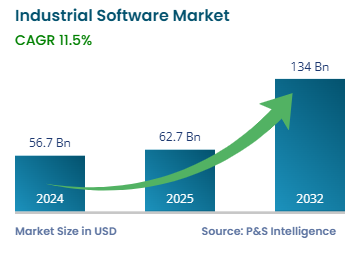
The global industrial software market will generate an estimated revenue of USD 56.7 billion in 2024, which is expected to witness a CAGR of 11.5% during 2025–2032, to reach USD 134.0 billion by 2032.
This growth can be attributed to the increasing adoption of digital transformation technologies across industries such as manufacturing, automotive, energy, and utilities. Industrial software solutions, which include tools for automation, data analytics, predictive maintenance, and supply chain optimization, are crucial for enhancing operational efficiency, reducing downtime, and improving decision-making processes.
Additionally, the growing emphasis on smart factories and Industry 4.0 initiatives is further driving the market as businesses seek to leverage software for better connectivity, real-time data insights, and improved productivity. The ongoing digital transformation and the push for more sustainable, efficient industrial operations will continue to fuel the growth of the global industrial software market in the coming years.
The global push for manufacturing digitisation is driving strong demand for industrial software, as industries seek to enhance productivity, reduce costs, and improve real-time decision-making. Initiatives like smart factories and digital twins are enabling automation, data integration, and remote monitoring, accelerating software adoption across automotive, electronics, and heavy engineering sectors.
Major countries are investing heavily in digital manufacturing projects. Germany’s Industrie 4.0 promotes interconnected production lines using industrial software. In Japan, the Connected Industries initiative enhances factory intelligence. India’s SAMARTH Udyog supports smart manufacturing adoption, while China’s Made in China 2025 emphasizes digital transformation of traditional manufacturing sectors through automation software.
Shift from On-Premises to Cloud-Based SCADA Systems Is Key Trend
A significant market opportunity in the global industrial software market is the rising shift from on-premises to cloud-based SCADA systems.
SCADA systems are essential for monitoring and controlling industrial processes, particularly in sectors such as manufacturing, energy, water treatment, and utilities.
Traditionally, these systems were deployed on-premises, requiring significant infrastructure, maintenance, and upfront capital investment.
However, as industries move toward digital transformation, cloud-based SCADA solutions are gaining popularity due to their scalability, flexibility, and cost-effectiveness.
Cloud-based SCADA systems offer the advantage of remote accessibility, enabling real-time monitoring and control of industrial processes from any location.
This capability is especially beneficial for businesses with multiple sites or global operations, allowing for centralized management and enhanced operational efficiency.
Cloud-based SCADA systems offer greater scalability, remote accessibility, and cost efficiency over on-premises systems.
They reduce infrastructure costs by up to 30% and improve system uptime through real-time monitoring.
Increasing Demand for Fault Detection and Classification Solutions Is Key Driver
A key driver for the global industrial software market is the rising demand for fault detection and classification solutions.
As industries become more automated and data-driven, the need for real-time monitoring and predictive maintenance has grown significantly.
According to the U.S. Department of Energy, predictive maintenance can reduce breakdowns by up to 75%, cut downtime by 45%, and lower maintenance costs by 30%, demonstrating the operational value of early fault identification.
These solutions enable businesses to detect equipment malfunctions or anomalies at an early stage, allowing quicker corrective actions, minimizing unplanned downtime, and preventing costly failures.
This is particularly crucial in sectors such as manufacturing and energy, where equipment failure leads to safety risks, production delays, and financial losses.
In manufacturing, fault detection systems monitor equipment like CNC machines or conveyors, identifying anomalies such as vibration or heat before failure occurs.
In the energy sector, these systems analyze transformers and turbines using IoT and thermal data to prevent grid disruptions and extend asset life.
Industrial software platforms with advanced algorithms and machine learning capabilities analyze large volumes of sensor and IoT data to detect patterns and classify faults before they escalate.
As highlighted by platforms like Inductive Automation, these tools support a shift from reactive to proactive maintenance, improving operational efficiency and asset longevity across industries.
Complexities in Integrating Components into Existing Infrastructure Pose Challenges
A significant challenge in the global industrial software market is the complexities associated with integrating new software components with existing infrastructure.
Many industrial organizations operate legacy systems that have been in place for years, often relying on outdated hardware and software technologies.
Integrating modern industrial software solutions, such as IoT platforms, advanced analytics, or AI-powered tools, with these existing infrastructures can be a complex and resource-intensive process.
The challenge lies in ensuring that new software systems are compatible with older equipment and technologies, which may not have been designed to handle the advanced capabilities of contemporary industrial software.
This integration often requires significant customization, which can increase costs, extend project timelines, and strain internal IT resources.
Moreover, the lack of standardization across various industrial systems makes the integration process even more difficult, as different platforms may use incompatible data formats, communication protocols, or software architectures.
Industrial Software Market Segmentation Analysis
Type Insights
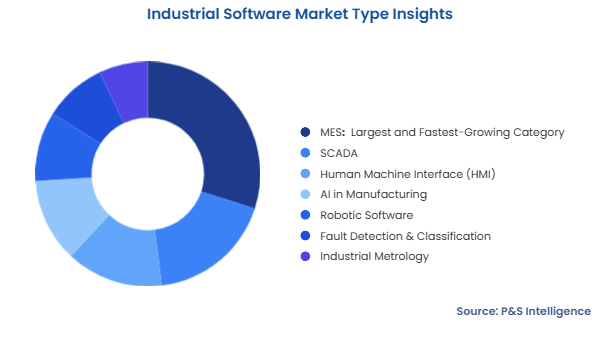
The manufacturing execution system (MES) type category is projected to grow at the highest CAGR, of approx. 11.5% in forecast period, after holding the largest market share, of 30%, in 2024. This is due to its critical role in optimizing manufacturing operations. MES solutions provide real-time visibility and control over production processes, helping manufacturers monitor and manage the entire production lifecycle, from raw materials to finished products. The growing demand for smart manufacturing and Industry 4.0 initiatives is a key driver behind the rise of MES adoption.
MES solutions integrate with other enterprise systems such as Enterprise Resource Planning (ERP) and Supply Chain Management (SCM), enabling seamless data flow and better decision-making. The increasing use of IoT sensors, machine learning, and big data analytics further enhances the capabilities of MES, allowing manufacturers to make data-driven decisions in real time. Additionally, the need for greater supply chain visibility, enhanced traceability, and reduced lead times in industries like automotive, pharmaceuticals, and electronics is fueling the demand for MES.
During the study, we have analyzed the following types in the report:
Manufacturing Execution System (MES) (Largest and Fastest-Growing Category)
SCADA
Human Machine Interface (HMI)
AI in Manufacturing
Robotic Software
Fault Detection & Classification
Industrial Metrology
End User Insights
The automotive category accounts for the largest share in 2024, of 25%. This is primarily due to the increasing adoption of advanced manufacturing technologies and the rising demand for automation, digitalization, and connectivity within the automotive industry. Automotive manufacturers are leveraging industrial software to integrate various processes, such as supply chain management, inventory control, and production scheduling, enabling them to streamline operations and reduce costs.
Additionally, the automotive industry is experiencing rapid changes driven by innovations such as electric vehicles (EVs), autonomous driving, and connected car technologies. These developments require advanced software solutions for designing, simulating, and testing new vehicle models, as well as for managing complex production lines.
The rise of electric vehicle manufacturing, in particular, has accelerated the demand for industrial software that can efficiently handle the complexities of battery production, energy management, and integration with emerging technologies.
The energy & power category has the highest CAGR, of approx. 12%, in forecast period, due to its need to enhance efficiency, reliability, and grid resilience. With the growing reliance on renewable energy, software solutions help manage variable inputs, optimize load balancing, and enable predictive maintenance for critical infrastructure like turbines and transformers.
Utilities use SCADA, asset performance management (APM), and energy management systems to monitor real-time data, reduce outages, and improve operational planning. Digital twins and AI-driven analytics are also being integrated to simulate energy flows and anticipate failures. As energy systems become more decentralized and complex, the demand for intelligent software platforms continues to grow across global energy markets.
The following end users are included in the report:
Oil & Gas
Chemicals
Pulp & Paper
Pharmaceuticals
Energy & Power (Faster-Growing Category)
Automotive (Largest Category)
Semiconductor & Electronics
Aerospace & Defense
Others
Drive strategic growth with comprehensive market analysis
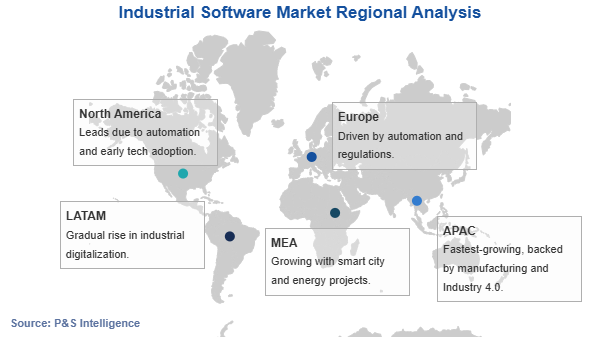
Geographically, North America holds the largest market share, of 40%, in 2024. This is driven by several key factors. The region is home to some of the world’s largest and most advanced manufacturing industries, including automotive, aerospace, pharmaceuticals, and electronics, all of which are early adopters of industrial software solutions. Additionally, North America’s robust technological infrastructure, including a high penetration of IoT devices, big data analytics, and cloud computing, supports the integration of industrial software in various manufacturing processes.
The region also boasts a strong focus on innovation, with companies investing heavily in research and development to drive technological advancements, which in turn stimulates the demand for advanced software solutions. Furthermore, the presence of major industrial software providers, such as Rockwell Automation, Siemens, and Honeywell, along with the favorable regulatory environment, further boosts the adoption of industrial software in North America.
Asia-Pacific is the fastest-growing region. Countries like China, India, Japan, and South Korea drive demand with their extensive automotive, electronics, and heavy machinery production. For example, China alone accounts for over 30% of global manufacturing output, necessitating widespread deployment of industrial PCs for automation, control, and data acquisition. The region’s rapid industrialization and government initiatives such as "Made in China 2025" and India’s smart manufacturing programs further boost hardware adoption.
Further, regions and countries analyzed for this report include:
Brazil (Largest and Fastest-Growing Country Market)
Mexico
Rest of LATAM
Middle East and Africa (MEA)
Saudi Arabia (Largest Country Market)
South Africa
U.A.E. (Fastest-Growing Country Market)
Rest of MEA
Industrial Software Market Share Analysis
The market is fragmented, characterized by the presence of numerous players offering a wide range of solutions across various industries, including manufacturing, energy, automotive, and pharmaceuticals. The market is driven by the diverse needs of industries that require specialized software to optimize processes such as production, maintenance, supply chain management, and quality control. As a result, there is no single dominant player across all segments, and the market includes both large multinational corporations and smaller, niche companies offering tailored solutions for specific industry needs.
While large companies like Siemens, Rockwell Automation, and SAP dominate key segments, there is still ample room for smaller players to innovate and capture market share. This ongoing innovation and customization for industry-specific needs contribute to the fragmented nature of the market, making it dynamic and competitive.
Key Industrial Software Companies:
ABB Ltd.
Rockwell Automation, Inc.
Emerson Electric Co.
General Electric Company
Honeywell International, Inc.
SAP SE
OMRON Corporation
Hexagon AB
Siemens AG
Oracle Corporation
Schneider Electric SE
Hitachi Ltd.
Toshiba Corporation
Robert Bosch GmbH
Eaton Corporation PLC
Industrial Software Market Developments
In July 2025, Apera AI introduced the Vue 9.50 Premier 4D vision software for enhanced industrial robotic efficiency. This latest version assists integrators and manufacturers in addressing real-world variations, streamlining setup processes, and enhancing robotic performance with increased speed, accuracy, and assurance.
In October 2024, Siemens AG acquired Altair Engineering Inc. for an enterprise value of USD 10 billion. The move strengthened Siemens’s capabilities in industrial AI and computational science software.
In May 2024, Accenture PLC acquired Teamexpat, a developer of embedded software for testing, development, and integration into lithography systems for the semiconductor industry.
In January 2024, ABB Ltd. announced plans to acquire a majority stake in Meshmind, to strengthen the former’s AI, IIoT, and machine vision R&D capabilities.
In February 2023, Siemens AG launched low-code personalization for Opcenter Execution Foundation, which features embedded Mendix. This integration enables manufacturers to tailor user experiences to specific industry requirements and their business processes.
Want a report tailored exactly to your business need?
Leading companies across industries trust us to deliver data-driven insights and innovative solutions for their most critical decisions. From data-driven strategies to actionable insights, we empower the decision-makers who shape industries and define the future. From Fortune 500 companies to innovative startups, we are proud to partner with organisations that drive progress in their industries.
Client Testimonials
Working with P&S Intelligence and their team was an absolute pleasure – their awareness of timelines and commitment to value greatly contributed to our project's success. Eagerly anticipating future collaborations.
McKinsey & Company
India
Unmatched Standards
Our insights into the minutest levels of the markets, including the latest trends and competitive landscape, give you all the answers you need to take your business to new heights
Complete Data Security
We take a cautious approach to protecting your personal and confidential information. Trust is the strongest bond that connects us and our clients, and trust we build by complying with all international and domestic data protection and privacy laws