This Report Provides In-Depth Analysis of the Copper Market Report Prepared by P&S Intelligence, Segmented by Type (Refined Copper, Copper Alloys, Copper Concentrates, Copper Scrap), Product/Form (Wires & Rods, Plates, Sheets, & Strips, Tubes & Pipes, Bars & Sections, Cathodes), Application (Electrical & Electronics, Construction & Building, Transportation, Industrial Machinery, Consumer & General Products), and Geographical Outlook for the Period of 2019 to 2032
Explore the market potential with our data-driven report
Copper Market Future Outlook
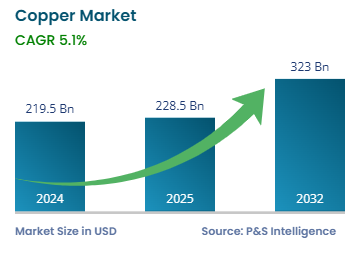
The global copper market size was USD 219.5 billion in 2024, which is predicted to reach USD 323.0 billion by 2032, growing at a CAGR of 5.1% during 2025–2032.
The substantial growth trajectory reflects copper's essential role as a critical enabler of the global energy transition, expanding electrification initiatives, and robust infrastructure development across emerging economies.
The accelerating adoption of renewable energy technologies represents a transformative force in copper consumption patterns. The expanding solar photovoltaic (PV) and wind capacity globally has sharply increased the copper demand, especially for cabling, power conductors, and transformers. Solar PV systems require approximately 5.5 metric tonnes of copper per Megawatt (MW) of installed capacity. Offshore wind installations exhibit even greater copper intensity, consuming up to 11 metric tonnes per MW.
Additionally, the rapid rise in electric vehicle (EV) production is significantly elevating copper demand. A typical battery electric vehicle incorporates over 60 kilograms of copper, compared to around 24 kilograms used in conventional internal combustion engine vehicles. This surge in consumption is creating intense pressure on existing mining operations, which are increasingly challenged to scale output in line with demand.
Copper Market Growth Factors
Electrification of Transportation Sector Is a Key Trend
The global transition toward EVs is significantly increasing copper demand, as EVs require 2 to 4 times more copper than internal combustion engine (ICE) vehicles.
A typical battery electric vehicle (BEV) uses approximately 60–83 kg (132–183 pounds) of copper, compared to about 23–28 kg (50–62 pounds) in a conventional gasoline-powered car.
Copper is used extensively in EV components such as electric motors, inverters, wiring harnesses, battery connectors, and thermal management systems.
EV charging infrastructure, including home chargers, fast-charging stations, and grid connections, further adds to copper consumption—each fast-charging station can contain up to 25 kg of copper.
As per the International Energy Agency (IEA), global electric car sales surpassed 14 million units in 2023 and 17 million units the next year, and projections suggest over 60 million EVs will be on the road by 2030, creating substantial and sustained copper demand.
Hybrid electric vehicles (HEVs) and plug-in hybrid electric vehicles (PHEVs) also consume high amounts of copper, averaging 40–60 kg per vehicle.
Automakers and battery manufacturers are investing heavily in expanding EV production capacity, leading to long-term structural demand for copper across the transportation value chain.
Expansion of Renewable Energy Installations Is Accelerating Market Growth
Renewable energy systems, such as solar PV and wind turbines, are highly copper-intensive, due to their need for efficient electrical conductivity in transformers, inverters, cables, and grounding systems.
The IEA projects the global solar PV capacity to reach over 5,400 GW and wind capacity to exceed 3,500 GW by 2040, significantly boosting copper demand.
Each utility-scale solar project typically contains thousands of feet of copper wiring, used to connect solar modules, inverters, and transmission equipment.
Wind power installations require copper in the nacelle, generator coils, cabling within the tower, and grid interconnection systems.
The rise of decentralized energy generation, including rooftop solar systems and microgrids, further adds to distributed copper usage in residential and commercial settings.
Governments are implementing aggressive renewable energy targets, including the EU’s goal of 42.5% renewable energy share by 2030 and the U.S.’s aim for 100% carbon pollution-free electricity by 2035.
Energy storage systems integrated with renewables also utilize copper in battery packs, control systems, and inverters.
As the global energy transition accelerates, copper has emerged as a critical enabler of low-carbon infrastructure, making renewable installations a key pillar of long-term market growth.
Copper Market Segmentation Analysis
Type Analysis
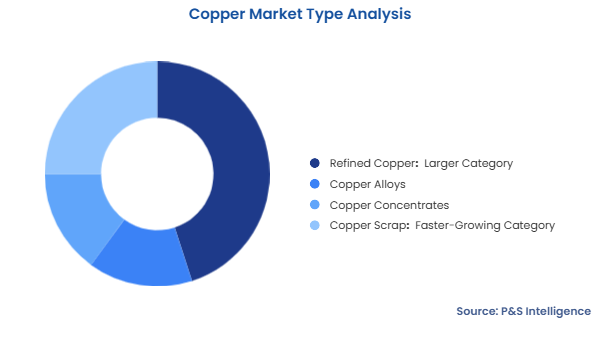
The refined copper category held the largest share in the copper market in 2024, at 45%, and it is expected to maintain its dominant position throughout the forecast period. This dominance stems from refined copper's superior electrical conductivity, consistent quality specifications, and broad applicability across high-performance applications, including power transmission infrastructure, precision electronics manufacturing, and renewable energy systems. The category benefits from established global trading mechanisms, standardized quality grades, and deep liquidity in commodity markets that facilitate efficient price discovery and risk management for industrial consumers.
Copper scrap will witness the highest CAGR, during the forecast period, driven by intensifying focus on circular economy principles, improving collection and processing infrastructure, and technological advances in recycling that enhance recovery rates and output quality. The growing availability of end-of-life products from the electronics boom of previous decades, combined with stricter environmental regulations mandating recycling and waste reduction, creates favorable conditions for secondary copper market expansion. Industrial consumers increasingly recognize recycled copper as a reliable, cost-effective alternative that meets identical performance specifications while offering superior environmental credentials and supply chain resilience.
These types are covered:
Refined Copper (Larger Category)
Copper Alloys
Copper Concentrates
Copper Scrap (Faster-Growing Category)
Product/Form Analysis
The wires & rods category commanded the largest market share in 2024, of 40%, reflecting its fundamental role in electrical power distribution, telecommunications infrastructure, and industrial machinery applications. The category's dominance extends across both developed markets undertaking infrastructure renewal and emerging economies building foundational electrical networks. In 2024, global electricity generation grew by over 1,200 TWh, while grid (transmission/distribution) investment rose to approximately USD 390 billion.
Plates, sheets, & strips represent the fastest-growing product category, during 2025–2032, propelled by the expanding applications in electric vehicle battery components, advanced heat exchangers, and architectural elements in sustainable building designs. The category benefits from innovations in copper alloy development that enhance formability, corrosion resistance, and thermal management properties, opening new applications in aerospace, renewable energy, and high-performance electronics cooling systems.
The electricals & electronics category is the largest application category in 2024, capturing 35% market share, driven by 5G network deployment, data center expansion, and consumer electronics proliferation. The category's copper intensity continues to increase as miniaturization demands higher conductivity materials, while the shift toward renewable energy and electric vehicles creates new subcategories of electrical applications requiring specialized copper products.
Construction & building applications are projected to achieve the highest growth rate, through 2032, fueled by the accelerating urbanization in developing economies, green building initiatives incorporating energy-efficient systems, and the integration of smart building technologies. The category benefits from stringent building codes mandating improved electrical safety, energy efficiency standards driving HVAC system upgrades, and the growing adoption of renewable energy integration at the building level.
These applications are covered:
Electrical & Electronics (Larger Category)
Construction & Building (Faster-Growing Category)
Transportation
Industrial Machinery
Consumer & General Products
Others
Drive strategic growth with comprehensive market analysis
Copper Market Geographical Analysis
Asia-Pacific Copper Market Share
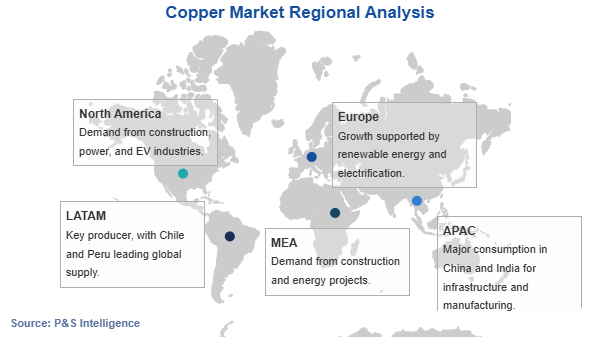
Asia-Pacific held the largest share in 2024, at 40%, driven by the strong demand from major economies, such as China, India, Japan, and South Korea. Among these, China alone represents more than 50% of the global refined copper demand, owing to its vast manufacturing base and expansive construction sector. The region is undergoing rapid industrialization and urbanization, which is fueling significant copper usage in infrastructure development, electrical networks, and transportation systems. The rise in renewable energy installations across the region—particularly solar and wind projects in China and India, has further accelerated copper demand, as these technologies require substantial amounts of copper for power generation and grid connectivity.
APAC also leads the global EV market, with China at the forefront, driving high copper consumption through vehicle manufacturing and EV charging infrastructure development. Moreover, major regional infrastructure programs such as China’s Belt and Road Initiative and India’s Smart Cities Mission are significantly boosting the need for copper in power distribution and smart grid systems.
Moreover, major regional infrastructure programs such as China’s Belt and Road Initiative and India’s Smart Cities Mission are significantly boosting the need for copper in power distribution and smart grid systems. Government policies favoring electrification, clean energy adoption, and digitalization continue to create sustained copper demand across multiple sectors. Furthermore, the presence of major copper mining and smelting operations within the region ensures a stable supply chain, reinforcing APAC’s position as the global leader in the copper market.
North America Copper Market Outlook
North America is expected to be the fastest-growing regional market, with a CAGR of approx. 6.0% during 2025–2032. This is primarily due to the clean energy transition, rising EV adoption, infrastructure modernization, and supportive government policies. The region is witnessing a rapid shift toward renewable energy sources, particularly solar and wind power, both of which require significant amounts of copper for power generation equipment, inverters, transformers, and transmission infrastructure. The U.S. government's Inflation Reduction Act and Canada’s Clean Electricity Regulations are accelerating investment in copper-intensive green technologies, further driving demand.
Electric vehicle production and adoption are expanding rapidly across North America, with major automakers, such as Tesla, General Motors, and Ford, scaling up their EV manufacturing capacities. Each EV contains significantly more copper than traditional vehicles, and the growing EV charging network adds to the region’s overall copper consumption. Additionally, North America's focus on grid modernization and digitalization is generating large-scale demand for copper in smart grids, energy storage systems, and data centers.
The North American market benefits from the presence of major copper mining operations in Arizona and New Mexico, reducing supply chain risks while supporting domestic value chains. Canada's renewable energy expansion and critical minerals strategy further reinforce regional copper demand, with significant investments in hydroelectric transmission and wind power development.
The regions and countries analyzed in this report are:
North America (Fastest-Growing Regional Market)
U.S. (Larger Country Market)
Canada (Faster-Growing Country Market)
Europe
Germany (Largest Country Market)
U.K. (Fastest-Growing Country Market)
France
Italy
Spain
Rest of Europe
Asia-Pacific (Largest Regional Market)
Japan
China (Largest Country Market)
India (Fastest-Growing Country Market)
South Korea
Australia
Rest of APAC
Latin America
Brazil (Largest Country Market)
Mexico (Fastest-Growing Country Market)
Rest of LATAM
Middle East and Africa
Saudi Arabia (Largest Country Market)
South Africa
U.A.E. (Fastest-Growing Country Market)
Rest of MEA
Copper Market Share Analysis
The global copper market is considered fragmented due to the large number of companies involved across different stages of the value chain and its wide range of end-use industries. In the upstream category, which includes copper mining and initial processing, some consolidation exists, with a few companies operating large-scale mines and controlling a notable share of global output. However, beyond the mining stage, the downstream segments, such as refining, wire and cable production, copper alloy manufacturing, and component fabrication, are highly fragmented, with hundreds of companies operating at national or regional levels.
Additionally, the growth of copper recycling and secondary production introduces many small-scale recyclers and processors into the market, increasing the number of participants and reducing the dominance of primary producers. Differences in regional infrastructure development, government policies, and energy transition goals also contribute to a geographically diverse and decentralized market structure.
Key Copper Companies:
Anglo American plc
Antofagasta plc
BHP Group Limited
Corporaci
First Quantum Minerals Ltd.
Freeport-McMoRan Inc.
Glencore International AG
Grupo M
Jiangxi Copper Company Limited
KGHM Polska Mied? S.A.
Mitsubishi Materials Corporation
Public Joint Stock Company Norilsk Nickel
Rio Tinto Group
Teck Resources Limited
Vale S.A.
Copper Market News & Updates
In March 2025, China Molybdenum Company (CMOC) confirmed that its copper production from operations in the Democratic Republic of Congo, including the Tenke Fungurume and Kisanfu mines, reached approximately 650,161 tonnes in 2024, marking a 55% year-on-year increase. This growth reflects the impact of CMOC’s ongoing multi-billion-dollar expansion strategy aimed at doubling production capacity across its Congolese assets.
In February 2025, BHP Group announced a USD 2-billion investment to optimize the concentrator operations at its Escondida mine in Chile. This marks the inaugural phase of a comprehensive USD 10.8 billion, decade‑long investment strategy aimed at sustaining production levels, despite challenges from declining ore grades.
In February 2025, National Copper Corporation of Chile and Anglo American plc signed a memorandum of understanding to jointly develop their adjacent copper operations in Chile, aiming to enhance production through shared infrastructure and operational synergies.
In April 2024, Prysmian S.p.A. signed a multi-year supply agreement with Aurubis AG to secure increasing volumes of copper wire rod, supporting its European manufacturing and future growth plans.
In May 2023, KGHM Polska Miedź commenced the operation of a post‑process gas treatment installation at its Legnica Copper Smelter and Refinery. This facility almost entirely eliminates arsenic and mercury emissions, leaving only nitrogen oxides, carbon dioxide, and minimal sulfur dioxide.
Want a report tailored exactly to your business need?
Leading companies across industries trust us to deliver data-driven insights and innovative solutions for their most critical decisions. From data-driven strategies to actionable insights, we empower the decision-makers who shape industries and define the future. From Fortune 500 companies to innovative startups, we are proud to partner with organisations that drive progress in their industries.
Client Testimonials
Working with P&S Intelligence and their team was an absolute pleasure – their awareness of timelines and commitment to value greatly contributed to our project's success. Eagerly anticipating future collaborations.
McKinsey & Company
India
Unmatched Standards
Our insights into the minutest levels of the markets, including the latest trends and competitive landscape, give you all the answers you need to take your business to new heights
Complete Data Security
We take a cautious approach to protecting your personal and confidential information. Trust is the strongest bond that connects us and our clients, and trust we build by complying with all international and domestic data protection and privacy laws