This Report Provides In-Depth Analysis of the Content Intelligence Market Report Prepared by P&S Intelligence, Segmented by Component (Software, Services), Deployment (Cloud, Hybrid, On-premises), Organization Size (Large Enterprises, Small and Medium-sized Enterprises), Technology (Natural Language Processing, Artificial Intelligence, Machine Learning, Predictive Analytics), End User (Media and Entertainment, Healthcare, Banking, Financial Services, and Insurance, Retail and E-commerce, Information Technology and Telecommunications, Manufacturing, Travel and Hospitality, Government), and Geographical Outlook for the Period of 2021 to 2032
Explore the market potential with our data-driven report
Content Intelligence Market Overview
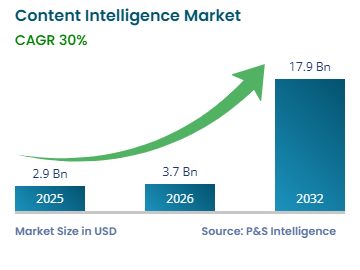
The content intelligence market size was USD 2.9 billion for 2025, and it will grow by 30.0% during 2026-2032, to reach USD 17.9 billion by 2032.
The market is expanding as organizations generate and manage growing volumes of digital content across websites, mobile applications, social media platforms, e-commerce channels, customer portals, and enterprise systems. Content has become a critical component of customer engagement, brand communication, and digital business operations, increasing the need for technologies that can measure performance, understand audience behavior, and improve content relevance. Organizations are increasingly adopting content intelligence platforms to transform large collections of structured and unstructured content into actionable insights that support marketing effectiveness, customer experience management and improvement, and data-driven decision-making. The growing use of artificial intelligence, machine learning, and natural language processing is further enhancing the ability of these platforms to analyze content performance, identify engagement patterns, and optimize content strategies across multiple channels.
The market is also benefiting from increasing adoption of personalization initiatives, omnichannel engagement strategies, and automated content workflows. Enterprises require solutions that can identify content gaps, improve content discoverability, automate classification processes, and deliver real-time recommendations that support more effective content planning. According to the International Telecommunication Union, 6.0 billion people, representing 74% of the global population, were online in 2025. The expanding digital population is increasing the volume of content created, consumed, and shared across digital platforms, generating larger datasets for content analysis and optimization.
Key Market Insights
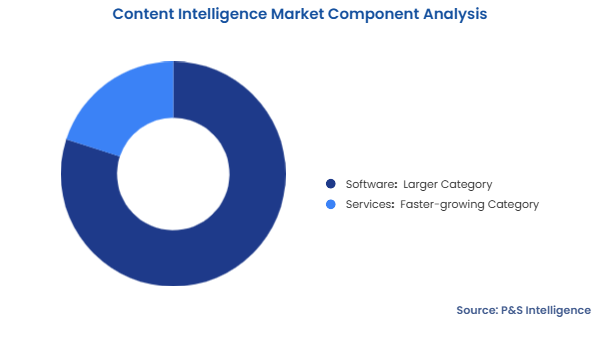
Software is the larger component, holding a market share of 80.0%, due to its central role in content analysis, optimization, audience insights, and performance measurement.
Cloud is the largest deployment type, holding a market share of 60.5%, due to scalable content processing, real-time analytics, and seamless platform integration.
Large Enterprises is the larger organization size segment, holding a market share of 80.0%, due to extensive content operations and significant digital engagement investments.
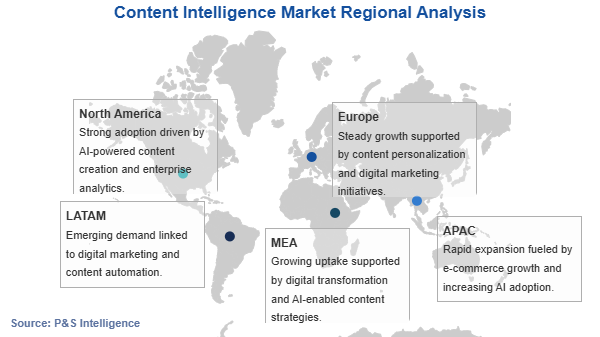
North America holds the largest share of 45.0%, due to its mature digital advertising ecosystem and early adoption of advanced analytics technologies.
Asia-Pacific is the fastest-growing region, registering a CAGR of 31.5%, driven by expansive digital economies, growing online user bases, and rising content generation.
Content Intelligence Market Trends and Drivers
AI-Powered Content Optimization and Real-Time Personalization Is Major Trend
The content intelligence industry is increasingly moving beyond content measurement toward real-time content optimization and automated personalization powered by artificial intelligence. Organizations are adopting platforms that continuously analyze audience behavior, content relevance, engagement patterns, and contextual signals to improve content performance across digital channels. Businesses increasingly expect predictive recommendations, automated content tagging, intelligent content creation support, and real-time decision-making capabilities rather than relying solely on historical performance reports. According to Eurostat, 11.75% of European Union enterprises used artificial intelligence technologies for analysis of written language, including text mining, in 2025. Eurostat also reported that 34.70% of European Union enterprises using artificial intelligence technologies utilized AI software or systems for marketing or sales activities in 2025. Growing adoption of AI for language analysis and customer-facing functions is accelerating demand for content intelligence platforms that can automate content evaluation, improve personalization strategies, and support faster content optimization cycles across digital environments.
Growing Need for Data-Driven Content Performance Measurement Drives Market
Organizations are investing in content intelligence solutions because they need greater visibility into how digital content influences customer engagement, marketing effectiveness, and business outcomes. Companies manage expanding content libraries across multiple channels and increasingly require tools that can identify high-performing assets, uncover audience preferences, and support evidence-based content decisions. Content intelligence platforms help transform large volumes of content-related information into actionable insights that improve resource allocation and content performance. According to the International Telecommunication Union, mobile broadband traffic reached 1.5 zettabytes and fixed broadband traffic reached 7.3 zettabytes in 2025. The International Telecommunication Union also reported 99 mobile broadband subscriptions per 100 inhabitants worldwide in 2025. The growth of digital traffic and connected audiences is generating larger volumes of content interaction data, increasing the need for technologies that can evaluate performance, identify engagement trends, and optimize content strategies across digital channels.
Complex Data Integration and Content Fragmentation Limit Market Adoption
One of the key challenges affecting the content intelligence market is the difficulty of integrating content data from multiple platforms, formats, and enterprise systems into a unified analytical environment. Organizations often manage content across websites, social media channels, customer relationship management systems, content management platforms, and marketing applications that operate independently. These fragmented environments can create inconsistencies in data collection, content classification, and performance measurement while increasing implementation complexity. According to the United Nations Conference on Trade and Development, privacy and data protection legislation covered 98% of developed countries, 80% of developing countries, and 58% of least developed countries in 2024. Variations in data governance frameworks across countries can complicate content integration, customer data management, and cross-border analytics initiatives, creating additional challenges for organizations seeking consistent insights across diverse content ecosystems.
Expansion of Content Intelligence Across Customer Experience Platforms Creates Market Opportunity
A significant opportunity in the content intelligence market is emerging from the growing integration of content insights into broader customer experience and digital engagement platforms. Organizations increasingly seek solutions that connect content performance with customer journeys, engagement outcomes, and business objectives across multiple digital touchpoints. This is creating demand for platforms that unify content intelligence with marketing automation, customer relationship management, e-commerce, and customer experience technologies. According to the International Telecommunication Union, 5G networks covered 55% of the global population in 2025. Expanding 5G coverage is supporting faster digital interactions, real-time content delivery, and richer customer experiences across connected channels. This is increasing the value of content intelligence solutions that help organizations understand customer behavior, optimize engagement strategies, and improve content effectiveness within integrated digital ecosystems.
Content Intelligence Market Segmentation Analysis
Component Analysis
Software is the larger category, holding a market share of 80.0%, due to its role in content analysis, audience insights, content optimization, and performance measurement across digital channels. Organizations increasingly rely on software platforms to automate content-related decision-making, integrate artificial intelligence capabilities, and manage content workflows within unified environments. According to Eurostat, 96.44% of enterprises using paid cloud computing services purchased at least one cloud Software-as-a-Service application in 2025.
Services is the faster-growing category, registering a CAGR of 30.5%, as organizations seek specialized expertise to deploy, integrate, customize, and optimize content intelligence solutions. Many enterprises require support for implementation, system integration, training, and ongoing management to maximize platform value. The increasing complexity of content ecosystems and artificial intelligence-driven applications is driving demand for consulting and managed services.
The components analysed in this report are:
Software (Larger Category)
Services (Faster-growing Category)
Deployment Analysis
Cloud is the largest category, holding a market share of 60.5%, because organizations increasingly prefer scalable deployment models that support software-based content intelligence platforms, real-time analytics, and distributed content operations. Cloud environments enable easier system integration, remote accessibility, and efficient processing of large content datasets across multiple digital channels. According to Eurostat, 52.74% of enterprises used paid cloud computing services in 2025.
Hybrid is the fastest-growing category, registering a CAGR of 30.1%, as enterprises seek to balance the scalability of cloud environments with the control and security of on-premises infrastructure. This approach allows organizations to manage sensitive content internally while leveraging cloud capabilities for analytics and processing. Increasing regulatory requirements, data governance considerations, and evolving enterprise technology strategies are supporting hybrid adoption.
The deployments analysed in this report are:
Cloud (Largest Category)
Hybrid (Fastest-growing Category)
On-premises
Organization Size Analysis
Large Enterprises is the larger category, holding a market share of 80.0%, due to their extensive content operations, large customer bases, and significant investments in digital engagement strategies. These organizations generate substantial volumes of content and increasingly adopt cloud-based and artificial intelligence-enabled platforms to manage performance, personalization, and audience insights. According to Eurostat, 55.03% of large enterprises used artificial intelligence technologies in 2025, compared with 17% of small enterprises.
Small and Medium-sized Enterprises is the faster-growing category, registering a CAGR of 31.0%, as accessible cloud-based solutions and subscription pricing models reduce barriers to adoption. Smaller businesses are increasingly recognizing the value of content analytics in improving marketing effectiveness and customer engagement. Growing digitalization across this segment is creating demand for tools that deliver actionable insights without requiring extensive internal resources.
The organization sizes analysed in this report are:
Large Enterprises (Larger Category)
Small and Medium-sized Enterprises (Faster-growing Category)
Technology Analysis
Natural Language Processing is the largest category, holding a market share of 45.5%, because it enables content intelligence platforms to understand, classify, analyze, and extract insights from large volumes of text-based and unstructured content. NLP supports applications such as sentiment analysis, topic identification, semantic analysis, content classification, and audience insight generation. The continued growth of digital content across websites, social media, e-commerce platforms, and enterprise systems is supporting demand for NLP-enabled content intelligence solutions.
Artificial Intelligence is the fastest-growing category, registering a CAGR of 31.2%, as organizations increasingly adopt AI technologies that can automate content creation, summarization, personalization, recommendation generation, and content optimization. Generative AI is enabling enterprises to move beyond content analysis toward automated content generation and real-time content experiences, strengthening its role within content intelligence platforms.
Media and Entertainment is the largest category, holding a market share of 25.5%, because content creation, distribution, audience engagement, and performance measurement are central to business operations within the industry. Organizations continuously analyze audience preferences and content consumption patterns to improve engagement and maximize content value. The large volume of digital assets generated across streaming, publishing, and media platforms creates strong demand for content intelligence solutions. Ongoing competition for audience attention further reinforces adoption.
Healthcare is the fastest-growing category, registering a CAGR of 30.6%, as healthcare organizations increasingly invest in digital communication, patient engagement, and content-driven information delivery. The growing volume of educational, clinical, and patient-facing content is increasing demand for technologies that improve content relevance, audience targeting, and communication effectiveness across digital health channels. Healthcare providers are also expanding digital engagement initiatives as part of broader digital transformation strategies. According to the Organisation for Economic Co-operation and Development, the average availability of online digital health services reached 82% in 2024.
The end users analysed in this report are:
Media and Entertainment (Largest Category)
Healthcare (Fastest-growing Category)
Banking, Financial Services, and Insurance
Retail and E-commerce
Information Technology and Telecommunications
Manufacturing
Travel and Hospitality
Government
Others
Drive strategic growth with comprehensive market analysis
Content Intelligence Market Regional Analysis
North America Content Intelligence Market Analysis
North America holds the largest share, of 45.0%, driven by its mature digital ecosystem, widespread adoption of advanced marketing technologies, and strong investments in artificial intelligence, cloud computing, and data analytics. Enterprises across the region increasingly use content intelligence solutions to analyze content performance, understand audience behavior, personalize digital experiences, and optimize marketing strategies across multiple channels. The region's highly developed digital advertising and e-commerce infrastructure generates substantial volumes of content and customer interaction data, creating strong demand for technologies that can convert this information into actionable insights. In 2025, U.S. internet advertising revenue reached USD 294.6 billion, increasing 13.9% year over year, highlighting the scale and continued expansion of the digital ecosystem that supports content intelligence adoption.
U.S. Content Intelligence Market Analysis
The U.S. is the larger country market due to its mature digital advertising ecosystem, extensive content creation activities, and early adoption of advanced analytics technologies. Organizations across media, retail, financial services, and technology sectors increasingly use content intelligence platforms to improve audience targeting, content effectiveness, and customer engagement. According to the United States Census Bureau, retail e-commerce accounted for 16.1% of total U.S. retail sales in 2024. The scale of digital commerce activity generates substantial content and engagement data, supporting wider adoption of content intelligence solutions that help businesses optimize content performance and customer interactions across digital channels.
Canada Content Intelligence Market Analysis
Canada is a faster-growing country market as organizations increasingly prioritize digital customer engagement, content performance measurement, and data-driven marketing strategies. Businesses are adopting content intelligence solutions to improve content relevance, strengthen customer communication, and support more effective digital interactions. According to Statistics Canada, 12.2% of Canadian businesses used artificial intelligence to produce goods or deliver services in 2025, while text analytics was the most reported application among AI users at 35.7%. Growing use of artificial intelligence and text-based analytics is supporting broader adoption of content intelligence technologies across enterprise content and marketing operations.
Asia-Pacific Content Intelligence Market Analysis
Asia-Pacific has the highest CAGR, of 31.5%, driven by the rapid expansion of digital platforms, increasing internet and mobile engagement, and growing enterprise investments in AI-enabled technologies and data-driven digital strategies. The region's large and increasingly connected digital population is generating substantial volumes of content and user-interaction data across e-commerce, social media, digital entertainment, and online services, creating strong demand for content intelligence solutions. According to GSMA, mobile technologies and services contributed approximately USD 1 trillion to the Asia-Pacific economy in 2025, equivalent to 5.9% of the region's GDP, highlighting the scale of the region's rapidly expanding digital ecosystem. The continued rollout of 5G, growing AI adoption, and increasing use of cloud-based digital services are further supporting the adoption of content intelligence technologies for content optimization, audience analysis, personalization, and digital experience management.
China Content Intelligence Market Analysis
China is the largest country market in Asia-Pacific due to its expansive digital economy, massive online population, and extensive content generation across e-commerce, social media, and digital entertainment platforms. Enterprises increasingly deploy artificial intelligence-enabled content intelligence tools to manage content volumes and improve user engagement across digital channels. According to the China Internet Network Information Center, China had 1.108 billion internet users and 1.101 billion social network users in 2024. The scale of digital activity generates vast amounts of content and interaction data, strengthening demand for content intelligence platforms that support content optimization, audience analysis, and engagement management.
Europe Content Intelligence Market Analysis
Europe represents a significant market for content intelligence, supported by the widespread adoption of digital technologies, expanding digital advertising activity, and increasing use of data-driven customer engagement strategies across industries. Organizations across the region are increasingly investing in technologies that enable them to analyze content performance, understand audience behavior, personalize digital experiences, and optimize marketing activities across multiple channels. The region's mature digital ecosystem and strong focus on data-driven business operations are creating favorable conditions for the adoption of content intelligence solutions. According to IAB Europe, the European digital advertising market grew by 10.5% in 2025 to reach €131 billion, highlighting the scale of digital content and advertising activity across the region. Increasing adoption of artificial intelligence is further supporting demand, with 20.0% of EU enterprises using AI technologies in 2025, up from 13.5% in 2024. As enterprises continue to modernize their digital operations, demand for content intelligence solutions is expected to expand across media, retail, financial services, healthcare, and other industries.
The regions and countries analysed in this report are:
North America (Largest Regional Market)
U.S. (Larger Country)
Canada (Faster-Growing Country)
Europe
Germany (Fastest-Growing Country)
U.K. (Largest Country)
France
Italy
Spain
Rest of Europe
Asia-Pacific (Fastest-Growing Regional Market)
China (Largest Country)
India (Fastest-Growing Country)
Japan
South Korea
Australia
Rest of APAC
Latin America
Brazil (Largest Country)
Mexico (Fastest-Growing Country)
Rest of LATAM
Middle East and Africa
Saudi Arabia (Largest Country)
U.A.E. (Fastest-Growing Country)
South Africa
Rest of MEA
Content Intelligence Market Share Analysis
The content intelligence market is fragmented, characterized by the presence of numerous technology providers offering specialized solutions across content analytics, audience insights, content optimization, artificial intelligence-driven recommendations, and digital experience management. The market includes a mix of established enterprise software companies, marketing technology vendors, customer experience platform providers, and emerging niche specialists focused on specific content intelligence capabilities. Continuous innovation in artificial intelligence, machine learning, and natural language processing has lowered barriers for new entrants, further expanding the competitive landscape. Organizations often select solutions based on industry requirements, integration capabilities, content workflows, and analytical needs, allowing multiple vendors to maintain strong positions within different customer segments.
Leading Companies in the Content Intelligence Market:
ABBYY
Adobe Inc.
OpenText Corporation
M-Files
Progress Software Corporation
Emplifi
Curata
Scoop.it
Microsoft Corporation
International Business Machines Corporation (IBM)
Oracle Corporation
Salesforce, Inc.
Acrolinx GmbH
Yext, Inc.
Bloomreach
Content Intelligence Market Developments
In May 2026, Yext, Inc. launched Scout MCP and Scout API, opening its visibility and competitive intelligence infrastructure to global partners. The launch made Scout's visibility intelligence dataset available through three access paths: a user interface, conversational MCP access, and API access.
In April 2026, Bloomreach launched Loomi AI for Shopify as an app in the Shopify App Store. The app connects merchants' Shopify stores with Bloomreach's marketing and search products, using customer, product, and commerce data to enable AI-powered personalization across search, browsing, email, messaging, and on-site experiences.
In April 2026, Adobe introduced Adobe Brand Intelligence and expanded its GenStudio Content Supply Chain solution to support agentic customer experience orchestration. The new capabilities connect enterprise context, brand intelligence, and AI agents across content planning, creation, activation, delivery, reporting, and insights.
In February 2026, Oracle announced new role-based AI agents embedded in Oracle Fusion Cloud Applications. For marketing, these include agents for program planning and program briefs, which analyze unified data, automate campaign processes, generate campaign narratives and content requirements, and provide predictive insights.
In September 2024, Salesforce, Inc. introduced Agentforce for Marketing, bringing predictive and generative AI together for end-to-end campaign planning and optimization. The solution could generate campaign briefs, identify target audiences, create initial email and landing-page content, build customer journeys, and continuously analyze campaign performance to recommend changes to audiences, content, and channels.
Frequently Asked Questions About This Report
What does the content intelligence market include for organizations?+
It includes software and services that analyze text, images, videos, and engagement data to understand content performance, audience behavior, meaning, and intent.
What factors are driving demand in the content intelligence market?+
Demand is driven by growing content volumes, increasing digital engagement, the need for data-driven content performance measurement, AI adoption, personalization initiatives, and the need for automated content insights.
Why are organizations adopting content intelligence solutions across operations?+
Leading companies across industries trust us to deliver data-driven insights and innovative solutions for their most critical decisions. From data-driven strategies to actionable insights, we empower the decision-makers who shape industries and define the future. From Fortune 500 companies to innovative startups, we are proud to partner with organisations that drive progress in their industries.
Client Testimonials
Working with P&S Intelligence and their team was an absolute pleasure – their awareness of timelines and commitment to value greatly contributed to our project's success. Eagerly anticipating future collaborations.
McKinsey & Company
India
Unmatched Standards
Our insights into the minutest levels of the markets, including the latest trends and competitive landscape, give you all the answers you need to take your business to new heights
Complete Data Security
We take a cautious approach to protecting your personal and confidential information. Trust is the strongest bond that connects us and our clients, and trust we build by complying with all international and domestic data protection and privacy laws