Construction Lubricants Market Size & Opportunities Analysis - Growth Strategies, Competitiveness, and Forecasts (2025 - 2032)
This Report Provides In-Depth Analysis of the Construction Lubricants Market Report Prepared by P&S Intelligence, Segmented by Base Oil (Synthetic Oil, Mineral Oil), Type (Hydraulic Fluid, Engine Oil, Gear Oil, Compressor Oil), Equipment (Earthmoving Equipment, Material Handling Equipment, Heavy Construction Vehicles), and Geographical Outlook for the Period of 2019 to 2032
Explore the market potential with our data-driven report
Construction Lubricants Market Future Outlook
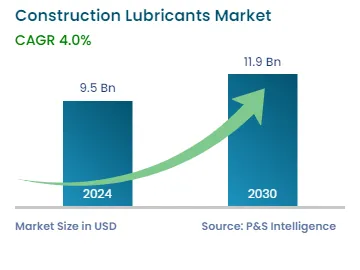
The construction lubricants market size was USD 9.5 billion in 2024, which is predicted to reach USD 12.9 billion by 2032, growing at a CAGR of 4.0% during 2025–2032.
The market is advancing due to an increase in the adoption of process automation solutions in the construction industry and the gradual expansion in the demand for construction equipment. Additionally, the usage of e-commerce to expand customer reach and the creation of zinc-free lubricants would drive the market. Total IIJA investment is about USD 1.2 trillion, including $550 billion of newly authorized spending. India’s NIP is estimated to cover projects worth approximately INR 109 lakh crore over the 2020–2025 period.
Saudi Arabia has earmarked approximately USD 2.1 trillion in planned construction investments over the next eight years. As per the State Council of China, China’s government work report for 2025 confirms that over RMB 5 trillion is earmarked for construction investment this year, covering key infrastructure areas such as railways, nuclear power, water conservancy, and major scientific facilities.
Moreover, the increasing need for cost savings and worker and equipment safety in the construction sector leads to heavy investments in automated and more-reliable equipment. Moreover, minimizing downtime is important for timely project completion and making a profit. The lifespan of the machinery can be increased and the need for maintenance and repairs decreased with proper lubrication.
Additionally, the productivity and efficiency of the equipment are becoming increasingly important for infrastructure and real estate organizations. By reducing wear and tear, minimizing friction, and improving equipment performance, lubricants play an important role in the delivery of projects on time. In addition to this, companies are becoming more aware of the significance of high-quality lubricants in completing these goals as they struggle for increased operational efficiency.
Construction Lubricants Market Dynamics
Technological Advancements in Construction Equipment Lubricants Are a Key Trend
Construction machines and equipment account for roughly 5.5% of global COâ‚‚ emissions, releasing about 1.1–1.7 Gigatonnes annually.
The development of advanced anti-wear, anti-oxidation, and anti-corrosion additives improves lubricant lifespan, reduces friction, and protects construction equipment in extreme working conditions.
The incorporation of nano-additives such as nanodiamonds or boron nitride enhances thermal stability, wear resistance, and load-carrying capacity for heavy-duty machinery.
ExxonMobil reports that fleet trials with Mobil Delvac synthetic gear oil achieved drain intervals of up to 250,000 miles, compared to approximately 100,000 miles for conventional mineral oils, representing roughly a 150% increase in service life.
Formulation innovations enable lubricants to maintain optimal viscosity across wide temperature ranges, ensuring smooth performance in both hot and cold job-site environments.
The focus is growing on environment-sustainable synthetic lubricants derived from renewable feedstocks to meet tightening environmental regulations.
New synthetic formulations offer longer lubrication cycles, reducing downtime and maintenance costs for high-value construction assets.
For instance, according to the National Fluid Power Association (NFPA), 70–80% of hydraulic system failures are caused by fluid contamination, highlighting the importance of proper hydraulic fluid maintenance in preventing equipment downtime.
Next-generation synthetics are tailored for modern low-emission, high-efficiency diesel engines used in construction equipment to comply with stringent emission norms.
Tailored lubricant formulations are developed for specific applications such as hydraulics, gear systems, and off-road diesel engines to improve reliability and reduce component failure.
According to the European Environment Agency, construction and demolition activities generate roughly one-third of the EU’s total waste, making it the single largest waste stream in Europe.
Emerging formulations integrate with IoT-enabled sensors to monitor degradation, contamination, and performance in real time, enabling predictive maintenance.
Rising Infrastructure Development and Urbanization Drive Market Growth
Large-scale infrastructure projects, such as highways, bridges, rail networks, and airports, are increasing demand for construction machinery, thereby boosting lubricant consumption.
Rapid urbanization is driving the construction of residential, commercial, and industrial buildings, creating sustained demand for heavy equipment maintenance products.
According to the United Nations Department of Economic and Social Affairs, 68% of the global population is projected to live in urban areas by 2050, compared to 56% in 2024.
This necessitates massive construction activities for residential complexes, commercial buildings, transportation networks, and utility infrastructure.
Expanding government investments in smart city projects and public infrastructure upgrades are fueling continuous equipment usage and the need for high-performance lubricants.
Growth in emerging economies is accelerating construction activities, especially in urban centers, which rely heavily on machinery that requires specialized lubricants.
The Rising population density in cities is prompting the development of transportation systems, utilities, and housing projects, increasing lubricant demand for construction fleets.
According to the International Energy Agency (IEA), global energy investment reached approximately USD 2.8 trillion in 2023.
Of this, more than USD 1.7 trillion was directed toward clean energy technologies, including renewable power generation, grid infrastructure, energy storage, and efficiency improvements.
Private sector participation in infrastructure development through public–private partnerships (PPPs) is further driving the utilization of construction equipment and related lubricant products.
Industrialization and the expansion of manufacturing hubs in developing regions are creating demand for new roads, warehouses, and facilities, contributing to higher lubricant consumption.
Seasonal and year-round construction activities in urban expansion areas lead to consistent lubricant usage for machinery under varying climatic conditions.
Construction Lubricants Market Segmentation and Category Analysis
Base Oil Analysis
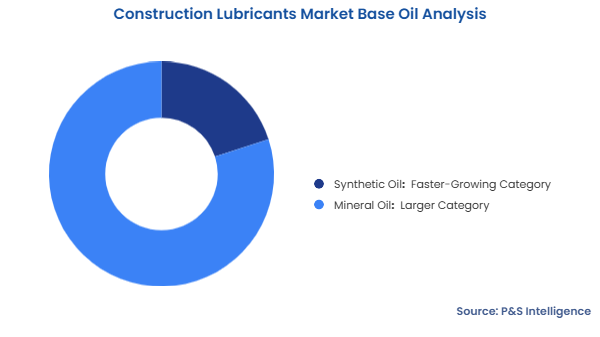
The mineral oil category held the larger market share, of 80%, in 2024, maintaining relevance in price-sensitive markets and older equipment fleets. While mineral-based lubricants offer lower initial costs, typically 30-40% less than synthetic alternatives, their shorter service intervals and reduced equipment protection capabilities limit adoption in critical applications. However, mineral oil lubricants continue dominating aftermarket sales in developing regions where construction companies prioritize immediate cost savings over lifecycle benefits. The category benefits from established supply chains, widespread availability, and compatibility with older equipment designs that may not fully leverage synthetic lubricant advantages.
The synthetic oil category will grow at the higher CAGR during the forecast period, driven by superior performance characteristics that justify premium pricing in demanding construction applications. Synthetic lubricants demonstrate exceptional thermal stability, maintaining viscosity across temperature extremes from −40 °C to 150 °C, critical for construction equipment operating in diverse climatic conditions. The enhanced oxidation resistance of synthetic formulations extends oil life by 200–300% compared to mineral oils, reducing maintenance downtime and total operational costs. Major equipment manufacturers, including Caterpillar, Komatsu, and Volvo, increasingly specify synthetic lubricants for warranty compliance, particularly for high-pressure hydraulic systems and turbocharged diesel engines meeting the latest emission standards.
The types analyzed here are:
Synthetic Oil (Faster-Growing Category)
Mineral Oil (Larger Category)
Type Analysis
The hydraulic fluid category held the larger market share, of 40%, in 2024, reflecting the predominance of hydraulically operated systems in modern construction equipment. Construction machinery relies extensively on hydraulic power for functions, including lifting, digging, pushing, and material handling, with excavators alone containing 50-100 gallons of hydraulic fluid depending on size. Advanced hydraulic fluid formulations incorporate anti-wear additives, foam suppressants, and contamination-resistant properties specifically engineered for construction environments characterized by high particulate contamination and moisture ingress.
The applications analyzed here are:
Hydraulic Fluid (Largest Category)
Engine Oil (Fastest-Growing Category)
Gear Oil
Compressor Oil
Equipment Analysis
The earthmoving equipment category dominated with 55% market share in 2024, as excavators, bulldozers, wheel loaders, and motor graders form the backbone of construction operations. These machines operate continuously under severe conditions, including high loads, shock loading, and contamination exposure, requiring robust lubricant formulations that maintain performance despite challenging operating environments. Excavators alone consume multiple lubricant types, including engine oil (15–40 gallons), hydraulic fluid (50–100 gallons), gear oil (5–20 gallons), and grease (multiple points requiring regular relubrication), representing significant lubricant consumption per unit. The increasing size and power of earthmoving equipment, with some mining-class excavators exceeding 1,000 tonnes in operating weight, drives the demand for premium lubricants capable of protecting components under extreme stress conditions.
Material handling equipment exhibits the highest growth potential, of approx. 4.5%, during 2025–2032, propelled by expanding logistics infrastructure and modular construction techniques requiring extensive lifting operations. Tower cranes, mobile cranes, and telehandlers play increasingly critical roles in modern construction projects, particularly high-rise developments and infrastructure projects requiring precise material placement. These machines demand specialized lubricants, including wire rope lubricants, open gear compounds, and high-performance hydraulic fluids that ensure safe and reliable operation at elevated heights and extended boom configurations. The trend toward larger capacity cranes, with some models exceeding 3,000-ton lifting capacity, necessitates advanced lubricant formulations that prevent wear and corrosion in highly loaded components while maintaining operational safety standards mandated by regulatory authorities.
These equipment categories are covered:
Earthmoving Equipment (Largest Category)
Material Handling Equipment (Fastest-Growing Category)
Heavy Construction Vehicles
Drive strategic growth with comprehensive market analysis
Construction Lubricants Market Geographical Analysis
Asia-Pacific Construction Lubricants Market Size
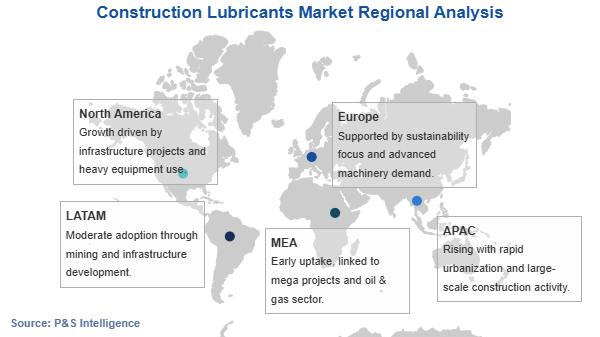
Asia-Pacific dominated the global construction lubricants market with a 40% share in 2024, driven by unprecedented infrastructure development and rapid urbanization across China, India, and Southeast Asian nations. The National Bureau of Statistics of China reported that infrastructure investment reached approximately USD 2.4 trillion (RMB 16.98 trillion) in 2023, marking a 6% increase over the previous year. The region's tropical and monsoon climates, characterized by high humidity and temperature variations, necessitate specialized lubricant formulations that resist moisture contamination and maintain viscosity stability under extreme conditions. The rapid expansion of renewable energy infrastructure across Asia-Pacific significantly contributes to construction lubricant demand.
According to the International Renewable Energy Agency (IRENA), Asia accounted for approximately 69% of global renewable energy capacity additions in 2023 and about 71% in 2024. These significant capacity increases, driven by solar, wind, and hydropower projects, involve extensive construction activities across the region. These projects often occur in remote locations with limited maintenance infrastructure, driving demand for extended drain interval lubricants that minimize service requirements. Additionally, the region's growing focus on sustainable construction practices has accelerated the adoption of environmentally acceptable lubricants, particularly in Japan and South Korea, where environmental regulations match European standards.
North America Construction Lubricants Market Size
North America contributed 25% of the global construction lubricants market revenue in 2024, characterized by high adoption rates of synthetic and semi-synthetic formulations driven by advanced equipment specifications and stringent environmental regulations. The implementation of the Infrastructure Investment and Jobs Act, allocating USD 1.2 trillion for infrastructure modernization, including USD 110 billion for roads and bridges, USD 66 billion for railways, and USD 65 billion for broadband infrastructure, has reinvigorated construction activity across the U.S.
The North American market demonstrates strong growth potential with a projected CAGR, of approx. 5.0%, during 2025–2032, driven by the reshoring of manufacturing facilities and expansion of data center infrastructure supporting digital transformation initiatives. The prevalence of equipment rental services, representing 55% of the construction equipment utilization in North America, creates demand for high-performance lubricants that protect equipment across multiple operators and varying maintenance practices.
Europe Construction Lubricants Market Outlook
Europe accounts for a 20% construction lubricants market share, distinguished by the highest adoption rate of bio-based and environmentally acceptable lubricants, driven by stringent environmental regulations and sustainability commitments. According to Eurostat, the construction sector in the European Union generated approximately EUR 549 billion in gross value added in 2019, representing about 5.5% of the EU’s GDP. The region's mature construction equipment fleet, with the average age exceeding 12 years, necessitates high-quality lubricants that compensate for wear and maintain performance in aging equipment.
The regions and countries analyzed in this report are:
North America (Fastest-Growing Regional Market)
U.S. (Larger Country Market)
Canada (Faster-Growing Country Market)
Europe
Germany (Largest Country Market)
U.K. (Fastest-Growing Country Market)
France
Italy
Spain
Rest of Europe
Asia-Pacific (Largest Regional Market)
Japan
China (Largest Country Market)
India (Fastest-Growing Country Market)
South Korea
Australia
Rest of APAC
Latin America
Brazil (Largest Country Market)
Mexico (Fastest-Growing Country Market)
Rest of LATAM
Middle East and Africa
Saudi Arabia (Largest Country Market)
South Africa
U.A.E. (Fastest-Growing Country Market)
Rest of MEA
Construction Lubricants Market Competitive Landscape
The construction lubricants market is moderately consolidated because a limited number of large multinational producers capture a substantial portion of total sales, using their global manufacturing capabilities, advanced R&D facilities, and long-standing partnerships with equipment manufacturers to maintain a competitive edge. These companies benefit from economies of scale in base oil production, additive procurement, and distribution, enabling them to compete effectively on both quality and cost. At the same time, the market also includes a wide range of regional and specialized lubricant manufacturers that focus on local demand, customized formulations, and price-sensitive segments. This combination of dominant global players and numerous smaller competitors creates a structure where market power is concentrated, but competition remains active, particularly in specific geographies and product niches.
Key Construction Lubricants Companies:
Shell PLC
Exxon Mobil Corporation
Chevron Corporation
TotalEnergies SE
BP plc
FUCHS Petrolub SE
Idemitsu Kosan Co. Ltd.
Sinopec Lubricant Company
Phillips 66 Lubricants
Valvoline Inc.
PetroChina Company Limited
Indian Oil Corporation Limited
Construction Lubricants Market News
In May 2025, Shell plc confirmed the sale of its gas station network in Indonesia, while retaining its lubricant business, emphasizing the strategic importance of its local lubricant supply infrastructure, including a blending plant and planned grease facility.
In April 2025, Sinopec and Saudi Aramco announced the expansion of their joint venture at Yasref in Saudi Arabia, which includes the addition of a 1.8 million metric ton-per-year steam cracker and a 1.5-million-metric-tonne-per-year aromatics complex, further strengthening their downstream petrochemical footprint
In November 2024, Shell plc launched its new Tellus range in India, introducing Shell Tellus S2 MX and Shell Tellus S2 VX, with India becoming the first market to receive these products.
In November 2024, TotalEnergies SE introduced the Rubia EV3R range, heavy-duty OEM-approved engine oils made with over 50% re-refined base oils. This eco-conscious product line supports sustainability goals and can be relevant for equipment used in construction.
In August 2024, Chevron Corporation announced a USD 1-billion investment to establish an R&D hub, named the Engineering and Innovation Excellence Center, in Bengaluru, India.
Want a report tailored exactly to your business need?
Leading companies across industries trust us to deliver data-driven insights and innovative solutions for their most critical decisions. From data-driven strategies to actionable insights, we empower the decision-makers who shape industries and define the future. From Fortune 500 companies to innovative startups, we are proud to partner with organisations that drive progress in their industries.
Client Testimonials
Working with P&S Intelligence and their team was an absolute pleasure – their awareness of timelines and commitment to value greatly contributed to our project's success. Eagerly anticipating future collaborations.
McKinsey & Company
India
Unmatched Standards
Our insights into the minutest levels of the markets, including the latest trends and competitive landscape, give you all the answers you need to take your business to new heights
Complete Data Security
We take a cautious approach to protecting your personal and confidential information. Trust is the strongest bond that connects us and our clients, and trust we build by complying with all international and domestic data protection and privacy laws