This Report Provides In-Depth Analysis of the Compressor Rental Market Report Prepared by P&S Intelligence, Segmented by Compressor Type (Positive Displacement), End-Use (Construction, Oil & Gas, Mining, Manufacturing, Power/Utilities, Chemical), Drive Type (Electric, Engine/Diesel, Gas, Hydraulically), and Geographical Outlook for the Period of 2019 to 2032
Explore the market potential with our data-driven report
Compressor Rental Market Analysis
The global compressor rental market was valued at USD 5,345.7 million in 2024 and is projected to grow at a CAGR of 5.7% during 2025–2032, reaching USD 8,234.2 million by 2032. The market growth is primarily driven by increasing infrastructure development activities, rising demand for cost-effective equipment solutions, and growing adoption of rental business models across various industries.
The expanding construction sector represents a major growth catalyst for the compressor rental market. According to the International Monetary Fund, construction activity in Asia is expected to grow by 5% annually, directly impacting the compressor rental segment. This growth is particularly pronounced in developing economies where governments are investing heavily in infrastructure projects, including roads, bridges, airports, and smart city developments.
Rising industrial automation and the need for temporary compressed air solutions during maintenance shutdowns are further boosting market demand. Companies increasingly prefer rental models over outright purchases to reduce capital expenditure, improve operational flexibility, and access the latest technologies without long-term commitments. According to studies, the air compressor market is projected to reach approximately USD 47.2 billion by 2032, reflecting a compound annual growth rate of around 4.6%, which directly supports the rental segment growth.
Digital Integration and Smart Fleet Management Key Trend
The integration of internet of things (IoT) technologies and digital fleet management systems represents a major trend reshaping the compressor rental industry. Modern rental fleets increasingly incorporate real-time monitoring capabilities, predictive maintenance algorithms, and remote diagnostics to optimize equipment utilization and minimize downtime. These technological advances enable rental companies to provide enhanced service levels while reducing operational costs.
Smart compressors equipped with sensors can monitor performance parameters, fuel consumption, and component wear in real-time, enabling proactive maintenance and preventing costly breakdowns.
Online booking platforms and mobile applications are also revolutionizing customer interactions, allowing for instant equipment availability checks, automated billing, and streamlined logistics coordination. This digital transformation enhances customer experience while improving operational efficiency, particularly beneficial for managing large-scale projects requiring multiple equipment units across different locations.
Expanding Infrastructure Development Is Driving Market Growth
Infrastructure development projects worldwide are creating substantial demand for compressor rental services. According to the World Bank, industrial value added in the Asia-Pacific region grew by nearly 6% in 2024 compared to the previous year, with countries like Vietnam and Bangladesh witnessing double-digit industrial growth. This rapid industrialization requires extensive use of compressed air systems for construction, manufacturing, and processing operations.
Major infrastructure investments are particularly prominent in emerging economies. In China, the Ministry of Industry and Information Technology recorded over RMB 350 billion in new infrastructure investments during the first half of 2024, including smart manufacturing hubs and logistics centers that rely heavily on compressed air systems. Similarly, India's infrastructure expansion under initiatives like Bharatmala and Smart Cities Mission is driving significant demand for rental compressors in highway construction, urban development, and industrial corridor projects.
This dominance is attributed to the sector's project-based nature, where temporary equipment needs align perfectly with rental models. Construction projects often require diverse compressor types for pneumatic tools, concrete spraying, excavation work, and powering various machinery, making rental solutions more economical than purchasing multiple units.
Rising Equipment Maintenance Costs Are Restraining Market Expansion
High maintenance and operational costs associated with rental compressor fleets present significant challenges for market growth. Compressor rental companies face substantial expenses in maintaining diverse equipment portfolios, ensuring regulatory compliance, and managing logistics across multiple locations. These operational complexities directly impact rental pricing and service availability, potentially limiting market accessibility for smaller contractors and budget-constrained projects.
The increasing complexity of modern compressors, while offering improved efficiency, also requires specialized technical expertise for maintenance and repair operations. This cost escalation forces rental companies to balance between maintaining competitive pricing and ensuring adequate profit margins.
Additionally, stringent environmental regulations regarding emissions and noise levels require continuous fleet upgrades and compliance monitoring, adding further operational costs. The need for certified technicians, specialized diagnostic equipment, and regular emissions testing increases the total cost of ownership for rental fleets, which can limit expansion plans and geographic coverage.
Compressor Rental Market Segmentation Analysis
Compressor Type Analysis
The positive displacement category dominated the compressor rental market with a share of 75% in 2024, driven by their versatility and suitability for diverse industrial applications. This dominance is attributed to positive displacement compressors' superior efficiency across varying load conditions, reliable performance, and ability to deliver consistent pressure output regardless of operating conditions.
The dynamic compressor segment is set to witness the faster growth, with a CAGR of 5.8% during 2025–2032. This growth is driven by the increasing demand for high-capacity applications in large industrial facilities, oil and gas processing plants, and power generation facilities where dynamic compressors excel in handling substantial air volumes efficiently.
According to the China General Machinery Industry Association, compressor sales rose by 8% in 2024, directly influencing the consumption of rental services across different compressor technologies. The growing requirement for specialized high-capacity compressors in industrial applications, particularly in chemical processing and power generation sectors, is creating new rental opportunities for dynamic compressor equipment.
These compressor types are covered:
Positive Displacement (Larger Category)
Reciprocating
In-line
V-shaped
Tandem piston
Single-acting
Double-acting
Diaphragm
Rotary
Screw
Vane
Lobe-and-scroll
Dynamic (Faster-Growing Category)
Centrifugal
Axial flow
End-Use Industry Analysis
The construction industry held the largest market share, of 40%, in 2024, and it is projected to maintain its leading position through 2032. Construction projects require diverse compressed air applications, including powering pneumatic tools, operating jackhammers, concrete spraying, sandblasting, and providing ventilation systems. The industry's project-based nature makes rental solutions particularly attractive, allowing contractors to access appropriate equipment for specific job requirements without long-term ownership commitments.
The oil & gas category is expected to register the fastest growth at a CAGR of 5.9% during the forecast period. This growth is driven by increasing exploration activities, pipeline maintenance requirements, and the need for specialized compressors in offshore operations. Global oil production averaged approximately 95.95 million barrels per day (Mb/d), up from 95.2 Mb/d in 2023. Meanwhile, global natural gas production rebounded by 2% in 2024, driven mainly by gains in Russia, China, and Norway.
These end-use industries are covered:
Construction (Largest Category)
Oil & Gas (Fastest-Growing Category)
Mining
Manufacturing
Power/Utilities
Chemical
Others
Drive Type Analysis
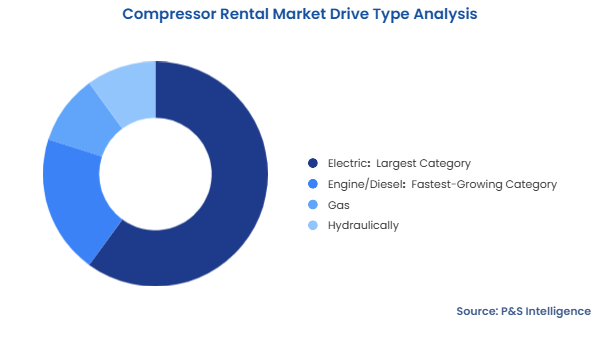
Electrically driven compressors captured the largest market share, of 60%, in 2024, reflecting their widespread adoption in industrial facilities with reliable power infrastructure. Electric compressors offer advantages, including lower operating costs, reduced emissions, quiet operation, and minimal maintenance requirements. Their popularity is increasing due to growing environmental consciousness and regulatory pressure to reduce carbon footprints.
Engine/diesel compressors are set to grow at the highest CAGR, of 5.8%, during 2025–2032. These units provide ultimate flexibility for remote locations and construction sites without reliable electrical infrastructure. Diesel-driven compressors offer immediate deployment capability and high mobility, making them essential for emergency applications, offshore operations, and temporary projects.
These drive types are covered:
Electric (Largest Category)
Engine/Diesel (Fastest-Growing Category)
Gas
Hydraulically
Drive strategic growth with comprehensive market analysis
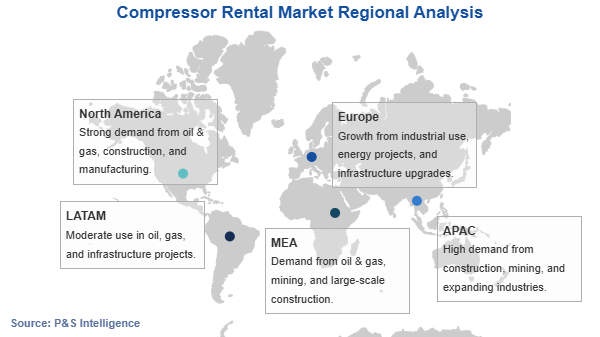
Asia-Pacific dominated the global market with a share of 45% in 2024, and it is expected to maintain its lead throughout the forecast period. This dominance is attributed to rapid industrialization, massive infrastructure development projects, and growing manufacturing activities in countries like China, India, and Japan. The region's strong economic growth, urbanization trends, and government initiatives supporting industrial development are key factors driving compressor rental demand.
According to the Asian Development Bank, the region requires USD 26 trillion in infrastructure investment through 2030 to maintain growth momentum, directly supporting the compressor rental market. China continues to lead regional demand due to sustained expansion in the chemical and mining industries, with extensive Belt and Road Initiative projects requiring substantial compressed air solutions.
India Compressor Rental Market Size
India represents the fastest-growing market within Asia-Pacific, driven by large-scale government infrastructure programs, including Bharatmala highway development, Smart Cities Mission, and Gati Shakti national master plan. The Indian Ministry of Road Transport and Highways reported significant increases in highway and infrastructure projects launched in FY 2024, all requiring extensive compressor usage for excavation, drilling, and material handling operations.
Europe Compressor Rental Market Growth
Europe held a market share of 15% in 2024, and it is projected to grow at a CAGR of 5.9% during 2025–2032, driven by robust infrastructure modernization initiatives and stringent environmental regulations promoting sustainable equipment solutions. The region's emphasis on energy efficiency and green construction practices is accelerating the adoption of advanced compressor rental services.
Germany Compressor Rental Market Size
Germany emerged as the largest European market, accounting for approximately 20% of regional revenue in 2024. According to the German Federal Statistical Office, the construction sector contributed approximately EUR 143 billion to the economy in 2023, with significant investments in renewable energy projects and urban development driving compressor rental demand.
France Compressor Rental Market Size
France represents the fastest-growing European market with a projected CAGR of 6.1% during 2025–2032. The European Investment Bank reported that infrastructure financing in the EU reached EUR 60 billion in 2023, with France receiving substantial allocations for transportation and energy projects requiring extensive compressed air solutions. The country's focus on nuclear energy modernization and renewable energy infrastructure expansion is creating sustained demand for specialized compressor rental services.
U.K. Compressor Rental Market Size
The U.K. maintains a substantial European market share, supported by large-scale housing and transport infrastructure projects. The Department for Business, Energy & Industrial Strategy reports that the U.K. added over 2 GW of new wind capacity in 2023, necessitating regular turbine servicing using mobile pneumatic equipment and driving demand for ruggedized rental compressors.
North America Compressor Rental Market Forecast
North America held the second-largest market share of 25% in 2024, and it is projected to grow at the highest CAGR, of 6.5%, during 2025–2032. The region's growth is driven by robust construction activities, expanding oil and gas exploration, and increasing adoption of rental business models.
U.S. Compressor Rental Market Size
The U.S. dominates the regional market with approximately 80% share, supported by extensive infrastructure modernization projects, shale gas production activities, and advanced manufacturing operations. Government initiatives, including the Infrastructure Investment and Jobs Act, are driving substantial investments in roads, bridges, broadband infrastructure, and clean energy projects, all requiring compressed air solutions.
These regions and countries are covered:
North America (Fastest-Growing Regional Market)
U.S. (Largest Country Market)
Canada (Fastest-Growing Country Market)
Europe
Germany (Largest Country Market)
U.K. (Fastest-Growing Country Market)
France
Italy
Spain
Rest of Europe
Asia-Pacific (Largest Regional Market)
China (Largest Country Market)
India (Fastest-Growing Country Market)
Japan
South Korea
Australia
Rest of APAC
Latin America
Brazil (Largest Country Market)
Mexico (Fastest-Growing Country Market)
Rest of LATAM
Middle East & Africa
U.A.E. (Largest Country Market)
Saudi Arabia (Fastest-Growing Country Market)
South Africa
Rest of MEA
Compressor Rental Market Share Analysis
The global compressor rental market is fragmented due to the presence of several established international players, alongside numerous regional and local operators. This structure fosters competitive pricing while encouraging technological innovation and service differentiation across market segments. Major players focus on expanding fleet capabilities, geographic coverage, and developing specialized solutions for specific industry requirements.
The market concentration analysis indicates that the top 10 key players collectively hold approximately 45% of the total market share, classifying the market as slightly fragmented. This fragmentation allows for significant competition while providing opportunities for new entrants and regional players to establish market presence through specialized services or cost-effective solutions.
Leading companies are investing heavily in fleet modernization, incorporating digital monitoring technologies, and expanding rental locations to improve service delivery and customer satisfaction. Strategic partnerships between equipment manufacturers and rental companies are becoming increasingly common, enabling access to the latest technologies and comprehensive maintenance support.
Key competitive strategies include fleet expansion through acquisitions, development of online booking platforms, implementation of predictive maintenance technologies, and offering comprehensive turnkey solutions, including installation, maintenance, and technical support services.
Major market players include Atlas Copco AB, United Rentals Inc., Ingersoll Rand Inc., Caterpillar Inc., Ashtead Group PLC, Aggreko PLC, Herc Rentals Inc., Sunbelt Rentals Inc., Kaeser Kompressoren SE, and Sullair LLC.
Key Compressor Rental Companies:
Atlas Copco
United Rentals Inc.
Ingersoll Rand Inc.
Caterpillar Inc.
Herc Rentals Inc.
Ashtead Group Plc
Loxam Group
Aggreko Ltd.
H&E Equipment Services Inc.
HSS ProService Limited
Kaeser Kompressoren SE
Sixt AG
Speedy Hire Plc
Compressor Rental Market News
In February 2025, Herc Rentals Inc. signed an agreement to acquire H&E Equipment Services for USD 5.3 billion, including USD 1.5 billion in debt. This will create a firm with over 600 locations and a combined fleet original equipment cost of around USD 10 billion.
In September 2024, Atlas Copco AB expanded its specialty rental portfolio through the acquisition of Integrated Pump Rental, a specialty rental provider of dewatering solutions in Johannesburg, South Africa, strengthening its presence in the African market and enhancing service capabilities for mining and construction sectors.
In August 2024, United Rentals Inc. announced the launch of its digital fleet management platform, incorporating IoT sensors and predictive analytics to optimize equipment utilization and reduce downtime across its compressor rental fleet.
In July 2024, Atlas Copco AB introduced the X-Air+ 1200-40, a new portable air compressor within the DrillAir range. Designed specifically for deep drilling applications, it offers enhanced fuel efficiency and reduced emissions compliance.
Want a report tailored exactly to your business need?
Leading companies across industries trust us to deliver data-driven insights and innovative solutions for their most critical decisions. From data-driven strategies to actionable insights, we empower the decision-makers who shape industries and define the future. From Fortune 500 companies to innovative startups, we are proud to partner with organisations that drive progress in their industries.
Client Testimonials
Working with P&S Intelligence and their team was an absolute pleasure – their awareness of timelines and commitment to value greatly contributed to our project's success. Eagerly anticipating future collaborations.
McKinsey & Company
India
Unmatched Standards
Our insights into the minutest levels of the markets, including the latest trends and competitive landscape, give you all the answers you need to take your business to new heights
Complete Data Security
We take a cautious approach to protecting your personal and confidential information. Trust is the strongest bond that connects us and our clients, and trust we build by complying with all international and domestic data protection and privacy laws