This Report Provides In-Depth Analysis of the Cloud Identity & Access Management Market Report Prepared by P&S Intelligence, Segmented by Component (Solutions, Services), Service Type (Single Sign-On, Multi-Factor Authentication, User Provisioning & De-provisioning, Privileged Access Management, Password Management, Directory Services, Identity Governance & Administration, Access Management), Deployment Mode (Public Cloud, Hybrid Cloud, Private Cloud), Enterprise Size (Large Enterprises, Small & Medium Enterprises), End User (Banking, Financial Services, and Insurance, Healthcare & Life Sciences, IT & Telecommunications, Retail & E-Commerce, Government & Public Sector, Manufacturing, Education, Media & Entertainment, Energy & Utilities), and Geographical Outlook for the Period of 2021 to 2032
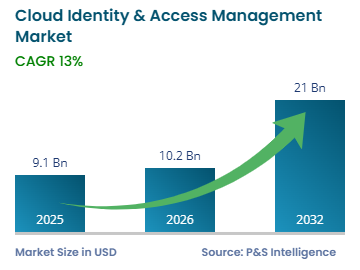
The cloud identity & access management market size was USD 9.1 billion for 2025, and it will grow by 13.0% during 2026-2032, to reach USD 21.0 billion by 2032.
The market is expanding as organisations increasingly adopt cloud-based applications, hybrid IT environments, remote working models, and digital business platforms that require secure and seamless access to enterprise resources. The widespread shift towards cloud-first strategies and Zero Trust security architectures is accelerating the adoption of cloud identity and access management (IAM) solutions, enabling organisations to authenticate users, enforce least-privilege access, and centrally manage identities across distributed environments. As enterprises continue migrating workloads to public, private, and hybrid clouds, traditional perimeter-based security models are becoming less effective, increasing the need for identity-centric security frameworks that protect users, applications, and sensitive business data.
Growing concerns over credential theft, account compromise, insider threats, and identity-based cyberattacks are further driving investments in advanced identity security capabilities. According to the International Criminal Police Organisation (INTERPOL), a global cybercrime operation in 2024 disrupted more than 22,000 malicious IP addresses and servers associated with phishing, information stealers, and ransomware activities, highlighting the growing scale of cyber threats targeting digital identities and access credentials. Consequently, organisations are increasingly implementing multi-factor authentication (MFA), privileged access management (PAM), identity governance and administration (IGA), passwordless authentication, and continuous access verification to reduce security risks while maintaining operational efficiency.
Key Market Insights
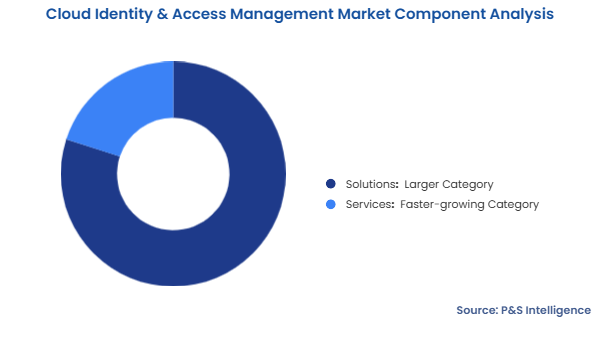
Solutions is the larger component, holding a market share of 80.0%, due to enterprise preference for unified identity governance and access control platforms.
Multi-Factor Authentication (MFA) is the fastest-growing service type, registering a CAGR of 13.4%, driven by rising credential theft and phishing-related security risks.
Public Cloud is the largest deployment mode, holding a market share of 65.0%, due to simplified deployment, centralised management, and growing adoption of cloud-native applications.
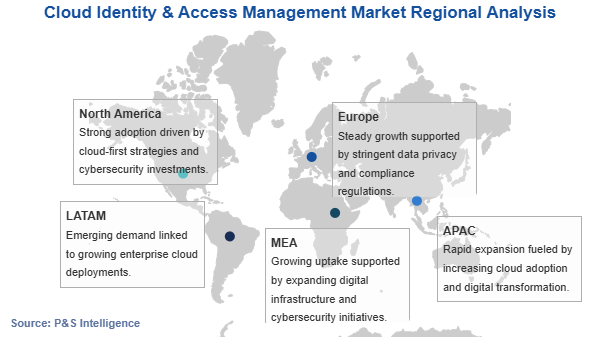
North America holds the largest share, of 40.5%, because the region has an advanced cloud ecosystem, high enterprise spending on cybersecurity.
Asia-Pacific has the highest CAGR, of 15.0%, because organizations across the region are rapidly expanding digital services, cloud deployments.
Cloud Identity & Access Management Market Trends and Drivers
AI-Driven Identity Security and Management of Non-Human Identities Is a Major Trend
The cloud identity and access management market is evolving from traditional user authentication towards comprehensive identity-centric security driven by artificial intelligence (AI), Zero Trust architectures, and the rapid growth of non-human identities. As organisations accelerate cloud adoption and deploy AI-driven applications, APIs, containers, and automated workloads, identity platforms are increasingly required to secure both human and machine identities through unified governance, continuous authentication, and risk-based access controls. This shift is encouraging enterprises to implement intelligent identity solutions capable of detecting anomalous behaviour, automating access decisions, and enforcing least-privilege principles across distributed cloud environments.
According to CyberArk, organisations worldwide had 82 machine identities for every human identity in 2025, while 42% of machine identities held privileged or sensitive access. Additionally, according to the Cloud Native Computing Foundation, 91% of organisations used containers in production in 2024, up from 80% in 2023. The rapid expansion of machine identities and cloud-native workloads is increasing demand for advanced cloud IAM platforms that provide centralised visibility, automated identity lifecycle management, and real-time governance across increasingly complex digital ecosystems.
Rising Frequency of Identity-Based Cyber Threats Drives Market
The growing volume of cyberattacks targeting credentials, privileged accounts, and access pathways is a major driver for the cloud identity and access management market. As organisations expand their operations across cloud platforms, remote working environments, and third-party ecosystems, identity security has become a critical component of enterprise cybersecurity strategies. According to IBM X-Force, abuse of user identities remained the preferred entry point for attackers in 30% of cases during 2024. Businesses are increasingly investing in identity and access management solutions to strengthen authentication, enforce least-privilege access, and reduce risks associated with unauthorised access and account compromise. According to Google Cloud Mandiant, stolen credentials accounted for 16% of investigations in 2024, making them the second most common initial infection vector. These threats are encouraging organisations to modernise identity security frameworks, deploy stronger authentication controls, and improve governance across increasingly complex digital environments.
Complex Integration Across Legacy and Multi-Platform Environments Restrains Market Growth
The complexity of integrating modern cloud identity and access management platforms with existing enterprise infrastructure remains a key restraint for the market. Many organisations operate a combination of legacy applications, on-premises systems, multiple cloud environments, and third-party platforms that were not originally designed to support a unified identity framework. Establishing consistent authentication policies, access governance, and identity lifecycle management across these diverse systems often requires extensive customisation, data migration, and interoperability efforts, increasing implementation complexity.
According to ISC2, the global cybersecurity workforce gap reached 4.8 million professionals in 2024. The shortage of skilled cybersecurity and identity specialists further limits organisations ability to plan, deploy, and manage complex IAM implementations, particularly across large enterprises with geographically distributed IT infrastructures. These technical and resource-related challenges increase implementation timelines, raise deployment costs, and create operational risks during migration and system modernisation projects.
Expansion of Identity Security Requirements for Machine and Autonomous Workloads Creates Market Opportunities
A significant opportunity is emerging from the rapid growth of machine identities, APIs, connected devices, cloud-native applications, and AI-driven workloads. As organisations accelerate digital transformation and automation initiatives, non-human identities are increasingly accessing enterprise applications, data, and digital services at a scale that exceeds traditional user accounts. This shift is creating growing demand for advanced cloud identity and access management solutions capable of providing secure authentication, credential management, identity governance, and continuous monitoring across increasingly complex digital ecosystems.
According to Cloudflare, API traffic with successful responses represented a median of 58% of dynamic HTTP traffic during 2024. The growing volume of API-driven interactions highlights the increasing need to secure non-human identities and automated workloads while ensuring seamless access across cloud-based environments. These evolving requirements are creating significant opportunities for vendors to develop intelligent IAM platforms that integrate AI-driven risk assessment, automated access decisions, identity lifecycle management, and unified governance for both human and machine identities.
Solutions is the larger category, holding a market share of 80.0%, due to strong enterprise demand for integrated platforms that combine authentication, authorisation, identity governance, privileged access management, and access control within a unified framework. According to Eurostat, 65.49% of European Union enterprises using paid cloud services purchased security software applications as a cloud service in 2025. The growing adoption of cloud-delivered security solutions continues to drive demand for comprehensive IAM platforms that enable centralised policy enforcement, improve operational efficiency, and protect users, applications, and digital assets.
Services are the faster-growing category, registering a CAGR of 13.8%, as enterprises increasingly require specialized expertise to deploy, integrate, optimize, and manage complex identity ecosystems. The growing adoption of hybrid and multi-cloud environments, combined with legacy system integration and evolving regulatory requirements, has increased demand for consulting, system integration, implementation, managed, and support services.
The component analysed in this report are:
Solutions (Larger Category)
Services (Faster-growing Category)
Service Type Analysis
Single Sign-On (SSO) is the largest category, holding a market share of 25.0%, because organizations increasingly require seamless and secure access across a growing portfolio of cloud applications, enterprise platforms, and digital services. SSO enhances user experience by enabling access to multiple applications through a single set of credentials while allowing administrators to centrally manage authentication and access policies. It also reduces password fatigue, lowers helpdesk costs associated with password resets, and strengthens security by minimizing credential-related risks.
Multi-Factor Authentication (MFA) is the fastest-growing category, registering a CAGR of 13.4%, as organisations strengthen protection against credential theft, phishing attacks, and unauthorised access. Growing adoption of Zero Trust security frameworks, stricter regulatory requirements, and the increasing use of remote and cloud-based applications are driving demand for stronger identity verification mechanisms. According to the Federal Bureau of Investigation (FBI) Internet Crime Complaint Center (IC3), phishing and spoofing generated 193,407 complaints in 2024, making it the most frequently reported internet crime category.
Public Cloud is the largest category, holding a market share of 65.0%, as organisations increasingly deploy identity and access management capabilities through scalable cloud-based environments. Public cloud platforms reduce infrastructure requirements, simplify deployment, and support rapid integration with modern enterprise applications. According to Eurostat, 52.74% of European Union enterprises used paid cloud computing services in 2025. Strong cloud adoption is encouraging organisations to implement identity services through cloud delivery models that provide centralised management, continuous updates, and support for geographically distributed users.
Hybrid Cloud is the fastest-growing category, registering a CAGR of 14.1%, because organizations are balancing existing on-premises investments with expanding cloud adoption strategies. Many enterprises require identity solutions that can operate consistently across multiple environments while maintaining security, compliance, and operational continuity. Hybrid architectures enable businesses to manage access across legacy systems and modern cloud applications through a unified framework. The increasing complexity of enterprise IT environments is creating strong demand for flexible identity platforms that support diverse infrastructures.
The deployment mode analysed in this report are:
Public Cloud (Largest Category)
Hybrid Cloud (Fastest-growing Category)
Private Cloud
Enterprise Size Analysis
Large Enterprises is the larger category, holding a market share of 75.5%, due to their extensive workforce, complex IT ecosystems, and greater investment in cybersecurity and digital transformation initiatives. These organizations manage large numbers of employees, contractors, partners, and business applications, requiring robust identity governance, privileged access controls, and regulatory compliance across distributed environments. Their continued migration to hybrid and multi-cloud infrastructures, coupled with the adoption of Zero Trust security strategies, has strengthened demand for advanced cloud identity and access management solutions capable of delivering centralized visibility and consistent access control across enterprise-wide operations.
Small & Medium Enterprises (SMEs) are the faster-growing category, registering a CAGR of 13.7%, as cloud-based IAM solutions become more affordable, scalable, and easier to deploy. Subscription-based delivery models allow SMEs to strengthen authentication, secure cloud applications, and protect sensitive business data without significant upfront infrastructure investments. According to Eurostat, 49.3% of European Union small enterprises used paid cloud computing services in 2025, an increase of 7.48 percentage points from 2023.
The enterprise size analysed in this report are:
Large Enterprises (Larger Category)
Small & Medium Enterprises (SMEs) (Faster-growing Category)
End User Analysis
Banking, Financial Services, and Insurance (BFSI) is the largest category, holding a market share of 25.0%, because banks, insurance providers, and financial institutions manage highly sensitive customer information, regulated transactions, and critical financial infrastructure. These organisations rely heavily on authentication, access governance, and fraud prevention controls to secure digital operations. According to the International Monetary Fund, financial institutions accounted for nearly one-fifth of reported cyber incidents within its cyber-risk dataset, with banks representing the most frequently targeted organisations. The high exposure to cyber threats is encouraging continuous investment in identity and access management platforms that strengthen security, support regulatory compliance, and protect digital financial services.
Healthcare & Life Sciences is the fastest-growing category, registering a CAGR of 14.3%, as healthcare organizations accelerate digital transformation initiatives and expand access to connected clinical systems. Hospitals, research institutions, and healthcare providers must secure sensitive patient information while enabling authorized access across increasingly distributed care environments. The adoption of telehealth services, electronic health records, cloud-based healthcare applications, and connected medical technologies is driving demand for stronger identity governance. Organizations are also responding to growing privacy requirements and cybersecurity concerns.
The end user analysed in this report are:
Banking, Financial Services, and Insurance (BFSI) (Largest Category)
Healthcare & Life Sciences (Fastest-growing Category)
IT & Telecommunications
Retail & E-Commerce
Government & Public Sector
Manufacturing
Education
Media & Entertainment
Energy & Utilities
Others
Drive strategic growth with comprehensive market analysis
Cloud Identity & Access Management Market Regional Outlook
North America Cloud Identity & Access Management Market Analysis
North America holds the largest share, of 40.5%, because the region has an advanced cloud ecosystem, high enterprise spending on cybersecurity, and widespread adoption of identity-centric security frameworks across both public and private sectors. Organizations in the region were among the earliest adopters of cloud-based identity platforms, allowing them to establish mature access governance and authentication infrastructures. The strong presence of major cloud providers, cybersecurity vendors, and digital service companies continues to support investment in identity modernization initiatives. Regulatory expectations related to data security and privacy are also encouraging organizations to strengthen identity controls across complex hybrid environments. In addition, the growing use of remote work models, software-as-a-service applications, and interconnected business systems has increased the importance of centralized identity management.
U.S. Cloud Identity & Access Management Market Analysis
The U.S. remains a leading market for cloud identity and access management due to its mature cybersecurity ecosystem and high concentration of cloud-driven enterprises. Organisations across financial services, healthcare, government, and technology sectors continue investing in identity governance, privileged access management, and zero-trust security frameworks. According to the Federal Bureau of Investigation Internet Crime Complaint Centre, phishing and spoofing generated 193,407 complaints in 2024, making it the most frequently reported internet crime category. The scale of identity-related threats is encouraging enterprises to strengthen authentication controls, modernise access management infrastructure, and expand deployment of cloud-based identity security platforms across critical business operations.
Canada is witnessing increasing adoption of cloud identity and access management solutions as organisations strengthen cybersecurity programmes and modernise digital services. Growing cloud utilisation, privacy requirements, and hybrid working environments are encouraging enterprises to improve identity governance and access controls across distributed infrastructures. According to Statistics Canada, fraud-related violations, including identity theft, identity fraud, and extortion, accounted for 62% of police-reported cybercrimes in 2024. The prevalence of identity-related offences is increasing demand for stronger authentication, centralised access visibility, and cloud-based identity management platforms that help organisations secure users, applications, and sensitive business information.
Asia-Pacific has the highest CAGR, of 15.0%, because organizations across the region are rapidly expanding digital services, cloud deployments, and connected business operations, creating a growing need for scalable identity security solutions. Governments and enterprises are investing heavily in digital infrastructure, cybersecurity programs, and cloud-first initiatives that require stronger identity governance capabilities. According to the Asian Development Bank (ADB), cloud computing contributed between 0.25% and 2.23% of GDP across selected Asia-Pacific economies, including Australia, India, Indonesia, Japan, Malaysia, New Zealand, the Philippines, Singapore, the Republic of Korea, Thailand, and Viet Nam, in 2023. This reflects the growing economic importance of cloud technologies and supports increasing investment in cloud-based identity and access management solutions across the region.
China Cloud Identity & Access Management Market Analysis
China's market is expanding due to rapid enterprise digitalisation, growing cloud adoption, and increasing deployment of cloud-native technologies across major industries. Organisations require stronger identity controls to manage access across large digital ecosystems spanning e-commerce, financial technology, manufacturing, and connected services. According to the State Council of the People's Republic of China, the country had 1.1 billion internet users in 2024. The scale of digital participation is increasing the number of users, applications, and connected services requiring secure authentication and access governance, encouraging broader adoption of identity management platforms across enterprise and public-sector environments.
India Cloud Identity & Access Management Market Analysis
India is experiencing strong growth in cloud identity and access management adoption due to expanding digital infrastructure, cloud-based business services, and technology-driven public platforms. Enterprises, financial institutions, and government organisations are increasingly prioritising secure identity verification and access governance as digital participation continues to rise. According to the Press Information Bureau of India, Aadhaar holders completed more than 2,707 crore authentication transactions during 2024–25. The extensive use of digital identity services is encouraging organisations to invest in scalable authentication systems, stronger access controls, and cloud-based identity platforms capable of managing large user populations across diverse digital ecosystems.
Europe Cloud Identity & Access Management Market Analysis
Europe represents a significant market driven by stringent data protection regulations, expanding digital transformation initiatives, and increasing investments in cybersecurity across both public and private sectors. According to Eurostat, 52.7% of enterprises in the European Union purchased cloud computing services in 2025, reflecting the growing adoption of cloud-based technologies across the region. This increasing reliance on cloud services is encouraging organizations to strengthen identity governance, authentication, and access management capabilities to secure distributed digital environments and support regulatory compliance.
The regions and countries analysed in this report are:
The cloud identity and access management market is fragmented, with numerous global and regional vendors competing across different areas of the identity security ecosystem. The industry comprises established cybersecurity providers, cloud platform companies, identity specialists, privileged access management vendors, and emerging firms offering specialized capabilities for authentication, identity governance, access management, and machine identity security. This diverse competitive landscape encourages continuous innovation, with vendors differentiating themselves through cloud-native architectures, AI-driven security capabilities, platform integration, user experience, and regulatory compliance features.
Leading Companies in the Cloud Identity & Access Management Market:
Microsoft Corporation
Oracle Corporation
IBM Corporation
Fortinet, Inc.
Ping Identity Corporation
Thales SA
Okta, Inc.
CyberArk Software Ltd.
SailPoint, Inc.
Saviynt, Inc.
Amazon.com, Inc.
RSA Security LLC
Cloud Identity & Access Management Market News
In May 2026, SailPoint, Inc. launched Agentic Fabric, a new identity security solution designed for AI agents and other non-human identities. The release extends SailPoint Identity Security Cloud with capabilities such as discovery, ownership mapping, governance, authorization, and protection for agentic systems operating across enterprise cloud environments and applications.
In March 2026, RSA Security LLC launched ID Plus Sovereign Deployment for high-assurance identity environments. This release introduces a deploy-anywhere model for RSA ID Plus, enabling IAM capabilities across private cloud, multi-cloud, on-premises, and air-gapped environments, with integrated authentication, access management, directory services, and governance functionalities.
In July 2025, Oracle Corporation enhanced Oracle Cloud Infrastructure (OCI) Identity and Access Management by introducing the Token Exchange grant type for JSON Web Tokens (JWT) in Identity Domains. The enhancement enables secure token-based authentication and strengthens identity federation across cloud environments.
In March 2025, Microsoft Corporation announced that Microsoft Entra ID will no longer support service-principal-less authentication beginning March 31, 2026. The update strengthens identity security by ensuring that all applications active within a tenant have an associated service principal, improving identity governance and reducing security risks across cloud environments.
Frequently Asked Questions About This Report
What does the cloud identity and access management market include for organizations?+
It includes cloud based tools for authentication, authorization, single sign on, privileged access, identity governance, and access policies.
What factors are driving demand in the cloud identity and access management market?+
Demand is driven by cloud adoption, remote work, zero trust programs, compliance needs, and attacks using stolen credentials.
Why are organizations adopting cloud identity and access management solutions across operations?+
Organizations adopt cloud identity tools to control access, verify users, manage roles, and protect applications across distributed environments.
How do cloud identity and access management solutions improve decision making and efficiency?+
These solutions improve security by applying consistent access policies, monitoring identity risk, and reducing unnecessary privileges.
What challenges affect adoption of cloud identity and access management solutions today?+
Adoption is affected by legacy directories, complex permissions, migration planning, user friction, compliance requirements, and integration across applications.
Want a report tailored exactly to your business need?
Leading companies across industries trust us to deliver data-driven insights and innovative solutions for their most critical decisions. From data-driven strategies to actionable insights, we empower the decision-makers who shape industries and define the future. From Fortune 500 companies to innovative startups, we are proud to partner with organisations that drive progress in their industries.
Client Testimonials
Working with P&S Intelligence and their team was an absolute pleasure – their awareness of timelines and commitment to value greatly contributed to our project's success. Eagerly anticipating future collaborations.
McKinsey & Company
India
Unmatched Standards
Our insights into the minutest levels of the markets, including the latest trends and competitive landscape, give you all the answers you need to take your business to new heights
Complete Data Security
We take a cautious approach to protecting your personal and confidential information. Trust is the strongest bond that connects us and our clients, and trust we build by complying with all international and domestic data protection and privacy laws