This Report Provides In-Depth Analysis of the Cloud-based Disaster Recovery Market Report Prepared by P&S Intelligence, Segmented by Service Type (Disaster Recovery as a Service, Replication as a Service, Backup as a Service), Deployment Mode (Public Cloud, Hybrid Cloud, Private Cloud), Recovery Type (Backup and Restore, Warm Standby, Pilot Light, Multi-Site / Hot Site), Organization Size (Large Enterprises, Small and Medium Enterprises), End User (BFSI, IT and Telecommunication, Government and Public Sector, Retail and Consumer Goods, Healthcare and Life Sciences, Manufacturing, Media and Entertainment), and Geographical Outlook for the Period of 2021 to 2032
Explore the market potential with our data-driven report
Cloud-based Disaster Recovery Market Overview
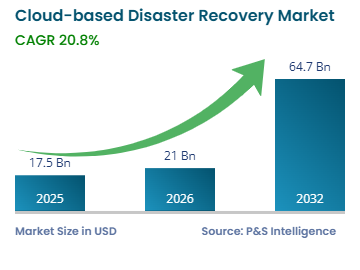
The cloud-based disaster recovery market size was USD 17.5 billion for 2025, and it will grow by 20.8% during 2026-2032, to reach USD 64.7 billion by 2032.
The market is expanding because enterprises are increasingly relying on cloud infrastructure, digital applications, and connected enterprise systems to manage daily operations. Businesses now store financial records, customer databases, operational workloads, and enterprise software across distributed cloud environments that require continuous availability and rapid recovery support. Remote working models, hybrid IT infrastructure, and rising adoption of software-as-a-service applications are also increasing the need for flexible disaster recovery platforms that can restore systems quickly during outages, cyberattacks, or hardware failures. Organisations are replacing traditional backup systems with cloud-based recovery platforms that provide automated failover, remote accessibility, and scalable recovery capabilities across multiple operating environments.
The market is also growing because ransomware attacks, operational disruptions, and cloud-based security incidents are becoming more frequent across industries. Enterprises are strengthening business continuity strategies to reduce downtime, protect critical workloads, and improve resilience against infrastructure failures and cyber threats. According to the International Telecommunication Union, around 6 billion people used the Internet globally in 2025, reflecting the scale of digital operations and cloud-connected services that require resilient recovery infrastructure. The growing dependence on cloud applications and online business systems is encouraging organisations to integrate disaster recovery into broader cloud transformation strategies. Government digitalisation programmes, expansion of hyperscale data centres, and increasing enterprise cloud investments are also supporting wider deployment of automated recovery platforms across BFSI, healthcare, retail, manufacturing, and public service environments where uninterrupted access to systems and operational data remains critical for daily business activities.
Key Market Insights
Disaster Recovery as a Service is the largest service type, holding a market share of 65.0%, due to rising enterprise demand for automated recovery management.
Hybrid Cloud is the fastest-growing deployment mode, registering a CAGR of 20.9%, driven by increasing adoption of multi-environment operational infrastructure across enterprises.
Backup and Restore is the largest recovery type, holding a market share of 45.5%, due to growing enterprise data volumes requiring continuous protection and restoration.
North America holds the largest share of 40.5%, due to advanced cloud infrastructure and increasing enterprise investment in cyber resilience platforms.
Asia-Pacific is the fastest-growing region, registering a CAGR of 22.0%, driven by rapid digital infrastructure expansion and rising enterprise cloud adoption.
Cloud-based Disaster Recovery Market Trends and Drivers
AI-Driven Autonomous Recovery Operations Is Major Trend
Cloud-based disaster recovery platforms are increasingly adopting artificial intelligence, automation, and cyber recovery technologies to reduce operational downtime and improve incident response capabilities. Vendors are developing autonomous recovery systems that detect failures, isolate threats, and restore workloads with limited manual intervention across hybrid and multi-cloud environments. Organisations are also integrating disaster recovery with cybersecurity operations to improve threat visibility, backup verification, and recovery orchestration within a unified infrastructure platform. According to the World Economic Forum, 66% of organisations expected artificial intelligence to significantly impact cybersecurity in 2025, while only 37% had processes to assess artificial intelligence tools before deployment. According to IBM, organisations extensively using security artificial intelligence and automation identified and contained data breaches nearly 100 days faster in 2024 than organisations without these technologies. Enterprises are therefore increasing investments in automated failover systems, immutable backup architecture, and predictive recovery platforms that strengthen cyber resilience and reduce operational complexity across cloud-connected business environments.
Growing Business Dependence on Continuous Digital Operations Drives Market
The market is growing because enterprises increasingly depend on cloud-connected systems to manage payments, communication platforms, customer operations, and supply chain activities without interruption. Businesses cannot afford extended downtime because operational disruptions directly affect financial transactions, customer trust, and service continuity across digitally connected environments. Organisations are therefore strengthening disaster recovery readiness to restore applications and operational data rapidly after cyberattacks, infrastructure failures, or system outages. According to Microsoft, customers faced more than 600 million cybercriminal and nation-state attacks daily in 2024, including ransomware, phishing, and identity-based attacks targeting enterprise infrastructure. According to Cisco, 71% of organisations expected a cybersecurity incident to disrupt business operations during 2025, while only 34% felt highly confident in their cyber resilience capabilities. Enterprises are consequently investing in cloud-based disaster recovery platforms that improve backup reliability, workload recovery speed, and operational continuity across hybrid infrastructure and remote working environments.
Complex Data Recovery Management Across Multi-Cloud Environments Restrains Market Growth
Many organisations continue facing operational difficulties while managing disaster recovery across hybrid infrastructure, legacy enterprise systems, and multiple cloud platforms. Different cloud providers often operate with separate recovery tools, storage architectures, compliance controls, and security policies, which increases administrative complexity for internal information technology teams. Businesses using older enterprise applications also struggle to integrate modern cloud-based disaster recovery platforms with existing databases and operational workloads. Recovery testing, workload migration, and cross-cloud synchronisation frequently become difficult because of compatibility limitations and inconsistent data visibility across environments. According to ISC2, the global cybersecurity workforce gap reached 4.8 million professionals in 2024, limiting the availability of skilled personnel required to manage advanced recovery configurations and continuous monitoring systems. Small and medium-sized businesses are particularly affected because they often lack specialised cybersecurity and infrastructure teams capable of maintaining resilient disaster recovery operations across distributed cloud environments.
Rising Cloud Adoption Among Small and Mid-Sized Businesses Creates New Growth Opportunities
Small and medium-sized businesses are increasingly adopting cloud infrastructure, digital applications, and online operational platforms, creating strong opportunities for cloud-based disaster recovery providers. Many smaller organisations previously depended on manual recovery processes and basic backup systems because conventional disaster recovery infrastructure required high capital investment and dedicated technical resources. Cloud-based recovery platforms are now becoming more accessible through subscription-based pricing, managed services, and simplified deployment models that reduce infrastructure complexity. According to the United Nations, micro, small, and medium-sized enterprises account for around 90% of businesses globally, highlighting the large potential customer base for scalable and accessible disaster recovery solutions. Vendors are therefore introducing lightweight disaster recovery solutions, managed recovery services, and industry-specific cloud platforms designed for organisations with limited information technology resources. Demand is particularly increasing across retail, healthcare, education, and professional services sectors, where operational continuity and secure access to digital systems are becoming increasingly important.
Disaster Recovery as a Service (DRaaS) is the largest category, holding a market share of 65.0%, because enterprises increasingly require scalable and managed recovery solutions that reduce infrastructure costs and simplify disaster recovery operations across cloud and hybrid environments. Organisations are adopting DRaaS platforms for automated failover, remote workload recovery, continuous data protection, and centralised recovery management without maintaining dedicated secondary infrastructure. Rising ransomware incidents, increasing cloud adoption, and growing requirements for business continuity are further supporting demand for managed disaster recovery services.
Replication as a Service is the fastest-growing category, registering a CAGR of 21.1%, as enterprises increasingly require continuous data availability and faster recovery for business-critical workloads. Replication technologies enable organisations to maintain synchronised copies of data and applications across geographically distributed environments, helping reduce recovery time and minimise data loss during operational disruptions. Growing adoption of hybrid and multi-cloud infrastructure is further increasing demand for replication services that support workload mobility, data synchronisation, and recovery across multiple IT environments.
The service types analysed in this report are:
Disaster Recovery as a Service (DRaaS) (Largest Category)
Replication as a Service (Fastest-Growing Category)
Backup as a Service (BaaS)
Deployment Mode Analysis
Public Cloud is the largest category, holding a market share of 55.5%, due to widespread enterprise adoption of scalable cloud infrastructure and lower operational costs compared with traditional disaster recovery environments. Organisations prefer public cloud deployments because they offer flexible storage capacity, rapid deployment, and access to managed recovery services. Cloud providers also offer integrated backup, replication, and failover capabilities that simplify disaster recovery management. The continued migration of enterprise workloads and applications to public cloud environments is further supporting demand for cloud-based disaster recovery solutions.
Hybrid Cloud is the fastest-growing category, registering a CAGR of 20.9%, as organisations increasingly operate workloads across public cloud, private cloud, and on-premise infrastructure. Businesses prefer hybrid deployments because they provide greater control over sensitive workloads while offering the scalability and flexibility of cloud-based recovery solutions. Hybrid environments also support gradual cloud migration and enable organisations to distribute workloads across multiple infrastructure environments during operational disruptions. According to Flexera, 73% of surveyed organisations used hybrid cloud in 2024, supporting the growing adoption of disaster recovery solutions designed for multi-environment infrastructure.
The deployment modes analysed in this report are:
Public Cloud (Largest Category)
Hybrid Cloud (Fastest-Growing Category)
Private Cloud
Recovery Type Analysis
Backup and restore is the largest category, holding a market share of 45.5%, because organisations continue to rely on cost-effective recovery solutions that support the restoration of files, applications, and operational data following outages or cyber incidents. This recovery approach is widely adopted because it supports both cloud-based and legacy IT environments without requiring highly complex infrastructure. According to the International Telecommunication Union, global fixed broadband traffic reached 6 zettabytes in 2024, reflecting the growing volume of data requiring secure backup and recovery capabilities.
Warm Standby is the fastest-growing category, registering a CAGR of 21.8%, because enterprises are increasingly prioritising faster recovery times while avoiding the costs associated with maintaining fully active duplicate infrastructure. Warm standby environments maintain partially operational recovery infrastructure that can be activated quickly during disruptions, providing a balance between recovery speed and operational costs. Organisations supporting customer-facing digital services, financial transactions, and cloud-based applications are increasingly adopting warm standby solutions to minimise downtime and improve business continuity.
The recovery types analysed in this report are:
Backup and Restore (Largest Category)
Warm Standby (Fastest-Growing Category)
Pilot Light
Multi-Site / Hot Site
Organisation Size Analysis
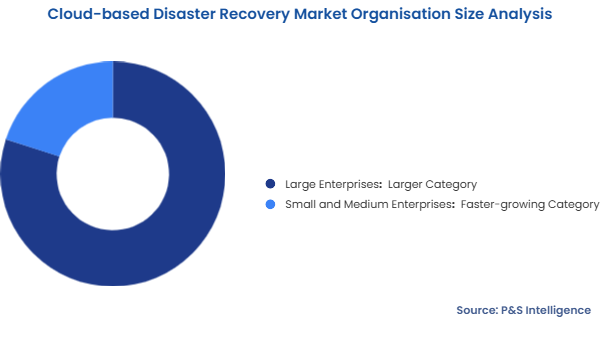
Large Enterprises is the larger category, holding a market share of 80.0% because large organisations manage extensive digital infrastructure, complex cloud environments, and high volumes of critical operational data. These organisations require robust disaster recovery solutions to maintain business continuity across multiple business units, applications, and geographic locations. Large enterprises also face greater exposure to cyber threats, regulatory requirements, and financial losses associated with operational downtime. Their larger IT budgets and continued investments in cloud transformation are therefore supporting strong adoption of enterprise-grade cloud-based disaster recovery solutions.
Small and medium enterprises are the faster-growing category, registering a CAGR of 21.3%, because cloud-based disaster recovery solutions are becoming more affordable and easier to deploy for organisations with limited IT resources. SMEs are increasingly recognising the risks associated with ransomware, system outages, and data loss and are adopting subscription-based recovery services that reduce the need for dedicated infrastructure and specialised recovery teams. According to the United Nations, micro, small, and medium-sized enterprises account for around 90% of businesses globally, highlighting the substantial potential customer base for accessible and scalable disaster recovery solutions.
The organization sizes analysed in this report are:
Large Enterprises (Larger Category)
Small and Medium Enterprises (Faster-Growing Category)
End User Analysis
BFSI is the largest category, holding a market share of 30.0%, because financial institutions require uninterrupted access to payment systems, customer databases, transaction platforms, and other business-critical applications. Banks, insurance providers, and financial service companies are strengthening disaster recovery capabilities to minimise operational downtime and improve resilience against cyber incidents, system failures, and infrastructure disruptions. According to the Bank for International Settlements, annual cashless payments reached 579 transactions per capita in advanced economies in 2024, reflecting the increasing reliance on digital payment infrastructure and continuous transaction processing.
IT and Telecommunication is the fastest-growing category, registering a CAGR of 21.5%, because telecom operators and technology companies are rapidly expanding cloud infrastructure, digital platforms, and connected services that require high availability and continuous operational performance. These organisations manage large volumes of real-time data and rely on uninterrupted network connectivity to support enterprise applications, digital communication, and online services. The increasing deployment of 5G networks, edge computing, and multi-cloud environments is further increasing demand for disaster recovery solutions capable of protecting distributed and data-intensive IT infrastructure.
The end users analysed in this report are:
BFSI (Largest Category)
IT and Telecommunication (Fastest-Growing Category)
Government and Public Sector
Retail and Consumer Goods
Healthcare and Life Sciences
Manufacturing
Media and Entertainment
Others
Drive strategic growth with comprehensive market analysis
North America Cloud-Based Disaster Recovery Market Analysis
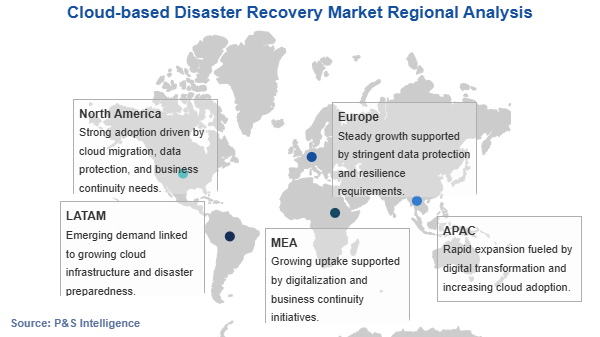
North America holds the largest share, of 40.5%, because enterprises across the region have deeply integrated cloud infrastructure into daily operations and business continuity planning. Large organisations in the U.S. and Canada are investing heavily in cyber resilience strategies as ransomware attacks, operational disruptions, and data security concerns continue to rise. The region also benefits from the strong presence of hyperscale cloud providers, managed recovery vendors, and advanced data centre infrastructure. Financial institutions, healthcare providers, government agencies, and technology companies are increasingly adopting automated recovery platforms that support hybrid and multi-cloud environments. Businesses in the region are also focusing more on compliance readiness and recovery testing, which is increasing demand for cloud-native disaster recovery services with continuous backup, rapid failover, and centralised management capabilities.
U.S. Cloud-Based Disaster Recovery Market Analysis
The U.S. represents the most mature market for cloud-based disaster recovery because enterprises continue investing heavily in cyber resilience, hybrid cloud infrastructure, and automated recovery operations. Organisations across finance, healthcare, retail, and government sectors are modernising continuity systems to reduce operational downtime and strengthen protection against ransomware and infrastructure failures. According to the Federal Bureau of Investigation, the Internet Crime Complaint Centre received 859,532 suspected internet crime complaints in 2024, increasing enterprise focus on scalable recovery planning and cyber preparedness. Businesses are therefore deploying artificial intelligence-enabled recovery orchestration, immutable backup systems, and cloud-based failover platforms that improve operational continuity across distributed enterprise infrastructure and cloud-connected business environments.
Canada is emerging as a fast-growing market because organisations are increasingly adopting secure cloud infrastructure, hybrid working models, and digitally connected operational systems. Enterprises are strengthening disaster recovery readiness to protect business-critical data across distributed networks and regionally connected cloud environments. Government agencies and regulated sectors are also increasing investments in managed recovery services that reduce internal infrastructure complexity and improve operational resilience. According to Statistics Canada, Canada recorded 225.1 police-reported cybercrimes per 100,000 people in 2024, increasing pressure on businesses to strengthen recovery preparedness and cyber resilience capabilities. Organisations are therefore adopting scalable cloud-based recovery platforms that support secure remote operations, continuous data protection, and faster restoration across hybrid infrastructure environments.
Asia-Pacific is the fastest-growing regional market, registering a CAGR of 22.0%, as organisations across the region are rapidly shifting toward cloud-first operational models and digital business platforms. Many countries in the region are experiencing strong growth in online services, digital payments, smart manufacturing, and connected enterprise infrastructure, increasing the need for reliable disaster recovery solutions. According to the Asian Development Bank, cloud computing contributed between 0.25% and 2.23% of GDP in 2023 across 11 economies in Asia and the Pacific, including India, Australia, Japan, Indonesia, and Singapore, highlighting the growing economic importance of cloud adoption across the region. Businesses are moving away from traditional backup environments and adopting scalable cloud-based recovery platforms that can support growing data volumes and distributed operations. Government-led digital transformation programmes and the expansion of regional cloud infrastructure are also supporting market growth. Demand is particularly increasing among mid-sized enterprises seeking cost-effective disaster recovery solutions without investing in secondary physical infrastructure. Local cloud partnerships and rising investments in regional data centres are further strengthening the adoption of cloud-based disaster recovery solutions across Asia-Pacific.
China Cloud-Based Disaster Recovery Market Analysis
China is leading the Asia-Pacific market because enterprises are rapidly expanding cloud infrastructure, digital operations, and large-scale connected business ecosystems across multiple industries. Organisations operating in manufacturing, e-commerce, telecommunications, and financial technology sectors are generating substantial operational data volumes that require continuous protection and scalable recovery systems. The country is also expanding domestic cloud ecosystems aligned with local cybersecurity and data governance requirements. According to the State Council Information Office of China, China had built 4.838 million 5G base stations in 2025, supporting large-scale digital infrastructure growth and increasing dependence on resilient cloud-connected operations. Enterprises are therefore strengthening disaster recovery capabilities that support uninterrupted digital services, industrial automation systems, and cloud-based enterprise platforms across high-volume operational environments.
Europe Cloud-Based Disaster Recovery Market Analysis
Europe is witnessing stable growth in the cloud-based disaster recovery market due to increasing adoption of cloud infrastructure, data governance, cybersecurity preparedness, and operational continuity solutions across enterprises. According to Eurostat, 52.7% of EU enterprises used paid cloud computing services in 2025, representing an increase of 7.4 percentage points from 2023 and highlighting the continued expansion of cloud-based business operations across the region. Organisations are therefore prioritising secure recovery frameworks that support data protection, business continuity, and compliance with evolving regulatory and privacy requirements. Industries such as banking, manufacturing, healthcare, and public administration are increasingly adopting cloud-based recovery platforms to improve resilience against cyber incidents, system failures, and service disruptions. European businesses are also placing greater emphasis on hybrid cloud environments and sustainable IT infrastructure, encouraging migration from traditional recovery systems. In addition, cross-border business operations and increasing adoption of distributed cloud infrastructure are strengthening demand for disaster recovery solutions that provide centralised management, compliance visibility, and secure workload recovery across multiple locations.
The regions and countries analysed in this report are:
The cloud-based disaster recovery market is moderately fragmented, with competition among global cloud providers, cybersecurity companies, backup and recovery software vendors, managed service providers, and regional disaster recovery specialists. Large technology providers benefit from established cloud infrastructure and integrated recovery capabilities, while specialised vendors differentiate through areas such as data protection, ransomware recovery, replication, hybrid cloud recovery, and industry-specific compliance solutions. The market also includes regional providers that offer local data hosting, regulatory support, and customised recovery services, particularly in markets with data sovereignty and compliance requirements. Differences in enterprise workload requirements, regulatory standards, cloud environments, recovery objectives, and infrastructure preferences prevent a small number of providers from fully dominating the market. Continuous product innovation, cloud partnerships, managed service offerings, and increasing demand for multi-cloud recovery capabilities are therefore contributing to a moderately fragmented competitive landscape.
Leading Companies in the Cloud-based Disaster Recovery Market:
Amazon Web Services, Inc.
Microsoft Corporation
Alphabet Inc.
IBM Corporation
Veeam Software Group GmbH
Hewlett Packard Enterprise Company
Acronis International GmbH
Kaseya Limited
Commvault Systems, Inc.
Cohesity, Inc.
Rubrik, Inc.
Druva, Inc.
Cloud-based Disaster Recovery Market News
In April 2026, Rubrik introduced cyber resilience capabilities for Google Cloud SQL through Rubrik Security Cloud, adding immutable backups, recovery support, and policy-based management for managed PostgreSQL workloads.
In November 2025, Commvault launched updates to the Commvault Cloud platform for cloud-first and hybrid enterprises. The release introduced a centralized resilience management experience across cloud regions, accounts, data centers, and edge environments, with availability through AWS and Microsoft Azure marketplaces.
In September 2025, Veeam launched the Veeam Software Appliance, a pre-configured backup and recovery solution delivered as a bootable ISO or virtual appliance. The platform could be deployed across physical, virtual, and cloud environments, and the release also introduced instant recovery to Microsoft Azure for cloud recovery workflows.
Frequently Asked Questions About This Report
What does the cloud based disaster recovery market include for organizations?+
It includes cloud services that replicate data, applications, and systems so businesses can recover after outages or disruptions.
What factors are driving demand in the cloud based disaster recovery market?+
Demand is driven by cyber incidents, downtime costs, remote operations, cloud adoption, and need for resilient business continuity.
Why are organizations adopting cloud based disaster recovery solutions across operations?+
Organizations adopt cloud recovery to protect critical workloads, reduce recovery time, avoid data loss, and simplify continuity planning.
How do cloud based disaster recovery solutions improve decision making and efficiency?+
These solutions improve resilience by automating backup, replication, failover, testing, and restoration through scalable cloud infrastructure.
What challenges affect adoption of cloud based disaster recovery solutions today?+
Adoption is affected by bandwidth, data sovereignty, recovery planning, application dependencies, cost control, and regular testing discipline.
Want a report tailored exactly to your business need?
Leading companies across industries trust us to deliver data-driven insights and innovative solutions for their most critical decisions. From data-driven strategies to actionable insights, we empower the decision-makers who shape industries and define the future. From Fortune 500 companies to innovative startups, we are proud to partner with organisations that drive progress in their industries.
Client Testimonials
Working with P&S Intelligence and their team was an absolute pleasure – their awareness of timelines and commitment to value greatly contributed to our project's success. Eagerly anticipating future collaborations.
McKinsey & Company
India
Unmatched Standards
Our insights into the minutest levels of the markets, including the latest trends and competitive landscape, give you all the answers you need to take your business to new heights
Complete Data Security
We take a cautious approach to protecting your personal and confidential information. Trust is the strongest bond that connects us and our clients, and trust we build by complying with all international and domestic data protection and privacy laws