Logo - P&S Intelligence
  • Home
  • Report Store
    • Report Store
      • Consumer Products
      • Life Sciences
      • ICT and Media
      • Semiconductor and Electronics
      • Chemicals and Materials
      • Automotive and Transportation
      • Power and Energy
      • Heating & Cooling
      • Aerospace & Defense
      • Construction & Heavy Machinery
    • Back
  • Services
  • Knowledge Center
    • Knowledge Center
      • Press Journals
      • Blogs
      • Case Studies
    • Back
  • About Us
  • Contact Us
Charcoal Market
  • Buy Report
  • Home
  • Power & Energy
  • Conventional Energy
  • Charcoal Market

Charcoal Market Size & Share Analysis - Trends, Drivers, Competitive Landscape, and Forecasts (2025 - 2030)

Get a Comprehensive Overview of the Charcoal Market Report Prepared by P&S Intelligence, Segmented by Type (Lump Charcoal, Charcoal Briquettes, Japanese Charcoal, Sugar Charcoal), Application (Metallurgical Fuel, Barbecue, Industrial, Filtration), and Geographic Regions. This Report Provides Insights from 2019 to 2030.

  • Published: October 2024
  • Pages: 174
  • Report Code: 11456
Share:
  • Order this report
  • Inquire Before Ordering
Build Data-Driven Growth Strategies

This report contains the pivotal information you need to refine and strengthen your business strategy.

Need Assistance?
  • +91 93541 34657
  • [email protected]
  • Report Summary
  • Table of Contents
  • Sample Pages

Charcoal Market Size

Market Statistics

Study Period 2019 - 2030
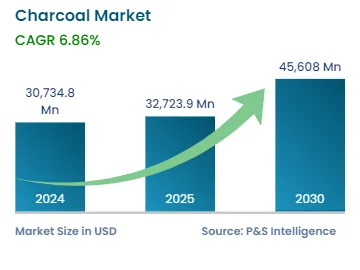
2024 Market SizeUSD 30,734.8 Million
2025 Market SizeUSD 32,723.9 Million
2030 ForecastUSD 45,608.0 Million
Growth Rate(CAGR) 6.86%
Largest RegionMiddle East and Africa
Fastest Growing RegionAsia-Pacific
Nature of the Market Fragmented
Largest Application Category Barbeque

Growth Forecast

Charcoal Market Size

Key Players

Charcoal Market Players

Key Report Highlights

  • Market Size and Forecast
  • Value Chain Analysis
  • Regulatory Landscape
  • Pricing Analysis
  • Companies’ Recent Strategic Developments
  • Key Stakeholders
  • Voice of Industry Experts/KOLs
  • Future Opportunities

Explore the market potential with our data-driven report

Charcoal Market Future Prospects

The global charcoal market stands at USD 30,734.8 million in 2024, and it is expected to reach USD 45,608.0 million by 2030, registering a CAGR of 6.86% during the forecast period (2025–2030). This is increasing due to several factors that have concurrently been moving forward across industries and geographies. The primary reasons are its extensive use as a fuel, particularly in places where there is not enough electricity or cleaner energy options.

Charcoal continues to be the main source of fuel in most developing countries, mainly in Africa and parts of Asia, for cooking and heating in homes. This is because charcoal is relatively cheap and accessible compared to other energy sources. With growth of populations as well as increased rates of urbanization within such regions, demand for charcoal can be presumed to rise and thereby solidify its positions as a major energy source in these regions.

Charcoal has been an input in the smelting processes of all blast furnaces, serving as a reducing agent to iron ore in countries such as Brazil. As carbon-emitting industries become more focused on decreasing their impact, this has placed charcoal in favor. This is because it emits fewer greenhouse gases than fossil fuels, particularly in Latin America, where the production of environmentally friendly steel is on the rise, and sustainable industrial practice is gaining attention.
Charcoal Market Trends and Growth Drivers

Sustainable and Eco-Friendly Charcoal Is Key Trend

  • The rising demand for sustainable and environmentally friendly charcoal products is a significant market trend. As environmental concerns about deforestation and such as emissions are increasing, the call to shift towards sustainably sourced charcoal, such as biochar and charcoal made from waste biomass, becomes common.
  • Consumers and industries increasingly require organisations such as Forest Stewardship Council to certify that charcoal was produced responsibly in an environmentally appropriate way.
  • Biochar, is charcoal used for carbon sequestration and enriching soil. It is gaining mileage as an environmentally friendly product. Biochar improves soil health and is adopted in agriculture for its capacity for retaining water, an enhancement of fertility and reduction in the use of chemical fertilizers.
  • It also absorbs carbon in the soil, thus contributing to global efforts at change through climate and atmospheric effects.
  • In addition, there is increased pressure from regulatory factors of governments, especially those in the EU, which are forcing for greater levels of sustainability compliance.
  • Charcoal producers are now charged with certifications and clean production technologies to disengage with environmental impact and to meet the increasing demand that these markets have, especially the North American and Europe regions.
  • This trend toward sustainability is driven not only by environmental concerns but also by shifting consumer preferences.
  • Many consumers in developed markets are prepared to pay extra for sustainably sourced and environmentally friendly products, such as responsibly managed forests' by-products, for instance, lump charcoal for grilling or barbecuing.

Increasing Use of Charcoal in Recreational Cooking Is Major Driver for Market

  • One of the drivers for the market is the growing demand for barbeque food. This has mainly been characterized by a live cooking setting accompanied well by a vibrant atmosphere, an extensive spread, and great music.
  • In barbeque restaurants, most of the available food involves slow-cooked pork shoulders, briskets, chicken thighs, and spare ribs.
  • In addition, the number of such restaurants is growing rapidly in the emerging economies such as India and China, mainly because of the ever-increasing demand for barbequed food.
  • Barbeque is a culture of food with history that dates it a century back in developed countries such as the U.S. and Germany but currently, over the past few years, the culture has spread worldwide.
  • According to the most recent survey conducted by the Hearth, Patio & Barbeque Association (HPBA) in 2023, 80% of all homeowners and 70% of all households in the U.S. own at least a grill or smoker, matching the highest percentage in the study’s history, up from 64% household ownership in 2019. In Canada, 70% of the households own a grill.
  • Moreover, 12% of grillers reported cooking during brunch, and 7% even grill breakfast.
  • In addition to traditional summer holidays, grilling on occasions such as Thanksgiving, Christmas, and even the Super Bowl has become increasingly popular.
  • The growing consciousness about healthy living and changing consumption habits of people by taking more grilled and barbequed food are contributing to its increased demand as a fuel for cooking.
  • Grilled food is relatively fat-free because any excess oil falling into the grates gets drained while it is being grilled.
  • In addition, grilled food retains much of its nutritional content since most of the moisture is retained and fewer amounts of oil or butter are used in its preparation process.
  • Thus, growing health awareness and changing food habits, coupled with ever-increasing practice of private parties in the outdoors is giving a boost to the popularity of barbequed food. This further contributes to increased demand for charcoal around the globe.
  • Moreover, growing consumption of meat in various regions of the world is driving growth in the market.

Environmental Regulations with Respect to Deforestation Is Major Challenge for Market

  • Charcoal production is often perceived to have a destructive environmental and ecological impact. One of the most cited effects is the clearance of woodlands or forests, i.e. deforestation.
  • Developing countries adopt unsustainable methods of producing charcoal for their energy sources, as sustainable ones such as using metal kilns which are quite expensive.
  • The majority of the unsustainable charcoal production arises from the cutting down of the forest trees.
  • There are two methods to produce charcoal, that is, pit kilns and earth mound kilns. Pit kiln involves piling wood inside a hole excavated from the ground, covering them with soil, and then burning it. Earth mound kiln method involves the stockpiling of wood on the ground, which is covered with soil and then burned.
  • The drawback of these practices is that they fail to produce the maximum quantity of charcoal, and hence, cause more wood wastage than required to produce a given amount of charcoal.

Charcoal Market Analysis

By Type

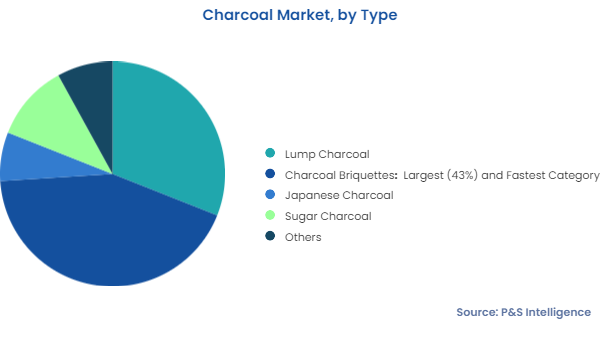
  • Charcoal briquettes hold largest market share, of 43%, in 2024 and will grow at a CAGR of 7.42% in the forecast period. This is due to their uniform quality, easy handling, and relatively high availability.
  • These are different from lump charcoal, which is obtained directly from wood by burning in a low-oxygen environment.
  • Instead, charcoal briquettes are obtained from a mixture of wood by-products and binders with additives to form uniform blocks.
  • This uniformity gives them an edge over the others, that is, they burn steadily and provide a more consistent form of heat, highly in demand for applications such as grilling and barbecuing by both commercial and household markets.
  • It gives the briquettes an edge as they burn steadily and result in a flow of consistent heat, which is ideal in commercial and domestic applications, for example, grilling and barbeque.

Charcoal Market Segments

The types analyzed in this report are:

  • Lump Charcoal
  • Charcoal Briquettes (Largest and Fastest-Growing Category)
  • Japanese Charcoal
  • Sugar Charcoal
  • Others

By Application

  • The barbeque category dominates the market and will grow at a CAGR of 8.06% in the forecast period.
  • Charcoal is widely utilized for cooking food in barbeques to enhance the flavor of the food.
  • It is also ideal for use when the food needs to be cooked on high heat, as it can reach a temperature of 260–370 °C.
  • Besides, charcoal barbeques are generally light in weight—a factor that increases their prospects for portability and further contributes to their popularity among the users.
  • Barbecuing has become an important part of most recreations and ceremonies among social life.
  • The demand for charcoal is relatively stable during summer in the form of two most important products: briquettes and lump charcoal, perceived as an ideal fuel for grilling.

The applications analyzed in this report are:

  • Metallurgical Fuel
  • Barbeque (Largest and Fastest-Growing Category)
  • Industrial
  • Filtration
  • Others

Drive strategic growth with comprehensive market analysis

Regional Analysis

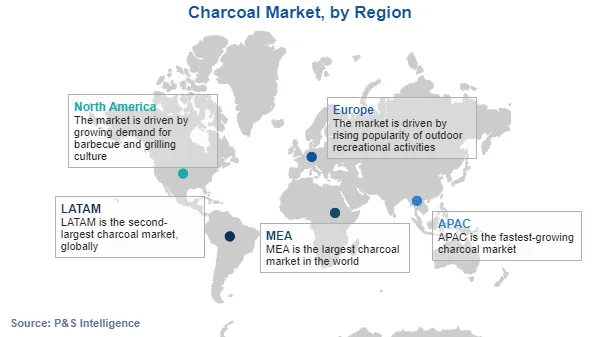
  • The MEA region dominates the global charcoal market with a share of 58% in 2024.
  • This primarily is attributed to the escalating demand for charcoal in barbeque applications and an increasing rate of urbanization within this region.
  • The demand for charcoal in Africa is mainly confined to middle-income households, and Middle East observes high volume consumption of charcoal in both barbeque and shisha applications.
  • In addition, charcoal serves as the main fuel source for power generation in the MEA region.
  • The United Nations Environment Programme claims that in Africa, almost 40% of all energy is generated from fuelwood and charcoal.
  • The market for charcoal in the APAC region will likely grow at the highest CAGR, of 9.31% over the forecast period.
  • Growth in the market can be primarily attributed to the increasing popularity of activated charcoal for water purification, increased silicon productions, and the growing number of barbeque restaurants in the APAC region.
  • Consumers are always in search of some novel food concept and hence get drawn towards barbeque restaurants which offer a lively atmosphere with live cooking, good music, and great food.
  • Competition in barbeque restaurants is expected to increase in the APAC region where, according to industry analysts, barbequed food is gaining momentum.
  • Charcoal also is increasingly used in traditional medicine practices. Activated charcoal has been in use for quite a long time as a detoxifying agent in traditional Asian medicine.
  • It can easily be found in natural remedies as applied in digestive health, skin care, and oral care in such countries as India, China, and Thailand.
  • The growth of demand for organic and natural health products in the APAC markets, with customers in the region increasingly being conscious of holistic wellbeing, has driven the use of activated charcoal in healthcare and personal care products.

Charcoal Market Regional Analysis

The regions and countries analyzed in this report are:

  • North America
    • U.S. (Larger Country Market)
    • Canada (Faster-Growing Country Market)
  • Europe
    • Germany (Largest Country Market)
    • U.K. (Fastest-Growing Country Market)
    • France
    • Italy
    • Rest of Europe
  • Asia-Pacific (APAC) (Fastest-Growing Regional Market)
    • China (Largest Country Market)
    • India
    • Japan
    • Thailand
    • Australia (Fastest-Growing Country Market)
    • Rest of APAC
  • Latin America (LATAM)
    • Brazil (Largest and Fastest-Growing Country Market)
    • Mexico
    • Rest of LATAM
  • Middle East and Africa (MEA) (Largest Regional Market)
    • South Africa (Largest and Fastest-Growing Country Market)
    • Saudi Arabia
    • Tanzania
    • Kenya
    • Rest of MEA

Charcoal Market Share

The charcoal market is fragmented in nature because it comprises a large number of producers, such as small local manufacturers and big industrial players, and enormous variance in production methods, quality, and distribution channels and exists. Regional differences regarding demand, sourcing, and environment regulation add up to further this fragmentation. Informal markets prevail in most regions, and there is, in general, a lack of consolidation within the industry as well.

Major Charcoal Providers:

  • Royal Oak Enterprises LLC
  • Maurobera SA
  • Gryfskand sp z o.o.
  • Sagar Charcoal and Firewood Depot
  • Parker Charcoal Company
  • NAMCHAR (Pty.) Ltd.
  • Timber Charcoal Company LLC
  • Bricapar S.A.
  • Duraflame Inc.
  • Kingsford Products Company LLC
  • E & C Charcoal (Pty) Ltd.
  • Umlilo Charcoal Products (Pty) Ltd.

Frequently Asked Questions About This Report

What will be the size of the charcoal market in 2030?+

By 2030, the market for charcoal will generate USD 45,608.0 million.

What are the regional insights of the charcoal industry?+

MEA is the largest region in the charcoal industry.

What is the most-popular type in the charcoal market?+

In the charcoal market, charcoal briquettes generate the highest revenue.

What is the market nature of charcoal?+

Charcoal market is fragmented in nature.

Why is the charcoal market growing?+

The market for charcoal is driven by increasing use of charcoal in recreational cooking.

Market Scope

  • Charcoal Market Size
  • Charcoal Market Share
  • Charcoal Market Trends
  • Charcoal Market Analysis

Want a report tailored exactly to your business need?

Request Customization

Empowering Leaders Across the Globe

Leading companies across industries trust us to deliver data-driven insights and innovative solutions for their most critical decisions. From data-driven strategies to actionable insights, we empower the decision-makers who shape industries and define the future. From Fortune 500 companies to innovative startups, we are proud to partner with organisations that drive progress in their industries.

Client Partners
Client Partners
Testimonials
Client Testimonials

Working with P&S Intelligence and their team was an absolute pleasure – their awareness of timelines and commitment to value greatly contributed to our project's success. Eagerly anticipating future collaborations.

McKinsey & Company

India
Unmatched Standards
Unmatched Standards

Our insights into the minutest levels of the markets, including the latest trends and competitive landscape, give you all the answers you need to take your business to new heights

Data Security
Complete Data Security

We take a cautious approach to protecting your personal and confidential information. Trust is the strongest bond that connects us and our clients, and trust we build by complying with all international and domestic data protection and privacy laws

  • Request Customization
  • Request Free Sample
close

Customize the Report to Align with Your Business Objectives

*
*
*
loader
close

Request the Free Sample Pages

*
*
*
loader
Connect with us
Quick Links
  • Research Methodology
  • Career
  • Media Citations
  • FAQs
  • Events and Conferences
Find Help
  • How to Order
  • Privacy Policy
  • Terms & Conditions
  • Sitemap
24/7 Customer Support
  • India: +91 93541 34657
  • For business enquiries - [email protected]
  • For career enquiries - [email protected]
  • Dun-Verified
  • Paypal-Secure

©2026 P&S Intelligence. All Rights Reserved.

We use cookies to enhance your experience. By continuing to use this site you consent to our use of cookies. Privacy Policy