This Report Provides In-Depth Analysis of the Cable Blowing Equipment Market Report Prepared by P&S Intelligence, Segmented by Power Type (Hydraulically Powered, Pneumatically Powered, Electrically Driven, Drill-Driven), Cable Type (Microduct, Normal Duct), and Geographical Outlook for the Period of 2019 to 2032
Explore the market potential with our data-driven report
Cable Blowing Equipment Market Future Outlook
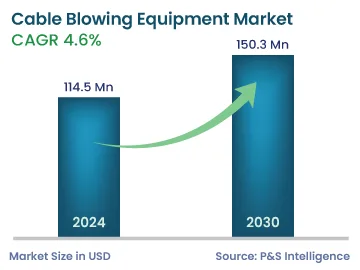
The cable blowing equipment market size will be an estimated USD 120.5 million for 2025, and it will grow by 4.7% during 2026–2032, to reach USD 165.9 million by 2032.
The growth is primarily driven by the accelerating deployment of fiber-optic networks worldwide, increasing government investments in broadband infrastructure, and the rapid expansion of 5G telecommunications networks that require extensive fiber optic connectivity. The market's robust expansion is fundamentally linked to the global telecommunications infrastructure transformation, where fiber optic cable deployment has become imperative for supporting high-speed data transmission requirements.
Moreover, the proliferation of smart city initiatives and Internet of Things applications has created unprecedented demand for reliable, high-speed connectivity infrastructure, positioning cable blowing equipment as a critical enabler in modern telecommunications deployment. Furthermore, the transition from traditional copper-based networks to fiber optic infrastructure represents a massive undertaking that requires specialized installation equipment. Cable blowing machines offer significant advantages over conventional pulling methods, including reduced installation time, lower labor costs, and minimal cable stress during deployment.
These benefits have made cable blowing equipment indispensable for telecommunications operators and contractors seeking to accelerate fiber optic network rollouts while maintaining installation quality and efficiency. The increasing complexity of urban environments and the need to install cables in existing duct systems without disruption have further amplified the importance of advanced cable blowing technologies in meeting contemporary connectivity demands.
Cable Blowing Equipment Market Trends & Drivers
Technological Advancements in Optical Fiber Are Key Trends
One of the advancements is the development of 10 Gigabit Symmetrical Passive Optical Network technology, which has become the standard for meeting the multi-gigabit bandwidth demands of residential and businesses.
Presently, the Gigabit Passive Optical Network is the standard, which is being used by internet service providers.
It is capable of providing network access at a speed of up to 2.4 Gbps downstream and 1.2 Gbps upstream, while XGS-PON can provide over 4x downstream and 8x upstream bandwidth to users.
These advancements will help all users, including online, for streaming higher-resolution content on multiple devices.
These technologies require high-quality fiber cables to run and in return drive the cable blowing equipment market.
Recent technological advancements in optical fiber are shaping the cable blowing equipment market.
Additionally, trends such as automation in cable installation, support for high fiber-count and microcable solutions, and energy-efficient equipment design are further influencing the market.
Modern cable blowing equipment now often incorporates smart sensors and automated controls, allowing precise and faster installation while minimizing operational costs and environmental impact.
Expansion of Broadband, 5G, and Data Center Infrastructure Is Biggest Driver
The rapid increase in government investments for broadband infrastructure and 5G network deployment is a major cable blowing equipment market driver.
As per studies, the worldwide spending on 5G services will reach USD 782.2 billion by 2030.
The BIL included USD 65 billion to connect everyone in America to reliable, affordable high-speed Internet service while providing connected devices and digital skills training to those who need it.
This massive investment has created substantial opportunities for cable blowing equipment manufacturers and service providers as telecommunications companies accelerate their fiber optic deployment schedules.
The scale of infrastructure investment extends beyond the United States, with governments worldwide recognizing broadband connectivity as essential infrastructure.
The BEAD Program provides USD 42.45 billion to states, territories, D.C., and Puerto Rico for projects that support broadband infrastructure deployment and adoption.
These initiatives prioritize fiber optic technology as the preferred medium for future-proof connectivity, directly translating into increased demand for efficient cable installation equipment.
Additionally, the focus on rural and underserved area connectivity has created new market opportunities for cable blowing equipment.
The Tribal Broadband Connectivity Program of the NTIA was implemented under the Consolidated Appropriations Act, 2021.
The TBCP directs funding to tribal governments to be used for broadband deployment on tribal lands.
The challenging terrain and extended distances typical of rural deployments make cable blowing equipment particularly valuable, as it enables faster installation with fewer personnel compared to traditional methods.
The plans for 5G have as many as 60 small cells covering just one square mile.
This dramatic increase in network density necessitates extensive fiber optic infrastructure to connect these small cells, creating unprecedented demand for efficient cable installation solutions.
The symbiotic relationship between 5G deployment and fiber infrastructure cannot be overstated.
MNOs connecting 3G and 4G cells, small and macro, via fiber are also laying the foundation for 5G, which has maximum theoretical download speeds from 1 Gbps for high mobility users (e.g., bullet train commuters) to 10 Gbps for low mobility users.
Cable blowing equipment enables telecommunications operators to rapidly deploy the fiber backhaul networks essential for 5G functionality while minimizing installation costs and time.
Simultaneously, the explosive growth in data center construction has created another significant demand driver.
The global data center capacity is around 59,600 MW in 2025, and it is projected to reach approximately 93,900 MW by 2030.
Studies predict that USD 622.4 billion will be spent on procuring the necessary IT and support components for data centers, globally, by 2030.
In 2025, hyperscalers move from planning and design phases to implementation phases as they activate and build upon the back-end network infrastructure needed to support AI.
These facilities require massive fiber optic connectivity, both for internal connections and external network links, driving demand for advanced cable blowing equipment capable of handling high-fiber-count cables efficiently.
The pneumatically powered category holds the largest market share, of around 45%, in 2025, because it is cost-effective. Moreover, it uses high-pressurized air to blow the air into HDPE pipes, which is a more efficient way as compared to using other types of machines. Additionally, these machines are many used to blow fiber optic cables, multipair cables, and tiny coaxial cables, which are being used in many applications like high-speed internet connections and data centers. Due to these factors, the demand for pneumatically-powered cable-blowing machines is high and increasing.
The electrically driven category will have the highest CAGR, driven by technological advancements and operational advantages offered by electric systems. Additionally, electric motor cable blowing is expected to grow at a progressive pace due to its easy portability and better fit for the conduits, such as ducts and small areas. The development of more powerful and efficient electric motors has enabled these systems to match the performance of traditional hydraulic and pneumatic alternatives while offering superior energy efficiency and reduced operational noise. Furthermore, the integration of smart controls and variable speed drives in electric cable blowing equipment has enhanced installation precision and reduced the risk of cable damage during deployment.
The power types analyzed in this report are:
Hydraulically Powered
Pneumatically Powered (Largest Category)
Electrically Driven (Fastest-Growing Category)
Drill-Driven
Cable Type Analysis
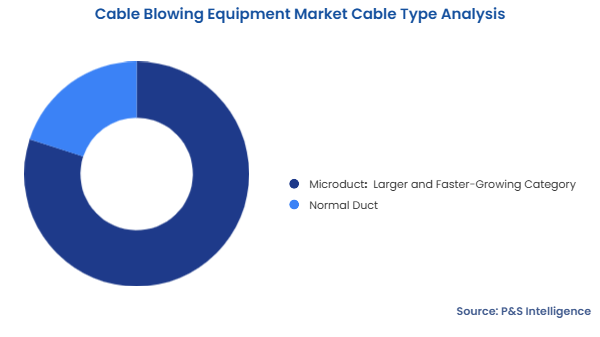
The microduct category holds the larger market share in 2025, and it will have the higher CAGR, driven by the increasing adoption of micro-duct systems in fiber-to-the-home (FTTH) deployments and 5G network infrastructure. This also due to its adaptability and efficiency. Microduct systems are designed to accommodate the increasing demand for high-capacity data transmission and telecommunication networks. The smaller diameter and flexible nature of micro-ducts enable more efficient use of existing duct space, allowing network operators to maximize their infrastructure investments while minimizing installation disruption.
The cable types analyzed in this report are:
Microduct (Larger and Faster-Growing Category)
Normal Duct
Drive strategic growth with comprehensive market analysis
Cable Blowing Equipment Market Regional Outlook
Asia-Pacific Cable Blowing Equipment Market Size
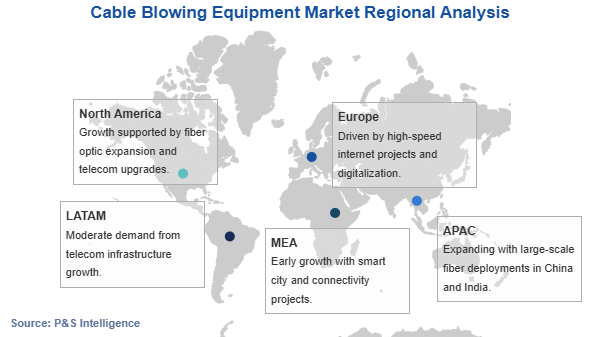
Asia-Pacific has the largest share, and it will have the highest CAGR. This can be ascribed to the various steps being taken for improving internet connectivity and increasing the development of data centers by major countries in the region, especially India and China. Diverse market conditions, from advanced urban centers to remote rural areas, are driving innovation in cable blowing equipment design.
Manufacturers are developing specialized equipment capable of handling the unique challenges presented by densely populated cities with complex underground infrastructure, as well as equipment suitable for long-distance installations in rural areas. Government initiatives such as India's BharatNet project and similar programs across Southeast Asia continue to fuel market growth, creating opportunities for both established players and new entrants in the cable blowing equipment sector.
China Cable Blowing Equipment Market Size
China’s leads the Asia-Pacific cable blowing equipment market as smart city initiatives and large-scale IoT implementations increase the need for real-time data transfer. This explosive growth in fiber optic infrastructure directly translates to increased demand for cable blowing equipment. Chinese manufacturers have also emerged as significant players in the global market, offering competitively priced equipment that has gained traction in both domestic and international markets.
China is also increasing its investments in high-speed internet and data centers. In 2022, China launched a new project for building a centralized data center system across eight regions in the nation, named the East to West Computing Capacity Diversion Project. This focuses on channeling the increasing demand for computing and data analysis in the country. This type of project will increase the demand for fiber cables and in return boosts the need for cable-blowing equipment. Also, the low production costs of such equipment and the presence of big players are driving the market growth in the country.
Europe Cable Blowing Equipment Market Size
Europe held the second-largest market share, due to the presence of a large number of data centers and the increasing investments in the improvement of telecommunication infrastructure in the region. Additionally, as per an international government organization, 10 out of the top 15 countries with respect to the percentage of fiber broadband subscriptions are from Europe, out of which Spain, Sweden, and Lithuania are some of the top countries with a percentage of around 81%, 79%, and 78%, respectively. Thus, these factors boost the market for cable-blowing equipment.
European telecommunications operators are systematically upgrading their networks to support emerging technologies while adhering to stringent environmental regulations. The implementation of the European Green Deal and associated infrastructure investments has accelerated fiber optic deployment across the region. European cities are at the forefront of smart city implementations, requiring extensive fiber optic networks to support IoT applications, intelligent transportation systems, and energy management platforms. This has created consistent demand for advanced cable blowing equipment capable of installing cables with minimal environmental impact and disruption to existing infrastructure.
North America Cable Blowing Equipment Market Size
The North American market is growing due to the rising number of data centers, the presence of highly advanced, extensive, and efficient technological infrastructure, and technological advancements in the region. In North America, the U.S. holds a major market share. Moreover, the research and development in the region are very strong which led to the development of next-generation data centers that are technologically advanced and efficient in terms of managing information.
In North America, various federal broadband funding grants and programs are being implemented to provide broadband services to underserved and unserved areas. These programs support FTTH deployments like Broadband Equity, Access, and Deployment, with funding of around USD 42.45 billion, which is administered by one of the agencies of the federal government named the National Telecommunications and Information Administration.
Also, the Canadian Radio-television and Telecommunications Commission funds the extension of high-speed broadband connectivity into underserved rural and remote locations of Canada. Thus, these factors drive the regional market. The convergence of 5G deployment, data center expansion, and broadband infrastructure development positions North America as the most dynamic market for cable blowing equipment globally.
U.S. Cable Blowing Equipment Market Size
The U.S. leads in data center construction and expansion, with hyperscale facilities requiring extensive fiber optic infrastructure. The world's largest data center market expanded its inventory by 523 MW year-over-year in Q1 to 3,046.1 MW. This growth in data center capacity directly correlates with increased demand for cable blowing equipment, as these facilities require both internal fiber networks and high-capacity external connections.
The geographical breakdown of the market is as follows:
North America
U.S. (Larger and Faster-Growing Country)
Canada
Europe
Germany (Largest Country)
U.K.
France (Fastest-Growing Country)
Italy
Spain
Rest of Europe
Asia-Pacific (Largest and Fastest-Growing Regional Market)
China (Largest Country)
India (Fastest-Growing Country)
Japan
South Korea
Australia
Rest of APAC
Latin America
Brazil (Largest Country)
Mexico (Fastest-Growing Country)
Rest of LATAM
Middle East and Africa
Saudi Arabia (Largest Country)
South Africa
U.A.E. (Fastest-Growing Country)
Rest of MEA
Cable Blowing Equipment Market Share
The market is fragmented due to the presence of numerous specialized manufacturers alongside larger industrial equipment companies. This competitive landscape has evolved due to the technical expertise required in developing equipment capable of handling diverse cable types and installation conditions. Established players are leveraging their technical expertise and global distribution networks to maintain market position, while new entrants, particularly from Asia-Pacific, are gaining market share through competitive pricing and localized product development.
The fragmented market structure has encouraged innovation, with companies differentiating themselves through specialized features such as enhanced portability, improved cable protection mechanisms, and integrated monitoring systems. Companies are investing heavily in research and development to create equipment capable of handling next-generation high-fiber-count cables and addressing the specific requirements of 5G and data center deployments. Key strategies adopted by the players in the cable blowing equipment market ecosystem to enhance their product portfolios, increase their market share, and expand their presence in the market mainly include new product launches, partnerships and acquisitions.
Key Cable Blowing Equipment Companies:
Plumettaz S.A.
General Machine Products (KT) LLC
LANCIER CABLE GmbH
Jakob Thaler GmbH
Condux International Inc.
Fremco A/S
Stanlay
Upcom Telekomunikasyon
Ningbo Marshine Power Technology Co., Ltd.
Jetting AB
Adishwar Tele-Networks Pvt Ltd
CBS Products (KT) Ltd.
Cable Blowing Equipment Market News
In May 2025, Charter Communications Inc. and Cox Communications Inc. entered into a merger agreement valued at USD 34.5 billion. They aim to significantly expand their presence in the market for cable installation equipment, including cable blowing machines across their combined network footprint.
In June 2024, Nokia Corporation announced the acquisition of Infinera Corporation for USD 2.3 billion, strengthening its position in optical networking and boosting demand for cable blowing equipment to support expanded fiber infrastructure deployments.
In September 2023, Allame Makina ve BiliÅŸim San. Tic. Ltd. Åžti., d.b.a. Skyfibertech, launched an advanced microduct cable blowing machine for precise fiber-optic installations in 5G networks. It features enhanced control over blowing speed and distance for optimal cable handling.
Want a report tailored exactly to your business need?
Leading companies across industries trust us to deliver data-driven insights and innovative solutions for their most critical decisions. From data-driven strategies to actionable insights, we empower the decision-makers who shape industries and define the future. From Fortune 500 companies to innovative startups, we are proud to partner with organisations that drive progress in their industries.
Client Testimonials
Working with P&S Intelligence and their team was an absolute pleasure – their awareness of timelines and commitment to value greatly contributed to our project's success. Eagerly anticipating future collaborations.
McKinsey & Company
India
Unmatched Standards
Our insights into the minutest levels of the markets, including the latest trends and competitive landscape, give you all the answers you need to take your business to new heights
Complete Data Security
We take a cautious approach to protecting your personal and confidential information. Trust is the strongest bond that connects us and our clients, and trust we build by complying with all international and domestic data protection and privacy laws