Bone Densitometer Market Size & Share Analysis - Emerging Trends, Growth Opportunities, Competitive Landscape, and Forecasts (2025 - 2032)
This Report Provides In-Depth Analysis of the Bone Densitometer Market Report Prepared by P&S Intelligence, Segmented by Technology (Axial, Peripheral), Application (Osteoporosis & Osteopenia Diagnosis, Cystic Fibrosis Diagnosis, Chronic Kidney Disease Diagnosis, Body Composition Measurement, Rheumatoid Arthritis Diagnosis), End User (Hospitals & Specialty Clinics, Diagnostic & Imaging Centers), and Geographical Outlook for the Period of 2019 to 2032
Explore the market potential with our data-driven report
Bone Densitometer Market Outlook
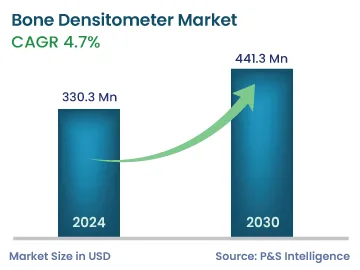
The global bone densitometer market was valued at USD 330.3 million in 2024, and it is projected to grow at a CAGR of 4.7% during 2025–2032, to reach USD 471.5 million by 2032. The market growth if driven by the increasing prevalence of osteoporosis, rising geriatric population, and technological advancements in bone density measurement systems.
The surging elderly population represents a key catalyst for the rising demand for bone densitometer devices globally. According to the World Health Organization, by 2030, 1 in 6 people in the world will be aged 60 years or over, increasing from 1 billion in 2020 to 1.4 billion. This demographic shift significantly increases the at-risk population for osteoporosis and bone-related disorders, as the disease affects one in three women and one in five men over the age of 50 worldwide, according to the International Osteoporosis Foundation.
The pace of population aging is accelerating worldwide, with the number of people aged 60 years and older projected to nearly double from 12% to 22% of the global population between 2015 and 2050 according to the World Health Organization. This demographic transformation is particularly pronounced in developed countries, where Japan already has 30% of its population over 60 years old.
Bone Densitometer Market Emerging Trends
Technological Advancements Are Major Market Trends
The integration of advanced technologies in bone densitometry is revolutionizing diagnostic capabilities. Artificial intelligence and machine learning algorithms are being incorporated into modern bone densitometer systems to improve measurement accuracy and reduce interpretation errors. Digital detector technology has largely replaced traditional film-based X-ray systems, enabling immediate image acquisition, enhanced image quality, and efficient data processing.
The development of portable and wireless bone densitometers is expanding market accessibility, particularly in rural and remote healthcare settings. These technological innovations are making bone density screening more convenient and cost-effective, encouraging early detection and preventive healthcare practices. Additionally, the advancement of dual-energy X-ray absorptiometry technology continues to enhance precision and reduce radiation exposure, making the procedures safer for patients while maintaining diagnostic reliability.
Cloud-based data management systems and telemedicine integration are transforming how bone density results are stored, analyzed, and shared among healthcare providers. These digital solutions enable remote consultation capabilities, allowing specialists to review bone density scans from distant locations and provide expert interpretations to healthcare facilities lacking specialized radiologists. The integration of electronic health records with bone densitometry systems facilitates comprehensive patient data management and longitudinal tracking of bone health progression. Real-time data synchronization ensures that patient information is immediately available across multiple healthcare touchpoints, improving care coordination and treatment continuity.
Automated reporting features powered by artificial intelligence are streamlining clinical workflows and reducing interpretation time for healthcare professionals. Modern bone densitometer systems can generate standardized reports with fracture risk assessments, trend analysis, and treatment recommendations based on established clinical guidelines. These technological enhancements are particularly valuable in busy clinical environments where rapid turnaround times and consistent reporting quality are essential for optimal patient care and treatment decision-making. Machine learning algorithms continuously improve diagnostic accuracy by analyzing vast datasets of bone density measurements and clinical outcomes, enabling more precise risk stratification and personalized treatment recommendations.
Three-dimensional imaging capabilities and advanced reconstruction algorithms are providing unprecedented insights into bone microarchitecture and quality assessment beyond traditional density measurements. High-resolution peripheral quantitative computed tomography and trabecular bone score technologies offer detailed evaluation of bone structure, cortical thickness, and trabecular connectivity, providing clinicians with comprehensive bone health assessments. These advanced imaging modalities enable earlier detection of bone deterioration and more accurate fracture risk prediction, particularly in patients with normal or slightly reduced bone density but compromised bone quality.
The emergence of smartphone applications and wearable devices integrated with bone densitometry systems is creating new opportunities for patient engagement and remote monitoring. Mobile health platforms allow patients to track their bone health metrics, receive medication reminders, and access educational resources about osteoporosis prevention. Wearable sensors can monitor physical activity levels, fall risk, and medication adherence, providing valuable data to complement bone density measurements in comprehensive fracture risk assessment. These digital health solutions are particularly appealing to younger patient populations who prefer technology-enabled healthcare interactions.
Increasing Osteoporosis Incidence Is Boosting Market Growth
The aging process is directly correlated with increased bone fragility and higher susceptibility to osteoporosis. According to the International Osteoporosis Foundation, osteoporosis is estimated to affect 200 million women worldwide, with the prevalence increasing dramatically with age - affecting approximately one-tenth of women aged 60, one-fifth of women aged 70, two-fifths of women aged 80, and two-thirds of women aged 90. The rising life expectancy, which reached 73.3 years globally in 2024, means more individuals are living long enough to develop age-related bone disorders, thereby increasing the demand for bone density assessment and monitoring.\
The growing awareness about early detection and prevention of bone diseases is accelerating market expansion. Osteoporosis causes more than 8.9 million fractures annually worldwide, resulting in an osteoporotic fracture every 3 seconds globally. The integration of artificial intelligence and machine learning algorithms in bone densitometer devices is enhancing diagnostic accuracy and efficiency, creating new growth opportunities in the market. Additionally, the development of portable and point-of-care devices is expanding accessibility to bone density screening in various clinical settings beyond traditional hospitals.
Osteoporosis affects over 200 million people globally, with 1 in 3 women and 1 in 5 men over age 50 experiencing osteoporotic fractures. In the U.S., 10.2 million adults have osteoporosis, and 43.4 million have osteopenia. Europe reports over 3.5 million fractures annually due to osteoporosis. In Asia, where the elderly population is rapidly increasing, fracture incidence is expected to double by 2050. Hip fractures alone cause over 8.9 million fractures annually worldwide. By 2050, more than 50% of all osteoporotic fractures are projected to occur in Asia. The global economic burden exceeds USD 100 billion annually.
High Equipment Costs Are Challenging Market Growth
The substantial capital investment required for bone densitometer equipment represents a significant barrier to market expansion, particularly in developing countries and smaller healthcare facilities. The cost of bone densitometer systems typically ranges from USD 9,180 to USD 199,000, depending on the technology and features, making them financially inaccessible for many healthcare providers with limited budgets. This high-cost structure creates disparities in access to bone health screening services, with many rural and underserved communities lacking adequate diagnostic capabilities.
Small and medium-sized hospitals, private clinics, and community health centers often struggle to justify the substantial capital expenditure required for advanced bone densitometry systems. The return on investment can be challenging to achieve in markets with limited patient volumes or inadequate reimbursement rates for bone density testing. This financial constraint forces many healthcare facilities to rely on older, less accurate equipment or refer patients to larger institutions, creating delays in diagnosis and treatment initiation.
Bone Densitometer Market Segmentation Analysis
Technology Insights
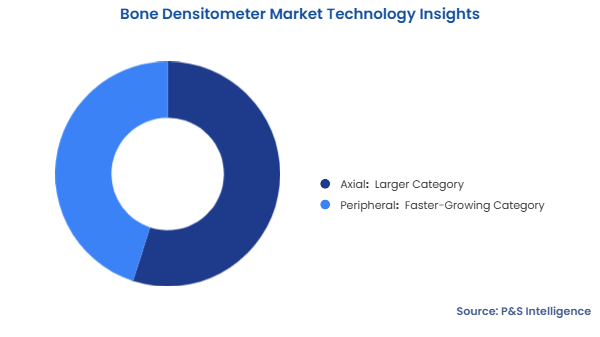
The axial category dominated the market with a 55.0% share in 2024, primarily driven by the widespread adoption of dual-energy X-ray absorptiometry systems. This dominance stems from axial bone densitometers' ability to provide highly accurate measurements of bone density at critical skeletal sites, including the spine and hip, which are most susceptible to fractures. These systems offer superior precision and reliability compared to peripheral devices, making them the preferred choice for osteoporosis diagnosis and monitoring in clinical practice.
The peripheral category is expected to witness the faster growth during the forecast period, with a CAGR of 4.8% from 2025–2032. This growth is attributed to the lower cost, faster scan speed, and enhanced portability of peripheral devices. The smaller size and portability of peripheral densitometers allow for deployment in various healthcare settings beyond traditional hospital environments, including specialty clinics and point-of-care facilities. These devices are particularly valuable for screening programs and initial assessments, offering greater accessibility to bone density testing.
These technology categories are covered:
Axial (Larger Category)
Dual Energy X-Ray Absorptiometry
Quantitative Computed Tomography
Peripheral (Faster-Growing Category)
Single Energy X-Ray Absorptiometry
Peripheral Dual Energy X-Ray Absorptiometry
Radiographic Absorptiometry
Quantitative Ultrasound
Peripheral Quantitative Computed Tomography
Application Analysis
The osteoporosis & osteopenia diagnosis category held the largest market share, of 60.0%, in 2024, reflecting the primary clinical application of bone densitometry. This category's dominance is driven by the critical role of bone density measurement in early detection and management of these prevalent bone disorders. The high burden of osteoporosis globally, affecting over 200 million people worldwide according to epidemiological studies, necessitates regular screening and monitoring, particularly among postmenopausal women and elderly populations.
Body composition measurement represents the fastest-growing category, with a projected CAGR of 4.9% during 2025–2032. This growth is attributed to the increasing awareness about the relationship between body composition and overall health outcomes, particularly in sports medicine, fitness assessment, and metabolic disorder management. Modern bone densitometers equipped with advanced software can provide detailed analysis of lean mass, fat mass, and bone mineral content, making them valuable tools for comprehensive health assessment beyond traditional bone health evaluation.
Body Composition Measurement (Fastest-Growing Category)
Rheumatoid Arthritis Diagnosis
Others
End User Analysis
The hospitals & specialty clinics category dominated the market with a 60.0% share in 2024, driven by their comprehensive infrastructure and advanced diagnostic capabilities. Hospitals possess the financial resources to invest in high-cost DXA scanners and maintain specialized staff for bone density assessments. The presence of multidisciplinary teams, including rheumatologists, endocrinologists, and orthopedic specialists in hospital settings, facilitates integrated patient care and treatment planning based on bone density results.
The diagnostic & imaging centers category is anticipated to witness the fastest growth during the forecast period, driven by the increasing trend toward specialized outpatient services and cost-effective healthcare delivery models. These facilities focus specifically on diagnostic procedures, enabling them to optimize workflows and reduce patient wait times. The growing preference for outpatient diagnostic services, combined with improved reimbursement policies for bone density testing, is supporting the expansion of dedicated imaging centers.
Drive strategic growth with comprehensive market analysis
Bone Densitometer Market Regional Growth Dynamics
North America Bone Densitometer Market Value
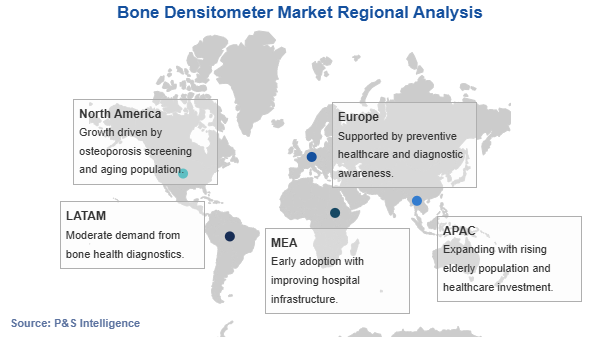
North America maintained its position as the largest regional market with a 45.0% share in 2024, supported by advanced healthcare infrastructure, high osteoporosis prevalence, and favorable reimbursement policies. The region's market leadership is reinforced by the presence of major market players, including Hologic and GE Healthcare, which have established strong distribution networks and continue to invest in research and development activities. According to the International Osteoporosis Foundation, over 2.3 million Canadians aged 40 and above were living with osteoporosis, while in the U.S., one in four men over age 50 is expected to suffer bone fractures due to osteoporosis.
The aging population in North America is driving increased demand for bone density screening and monitoring services. The region benefits from well-established healthcare systems, comprehensive insurance coverage for bone density testing, and widespread awareness about osteoporosis prevention. Government-backed screening programs and clinical guidelines recommending regular bone density assessments for at-risk populations further support market growth in the region.
Asia-Pacific Bone Densitometer Market Forecast
Asia-Pacific is projected to be the fastest-growing regional market with a CAGR of 4.8% during 2025–2032, driven by rapidly aging populations, improving healthcare infrastructure, and increasing healthcare expenditure. The region's demographic transition is particularly pronounced, with countries like China and Japan experiencing significant increases in elderly populations. According to demographic projections, by 2050, two-thirds of the world's population over 60 years will live in low- and middle-income countries, with Asia-Pacific representing a substantial portion.
The rising healthcare awareness and expanding access to diagnostic services in emerging economies are creating new opportunities for bone densitometer adoption. China, India, and South Korea are investing heavily in healthcare infrastructure development and modernization of medical facilities. The increasing prevalence of lifestyle-related risk factors for osteoporosis, including sedentary behavior and dietary changes, is driving demand for bone health assessment in the region.
These regions and countries are covered:
North America (Largest Regional Market)
U.S. (Largest Country Market)
Canada (Fastest-Growing Country Market)
Mexico
Europe
Germany (Largest Country Market)
U.K. (Fastest-Growing Country Market)
France
Italy
Spain
Rest of Europe
Asia-Pacific (Fastest-Growing Regional Market)
China (Largest Country Market)
Japan (Fastest-Growing Country Market)
India
Australia
South Korea
Rest of APAC
Latin America
Brazil (Largest Country Market)
Mexico (Fastest-Growing Country Market)
Rest of LATAM
Middle East and Africa
Saudi Arabia (Largest Country Market)
U.A.E. (Fastest-Growing Country Market)
South Africa
Rest of MEA
Bone Densitometer Market Share
The bone densitometer market exhibits a moderately consolidated structure due to the presence of established global players alongside regional manufacturers. The market is characterized by intense competition among key players who focus on technological innovation, product differentiation, and geographic expansion to maintain their market positions. Major companies have invested significantly in research and development activities to introduce advanced bone densitometry systems with enhanced accuracy, reduced radiation exposure, and improved user experience.
The leading players collectively hold approximately 60.0% of the total market share in 2024, indicating moderate market concentration. Companies such as Hologic and GE Healthcare dominate the market through their comprehensive product portfolios, extensive distribution networks, and strong brand recognition in the medical imaging industry. These companies leverage their expertise in DXA technology and continue to innovate by integrating artificial intelligence and digital solutions into their bone densitometry systems.
Strategic partnerships and collaborations have become increasingly common as companies seek to expand their market reach and technological capabilities. Recent activities include product launches, acquisitions, and geographic expansion initiatives. The competitive landscape is also influenced by the entry of emerging players offering cost-effective solutions, particularly in developing markets where price sensitivity is higher.
Key Bone Densitometer Companies:
GE Healthcare Technologies Inc.
Hologic Inc.
Swissray International Inc.
DMS Imaging
Echolight S.p.a
BeamMed Ltd.
Osteometer Meditech Inc.
Furuno Electric Co., Ltd.
Osteosys Co., Ltd.
Medilink
Scanflex Healthcare AB
Xingaoyi Medical Equipment Co., Ltd.
Bone Densitometer Market News
In July 2025, Medimaps Group S.A. announced the European launch of its MDR-cleared next-generation TBS Osteo Advanced software.
In June 2025, Medimaps Group S.A. announced that it is expanding its operations in the U.S. with the launch of its FDA-cleared next-generation TBS Osteo Advanced software. The software aims to support osteoporosis detection and bone health assessment in the U.S. market.
In October 2023, South Korea-based OsteoSys Corp. developed bone densitometry equipment, including bone mineral density scan machines used for diagnosing osteoporosis and for scanning laboratory animals to support research on body composition.
Want a report tailored exactly to your business need?
Leading companies across industries trust us to deliver data-driven insights and innovative solutions for their most critical decisions. From data-driven strategies to actionable insights, we empower the decision-makers who shape industries and define the future. From Fortune 500 companies to innovative startups, we are proud to partner with organisations that drive progress in their industries.
Client Testimonials
Working with P&S Intelligence and their team was an absolute pleasure – their awareness of timelines and commitment to value greatly contributed to our project's success. Eagerly anticipating future collaborations.
McKinsey & Company
India
Unmatched Standards
Our insights into the minutest levels of the markets, including the latest trends and competitive landscape, give you all the answers you need to take your business to new heights
Complete Data Security
We take a cautious approach to protecting your personal and confidential information. Trust is the strongest bond that connects us and our clients, and trust we build by complying with all international and domestic data protection and privacy laws