This Report Provides In-Depth Analysis of the Blockchain Security Market Report Prepared by P&S Intelligence, Segmented by Component (Solutions, Services), Deployment Mode (Cloud, On-Premises), Organization Size (Large Enterprises, Small and Medium Enterprises), Blockchain Type (Public Blockchain, Hybrid Blockchain, Private Blockchain), Application (Smart Contract Security, Fraud Detection and Prevention, Wallet and Custody Security, Exchange Security, Payment Security, Digital Identity Security), End-User (Banking, Financial Services, and Insurance, Manufacturing, IT and Telecom, Healthcare, Retail and E-commerce, Government), and Geographical Outlook for the Period of 2021 to 2032
Explore the market potential with our data-driven report
Blockchain Security Market Future Outlook
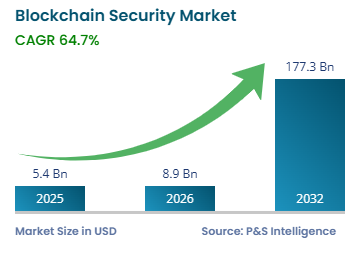
The blockchain security market size was USD 5.4 billion for 2025, and it will grow by 64.7% during 2026-2032, to reach USD 177.3 billion by 2032.
The blockchain security market is expanding as enterprises move payments, digital assets, digital identities, supply-chain records, and smart contracts onto distributed ledger environments. This adoption is moving beyond cryptocurrency platforms into banking, healthcare, logistics, retail, government services, and enterprise data-sharing systems. Blockchain applications now support wallet operations, tokenized assets, automated contract execution, custody workflows, and partner-level transaction validation, which makes security a built-in requirement rather than a later software add-on. Organizations need stronger control over private keys, access permissions, smart contract logic, identity verification, and transaction visibility because blockchain systems often connect multiple users, applications, cloud platforms, and external partners across one shared network.
According to the International Telecommunication Union, 132 countries had implemented a National Cybersecurity Strategy in 2024. This policy focus strengthens demand for blockchain audit, monitoring, key-management, access-control, and threat-detection solutions across regulated and data-sensitive sectors. Enterprises adopting blockchain must align distributed ledger systems with cybersecurity policies, compliance reporting, data protection rules, and operational governance standards. Security vendors benefit because buyers need platforms that can review smart contract code, monitor on-chain activity, protect wallets, manage cryptographic keys, and support secure integration with enterprise applications. The demand is especially strong where blockchain is used for financial transactions, identity systems, supply-chain traceability, and record verification across multi-party business networks.
Key Market Insights
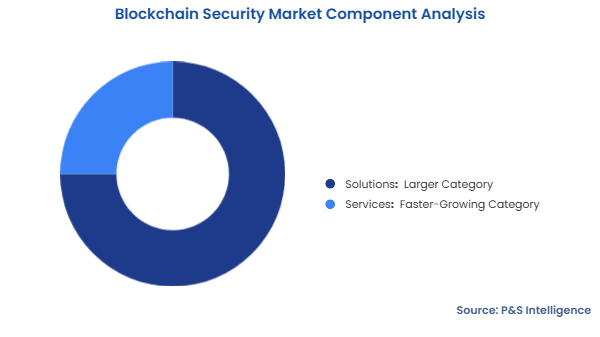
Solutions are the larger category, holding a market share of 75%, due to enterprise demand for integrated blockchain security platforms enabling audit, monitoring and compliance control.
Cloud is the faster-growing category, registering a CAGR of approximately 64.9%, driven by scalable infrastructure enabling real-time monitoring, key management and secure blockchain application deployment.
Smart Contract Security is the largest category, holding a market share of 35%, due to its critical role in securing transactions, assets and core blockchain business logic.
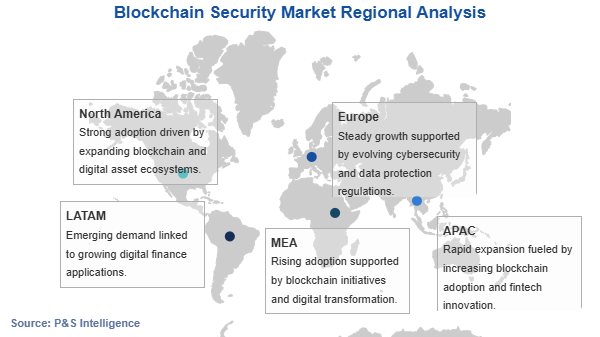
North America holds the largest share of 40%, due to strong regulatory enforcement, advanced enterprise adoption and presence of leading blockchain security providers.
Asia-Pacific is the fastest-growing region, registering a CAGR of approximately 65.6%, driven by expanding digital infrastructure, fintech growth and increasing enterprise blockchain adoption.
Blockchain Security Market Trends and Drivers
Real-Time Smart Contract Monitoring Is a Major Trend
Blockchain security is shifting from one-time smart contract audits toward continuous monitoring of contracts, wallets, exchanges, and decentralized applications. This trend is driven by higher transaction activity, live smart contract execution, and growing use of cloud-based security tools across public and hybrid blockchain environments. Organizations increasingly require continuous visibility into on-chain transactions, contract behavior, wallet activity, identity access, and cross-chain interactions to maintain secure blockchain operations. Additionally, real-time monitoring enables faster validation of contract execution, automated policy enforcement, and continuous security assessment across distributed blockchain ecosystems.
According to Microsoft Corporation, Microsoft blocked 7,000 password attacks per second in 2024. According to International Business Machines Corporation, financial firms using AI and automation saved an average of USD 1.9 million in breach costs in 2024 compared with firms that did not use them. These developments strengthen demand for automated blockchain monitoring, runtime threat detection, identity protection, wallet analytics, AI-enabled security operations, and integrated platforms supporting secure enterprise blockchain environments.
Rising Blockchain Attacks and Asset Theft Drive Market
Rising cryptocurrency fraud and digital asset theft are increasing demand for blockchain security solutions across exchanges, wallets, payment platforms, and decentralized finance applications. Financial institutions, Web3 firms, and digital asset service providers are strengthening smart contract audits, transaction monitoring, identity controls, wallet protection, and blockchain analytics as digital asset ecosystems continue expanding across regulated and consumer-facing markets. Furthermore, organizations are investing in continuous monitoring, compliance automation, secure custody infrastructure, and real-time transaction validation to strengthen operational security throughout blockchain networks.
According to the International Criminal Police Organization, Operation First Light 2024 covered 61 countries, led to 3,950 arrests, and froze 6,745 bank accounts linked to online scam networks in 2024. According to the Federal Bureau of Investigation, Operation Level Up notified 8,103 victims and generated estimated savings of USD 511.5 million in 2025. These enforcement efforts encourage broader investment in fraud analytics, on-chain monitoring, compliance platforms, wallet security, transaction intelligence, and managed blockchain security services across enterprise and financial applications.
High Complexity and Shortage of Skilled Talent Restrain the Market
High technical complexity and integration challenges are restraining the adoption of blockchain security solutions across enterprises. Smart contract security, wallet management, cross-chain infrastructure, key protection, and legacy system integration require specialized technical skills that many organizations cannot build quickly. According to the World Economic Forum, 63% of employers cited the skills gap as the key barrier to business transformation in 2025. This raises demand for advisory, managed security, smart contract review, compliance support, and integration services, especially among SMEs and regulated industries that need secure blockchain deployment across cloud, hybrid, and enterprise technology environments. Poor setup also makes buyers more dependent on expert support.
Expanding enterprise use of blockchain beyond cryptocurrency creates strong opportunities for security solution providers across regulated and data-sensitive industries. Organizations are deploying blockchain in digital identity, supply chains, healthcare records, tokenized assets, and financial workflows, which connects this opportunity with hybrid blockchain, smart contract security, BFSI adoption, and cloud-based platforms. According to the World Bank, people in approximately 45% of countries could obtain at least one government-recognized digital identity credential for remote authentication in 2024. This supports demand for identity protection, access management, transaction security, compliance monitoring, and audit-ready platforms that integrate blockchain security into enterprise systems from the design stage.
Blockchain Security Market Segmentation Analysis
Component Analysis
Solutions are the larger category, holding a market share of 75%, due to strong enterprise demand for integrated platforms that secure blockchain networks, smart contracts, digital identities, wallets, and transactions. Their adoption is closely connected with cloud deployment, large enterprise use, public blockchain activity, and smart contract security needs, as organizations prefer centralized auditing, continuous monitoring, access control, compliance validation, and cryptographic key management in one system. According to the World Intellectual Property Organization, global software spending reached USD 675 billion in 2024. This supports adoption across exchanges, financial institutions, cloud environments, decentralized applications, and enterprise blockchain deployments requiring scalable protection and governance.
Services are the faster-growing category, as organizations increasingly use external expertise for blockchain development, integration, advisory, managed security, support, and post-deployment operations. This category grows alongside SMEs, hybrid blockchain adoption, fraud detection tools, and manufacturing supply chain use cases because many buyers prefer guided implementation with ongoing monitoring and compliance support. Service providers help organizations review smart contracts, integrate wallets, manage key protection, configure access systems, and align blockchain applications with sector-specific requirements. This strengthens demand for consulting, managed security services, incident response, and support across banking, fintech, healthcare, logistics, government, and Web3 application environments.
Cloud is the larger and faster-growing category, holding a market share of 80% and registering a CAGR of approximately 64.9%, because blockchain security platforms are increasingly delivered through scalable, centrally managed, and flexible infrastructure. This deployment mode connects strongly with solutions, SMEs, public blockchain applications, and fraud detection because it supports rapid rollout, automated updates, transaction monitoring, key management, and smart contract protection across distributed users. According to the World Bank, high-income countries accounted for 77% of global colocation data center capacity in 2025. This cloud infrastructure supports wider adoption among financial institutions, exchanges, fintech providers, Web3 developers, and enterprise blockchain users requiring secure and scalable operations.
The deployment modes analysed in this report are:
Cloud (Larger and Faster-Growing Category)
On-Premises
Organisation Size Analysis
Large Enterprises are the larger category, as they manage high-value digital assets, regulated transactions, complex partner networks, and multi-location blockchain deployments. Their demand is connected with solutions, cloud and on-premises systems, hybrid blockchain, smart contract security, and BFSI applications because these organizations require strong identity governance, access policies, monitoring, and compliance validation across internal and external systems. According to the World Economic Forum, 54% of large organizations identified supply chain challenges as the biggest barrier to cyber resilience in 2025. This supports demand for secure integration, transaction visibility, and blockchain security platforms across enterprise and partner networks.
Small and Medium Enterprises are the faster-growing category, due to rising use of crypto services, Web3 applications, digital payments, token-based platforms, and blockchain-enabled customer solutions. Their demand connects closely with cloud deployment, services, wallet security, fraud detection, and public blockchain applications because SMEs prefer flexible tools, external audits, and managed support that can be implemented without large internal teams. Cloud-based solutions and advisory services help these firms secure transactions, review smart contracts, manage keys, and meet compliance needs while expanding digital services. This makes SMEs an important growth base for scalable blockchain security solutions and managed services.
The organization sizes analysed in this report are:
Large Enterprises (Larger Category)
Small and Medium Enterprises (SMEs) (Faster-Growing Category)
Blockchain Type Analysis
Public Blockchain is the largest category, holding a market share of 60%, as open networks support digital asset transactions, decentralized finance, non-fungible tokens, exchanges, wallets, and decentralized applications. Its demand is closely connected with smart contract security, fraud detection, wallet protection, cloud-based monitoring, and SME-led Web3 activity because public networks require continuous transaction visibility and strong user trust. Security providers support these environments through code review, access management, on-chain monitoring, key protection, and compliance tools for platforms handling digital assets. This keeps public blockchain security central to exchanges, fintech applications, developer ecosystems, and consumer-facing blockchain services.
Hybrid Blockchain is the fastest-growing category, registering a CAGR of approximately 65.1%, as enterprises increasingly combine private governance with public blockchain interoperability for secure and efficient information exchange. This category connects strongly with large enterprises, manufacturing, BFSI, government, cloud deployment, and services because organizations use hybrid structures to manage sensitive data while enabling trusted collaboration across partners. According to the United Nations, the proportion of the global population lagging in digital government development decreased from 45.0% in 2022 to 22.4% in 2024. This supports deployment of hybrid environments requiring identity management, controlled data sharing, compliance monitoring, and protected communication across interconnected enterprise networks.
The blockchain types analysed in this report are:
Public Blockchain (Largest Category)
Hybrid Blockchain (Fastest-Growing Category)
Private Blockchain
Application Analysis
Smart Contract Security is the largest category, holding a market share of 35%, because smart contracts manage transactions, digital assets, automated workflows, and core business logic across blockchain systems. Its demand connects with public blockchain, BFSI, exchanges, wallets, cloud platforms, and solution-based security because enterprises and developers need code review, logic validation, access checks, and continuous monitoring before and after deployment. According to the Federal Bureau of Investigation, cryptocurrency investment fraud losses exceeded USD 6.5 billion in 2024. This supports higher demand for auditing, testing, monitoring, and validation solutions across crypto platforms, fintech applications, decentralized applications, and enterprise blockchain systems.
Fraud Detection and Prevention is the fastest-growing category, blockchain use is expanding across wallets, exchanges, bridges, payment platforms, and consumer-facing digital asset applications. This category connects with cloud deployment, public blockchain, SMEs, BFSI, and managed services because buyers need tools that identify unusual transaction patterns, account misuse, identity deception, and key-related activity in near real time. As regulated financial institutions and Web3 platforms increase live blockchain operations, demand is shifting beyond pre-deployment checks toward continuous post-deployment monitoring. This supports faster adoption of analytics, transaction scoring, compliance alerts, and managed detection services.
The applications analysed in this report are:
Smart Contract Security (Largest Category)
Fraud Detection and Prevention (Fastest-Growing Category)
Wallet and Custody Security
Exchange Security
Payment Security
Digital Identity Security
End-User Analysis
Banking, Financial Services, and Insurance is the largest category, holding a market share of 35%, due to extensive blockchain use in payments, settlements, digital assets, tokenization, identity verification, and compliance workflows. Its demand connects with large enterprises, solutions, cloud deployment, smart contract security, public blockchain, and hybrid blockchain because financial institutions need secure transaction processing, auditable records, access control, and customer data protection across regulated systems. Blockchain security platforms help banks, insurers, exchanges, and payment providers manage keys, monitor transactions, validate smart contracts, and maintain compliance reporting. This makes BFSI the main end-use sector for integrated blockchain security adoption.
Manufacturing is the fastest-growing category, registering a CAGR of approximately 65.4%, as companies adopt blockchain for supply chain traceability, supplier validation, product authentication, and record integrity across distributed networks. This category connects strongly with hybrid blockchain, services, large enterprises, cloud deployment, and identity security because manufacturers work with multiple suppliers, logistics partners, and enterprise systems requiring trusted data exchange. According to the United Nations Industrial Development Organization, global manufacturing output expanded by 2.9% in 2024. This supports wider deployment of blockchain-based tracking systems, increasing demand for secure integration, monitoring, validation, and access management across manufacturing supply chains.
The end-users analysed in this report are:
Banking, Financial Services, and Insurance (BFSI) (Largest Category)
Manufacturing (Fastest-Growing Category)
IT and Telecom
Healthcare
Retail and E-commerce
Government
Others
Drive strategic growth with comprehensive market analysis
Blockchain Security Market Regional Outlook
North America Blockchain Security Market Analysis
North America holds the largest share of 40% due to early enterprise blockchain adoption, substantial cybersecurity investments, and the presence of leading technology providers, financial institutions, and digital asset companies. The United States generates significant demand through commercial banks, cryptocurrency exchanges, cloud service providers, software companies, and enterprise blockchain deployments across financial services, healthcare, retail, and government applications. Additionally, organizations increasingly deploy blockchain security platforms to protect digital identities, tokenized assets, decentralized applications, and cross-border transactions. Furthermore, Canada strengthens regional demand through regulated digital asset platforms, expanding fintech ecosystems, public sector blockchain initiatives, and enterprise modernization programs. Similarly, organizations across the region prioritize scalable identity management, cryptographic key protection, blockchain monitoring, compliance automation, and secure infrastructure integration. Moreover, strong technology ecosystems, experienced cybersecurity vendors, and continuous enterprise digital transformation keep North America at the forefront of blockchain security adoption.
U.S. Blockchain Security Market Analysis
The United States leads the blockchain security market because its financial institutions, cloud providers, digital asset custodians, and blockchain software companies are early users of security-led infrastructure. Demand is supported by enterprise adoption of tokenization, smart contract platforms, custody systems, and compliance workflows across capital markets and fintech. According to the United States Securities and Exchange Commission, fiscal year 2024 financial remedies reached USD 8.2 billion, with about 56% attributable to the Terraform Labs and Do Kwon monetary judgment. This keeps audit systems, key management, blockchain monitoring, transaction analytics, and compliance-focused security tools important for regulated digital asset operations.
Canada Blockchain Security Market Analysis
Canada’s blockchain security market is growing as fintech firms, digital asset platforms, payment companies, and enterprise technology buyers place greater focus on secure blockchain integration. Demand is shaped by regulated trading platforms, stablecoin-related policy discussions, custody requirements, and trusted digital transaction systems used across financial and enterprise environments. According to Statistics Canada, business spending on intellectual property products in 2024 was supported by software investment growth of 1.3%. This strengthens the use of secure application integration, blockchain auditing tools, identity controls, transaction validation, and compliance reporting platforms among organizations modernizing digital finance and enterprise workflows.
Asia-Pacific Blockchain Security Market Analysis
Asia-Pacific registers the highest CAGR of approximately 65.6% as blockchain adoption continues to expand across fintech, digital identity, supply chain management, gaming, healthcare, and public digital services. China supports extensive blockchain infrastructure development and enterprise blockchain implementations, while India experiences strong growth in digital payments, cryptocurrency platforms, decentralized finance, and Web3 innovation. Additionally, Japan, South Korea, Singapore, and Australia continue expanding enterprise blockchain projects supported by financial institutions, technology companies, and government-backed digital transformation initiatives. Furthermore, increasing deployment of tokenized assets, digital wallets, smart contracts, and blockchain-based business applications strengthens demand for advanced security platforms. Similarly, expanding startup ecosystems and enterprise innovation accelerate investment in blockchain monitoring, smart contract auditing, identity protection, compliance automation, and managed security services. Moreover, the region's rapidly expanding blockchain ecosystem continues creating significant opportunities for specialized blockchain security providers across multiple industries.
China Blockchain Security Market Analysis
China’s blockchain security demand is supported by state-led blockchain infrastructure, digital renminbi deployment, enterprise data platforms, and regulated financial technology systems. Buyers focus on secure transaction validation, identity management, data governance, and compliance monitoring for large public and private blockchain applications. According to the Government of China, cumulative digital renminbi activity reached 14.2 trillion yuan and 3.32 billion transactions by the end of September 2025. This scale supports demand for secure wallet infrastructure, transaction monitoring, cryptographic controls, compliance architecture, and blockchain security frameworks across government-backed financial systems, retail payment use cases, and enterprise digital platforms.
India Blockchain Security Market Analysis
India’s blockchain security market is expanding as fintech activity, digital payments, Web3 development, and enterprise blockchain pilots grow across financial services and technology sectors. Demand is linked to high-volume digital transactions, wallet-based services, smart contract use, and compliance-led platform development. According to the Press Information Bureau, Unified Payments Interface handled 18.39 billion transactions worth more than INR 24.03 lakh crore in 2025. This digital payment scale supports demand for wallet protection, smart contract auditing, transaction monitoring, identity verification, and scalable blockchain security systems used by exchanges, fintech platforms, developers, and enterprise digital service providers.
Europe Blockchain Security Market Analysis
Europe maintains a strong and stable blockchain security market driven by financial sector modernization, enterprise blockchain adoption, digital identity initiatives, and comprehensive regulatory frameworks supporting secure digital operations. Organizations across the region prioritize blockchain platforms that provide secure transaction processing, identity verification, auditability, data integrity, and compliance management for enterprise applications. Additionally, the United Kingdom, Germany, and France remain leading markets because of active fintech ecosystems, banking digital transformation programs, and expanding enterprise blockchain deployments. Furthermore, manufacturers, healthcare providers, logistics companies, and public sector organizations increasingly integrate blockchain technologies into operational workflows, supporting demand for secure infrastructure and trusted transaction management. Similarly, enterprises emphasize interoperability, governance, cryptographic key management, and blockchain lifecycle management across distributed environments. Moreover, sustained enterprise investment, mature digital infrastructure, and long-term modernization strategies continue supporting steady adoption of blockchain security solutions throughout the European market.
The regions and countries analysed in this report are:
North America (Largest Regional Market)
U.S. (Larger Country)
Canada (Faster-Growing Country)
Europe
Germany (Largest Country)
U.K. (Fastest-Growing Country)
France
Italy
Spain
Rest of Europe
Asia-Pacific (Fastest-Growing Regional Market)
China (Largest Country)
India (Fastest-Growing Country)
Japan
South Korea
Australia
Rest of APAC
Latin America
Brazil (Largest Country)
Mexico (Fastest-Growing Country)
Rest of LATAM
Middle East and Africa
Saudi Arabia (Largest Country)
U.A.E. (Fastest-Growing Country)
South Africa
Rest of MEA
Blockchain Security Market Competitive Landscape
The blockchain security market is fragmented, with cybersecurity vendors, blockchain-native security firms, audit specialists, cloud security providers, and emerging technology companies serving diverse enterprise and Web3 requirements. Customer demand spans smart contract auditing, digital asset custody, wallet protection, identity and access management, compliance platforms, blockchain monitoring, and managed security services, encouraging participation from companies with different technical strengths. Additionally, established providers benefit from enterprise relationships, global service capabilities, and broad technology integration expertise. Furthermore, specialized firms strengthen their market position through advanced blockchain analytics, protocol-specific security solutions, and dedicated Web3 expertise. Similarly, continuous blockchain adoption across financial services, supply chains, healthcare, gaming, and digital identity applications creates opportunities for both established vendors and innovative companies. Moreover, ongoing platform enhancements, expanding enterprise deployments, and evolving security capabilities support active competition across multiple solution and service categories, allowing organizations to address a broad range of blockchain security requirements.
Top Companies in the Blockchain Security Market:
International Business Machines Corporation
Amazon Web Services Incorporated
Microsoft Corporation
Oracle Corporation
Intel Corporation
Accenture Public Limited Company
Deloitte Touche Tohmatsu Limited
Infosys Limited
Thales Group
Infineon Technologies Aktiengesellschaft
Kaspersky Lab
Kudelski Group
Chainalysis Incorporated
CertiK Global Limited
ConsenSys Software Incorporated
TRM Labs
Blockchain Security Market News
In March 2026, TRM Labs, Inc. launched Co-Case Agent, an AI assistant available within its TRM Forensics platform. The tool converts investigator prompts into actionable steps such as fund tracing, graph analysis, and recommended next actions, enhancing blockchain intelligence workflows.
In November 2025, Chainalysis Inc. launched Hexagate Ltd.’s Wallet Compromise Detection Kit, a behaviour-based security solution designed to detect wallet-level takeovers. The kit monitors wallet activity, applies machine learning–driven anomaly detection, and performs pre-signing transaction simulations to prevent malicious transactions. It is designed for exchanges, asset managers, and security teams to identify and respond to suspicious wallet activity before funds are moved.
Frequently Asked Questions About This Report
What security risks do blockchain applications commonly face during deployment?+
How do smart contract audits improve blockchain application security before launch?+
Smart contract audits review code for logic flaws, access issues, reentrancy risks, and transaction errors before attackers can exploit deployed blockchain applications.
Why is private key management important for blockchain security in enterprises?+
Private keys control blockchain transactions and asset access, so weak storage, sharing, or recovery practices can expose organizations to irreversible losses.
What is a fifty-one percent attack in blockchain networks?+
A fifty-one percent attack occurs when attackers control most network validation power, allowing transaction manipulation, double spending, or disruption of blockchain trust.
How can blockchain security protect decentralized finance platforms from attacks?+
Leading companies across industries trust us to deliver data-driven insights and innovative solutions for their most critical decisions. From data-driven strategies to actionable insights, we empower the decision-makers who shape industries and define the future. From Fortune 500 companies to innovative startups, we are proud to partner with organisations that drive progress in their industries.
Client Testimonials
Working with P&S Intelligence and their team was an absolute pleasure – their awareness of timelines and commitment to value greatly contributed to our project's success. Eagerly anticipating future collaborations.
McKinsey & Company
India
Unmatched Standards
Our insights into the minutest levels of the markets, including the latest trends and competitive landscape, give you all the answers you need to take your business to new heights
Complete Data Security
We take a cautious approach to protecting your personal and confidential information. Trust is the strongest bond that connects us and our clients, and trust we build by complying with all international and domestic data protection and privacy laws