This Report Provides In-Depth Analysis of the Biologics Safety Testing Market Report Prepared by P&S Intelligence, Segmented by Offerings (Instruments, Consumables, Services), Application (Vaccines, Cellular & Gene Theraphy, Blood & Blood-Based Products, Monoclonal Antibodies), Test Types (Sterility, Endotoxin, Bioburden, Mycoplasma, Virus Safety, Residual Host Cell Protein & DNA Detection), End Users (CDMOs, Biopharmaceutical Companies, CROs), and Geographical Outlook for the Period of 2019 to 2032
Explore the market potential with our data-driven report
Biologics Safety Testing Market Outlook
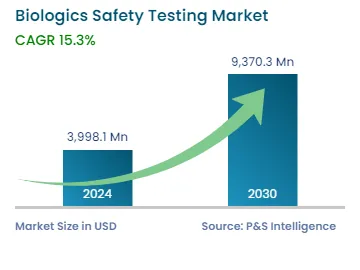
The biologics safety testing market size was USD 4.0 billion in 2024, and it will grow by 15.3% during 2025–2032, to reach USD 12.4 billion by 2032.
The market expansion is primarily driven by the increasing development of complex biologics, stringent regulatory requirements for product safety, and the growing adoption of monoclonal antibodies and cell & gene therapies across the healthcare sector.
The rising prevalence of chronic diseases and the subsequent surge in biopharmaceutical production have created unprecedented demand for comprehensive safety testing services. According to the World Health Organization, over 17.9 million people die of heart diseases each year, making it the leading cause of death globally. This disease burden has accelerated the development of innovative biologics, particularly monoclonal antibodies and gene therapies, which require rigorous safety testing protocols. The biologics safety testing industry has also witnessed significant technological advancements, with the integration of automation, artificial intelligence, and rapid microbiological methods enhancing testing efficiency and accuracy.
The substantial growth in contract development and manufacturing organizations has further propelled market expansion. These organizations are increasingly investing in state-of-the-art testing facilities and expanding their service portfolios to meet the evolving needs of biopharmaceutical companies. The COVID-19 pandemic has particularly highlighted the critical importance of biologics safety testing, as the rapid development and deployment of vaccines necessitated accelerated yet thorough safety assessments, establishing new benchmarks for the industry.
Biologics Safety Testing Market Trends and Growth Drivers
Technological Advancements to Transform Testing Capabilities Are Key Trend
The integration of cutting-edge technologies for enhancing both efficiency and accuracy is a key trend transforming the biologics safety testing landscape.
Automation and robotics have streamlined testing processes, reducing human error and increasing throughput capacity.
Next-generation sequencing is a powerful tool for detecting and identifying contaminants with unprecedented sensitivity.
Digital PCR and real-time PCR methods provide rapid and accurate quantification of nucleic acids, essential for residual DNA testing and virus detection.
The adoption of rapid microbiological testing methods has significantly reduced testing timelines, enabling faster product release and improved manufacturing efficiency.
Artificial intelligence and machine learning algorithms are being integrated into data analysis workflows, enabling pattern recognition and predictive analytics that enhance quality control processes.
Laboratory information management systems have also evolved to provide comprehensive data integration and traceability, ensuring regulatory compliance and facilitating audit processes.
These technologies facilitate the identification of potential contamination sources and enable proactive risk management strategies.
The continuous evolution of testing technologies has enabled the industry to keep pace with the increasing complexity of biologics, particularly in the cell and gene therapy, where traditional testing methods may be insufficient.
Investments in cutting-edge techniques, such as automated endotoxin detection and quick mycoplasma tests, are common among CROs.
With this, life sciences firms can significantly decrease their operational costs, thereby increasing their R&D budgets.
The implementation of stringent guidelines on biologics testing to identify, detect, and remove any sort of contaminant from these agents is propelling the growth of the biologics safety testing market.
The updated ICH Q5A(R2) guidelines support the use of next-generation sequencing and advanced analytics in viral safety testing of biologics.
WuXi Biologics has integrated NGS into its viral testing workflow to boost accuracy and minimize testing time.
ATP bioluminescence-based sterility tests reduce testing time and enhance release efficiency.
Stringent Regulatory Requirements Are Biggest Drivers
Regulatory authorities worldwide have implemented increasingly rigorous safety standards for biologics, creating a robust framework that mandates comprehensive testing throughout the product lifecycle.
The U.S. Food and Drug Administration, European Medicines Agency, and other regulatory bodies enforce strict guidelines that require extensive safety assessments before product approval and during commercial manufacturing.
The FDA’s 21 CFR Parts 600–680 outline comprehensive guidelines for biologics, including sterility testing, contaminant limits, and procedures to ensure safety, purity, and potency.
These regulatory requirements encompass multiple testing parameters, including sterility testing to ensure products are free from viable microorganisms, endotoxin testing to detect bacterial endotoxins that could cause adverse reactions, bioburden testing to quantify microbial contamination levels, mycoplasma testing to identify contamination from these specialized bacteria, and virus safety testing to ensure the absence of adventitious viruses.
The complexity of regulatory compliance has led many biopharmaceutical companies to outsource safety testing to specialized service providers who possess the expertise and infrastructure to meet these stringent requirements.
This trend has significantly contributed to the growth of the biologics safety testing services market, as companies seek to ensure compliance while focusing on their core competencies in drug development.
In addition, the rising public awareness of drug safety has led to the implementation of safety rules by regulatory authorities.
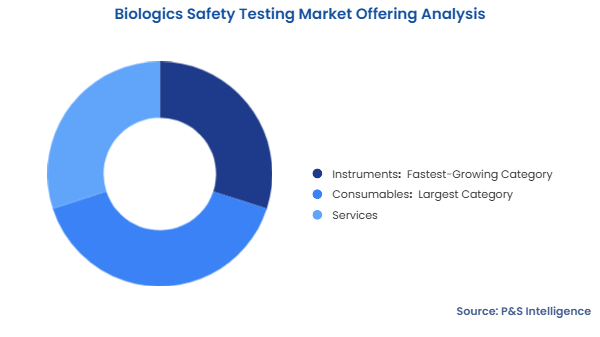
The consumables category held the largest market share, of 40%, in 2024. This is ascribed to the significant usage of consumables for the detection and identification of contaminants in biologics. Consumables consist of kits, reagents, and other products that are widely used in clinical laboratories and research centres. Reagents include biological buffers and dissociation reagents. As per the current market scenario, the advancements in the formulation of such agents are set to fuel their adoption significantly. Similarly, kits are in high demand due to their long shelf life and ease of use.
The instruments category will have the highest CAGR, of 15.4%. This is attributable to the implementation of strict guidelines for ensuring the safety of therapeutics and the growing need to perform safety tests due to this. The rising utilization of advanced analytics technologies, such as PCR, ELISA, and NGS, is enhancing the accuracy and speed of biologics safety testing.
The offerings analysed in this report are:
Instruments (Fastest-Growing Category)
Consumables (Largest Category)
Services
Applications Analysis
The vaccines category held the largest market share, of 40%, in 2024. This is attributable to a surge in the incidence of several diseases over the years. Many chronic ailments, including diabetes and cancer, and infectious diseases, including influenza and measles, require the administration of vaccines for their treatment, management, or prevention. Additionally, several guidelines have been laid out by government agencies to ensure the safety and efficacy of vaccines, as they are given to a large number of individuals and administered directly into the bloodstream; therefore, ensuring their sterility is imperative Guidelines for the same issued by the Food and Drug Administration (FDA) govern the characterization and qualification of the components utilized for the manufacturing of vaccines. Major sources suggest that approximately 5 to 7 billion vaccine doses are administered globally each year.
The cellular & gene therapy category will have the highest CAGR, of 15.6%. This is attributable to the growing research, coupled with the advancements in cellular and gene therapies. Moreover, there are many contaminants that can be found in CGTs, such as cytokines, pyrogens, dead cells, endotoxins, mycoplasma, and sera. Such contaminants, if not detected and eliminated, can deteriorate the quality of the CGT, increasing the overall cost of the manufacturing process and posing a danger to patients. Each cell and gene therapy product requires extensive safety assessments, including viral clearance studies, genetic stability testing, and comprehensive characterization to ensure patient safety. As per forecasts, biopharmaceutical companies could spend up to USD 20.2 billion on cell & gene therapy manufacturing services by 2030.
The bioburden category held the largest market share, of 30%, in 2024, because public agencies, including the WHO, have released several guidelines for maintaining the sterility of drugs, which are applicable to a broad range of biologics, such as cell, tissue, and blood products and vaccines. Such guidelines are released to ensure that the product is free from any type of contaminant and meets the safety requirements. Essentially, the rising burden of diseases has led to the increasing demand for biologic products. All such factors have led to an increasing demand for sterilization, thereby propelling the adoption of bioburden tests for a broad range of biopharmaceuticals as well as medical devices.
Additionally, the rapidly growing pace of advancements in novel bioburden testing technologies is expected to fuel the growth of the market. Moreover, this test has a wide range of applications in detecting the effectiveness of cleaning procedures, validation of sterilization procedures, and surveillance of components, raw materials, and manufacturing procedures.
The endotoxin category will have the highest CAGR, of 15.7%. This can be ascribed to the increasing utilization of this test during the production of therapeutics in order to reduce the burden of endotoxins. Several types of endotoxin tests, such as kinetic turbidimetric bacterial endotoxin test, kinetic chromogenic test, and gel-clot test, are utilized to meet the requirement.
The test types analysed in this report are:
Sterility
Endotoxin (Fastest-Growing Category)
Bioburden (Largest Category)
Mycoplasma
Virus Safety
Residual Host Cell Protein & DNA Detection
End User Analysis
The biopharmaceutical companies category held the largest market share, of 45%, in 2024, because these companies develop and manufacture the majority of biological products. Large pharmaceutical companies maintain extensive in-house testing capabilities while also utilizing external services for specialized tests or capacity overflow.
The CDMOs category will have the highest CAGR, of 15.9%, due to the burgeoning trend of outsourcing manufacturing activities, along with the growing number of small and virtual biotechnology companies. CDMOs are expanding their safety testing capabilities to offer integrated development and manufacturing services, positioning themselves as one-stop solutions for biologics development. As per reports, biologics CDMOs could make USD 31.8 billion by 2030.
The end users analysed in this report are:
CDMOs (Fastest-Growing Category)
Biopharmaceutical Companies (Largest Category)
CROs
Drive strategic growth with comprehensive market analysis
North America Biologics Safety Testing Market Size
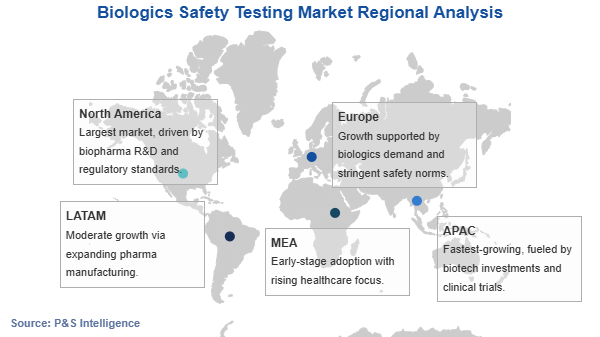
North America held the largest market share, of 40%, in 2024. This can be ascribed to the significant presence of key players, high prevalence of severe contagious and non-contagious ailments, such as coronavirus and diabetes, respectively; established healthcare infrastructure, growing research and development activities with the supportive government policies, and stringent regulations aimed at ensuring the safety of therapeutics. Canada contributes significantly to the region's dominant share due to the robust medical infrastructure, technological advancements, and favourable government policies for biologic production and safety testing. Additionally, Canada is increasingly adopting cell therapies for the treatment of several cancers, which, in turn, is favouring the market growth due to the increasing requirement for safety testing during their production.
Additionally, the region benefits from a well-established network of CDMOs and CROs that provide specialized safety testing services. These organizations have invested heavily in state-of-the-art facilities and technologies to meet the evolving needs of biopharmaceutical companies. Moreover, the presence of leading academic institutions and research centres further strengthens the region's position as a hub for biologics development and testing innovation.
U.S. Biologics Safety Testing Market Size
The U.S. market dominates the world due to the rising consumer awareness regarding the safety of biopharmaceuticals, significant adoption of advanced technologies, presence of cutting-edge medical facilities, and rising government and academic investments in the nation. According to the CDC data published in May 2024, every year in the U.S., 1.7 million people are diagnosed with cancer, and more than 600,000 die of it, making it the second-leading cause of death. This significant disease burden has accelerated the development of innovative biologics, particularly monoclonal antibodies and cell therapies, creating substantial demand for comprehensive safety testing services. The FDA's proactive approach to regulating biologics, combined with its support for advanced therapy development, has established a favourable environment for market growth.
Asia-Pacific Biologics Safety Testing Market Size
Asia-Pacific will have the highest CAGR, of 16.2%. The region's growth is fuelled by increasing investments in biopharmaceutical infrastructure, growing domestic demand for biologics, and the expansion of contract manufacturing capabilities. China, India, and South Korea are leading this growth trajectory through significant government support and private sector investments. The region has witnessed a substantial increase in biologics manufacturing capacity, with many global pharmaceutical companies establishing production facilities to serve both local and international markets. According to the United Nations Population Fund, one in four individuals in APAC will be over 60 years of age by 2050. This aging demographic is driving demand for biological therapeutics, necessitating robust safety testing infrastructure to ensure product quality and patient safety.
Government initiatives promoting biotechnology development, coupled with improving regulatory frameworks aligned with international standards, have created a conducive environment for market growth. The increasing number of biosimilar developments in the region, particularly in India and China, has further amplified the demand for comprehensive safety testing services. Local CDMOs and testing laboratories are expanding their capabilities to meet international quality standards, attracting global clients seeking cost-effective yet high-quality testing services.
Japan Biologics Safety Testing Market Size
Japan has a significant market growth potential, characterized by its advanced biotechnology sector and stringent regulatory standards. The country's biologics safety testing market benefits from strong government support for regenerative medicine and cell therapy development. Japan's Pharmaceuticals and Medical Devices Agency (PMDA) has implemented progressive regulations that facilitate the development of innovative biologics while maintaining high safety standards. The increased collaboration between domestic companies and international partners, driving technology transfer and capability enhancement, further contributes to the market growth. The country's focus on quality and precision aligns well with the requirements of biologics safety testing, positioning it as a preferred destination for advanced testing services in the region.
The geographical breakdown of the market is as follows:
The market is moderately fragmented due to the presence of large multinational and regional players. Companies, such as Charles River Laboratories and Eurofins Scientific, hold a significant market share. The strict regulations and high costs make it hard for new companies, but niche and emerging companies meet the demand for local and specialized testing services, thereby enhancing the market competition.
Key Biologics Safety Testing Companies:
Charles River Laboratories International Inc.
Merck KGaA
F. Hoffmann-La Roche Ltd.
Soci
bioM
Lonza Group Ltd.
InvivoGen
Agilent Technologies Inc.
WuXi AppTec
Microcoat Biotechnologie GmbH
Thermo Fisher Scientific Inc.
Eurofins Scientific SE
Biologics Safety Testing Market News
In May 2024, Lonza Group Ltd. introduced a new suite of analytical methods for residual DNA quantification in cell and gene therapy products, addressing the unique challenges of testing these complex therapeutics.
In January 2024, Charles River Laboratories International Inc. launched Endosafe Trillium rCR, an animal-free endotoxin testing cartridge, advancing faster and more ethical bacterial endotoxin testing methods.
In March 2023, Forge Biologics Inc. and Labcorp Holdings Inc. announced a strategic collaboration to advance the development and manufacturing of AAV-mediated gene therapies, aiming to streamline the process and improve access to specialized safety testing services for gene therapy clients.
In 2024, Thermo Fisher Scientific Inc. launched the SteriSEQ, a qPCR-based rapid sterility testing system that detects microbial contamination in under 5 hours.
Want a report tailored exactly to your business need?
Leading companies across industries trust us to deliver data-driven insights and innovative solutions for their most critical decisions. From data-driven strategies to actionable insights, we empower the decision-makers who shape industries and define the future. From Fortune 500 companies to innovative startups, we are proud to partner with organisations that drive progress in their industries.
Client Testimonials
Working with P&S Intelligence and their team was an absolute pleasure – their awareness of timelines and commitment to value greatly contributed to our project's success. Eagerly anticipating future collaborations.
McKinsey & Company
India
Unmatched Standards
Our insights into the minutest levels of the markets, including the latest trends and competitive landscape, give you all the answers you need to take your business to new heights
Complete Data Security
We take a cautious approach to protecting your personal and confidential information. Trust is the strongest bond that connects us and our clients, and trust we build by complying with all international and domestic data protection and privacy laws