This Report Provides In-Depth Analysis of the Bidirectional Charging Market Report Prepared by P&S Intelligence, Segmented by Application (Vehicle-to-Grid (V2G), Vehicle-to-Home (V2H), Vehicle-to-Load (V2L)), Propulsion Type (Battery Electric Vehicle (BEV), Plug-in Hybrid Electric Vehicle (PHEV)), Vehicle Type (Passenger Car, Light Commercial Vehicle (LCV), Heavy commercial vehicles (HCV)), Charging Type (AC Charging, DC Charging), and Geographical Outlook for the Period of 2021 to 2032
Explore the market potential with our data-driven report
Bidirectional Charging Market Overview
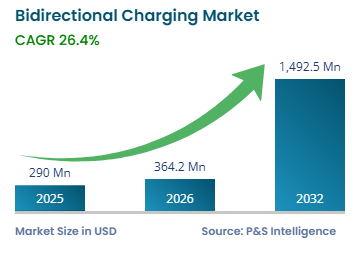
The bidirectional charging market size was USD 290.0 million for 2025, and it will grow by 26.4% during 2026–2032, to reach USD 1,492.5 million by 2032.
This growth is driven by accelerating electric vehicle adoption, expanding deployment of vehicle-to-grid, vehicle-to-home, and vehicle-to-load technologies, and growing pressure on utilities to integrate distributed energy storage into grid operations. The ISO 15118 communication protocol is increasingly adopted across EV charging ecosystems to enable secure vehicle-to-grid communication and Plug & Charge functionality.
The market's expansion is reinforced by converging government mandates and large-scale public investment in smart charging infrastructure. The International Energy Agency (IEA) reported that global EV sales exceeded 17 million units in 2024, representing a 25% year-on-year increase, with the cumulative global EV fleet surpassing 58 million vehicles, each a potential bidirectional energy node as vehicle-grid integration standards mature across major economies. The U.S. Department of Energy (DOE) has further published a 10-year VGI roadmap outlining bidirectional charging as a strategic enabler of frequency regulation, voltage management, and blackstart grid services.
Key Market Insights
The V2G category holds the largest market share, of 55%, in 2025, driven by its direct economic value proposition for utilities, grid operators, and energy aggregators.
The V2H category will have the highest CAGR, of 26.5%, driven by rising residential electricity tariffs, the increasing frequency of grid outages caused by extreme weather events, and growing consumer demand for energy self-sufficiency.
The BEV category holds the larger market share, of 70%, in 2025, and it will have the higher CAGR, of 26.6%, reflecting the dual advantage of superior bidirectional compatibility and accelerating global fleet growth.
The LCV will have the highest CAGR, of 26.8%, driven by the electrification of last-mile delivery fleets by logistics operators including Amazon, DHL, and FedEx.
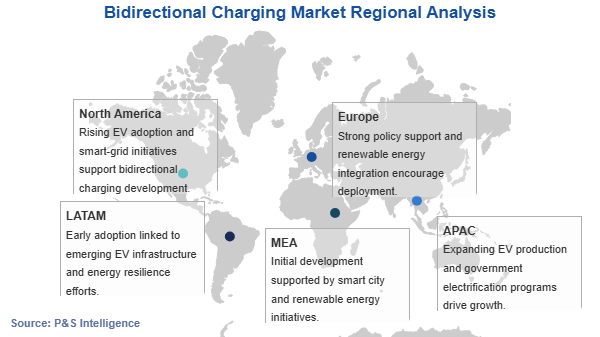
North America holds the largest market share, of 40%, in 2025, driven by a convergence of federal policy momentum, mature EV adoption infrastructure, and early-stage commercial V2G deployments.
Bidirectional Charging Market Trends & Drivers
OEM-Driven Native Bidirectional Integration Is Key Trend
A structural transformation is underway in the automotive industry as original equipment manufacturers (OEMs) progressively integrate bidirectional charging as a native vehicle capability rather than an aftermarket addition. General Motors has introduced bidirectional home energy solutions through its GM Energy ecosystem, initially supporting V2H capability with the Chevrolet Silverado EV and compatible Ultium-based vehicles. Tesla's Cybertruck features Powershare, delivering up to 11.5 kW of bidirectional AC power for home backup or external loads. Hyundai IONIQ 5 and Kia EV6 support vehicle-to-load functionality, while Ford's F-150 Lightning offers home backup power capability through Ford Intelligent Backup Power. The Nissan LEAF remains one of the earliest mass-market EVs supporting vehicle-to-grid functionality, with over 650,000 units sold globally since its launch, demonstrating the long-term feasibility of OEM-integrated bidirectional systems.
This shift has profound implications for market expansion, as bidirectional capability transitions from a premium retrofit to a factory-installed standard, the addressable base of V2G-eligible vehicles expands exponentially. Automakers are increasingly coupling hardware deployment with proprietary energy management software platforms and grid-service subscriptions, creating vertically integrated energy ecosystems that transform EVs from mobility products into networked energy assets. According to the CHAdeMO Association, more than 10,000 bidirectional chargers have been installed globally, with early deployments concentrated in Japan, where vehicle-to-home systems are widely used for residential backup power.
Rising Renewable Energy Penetration and Grid Instability Are Biggest Drivers
The accelerating integration of variable renewable energy sources, solar photovoltaic and wind, into national electricity systems is creating structural grid stability challenges that bidirectional charging is uniquely positioned to address. As renewable penetration rises, grid operators increasingly require distributed, fast-responding storage assets capable of absorbing surplus generation during off-peak periods and releasing stored energy during demand spikes. Electric vehicles can provide distributed battery storage when connected through bidirectional chargers, enabling them to absorb excess renewable electricity and return power to the grid during peak demand periods.
The International Energy Agency (IEA) reported that global renewable electricity capacity additions reached a record 585 GW in 2024, intensifying the frequency and magnitude of grid balancing events that V2G fleets can monetize through frequency regulation, voltage management, and demand response programs. The DOE's Vehicle-Grid Integration Assessment (January 2025) formally designates bidirectional charging as a strategic instrument for blackstart grid services and ancillary market participation, creating a policy-backed demand signal that is mobilizing utility procurement and state commission rulemaking across the U.S.
Commercial Fleet Electrification Generating Scaled V2G Deployment Is Biggest Opportunity
The electrification of commercial vehicle fleets, delivery vehicles, municipal buses, school buses, and utility trucks, presents a high-density deployment pathway for V2G infrastructure that individual residential adoption cannot replicate. Commercial fleets offer predictable charge/discharge cycles, centralized depot charging infrastructure, and aggregated battery capacity at a scale that makes them viable participants in formal grid ancillary markets. Oakland's school bus V2G program demonstrated that 74 bidirectional electric school buses could return 2.1 GWh annually to the local grid, establishing a template that school districts, transit agencies, and logistics operators across North America, Europe, and Asia Pacific are actively evaluating. The U.S. Environmental Protection Agency (EPA) has committed approximately USD 5 billion through the Clean School Bus Program to accelerate electric school bus deployment, a funding stream that directly expands the fleet-scale V2G opportunity.
Fleet operators are increasingly evaluating bidirectional charging as a mechanism to optimize charging costs and potentially participate in grid-support programs where regulations permit vehicle-to-grid integration. This dynamic is drawing specialized V2G aggregation platforms into the commercial segment and accelerating investment in depot-scale bidirectional infrastructure.
Bidirectional Charging Market Segmentation and Category Analysis
Application Analysis
The V2G category holds the largest market share, of 55%, in 2025, driven by its direct economic value proposition for utilities, grid operators, and energy aggregators. Unlike V2H or V2L, V2G enables EVs to participate in formal electricity markets, providing frequency regulation, peak shaving, voltage management, and demand response services that generate monetizable revenue streams for both vehicle owners and program operators. Utility-sponsored programs in California, Denmark, the Netherlands, and Japan are establishing regulatory frameworks and compensation models necessary for market participation at scale.
The V2H category will have the highest CAGR, of 26.5%, driven by rising residential electricity tariffs, the increasing frequency of grid outages caused by extreme weather events, and growing consumer demand for energy self-sufficiency. V2H transforms EVs into home backup power sources, avoiding the separate capital expenditure of dedicated battery storage systems, making it economically compelling for households with rooftop solar installations. OEM-native V2H integration across platforms such as GM's Ultium, Ford's Intelligent Backup Power, and Hyundai's E-GMP architecture is rapidly expanding the accessible residential market. The U.S. Department of Energy (DOE) has identified V2H as a critical residential resilience tool within its Vehicle-Grid Integration Roadmap, underscoring sustained federal support for residential bidirectional deployment.
The applications analyzed in this report are:
Vehicle-to-Grid (V2G) (Largest Category)
Vehicle-to-Home (V2H) (Fastest Growing Category)
Vehicle-to-Load (V2L)
Propulsion Type Analysis
The BEV category holds the larger market share, of 70%, in 2025, and it will have the higher CAGR, of 26.6%, reflecting the dual advantage of superior bidirectional compatibility and accelerating global fleet growth. BEVs possess larger usable battery capacities, typically 60 to 100 kWh, compared to PHEV packs, enabling substantially greater energy export potential per vehicle per V2G or V2H session. Many BEVs are being developed with compatibility for bidirectional charging standards such as ISO 15118, depending on vehicle architecture and charger configuration, whereas PHEVs face architectural constraints that limit their bidirectional utility in grid-service contexts. BEV adoption is structurally supported by zero-emission vehicle policies and electrification targets in regions such as the EU, California, and Canada, which are accelerating fleet electrification and expanding the potential pool of vehicles capable of supporting bidirectional charging.
The propulsion types analyzed in this report are:
Battery Electric Vehicle (BEV) (Larger and Faster-Growing Category)
Plug-in Hybrid Electric Vehicle (PHEV)
Vehicle Type Analysis
The passenger car category holds the largest market share, of 60%, in 2025, reflecting their dominant position in the overall global EV fleet and their compatibility with the residential and semi-public charging infrastructure through which V2H and V2G services are primarily delivered. The accessibility of residential Level 2 AC charging, which facilitates overnight V2H enrollment without additional infrastructure investment, has made passenger cars the most practical near-term platform for bidirectional deployment. According to the International Energy Agency (IEA), the global electric car fleet reached nearly 40 million passenger vehicles in 2023, highlighting the large installed base that can potentially participate in bidirectional energy applications.
The LCV will have the highest CAGR, driven by the electrification of last-mile delivery fleets by logistics operators including Amazon, DHL, and FedEx. LCVs offer predictable depot-based charging patterns and centrally managed battery assets that are structurally ideal for utility-coordinated V2G programs. In Europe, electrically chargeable van registrations grew by 32.6% in the first quarter of 2025, increasing their market share from 5.7% to 8.7% of total EU van sales, reflecting the accelerating transition of commercial delivery fleets toward electrified platforms suitable for depot-based bidirectional charging deployment.
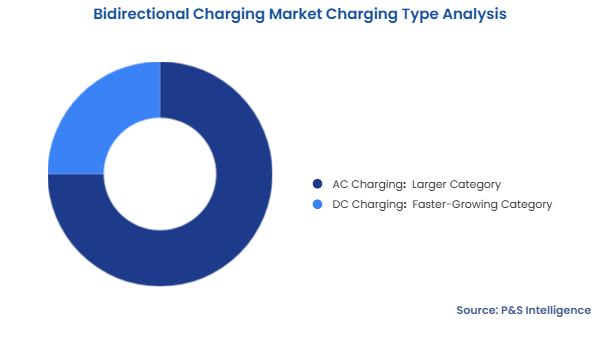
The AC charging category holds the larger market share, of 75%, in 2025, sustained by the widespread installed base of residential Level 2 AC chargers and the native V2H compatibility of multiple OEM EV platforms that conduct the AC-to-DC power conversion onboard the vehicle via an integrated inverter. AC bidirectional charging typically requires no modification to external charger power electronics, with power conversion handled by the vehicle’s onboard inverter, making it a cost-effective deployment pathway that is fully compatible with existing residential electrical infrastructure at typical power outputs of 7.2 to 11.5 kW. This lower hardware cost and integration simplicity have accelerated AC bidirectional adoption, particularly in the residential V2H segment across North America, Europe, and Japan.
The DC charging category will have the higher CAGR, driven by its capacity to deliver higher bidirectional power outputs, ranging from 22 kW to 150 kW, that are required for commercial fleet V2G programs, utility-scale grid services, and multi-vehicle depot bidirectional systems. DC bidirectional chargers handle power conversion externally, enabling faster charge-discharge cycles and greater grid service precision, making them the preferred hardware format for commercial, semi-public, and grid-operator-facing applications. The commercial deployment of CCS-compatible bidirectional hardware by Wallbox, Sigenergy, and Delta Electronics is accelerating DC bidirectional adoption.
The charging types analyzed in this report are:
AC Charging (Larger Category)
DC Charging (Faster-Growing Category)
Drive strategic growth with comprehensive market analysis
Bidirectional Charging Market Regional Outlook
North America Bidirectional Charging Market Size
North America holds the largest market share, of 40%, in 2025, driven by a convergence of federal policy momentum, mature EV adoption infrastructure, and early-stage commercial V2G deployments. The region’s leadership is supported by regulatory frameworks such as the Bipartisan Infrastructure Law, which allocated USD 5 billion for EV charging through the National Electric Vehicle Infrastructure (NEVI) program, and state-level initiatives that have established structured V2G interconnection processes. The Maryland DRIVE Act promotes vehicle-grid integration programs and directs utilities and regulators to develop frameworks supporting EV grid services, including V2G pilot initiatives. California, Massachusetts, and Michigan have further advanced bidirectional interconnection standards, while utility-sponsored V2G pilot programs involving PG&E, Ford, and General Motors are generating commercial-scale data.
The International Energy Agency (IEA) confirmed that the U.S. increased its public EV charging stock by 20% in 2024, reaching just under 200,000 public charging points, establishing the foundational density upon which commercial-scale V2G and V2H deployment will be built. The U.S. Department of Energy (DOE) has outlined that V2G technology can deliver ancillary grid services including frequency regulation, voltage management, and blackstart support, positioning bidirectional charging as a strategic national energy infrastructure priority within its 10-year Vehicle Grid Integration roadmap.
U.S. Bidirectional Charging Market Size
The U.S. is the largest country market in North America for bidirectional charging, benefiting from an established EV ecosystem, active federal and state-level grid integration programs, and an expanding portfolio of utility-sponsored V2G pilots. California regulators and utilities, including PG&E and Southern California Edison, have supported vehicle-grid integration pilot programs to evaluate bidirectional charging and grid services, while Oakland launched the world's largest vehicle-to-grid deployment in 2024, 74 electric school buses each equipped with dedicated bidirectional chargers, projected to return 2.1 GWh annually to the local grid. The Vehicle-Grid Integration Council (VGIC) reported state-level progress in Maryland, Michigan, California, Nevada, and Texas in standardizing bidirectional interconnection rules during 2025.
At the federal level, the DOE's VGI Assessment Report (January 2025) articulates a structured 10-year research, development, and deployment roadmap, signaling sustained institutional commitment to bidirectional technology maturation. Major logistics companies such as Amazon, FedEx, and UPS are expanding electric delivery fleets and pilot electrification programs, increasing the potential for commercial fleet-based V2G applications. The U.S. Environmental Protection Agency (EPA) estimates that the transportation sector contributes 29% of total U.S. greenhouse gas emissions, strengthening the regulatory case for V2G adoption as a fleet and residential decarbonization mechanism across all major states.
Asia-Pacific Bidirectional Charging Market Size
Asia-Pacific will have the highest CAGR, of 26.7%, driven by China's unmatched EV fleet scale, Japan's long-established V2H commercialization ecosystem, South Korea's island-based V2G testbeds, and India's emerging grid integration policy framework. The region hosts the world's highest EV penetration rates alongside state-directed grid modernization programs and dominant manufacturing capacity for power electronics, inverters, and EV battery systems. South Korea's KEPCO–Hyundai V2G testbed on Jeju Island is progressing toward smart grid integration with renewable energy balancing. Japan's residential V2H market, pioneered by Nissan and Panasonic, represents the most commercially mature V2H segment globally.
The region's trajectory is anchored by China's 10-gigawatt-scale V2G flexibility target for 2030 and India's NITI Aayog–Ministry of Power collaboration on V2G implementation for electric public transport buses. China's National Development and Reform Commission (NDRC), in collaboration with the National Energy Administration (NEA) and Ministry of Industry and Information Technology (MIIT), issued guidelines in January 2024 to establish a bidirectional V2G framework with draft standard systems by 2025 and large-scale market application by 2030, alongside an EV fleet V2G flexibility capacity target of tens of millions of kilowatts. The IEA confirmed that China holds approximately 65% of the world's public EV charging infrastructure, providing the foundational network density essential for scaled bidirectional charging deployment across residential, commercial, and utility applications.
China Bidirectional Charging Market Size
China is the largest and most strategically significant country market within Asia Pacific for bidirectional charging, supported by the world's largest EV fleet, exceeding 40 million vehicles at end-2024, and an accelerating national V2G pilot rollout. China's National Development and Reform Commission (NDRC) and energy authorities have launched V2G pilot programs in multiple cities to evaluate vehicle-grid integration and large-scale bidirectional charging deployment. The government's New Power System Action Plan (2024–2027) explicitly classifies V2G-enabled chargers as distributed energy assets essential to peak-shaving, demand response, and renewable energy balancing, directly linking bidirectional charging to China's dual carbon targets of carbon peaking by 2030 and neutrality by 2060.
China's New Energy Vehicle (NEV) credit policy requires automakers to meet minimum NEV credit ratios, supporting continued EV fleet expansion and increasing the pool of vehicles capable of participating in future V2G programs. The IEA reported that China sold over 11 million EVs domestically in 2024, representing nearly half of all global EV sales, confirming the scale of the EV fleet that China's V2G programs are systematically targeting for conversion into distributed grid resources.
The regions and countries of the market are as follows:
The market is fragmented due to its early commercialization stage and the presence of diverse participants across the EV and energy value chain. Competition arises from EV manufacturers, charger hardware providers, grid technology companies, utilities, and V2G software aggregators, each operating in different layers of the ecosystem. No single company controls the full technology stack or global deployment footprint. Regional differences further reinforce fragmentation, with Asia-Pacific dominated by EV manufacturers and electronics firms, while North America and Europe feature utilities, grid technology providers, and V2G platform specialists. In addition, evolving global standardization of bidirectional communication protocols continues to allow proprietary system architectures to persist across markets.
Top Bidirectional Charging Technology Providers:
Wallbox N.V.
Nuvve Holding Corp.
Siemens AG
ABB Ltd.
Schneider Electric SE
Delta Electronics, Inc.
Zaptec AS
The Mobility House GmbH
Denso Corporation
Kaluza Ltd.
E.ON SE
Nichicon Corporation
Bidirectional Charging Market News
In November 2025, Kaluza Ltd. strengthened its presence in Japan by expanding its partnership with Mitsubishi Corporation and launching a residential Vehicle-to-Grid demonstration project with MC Retail Energy, Nichicon Corporation, and Mitsubishi Motors to deploy bidirectional EV energy management technology in Japanese homes.
In October 2025, Wallbox N.V. and Bidirectional Energy, Inc. launched a multi-state bidirectional charging pilot program in the United States using the Quasar 2 bidirectional DC charger (12.48 kW) to enable Kia EV9 owners to power homes and export electricity back to the grid.
In September 2025, BMW Group and E.ON SE launched Germany’s first commercial Vehicle-to-Grid solution for private customers, combining the 11 kW BMW Wallbox Professional bidirectional charger, an E.ON V2G electricity tariff, and smart-meter integration for BMW iX3 owners.
In April 2025, Nuvve Holding Corp. acquired all net assets of Fermata Energy, LLC through its subsidiary Fermata Energy II LLC (Fermata 2.0) in a transaction valued at approximately USD 659,000 to expand its vehicle-to-grid software platform and intellectual property portfolio.
Frequently Asked Questions About This Report
What is the growth rate of the bidirectional charging market?+
The bidirectional charging market is growing at a CAGR of 26.4% during the forecast period.
Which regions are leading the bidirectional charging market?+
North America currently holds the largest share, while Asia-Pacific is expected to witness the fastest growth.
What factors are driving the growth of the bidirectional charging market?+
The market is driven by increasing EV penetration, rising investments in smart grid technologies, supportive government policies for grid flexibility, and the growing need to integrate renewable energy sources into electricity networks.
Which EVs support bidirectional charging technology?+
Several electric vehicles support bidirectional charging, including models equipped with vehicle-to-grid or vehicle-to-home capabilities, particularly certain Nissan, Ford, Hyundai, and Kia electric vehicles.
What infrastructure is required for bidirectional charging?+
Bidirectional charging requires compatible EVs, bidirectional chargers, energy management systems, and grid communication technologies to enable energy flow between the vehicle battery and the power grid or building.
What challenges are limiting the adoption of bidirectional charging?+
Key challenges include high infrastructure costs, limited availability of compatible vehicles and chargers, regulatory barriers, and concerns regarding battery degradation from frequent energy cycling.
Want a report tailored exactly to your business need?
Leading companies across industries trust us to deliver data-driven insights and innovative solutions for their most critical decisions. From data-driven strategies to actionable insights, we empower the decision-makers who shape industries and define the future. From Fortune 500 companies to innovative startups, we are proud to partner with organisations that drive progress in their industries.
Client Testimonials
Working with P&S Intelligence and their team was an absolute pleasure – their awareness of timelines and commitment to value greatly contributed to our project's success. Eagerly anticipating future collaborations.
McKinsey & Company
India
Unmatched Standards
Our insights into the minutest levels of the markets, including the latest trends and competitive landscape, give you all the answers you need to take your business to new heights
Complete Data Security
We take a cautious approach to protecting your personal and confidential information. Trust is the strongest bond that connects us and our clients, and trust we build by complying with all international and domestic data protection and privacy laws