This Report Provides In-Depth Analysis of the Bicycle Saddles Market Report Prepared by P&S Intelligence, Segmented by Material Type (Synthetic/Plastic, Carbon Fiber, Leather, Gel/Foam), Bicycle Type (Road Bikes, E-bikes, Mountain Bikes, Hybrid/Commuter Bikes, BMX Bikes), Distribution Channel (Specialty Bicycle Retailers, Online Stores, Supermarkets/Hypermarkets), and Geographical Outlook for the Period of 2019 to 2032
Explore the market potential with our data-driven report
Bicycle Saddles Market Overview
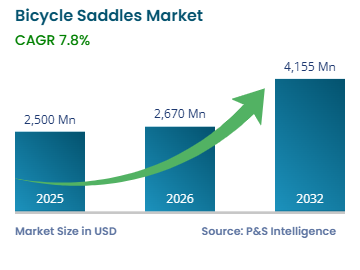
The global bicycle saddles market size will be an estimated USD 2500.0 million in 2025, which is predicted to reach USD 4155.0 million by 2032, growing at a CAGR of 7.8% during 2026–2032.
The market growth is primarily driven by the increasing health consciousness among consumers, rising adoption of cycling as a sustainable transportation mode, and growing participation in recreational and professional cycling activities worldwide.
The surge in health awareness has positioned cycling as a preferred fitness activity, contributing significantly to the demand for comfortable and ergonomic bicycle saddles. According to the United Nations, the bicycle is recognized as a simple, affordable, reliable, clean, and environmentally sustainable means of transportation. This global recognition has amplified the adoption of cycling across different demographics and regions, directly impacting the bicycle saddles market.
The market is experiencing substantial innovation in saddle design and materials, with manufacturers focusing on developing products that offer enhanced comfort, durability, and performance. The growing popularity of e-bikes and the expanding cycling infrastructure in urban areas are creating additional growth opportunities for bicycle saddle manufacturers. Furthermore, the increasing participation of women in cycling activities has led to the development of gender-specific saddle designs, opening new market segments and revenue streams.
Bicycle Saddles Market Trends & Drivers
Technological Advancements in Saddle Design Is a Key Trend
Bicycle saddle manufacturers are incorporating advanced materials like carbon fiber, gel padding, and memory foam to improve comfort and reduce weight.
Ergonomic designs are becoming more common, with saddles shaped to reduce pressure on sensitive areas and improve blood flow.
Smart saddles with integrated sensors are emerging, capable of tracking performance metrics such as pressure distribution and riding posture.
3D printing technology is being used to produce custom-fit saddles tailored to individual riders’ anatomy and riding style.
Adjustable and modular saddles allow cyclists to fine-tune their seat setup for different terrains or riding disciplines.
Brands are focusing on gender-specific saddle designs, recognizing anatomical differences to enhance comfort for both male and female riders.
Eco-friendly materials and manufacturing processes are gaining traction, aligning with the growing demand for sustainable products.
Collaboration with professional athletes and use of biomechanical research are leading to performance-driven saddle innovations.
Rising Health Consciousness Is Fueling Market Growth
More people are choosing cycling as a regular form of exercise to improve fitness and overall health.
Growing awareness about lifestyle diseases like obesity and heart problems is pushing individuals toward active transportation like biking.
The World Health Organization (WHO) recognizes cycling as an effective way to improve heart health.
It helps lower the risk of heart disease and stroke by improving circulation, reducing blood pressure, and balancing cholesterol levels.
Demand for comfortable and ergonomic bicycle saddles is rising as more health-conscious consumers spend longer hours riding.
Urban dwellers are incorporating cycling into daily routines for commuting and recreational purposes, increasing saddle usage.
Fitness influencers and health campaigns are promoting cycling, indirectly boosting demand for quality bike components, including saddles.
Post-pandemic focus on outdoor and solo physical activities has made cycling a preferred fitness option, leading to higher saddle sales.
Government initiatives promoting cycling for health benefits are encouraging more people to invest in bikes with better saddles.
Cycling events, charity rides, and wellness programs are contributing to increased saddle demand from both casual and serious riders.
Globally, over 4 billion people are projected to be overweight or obese by 2035, while cardiovascular diseases cause one in three deaths worldwide.
Around 589 million adults currently live with diabetes, expected to rise to 853 million by 2050, as per the International Diabetes Federation.
Chronic respiratory diseases rank as the third leading cause of death, with air pollution contributing to about 1.3 million deaths annually.
Regular cycling can help tackle these issues by promoting physical activity, improving cardiovascular and respiratory health, aiding weight management, and reducing dependence on motor vehicles—thereby lowering harmful emissions and associated health risks globally.
Bicycle Saddles Market Segmentation Analysis
Material Type Analysis
The synthetic/plastic category holds the largest market share, of approximately 40.0%, in 2025, driven by its cost-effectiveness, durability, and versatility in design applications. Synthetic materials offer excellent weather resistance and are easier to maintain compared to traditional leather saddles, making them popular among recreational cyclists and commuters. The category's dominance is also attributed to the wide range of synthetic material options available, allowing manufacturers to create saddles with varying levels of firmness, cushioning, and aesthetic appeal.
Carbon fiber represents the fastest-growing category, during 2026–2032, fueled by increasing demand from professional cyclists and performance-oriented recreational riders. Carbon fiber saddles offer superior strength-to-weight ratios, enhanced vibration dampening, and improved overall performance characteristics. The growing participation in competitive cycling events and the increasing number of cycling enthusiasts seeking high-performance equipment are driving the adoption of carbon fiber saddles despite their higher price points.
These material types are covered:
Synthetic/Plastic (Largest Category)
Carbon Fiber (Fastest-Growing Category)
Leather
Gel/Foam
Others
Bicycle Type Analysis
Road bikes dominate the bicycle saddles market in 2025 with a market share of 35.0%, reflecting the substantial global participation in road cycling activities. Road cycling's popularity spans recreational riding, competitive racing, and fitness-oriented cycling, creating consistent demand for specialized saddles designed for extended riding periods and aerodynamic positioning. The category's leading position is supported by the growing number of cycling clubs, organized road cycling events, and the increasing adoption of road cycling as a primary fitness activity.
E-bikes represent the fastest-growing application category during 2026–2032, driven by technological advancements in electric bicycle systems and increasing consumer acceptance of e-mobility solutions. The e-bike market expansion is particularly pronounced in urban areas where electric bicycles offer practical solutions for commuting and recreational activities. E-bike saddles require specialized design considerations to accommodate the additional weight and different riding dynamics of electric bicycles, creating opportunities for innovative saddle designs and premium product positioning. From USD 25.6 billion in 2024, e-bike sales are predicted to surge to USD 61.5 billion by 2030.
These bicycle types segments are covered:
Road Bikes (Largest Category)
E-bikes (Fastest-Growing Category)
Mountain Bikes
Hybrid/Commuter Bikes
BMX Bikes
Others
Distribution Channel Analysis
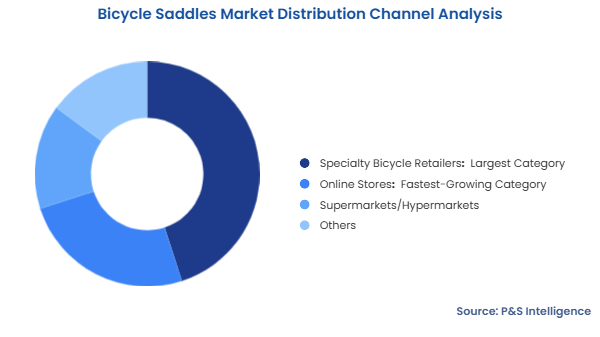
Specialty bicycle retailers maintain the largest market share, of 45.0%, in 2025, benefiting from their expertise in bicycle components and ability to provide personalized fitting services and technical advice to customers. These retailers offer comprehensive product ranges, professional installation services, and after-sales support, making them the preferred choice for serious cyclists and consumers seeking specialized saddle solutions. The category's dominance is also supported by the trust and credibility that specialty retailers have built within the cycling community.
Online stores are experiencing the highest growth rate, during 2026–2032, driven by the convenience of online shopping, competitive pricing, and expanding e-commerce capabilities. The digital transformation of retail, accelerated by changing consumer shopping behaviors, has made online platforms increasingly attractive for bicycle saddle purchases. Online retailers benefit from lower operational costs, wider product selection, and the ability to reach consumers in markets with limited physical bicycle retail presence.
These distribution channels are covered:
Specialty Bicycle Retailers (Largest Category)
Online Stores (Fastest-Growing Category)
Supermarkets/Hypermarkets
Others
Drive strategic growth with comprehensive market analysis
Bicycle Saddles Market Geographical Analysis
Europe Bicycle Saddles Market Share
Europe holds the largest regional market share, of 40.0%, in 2025 and is expected to maintain its leading position during the forecast period. This dominance is primarily attributed to the region's well-established cycling culture, extensive cycling infrastructure, and strong government support for sustainable transportation initiatives. The Netherlands, Denmark, and Germany have integrated cycling into their urban planning and transportation policies, creating sustained demand for bicycle components.
The European market benefits from a mature cycling industry with numerous established manufacturers and suppliers, advanced product development capabilities, and strong consumer awareness of cycling benefits. The region's focus on environmental sustainability and carbon emission reduction has led to increased investment in cycling infrastructure and promotion of bicycle transportation. Government incentives for bicycle purchases, integration of cycling with public transportation systems, and corporate wellness programs promoting cycling are contributing to sustained market growth in Europe.
Asia-Pacific Bicycle Saddles Market Forecast
Asia-Pacific is projected to be the fastest-growing regional market, with a CAGR of approx. 8.5%, during 2026–2032, driven by rapid urbanization, increasing disposable income, and growing health consciousness among the population. The region's large population base, particularly in countries like China and India, represents substantial market potential for bicycle saddle manufacturers. Urban congestion and air pollution concerns are encouraging governments and consumers to adopt cycling as an alternative transportation mode.
The expanding middle class in Asian countries is driving demand for recreational and fitness cycling activities, creating opportunities for premium saddle products and specialized cycling equipment. The region's manufacturing capabilities in bicycle components provide cost advantages and supply chain efficiencies for both domestic consumption and export markets.
China and India are leading the regional growth, with significant investments in urban cycling infrastructure and government initiatives promoting bicycle transportation. The increasing popularity of cycling as a recreational activity and the growing adoption of e-bikes in urban areas are key factors driving the Asia-Pacific bicycle saddles market expansion.
The regions and countries analyzed in this report are:
North America
U.S. (Larger Country Market)
Canada (Faster-Growing Country Market)
Europe (Largest Regional Market)
Germany (Largest Country Market)
U.K. (Fastest-Growing Country Market)
France
Italy
Spain
Rest of Europe
Asia-Pacific (Fastest-Growing Regional Market)
Japan
China (Largest Country Market)
India (Fastest-Growing Country Market)
South Korea
Australia
Rest of APAC
Latin America
Brazil (Largest Country Market)
Mexico (Fastest-Growing Country Market)
Rest of LATAM
Middle East and Africa
Saudi Arabia (Largest Country Market)
South Africa
U.A.E. (Fastest-Growing Country Market)
Rest of MEA
Bicycle Saddles Market Share
The global bicycle saddles market is moderately consolidated, with several established manufacturers holding significant market positions, while numerous smaller players serve niche segments and regional markets. The competitive landscape is characterized by product innovation, brand recognition, and distribution network strength, with leading companies focusing on research and development to create differentiated saddle solutions.
Leading companies maintain their competitive positions through continuous innovation in saddle design, materials technology, and manufacturing processes. Strategic partnerships with bicycle manufacturers, professional cycling teams, and specialty retailers provide market access and brand visibility advantages. The industry leaders leverage their global distribution networks and brand recognition to capture market share across different geographic regions and application segments.
Key competitive strategies include product diversification across different cycling applications, development of gender-specific and activity-specific saddle designs, and investment in advanced materials and manufacturing technologies. Companies are also focusing on direct-to-consumer sales channels and digital marketing to reach cycling enthusiasts and build brand loyalty.
The market offers opportunities for new entrants in specialized niches such as e-bike saddles, women-specific designs, and sustainable material applications. However, established players' strong brand recognition and distribution networks create significant barriers to entry for new competitors seeking substantial market share.
Key Bicycle Saddles Companies:
SelleRoyalS.p.A.
Brooks England Ltd.
Wilderness Trail Bikes, Inc.
Prologo
ISM
Ergon
SQ?lab?GmbH
Selle?Italia?S.r.l.
Bontrager
Specialized Bicycle Components, Inc.
Giant Manufacturing Co., Ltd.
SDG Components
Bicycle Saddles Market News
In January 2025, Fizik partnered with UAE Team Emirates XRG and UAE Team ADQ as their official saddle supplier. The collaboration highlights key trends in the bicycle saddles market, including 3D-printed Adaptive saddles and custom-fit designs that focus on rider comfort, performance, and innovation.
In April 2023, Prologo launched the Scratch NDR saddle, specifically designed for Cross Country (XC) and Cross Country Marathon (XCM) disciplines. This saddle was developed in collaboration with professional riders from eight MTB teams, including Cannondale Factory Racing, Team BMC Factory Racing, Lapierre Racing Unity, Wilier-Vittoria, Origine Racing Division, and BH Coloma Team.
Want a report tailored exactly to your business need?
Leading companies across industries trust us to deliver data-driven insights and innovative solutions for their most critical decisions. From data-driven strategies to actionable insights, we empower the decision-makers who shape industries and define the future. From Fortune 500 companies to innovative startups, we are proud to partner with organisations that drive progress in their industries.
Client Testimonials
Working with P&S Intelligence and their team was an absolute pleasure – their awareness of timelines and commitment to value greatly contributed to our project's success. Eagerly anticipating future collaborations.
McKinsey & Company
India
Unmatched Standards
Our insights into the minutest levels of the markets, including the latest trends and competitive landscape, give you all the answers you need to take your business to new heights
Complete Data Security
We take a cautious approach to protecting your personal and confidential information. Trust is the strongest bond that connects us and our clients, and trust we build by complying with all international and domestic data protection and privacy laws