Barrier Films Market Size & Share Analysis - Key Trends, Future Opportunities, Growth Strategies, and Forecasts (2026 - 2032)
This Report Provides In-Depth Analysis of the Barrier Films Market Report Prepared by P&S Intelligence, Segmented by Type (Metalized, Transparent, White), Material Type (Polyethylene Terephthalate (PET), Polyethylene (PE), Polypropylene (PP), Polyamide (PA)), Coating Type (Organic, Inorganic Oxide), Packaging (Pouches, Bags, Blister Packs), End User (Food & Beverage, Pharmaceutical, Agriculture), and Geographical Outlook for the Period of 2019 to 2032
Explore the market potential with our data-driven report
Barrier Films Market Analysis
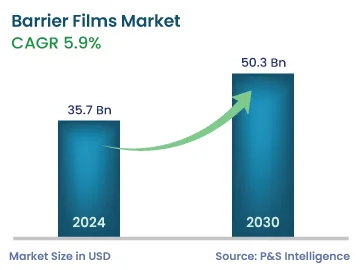
The barrier films market size will be an estimated USD 37.4 billion for 2025, and it will grow by 5.9% during 2026–2032, to reach USD 55.8 billion by 2032.
The major factors responsible for the growth of the market include stringent regulations for food safety, increasing demand for longer shelf life of packaged products, and the rising adoption of flexible packaging solutions across various industries. This transition is particularly pronounced in the food and beverage industry, where barrier films prevent quality degradation while reducing packaging weight by up to 70% compared to conventional alternatives.
Additionally, the replacement of traditional rigid packaging, such as glass and cans, with flexible barrier films supports market expansion by combining convenience with advanced preservation features. The evolution of barrier films extends beyond simple protection, as these materials now incorporate advanced functionalities, including oxygen scavenging, moisture control, and UV resistance, enabling manufacturers to meet increasingly complex preservation requirements while addressing sustainability concerns through reduced material usage and improved recyclability options.
Barrier Films Market Emerging Trends & Growth Drivers
Rise of Mono-Material Barrier Films Is Key Trend
The barrier films industry stands at a critical inflection point as mono-material solutions emerge as the most transformative trend reshaping packaging sustainability.
These containers use recycled materials or mono-materials, and can reduce the amount of plastic used or lower CO2 emissions, fundamentally altering how manufacturers approach barrier packaging design.
This shift represents more than incremental improvement; it signals a complete reimagining of flexible packaging structures that have dominated the industry for decades.
Traditional multi-layer barrier films, while offering exceptional performance, create significant recycling challenges that conflict with circular economy principles.
Multilayer films that contain different polymers or metal foil layers provide stiffness or heat resistance and act as barriers to flavor, aroma, oxygen, water, and oil.
These multi-material constructions, however, are difficult to recycle.
The complexity of separating different polymer layers during recycling processes often renders these materials unsuitable for mechanical recycling, leading to downcycling or disposal rather than true material recovery.
The mono-material revolution addresses this fundamental challenge through innovative engineering that maintains barrier performance while enabling recyclability.
According to the CEFLEX Designing for a Circular Economy guidelines, in a mono-material package, at least 90 percent of the package is made of one polymer type; barrier materials, inks, and adhesives may make up the remainder.
Leading manufacturers have developed sophisticated coating technologies and polymer modifications that allow single-material structures to achieve barrier properties previously requiring multiple layers.
For instance, re/cycle StandUpPouch is an award-winning packaging solution with a structure made of PP or PE mono-material.
It is certified recyclable with up to an AAA rating (>95%) and is lighter & stronger than PET/PE laminates of the same thickness.
Market dynamics strongly favor this transition, with regulatory pressures and brand commitments accelerating adoption.
The EU Packaging and Packaging Waste Regulation (PPWR) and FDA guidelines are accelerating sustainability adoption by requiring recyclable packaging, minimum recycled content, and circular economy compliance.
Major consumer goods companies have established aggressive targets for recyclable packaging by 2025–2030, creating urgent demand for mono-material solutions that meet both performance requirements and sustainability goals.
The technological breakthroughs enabling this transition extend beyond simple material substitution.
Advanced extrusion technologies, including biaxially oriented polyethylene (BOPE) films, provide the mechanical properties necessary to replace multi-material structures.
By making these resins globally accessible, existing packaging processes have been transformed into a cost-effective solution for mono-material packaging designs.
Furthermore, innovations in barrier coatings allow manufacturers to achieve oxygen and moisture protection levels approaching those of traditional metallized structures while maintaining compatibility with existing recycling streams.
Economic Imperative of Food Waste Reduction Is Biggest Driver
The staggering economic losses associated with food waste represent one of the most compelling drivers accelerating barrier films market expansion globally.
As per UN and FAO, 13% of the food produced globally is lost each year from harvest up.
This massive financial hemorrhage spans the entire food supply chain, creating urgent demand for packaging technologies that extend shelf life and preserve product quality from farm to consumer.
The scope of food waste extends far beyond simple economic calculations, encompassing environmental and social dimensions that amplify the urgency for solutions.
Food loss & waste significantly contribute to the climate crisis, accounting for 8–10% of the global GHG emissions, while also wasting valuable resources such as water, energy, and agricultural land.
When food spoils due to inadequate packaging protection, all inputs required for production, processing, and transportation become wasted investments.
Barrier films emerge as a critical intervention point, offering cost-effective protection that significantly reduces these losses through superior moisture control, oxygen barriers, and extended shelf life capabilities.
The financial mathematics strongly favor investment in advanced barrier packaging solutions.
For food manufacturers and retailers, barrier films that extend shelf life by even a few days can translate into millions of dollars in recovered value through reduced markdowns, fewer product returns, and decreased disposal costs.
The technology enables supply chain optimization by allowing longer distribution windows and reducing the frequency of restocking, particularly beneficial for international trade and e-commerce fulfillment.
Consumer behavior patterns further reinforce this economic driver, as households increasingly seek packaging solutions that preserve freshness and prevent premature spoilage.
At least 20% food waste is a result of errors or misinterpretation of food date labels, highlighting how improved barrier packaging with integrated freshness indicators can reduce consumer-level waste.
The proliferation of smaller household sizes and busy lifestyles creates demand for portion-controlled packaging with resealable features that maintain product integrity after opening.
Barrier films incorporating active packaging elements, such as moisture absorbers or ethylene scavengers, command premium pricing while delivering measurable value through extended usability periods.
This consumer willingness to pay for waste reduction creates a virtuous cycle where packaging innovation directly translates into market growth and profitability across the value chain.
Barrier Films Market Segmentation Analysis
Type Analysis
The metalized category holds the largest market share, of 40%, in 2025, to the increasing consumption of flexible packaging in the consumer goods, pharmaceutical & medical device, and agrochemical industries. Metalized films protect against oxygen, moisture, and light, thus keeping them fresh for a long time. Moreover, the globalization of the food & beverage industry, surging concerns for health, rising demand to extend the shelf life of packaged foods, and increasing efforts to reduce plastic usage drive the demand for metalized films. Resultingly, several major companies in the market are conducting R&D for more-effective and sustainable packaging. The market is also driven by the growing popularity of ready-to-eat food products due to the changing lifestyles worldwide.
The transparent category will have the highest CAGR, of 6.1%, owing to the increasing consumer preference for product visibility combined with protection requirements. These films enable consumers to view products before purchase while maintaining essential barrier properties through advanced coating technologies. The pharmaceutical and fresh produce sectors particularly drive demand for transparent barriers that protect products while allowing visual inspection for quality assurance.
The types analyzed in this report are:
Metalized (Largest Category)
Transparent (Fastest-Growing Category)
White
Material Type Analysis
The PET category holds the largest market share, of 35%, in 2025, due to the rapid increase in the demand for barrier films made of polyester from the food & beverage industry. Polyester is a transparent, durable, and lightweight plastic that is frequently used in the packaging of food and beverages, especially juices, soft drinks, water, alcoholic beverages, and edible oils. In addition, the FDA and other health & safety organizations worldwide have authorized PET for food & beverage contact applications, which has rapidly made it a preferred packaging material in this industry.
The PA category will have the highest CAGR, of 6.0%, driven by superior mechanical properties and excellent gas barrier capabilities. PA films provide exceptional puncture resistance and maintain barrier properties across wide temperature ranges, making them ideal for demanding applications, including modified atmosphere packaging and high-temperature sterilization processes. The material's transparency and printability further enhance its appeal for premium packaging applications where both protection and presentation are critical.
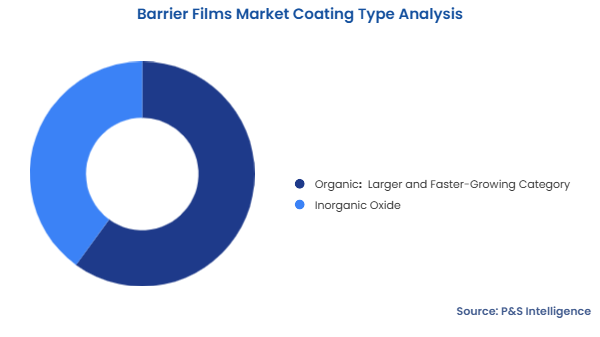
The organic coatings category holds the larger market share, of 60%, in 2025, and it will have the higher CAGR during the forecast period, driven by the widespread use of films made from organic oxides in the food & beverage sector to improve shelf life by preventing moisture and gases from either entering or leaving the package.
Additionally, the use of organic coating barrier films is influenced by the rising need for flexible packaging and to protect electronic devices from dust and other contaminants. Consumers' inclination is shifting toward organic goods due to their eco-conscious choices. Moreover, governments' strict regulations regarding chemical usage in packaging materials favor the usage of organic coatings.
The coating types analyzed in this report are:
Organic (Larger and Faster-Growing Category)
Inorganic Oxide
Packaging Analysis
The bags category holds the largest market share, of 45%, in 2025, due to the rising need for flexible packaging options. The increasing consumption of packaged products, sustainability concerns, and rapidly advancing technology drive the market in this category. Further, the demand of the food & beverage industry to protect and preserve products and increase shelf life leads to the need to control pH and water activity, temperature, humidity, and other elements, or to prevent them from affecting the products altogether.
Thus, barrier films are widely used in the form of bags to store baked goods, frozen foods, meat, and dairy products. The demand for packaged food is increasing as customers are choosing grab-and-go products more frequently, which accelerates the adoption of bags for packaging purposes in the food & beverage business. Moreover, the market for bags is driven by their growing usage in the electronics and agriculture industries. Bags protect electronic components from moisture and impurities during storage and transportation. And, in agriculture, they preserve products such as seeds and fertilizers by improving their shelf life.
The blister packs category will have the highest CAGR, of 6.3%, primarily driven by pharmaceutical and healthcare applications. The format provides individual dose protection, tamper evidence, and extended shelf life for sensitive medications. Pharmaceutical companies and healthcare facilities rely heavily on barrier films for packaging needles, medication bottles, medical devices, implants, and consumables. Aging populations and increased medication usage in developed markets sustain demand growth, while emerging markets adopt blister packaging to improve medication safety and compliance.
The packaging analyzed in this report are:
Pouches
Bags (Largest Category)
Blister Packs (Fastest-Growing Category)
End User Analysis
The food & beverages category holds the largest market share, of 50%, in 2025, due to the growing popularity of packaged foods. The rising sale of ready-to-eat meals and packaged instant-cook products from self-service outlets is contributing to the demand for these materials. This sector utilizes barrier packaging films to store and transport ready-to-eat meals, meats, bakery items, seafood, dairy products, confectionery, fruits, vegetables, as well as alcoholic and non-alcoholic beverages. This is done to offer a longer shelf life and preserve product quality.
Moreover, several manufacturers are investing in advanced packaging technologies to prevent contamination and get a competitive advantage. For instance, in July 2023, Winpak Ltd. became the first to install the CrystalClearConnect automated flexo platemaking system to increase production and reduce human intervention. With such innovations in the packaging technology, players are supplying barrier films to this sector.
The agriculture category will have the highest CAGR during the forecast period, due to the rising need for modern farming solutions. This creates the demand for these packaging films to protect and increase the shelf life of fertilizers, pesticides, fungicides, and seeds. Further, silage films made of multi-layered, multi-extruded plastics form an airtight seal to preserve the nutrients and freshness of stored livestock feed. Additionally, these films are used to create greenhouse covers, to offer a controlled environment that helps plants grow efficiently and stay protected from adverse weather. This, in turn, increases the crop yield, improves product quality, and enhances sustainability in agricultural processes.
The end users analyzed in this report are:
Food & Beverage (Largest Category)
Pharmaceutical
Agriculture (Fastest-Growing Category)
Others
Drive strategic growth with comprehensive market analysis
Barrier Films Market Geographical Analysis
Asia-Pacific Barrier Films Market Size
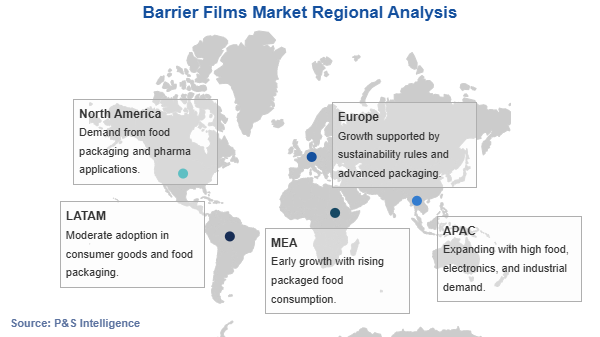
Asia-Pacific holds the largest market share, of 40%, in 2025, and it will have the highest CAGR, of 6.2%, due to the rising population and rapid urbanization, which have increased the consumption of packaged foods & beverages, medicinal products, and personal care products. Further, the rapidly growing e-commerce business in this region fuels collaborations, partnerships, and mergers between the players and packaging businesses to meet the demand for strong protective films that can endure handling and shipping procedures.
For instance, in June 2023, Dow and P&G China announced a collaboration to develop a recyclable air capsule for e-commerce packaging. The shift in the retail landscape toward sustainability necessitates efficient packaging solutions, making barrier films crucial to ensure product safety and an extended shelf life.
Urbanization, higher incomes, and demand for packaged goods in China and India are key factors. E-commerce growth, government support for advanced materials, and increasing agricultural film usage bolster this trend. The region's manufacturing capabilities, particularly in flexible packaging conversion, provide cost advantages that attract global brand owners. Additionally, the shift from traditional wet markets to modern retail formats accelerates demand for packaged products requiring barrier film protection.
Moreover, the Indian pharmaceutical industry is one of the largest by volume, which will continue to drive the barrier films industry over the forecast period. Maintaining the integrity and efficacy of medical items is imperative, which essentially drives the demand for these materials.
China Barrier Films Market Size
China represents the largest country within the Asia-Pacific barrier films market. The country's massive food processing industry, combined with stringent food safety regulations implemented in recent years, drives adoption of high-performance barrier films. Government initiatives promoting sustainable packaging create opportunities for innovative barrier solutions that balance performance with environmental responsibility.
North America Barrier Films Market Size
North America is also experiencing significant growth due to the expanding usage of these films in the food & beverage, agriculture, and pharmaceutical industries. Several major companies are adopting advanced and sustainable packaging technologies to meet the environmental targets and cater to consumers’ need for food items packaged in an eco-friendly way. The region's emphasis on food safety, coupled with advanced cold chain logistics, creates consistent demand for high-performance barrier films.
U.S. Barrier Films Market Size
The U.S. dominates the North American market, benefiting from its large food processing industry and leadership in packaging innovation. The rise of online grocery shopping and pharmaceutical delivery in the USA has increased demand for high-barrier packaging films. E-commerce expansion necessitates packaging solutions that withstand extended distribution channels while maintaining product integrity, driving the adoption of advanced multi-layer barrier structures with enhanced mechanical properties.
The U.S. Food and Drug Administration (FDA) supervises the implementation and the enforcement of the various existing regulations. Regulatory frameworks ensuring packaging material safety drive continuous innovation in barrier film technologies. The pharmaceutical sector's growth, particularly in biologics and specialized medications requiring sophisticated barrier protection, further strengthens market position.
Europe Barrier Films Market Size
Europe also demonstrates significant market presence, propelled by stringent environmental regulations and circular economy initiatives. The region leads in developing recyclable and compostable barrier films that meet both performance requirements and sustainability goals. Extended Producer Responsibility schemes across European Union member states accelerate innovation in mono-material barrier structures that facilitate recycling while maintaining essential protective properties.
The geographical breakdown of the market is as follows:
North America
U.S. (Larger and Faster-Growing Country)
Canada
Europe
Germany (Largest Country)
U.K. (Fastest-Growing Country)
France
Italy
Spain
Rest of Europe
Asia-Pacific (Largest and Fastest-Growing Regional Market)
China (Largest and Fastest-Growing Country)
India
Japan
South Korea
Australia
Rest of APAC
Latin America
Brazil (Largest and Fastest-Growing Country)
Mexico
Rest of LATAM
Middle East and Africa
Saudi Arabia
South Africa
U.A.E. (Largest and Fastest-Growing Country)
Rest of MEA
Barrier Films Market Share
The market is fragmented due to the presence of numerous regional and local manufacturers competing alongside a few multinational corporations. Small and medium-sized enterprises serve niche applications and regional demand, often introducing specialized or customized films. Additionally, low entry barriers in certain regions encourage new players to enter the market. This results in diverse product offerings, varied pricing strategies, and intense competition, particularly in emerging economies, making the market fragmented.
Key Barrier Films Companies:
Amcor Group GmbH
Berry Global Inc.
DuPont de Nemours Inc.
FLAIR Flexible Packaging Corporation
HPM Global Inc.
Huhtam
Kureha Corporation
Toppan Inc.
Sealed Air Corporation
Mondi plc
Toray Industries, Inc.
Winpak Ltd.
Barrier Films Market News
In April 2025, Toyo Seikan Group Holdings introduced a new brand of functional materials for electronic devices named MiraNeo and created Ultra Moisture Barrier Film as part of its product range.
In November 2024, Winpak Ltd., a manufacturer of packaging materials, announced a strategic partnership with AdvantekFuel Systems Private Limited and NOVA Chemicals Corporation. This collaboration aims to enhance precision component packaging solutions and integrate post-consumer recycled polyethylene into flexible packaging, advancing circular economy objectives.
Want a report tailored exactly to your business need?
Leading companies across industries trust us to deliver data-driven insights and innovative solutions for their most critical decisions. From data-driven strategies to actionable insights, we empower the decision-makers who shape industries and define the future. From Fortune 500 companies to innovative startups, we are proud to partner with organisations that drive progress in their industries.
Client Testimonials
Working with P&S Intelligence and their team was an absolute pleasure – their awareness of timelines and commitment to value greatly contributed to our project's success. Eagerly anticipating future collaborations.
McKinsey & Company
India
Unmatched Standards
Our insights into the minutest levels of the markets, including the latest trends and competitive landscape, give you all the answers you need to take your business to new heights
Complete Data Security
We take a cautious approach to protecting your personal and confidential information. Trust is the strongest bond that connects us and our clients, and trust we build by complying with all international and domestic data protection and privacy laws