This Report Provides In-Depth Analysis of the Automotive Refinish Coatings Market Report Prepared by P&S Intelligence, Segmented by Product / Layer Type (Primer, Basecoat, Clearcoat, Topcoat), Resin Type (Acrylic, Alkyd, Epoxy, Polyurethane), Technology (Solvent-borne, Water-borne, UV-cured), Vehicle Type (Passenger Cars, Commercial Vehicles), and Geographical Outlook for the Period of 2022 to 2033
Explore the market potential with our data-driven report
Automotive Refinish Coatings Market Outlook
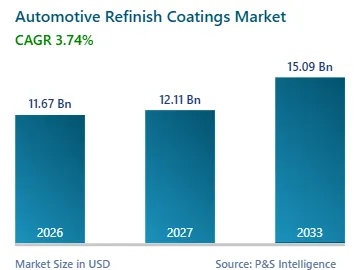
The global automotive refinish coatings market size is estimated at USD 11.67 billion in 2026, with revenue projected to reach USD 12.11 billion in 2027. By 2033, sales are projected to climb to USD 15.09 billion, a 3.74% CAGR over 2027-2033, as the global car fleet and the value of each repair rise. Collision centers, dealer body shops, and fleet workshops buy primers, basecoats, and clearcoats for every damaged panel they repair, so sales follow accident counts and fleet size more than new-vehicle output. That gives paint makers a repeat, job-by-job revenue stream.
Growth depends on how many vehicles stay in service long enough to need bodywork. The European Automobile Manufacturers' Association reports that 256 million cars were in use on EU roads in 2024, 1.4% more than a year earlier. Each additional car adds to the pool of scratched bumpers, dented doors, and sun-faded panels that body shops repaint. Suppliers that keep tinting machines, color formulas, and technical staff close to those shops tend to capture much of that recurring spend, because painters reorder from the system they already use.
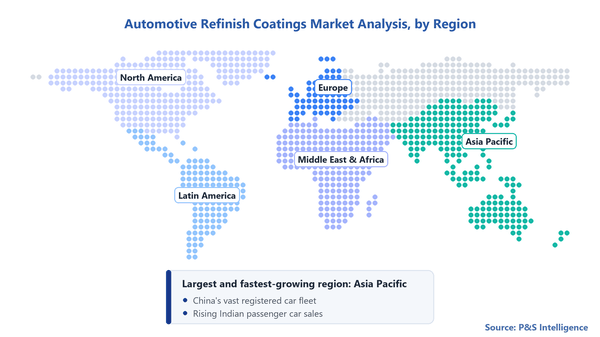
Asia-Pacific holds 37.5% of automotive refinish coatings demand in 2026 and is also set for the fastest regional growth, a 4.72% CAGR during 2027-2033. China supplies much of the volume through the sheer size of its car fleet, while India and Indonesia add first-time owners whose cars are starting to reach body shops. Japan, South Korea, and Australia contribute established dealer repair networks that buy premium multi-layer systems. North America and Europe expand more slowly because their fleets grow slowly, so suppliers there compete for the value of each repair, including water-borne upgrades and faster-curing clearcoats.
Key market insights
By product and layer type, basecoat accounts for 35.5% of revenue in 2026, while clearcoat is forecast to expand at a 4.35% CAGR over 2027-2033.
By resin type, polyurethane holds a 54.9% share in 2026, and acrylic is set to rise at a 4.54% CAGR across 2027-2033.
By technology, solvent-borne coatings represent 48.1% of 2026 revenue, while water-borne coatings are on track for a 4.37% CAGR in 2027-2033.
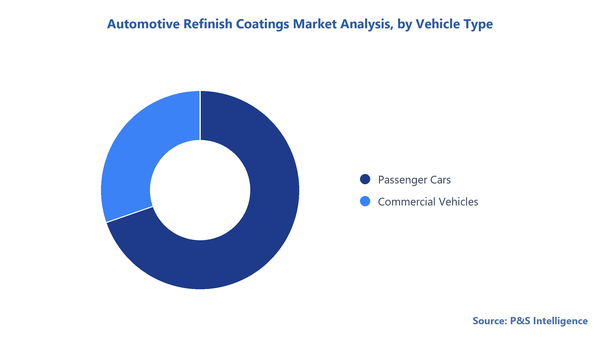
By vehicle type, passenger cars account for 69.7% of revenue in 2026.
By geography, Asia-Pacific holds 37.5% of revenue in 2026 and is also set to grow fastest, at a 4.72% CAGR during 2027-2033.
Automotive Refinish Coatings Market Dynamics
Tighter solvent emission limits are redefining body shop paint systems
Regulators are capping how much solvent a repair paint may release, and that pressure is moving body shops from solvent-borne color layers to water-borne basecoats. A conversion rarely stops at the paint. Shops usually take new mixing banks, color formulas, drying equipment, and painter training from the supplier at the same time, which turns a compliance deadline into a supply relationship lasting several years. Paint makers with complete water-borne lines tend to win those conversions.
European Union Directive 2004/42/EC limits the volatile organic compound content of refinish topcoats to 420 grams per liter of ready-to-use product, and of surfacer and general metal primers to 540 grams per liter, with both caps in force since January 1, 2007. Conventional solvent-borne basecoats typically exceed the topcoat ceiling, which helps explain why European shops moved early to water-borne color. Suppliers able to bundle compliant paint with color software and training are well placed if other countries adopt comparable limits.
Sensor-laden bodywork is driving more paint work per collision repair
More cars now carry cameras and radar units behind bumpers, grilles, and side mirrors, and that equipment is changing the size of a typical repair. A minor impact on one of these parts often means removing the panel, replacing or recalibrating the sensor, and refinishing the whole part, where a scratch on an older car might have been spot-blended. Each job therefore tends to use more primer, basecoat, and clearcoat, and it keeps the vehicle in the paint booth longer.
The U.S. Bureau of Labor Statistics counts 185,800 jobs for automotive body and glass repairers in 2025 and projects 4% employment growth over 2025-2035, partly because repairs take longer when technicians must work around a growing number of cameras and sensors. Longer jobs push shops toward paints that dry faster and cover in fewer coats. Suppliers selling quick-cure primers and high-productivity clearcoats can turn those extra repair hours into higher paint sales per claim, while shops win back booth time.
Fast-growing car fleets in emerging economies are opening new body shop accounts
Car ownership is rising quickly in economies where many collision repairs still happen in small workshops using low-cost local paint. As more new cars with multi-coat factory finishes enter these fleets, owners and dealers increasingly want color matches that cheap products struggle to deliver. That shifts work toward organized body shops buying branded primers, basecoats, and clearcoats. Each new dealer network gives a global supplier a group of accounts it can win in a single negotiation.
The Society of Indian Automobile Manufacturers reports passenger vehicle sales of 4.64 million units in India for April 2025 to March 2026, up 7.9% on the previous financial year. Every one of those cars joins the pool of vehicles that will need panel repair over its life, and much of that early work is likely to go to dealer-linked body shops. Suppliers that set up mixing centers and painter training in such markets now can lock in accounts before repair volumes peak.
Crash avoidance systems are limiting growth in collision repair volumes
Automatic emergency braking and forward collision warning are reducing low-speed rear-end crashes, which have long supplied a steady flow of bumper, hood, and tailgate repaints. As these systems spread from premium models across the whole new-car fleet, body shops may see fewer jobs per thousand vehicles on the road, even as each job becomes more complex. Paint demand in mature fleets therefore depends more on the value of each repair than on the number of repairs.
A 2017 study by the Insurance Institute for Highway Safety found that forward collision warning combined with automatic braking cut rear-end striking crash involvement rates by 50% and rear-end crashes with injuries by 56%. Fewer rear-end collisions mean fewer refinish jobs on both the front of the striking car and the rear of the struck one. Suppliers that depend on high-volume collision work in mature fleets face slower volume growth, so pricing, premium product mix, and service contracts matter more to their revenue than shop counts.
Segmentation Analysis
Product and Layer Type
Basecoat accounts for 35.5% of revenue in 2026, the largest share among product layers, because it carries the color and almost every visible repair needs it. Modern metallic and pearl finishes are hard to match, so body shops buy basecoat through tinting systems backed by large color-formula libraries and handheld spectrophotometers. Painters also spray basecoat beyond the damaged area, blending it into neighboring panels so the repair cannot be seen, which raises the volume used on each job.
Clearcoat is expected to post the quickest gains of any layer, a 4.35% CAGR during 2027-2033. Drivers and insurers judge a finished repair largely on gloss and durability, and both depend on the clear layer. Suppliers are also selling low-energy and air-dry clearcoats that free up a paint booth sooner, and these premium grades typically sell above standard products. For a shop running a fixed number of booths, faster clearcoat drying can translate into more cars finished per day.
Resin Type
Polyurethane holds 54.9% of 2026 revenue, more than any other resin, because two-component polyurethane systems give the hard, glossy, chemical-resistant finish that a repair must match against factory paint. Most refinish clearcoats and many primers are built on polyurethane chemistry, so the resin appears in nearly every job whichever basecoat a shop uses. Long acceptance in vehicle makers' approved repair procedures also makes body shops slow to switch away from it. For paint makers, that steady base protects polyurethane volumes even as shops change other parts of their paint system.
Acrylic resins are on course for the fastest growth among resin types, at a 4.54% CAGR during 2027-2033. Water-borne basecoats rely heavily on acrylic dispersions, so the resin gains each time a body shop converts its color layer away from solvent. Acrylics also dry quickly and resist fading in sunlight, which suits repair chains that compete on turnaround time. Resin producers with water-borne acrylic grades stand to win a larger slice of paint makers' raw material purchases.
Technology
Solvent-borne coatings represent 48.1% of 2026 revenue, the largest technology share, because many of the world's body shops operate where rules on refinish solvent content are less strict. Solvent systems dry reliably in humid or unheated workshops without the extra airflow equipment that water-borne paint needs, and painters trained on them need no retraining. Even shops that use water-borne color often keep solvent-borne clearcoats and primers. Suppliers therefore keep solvent-borne lines in their catalogs for these buyers while promoting water-borne systems elsewhere.
Water-borne coatings are set to grow fastest, at a 4.37% CAGR during 2027-2033. Each new or tighter solvent limit pushes shops to convert, and converted shops seldom switch back because their mixing systems, formulas, and training are tied to the water-borne line. Paint makers have also shortened water-borne drying times, closing much of the productivity gap that once deterred shops. Every conversion therefore gives a supplier the chance to hold a body shop account for many years.
Vehicle type
Passenger cars account for 69.7% of revenue in 2026 because they make up most vehicles on the road and generate most collision claims. Private owners and their insurers usually pay to restore the original appearance, which calls for exact color matching and multi-layer repairs even after minor damage. Dealer body shops and repair chains handle much of this work and buy paint under supply contracts that favor suppliers with broad color libraries and on-site technical support.
Copyright P&S Intelligence. Reuse requires attribution under CC BY 4.0.
Commercial vehicles generate the remaining demand, and their owners buy differently. Operators of trucks, vans, and buses care more about downtime and corrosion protection than showroom gloss, so they favor durable primers and topcoats that cure quickly and go on in fewer coats. Many fleets also repaint vehicles for rebranding or resale, adding jobs unrelated to accidents. Demand for automotive refinish coatings from fleet operators tends to follow freight activity, which gives suppliers with fleet color programs a steadier customer base.
The following segments are analysed in this report.
Product / Layer Type
Primer
Basecoat
Clearcoat
Topcoat
Resin Type
Acrylic
Alkyd
Epoxy
Polyurethane
Technology
Solvent-borne
Water-borne
UV-cured
Vehicle Type
Passenger Cars
Commercial Vehicles
Regional Analysis
Asia-Pacific automotive refinish coatings market outlook
Asia-Pacific holds a 37.5% share of global revenue in 2026, the largest of any region. China, Japan, India, South Korea, Australia, and Indonesia together account for a pool of cars needing bodywork that grows every year as new-car sales in China and India add to it. Japan, South Korea, and Australia also run established dealer and insurer repair networks that buy premium multi-layer paint systems, which lifts the value of each repair across the region.
Copyright P&S Intelligence. Reuse requires attribution under CC BY 4.0.
China is the region's largest market. Its Ministry of Public Security reports that 371 million automobiles were registered in the country at the end of June 2026. A fleet of that size gives paint makers a repair base few countries can match, and collision work there is likely to keep shifting from roadside workshops toward dealer and chain body shops that buy branded systems. Suppliers with local tinting plants and dealer contracts in China hold the strongest position as that shift continues.
Asia-Pacific is also on track for the fastest growth of any region, a 4.72% CAGR during 2027-2033. New vehicles from China, India, and Indonesia are steadily entering the repair stream, and dealer-linked body shops serving first-time owners in India and Southeast Asia give global brands a route into markets where local paint has long dominated. The region's share is therefore likely to rise further, and global suppliers are likely to direct more of their mixing-center and painter-training spending toward it.
North America market analysis
North America contributes a large, mature share of automotive refinish coatings demand, and growth there comes from the value of each repair more than from fleet expansion. Collision repair in the United States and Canada continues to shift toward multi-shop operators that negotiate national paint contracts, often bundling equipment, training, and business-management support with the paint itself. Those contracts usually run for several years, so winning one large operator can lock in many shops at once.
Environmental rules also shape what these shops buy. The U.S. Environmental Protection Agency's area-source rule for paint and autobody shops, known as 6H, requires filters in every spray booth that capture at least 98% of paint overspray, limits spraying to high-volume low-pressure, electrostatic, airless, or equivalent guns, and requires painters to be trained. Those obligations add fixed cost to every paint booth, which tends to favor larger shops and the suppliers that equip them. Paint makers with deep multi-shop operator relationships are best placed to win regional volume.
Europe market analysis
Europe keeps a steady share of global demand, supported by a large, aging car fleet and long experience with water-borne refinish systems. Body shops in Germany, France, the U.K., Italy, and Spain have used water-borne basecoats for years, so suppliers there compete on color-matching accuracy, booth productivity, and lower energy use instead of on conversions. Low-bake and air-dry clearcoats appeal in particular to shops facing high electricity and gas bills for their paint booths.
Germany shows how fleet age shapes buying. The Kraftfahrt-Bundesamt reports 49,486,487 passenger cars registered in Germany on January 1, 2026, with an average age of 10.9 years. Older cars are more likely to be repaired at the owner's own expense, which sends part of the work to independent shops using economy paint lines. Suppliers that offer both premium and economy brands can serve dealer body shops and independents without one line undercutting the other.
Latin America market analysis
Latin America contributes a smaller share of global demand, with Brazil and Mexico generating much of the region's body shop paint purchases. Brazil's vehicle manufacturers' association, ANFAVEA, reports that 2.69 million new vehicles were registered in the country in 2025, up 2.1% but still about 100,000 units short of the 2019 total. With new-vehicle sales below their pre-pandemic level, owners are likely to keep older cars in service longer, and in independent workshops price often decides which paint gets used. That keeps lower-priced solvent-borne products and local brands competitive.
In Mexico, dealer networks that follow vehicle makers' approved repair procedures favor global brands holding those approvals. Dealer groups and insurers in Brazil's larger cities play a similar role, steering repair work toward certified paint systems. Currency swings also raise the cost of imported resins and pigments, so suppliers with production in Brazil or Mexico can hold prices steadier than importers can. Paint makers that pair an economy line for independent workshops with a certified premium line for dealer shops are best positioned to grow across the region.
Middle East & Africa market analysis
Demand in the Middle East and Africa is smaller than in the other regions and depends mostly on climate and fleet ownership. Intense heat and sunlight in the Gulf states can fade and chalk vehicle finishes faster than in temperate climates, which supports demand for UV-resistant clearcoats and full-panel repaints. Car-dependent cities in Saudi Arabia and the United Arab Emirates, along with large government and rental fleets, send steady repair work through dealer body shops in the region.
South Africa has a well-established repair industry served by both global brands and local paint makers. Its industry body, naamsa, reports that new passenger car sales rose 20.1% to 422,292 units in 2025, helped by an influx of affordable imports from China and India. Those cars are likely to start reaching dealer body shops as owners file their first claims. Across much of the rest of Africa, price remains the main purchase criterion, and suppliers working through distributors in hubs such as Dubai and Johannesburg can reach buyers without building local plants.
The following geographies are analysed in this report.
The automotive refinish coatings market is oligopolistic, with a small group of global paint makers supplying a large share of body shops in North America and Europe and a wider set of regional producers competing across Asia-Pacific. Scale matters because a refinish supplier must keep large color-formula libraries current as vehicle makers launch new shades, and must place tinting equipment and technical staff in thousands of shops. Vehicle maker approvals for repair systems add another barrier, since dealer body shops usually buy only approved brands. Installed mixing equipment also raises the cost of switching suppliers.
Axalta Coating Systems Ltd., PPG Industries Inc., Akzo Nobel N.V., and BASF SE, whose former coatings unit now operates as Surventis, compete for multi-shop operators and dealer networks. They bundle premium water-borne systems with color software, painter training, and shop-management services. The Sherwin-Williams Company reaches body shops through its own branches as well as independent distributors. These suppliers win large accounts mostly on service depth and color accuracy. For buyers, paint price is only one part of a contract that often includes equipment and training.
Regional producers based in Japan, South Korea, and India compete across Asia on price, local distribution, and ties with domestic vehicle makers. Ownership changes at the top mean the structure is still evolving. The pending merger of Akzo Nobel N.V. and Axalta Coating Systems Ltd., if regulators clear it, would leave large body shop groups with one fewer global supplier to play against another in contract talks, which could give regional producers an opening with shops that want a second source.
Major Companies in Automotive Refinish Coatings Market:
In August 2026, Axalta Coating Systems Ltd. and Akzo Nobel N.V. won shareholder approval for their all-stock merger of equals at meetings held on the same day, leaving regulatory clearances as the main condition before a closing expected in late 2026 to early 2027. The deal would combine two major refinish brand portfolios under one owner.
In August 2026, PPG Industries Inc. launched its PPG QUICKLINE water-borne refinish system for collision repair shops in the U.S. and Canada, covering basecoats, undercoats, clearcoats, toners, and ancillary products. The line gives PPG a complete water-borne offer for North American shops that want lower solvent emissions and faster booth turnaround.
In June 2026, BASF SE completed the sale of its coatings business, including refinish coatings, to funds managed by Carlyle in partnership with the Qatar Investment Authority at an enterprise value of EUR 7.7 billion, keeping a 40% stake in the company now named Surventis. Body shops now buy those brands from a standalone coatings group run separately from BASF's chemicals portfolio.
Frequently Asked Questions About This Report
How big is the automotive refinish coatings market?+
The global automotive refinish coatings market size is estimated at USD 11.67 billion in 2026, with revenue projected to reach USD 12.11 billion in 2027.
What is the growth rate of the automotive refinish coatings market?+
By 2033, sales are projected to climb to USD 15.09 billion, a 3.74% CAGR over 2027-2033, as the global car fleet and the value of each repair rise.
Which region holds the largest share of the automotive refinish coatings market?+
Asia-Pacific holds 37.5% of automotive refinish coatings demand in 2026 and is also set for the fastest regional growth, a 4.72% CAGR during 2027-2033.
Who are the key players in the automotive refinish coatings market?+
Axalta Coating Systems Ltd., PPG Industries Inc., Akzo Nobel N.V., and BASF SE, whose former coatings unit now operates as Surventis, compete for multi-shop operators and dealer networks.
Why are body shops switching to waterborne refinish paint?+
Regulators are capping how much solvent a repair paint may release, and that pressure is moving body shops from solvent-borne color layers to water-borne basecoats.
Which resin type dominates automotive refinish coatings?+
Polyurethane holds 54.9% of 2026 revenue, more than any other resin, because two-component polyurethane systems give the hard, glossy, chemical-resistant finish that a repair must match against factory paint.
Is solvent-borne or waterborne refinish paint more widely used?+
Solvent-borne coatings represent 48.1% of 2026 revenue, the largest technology share, because many of the world's body shops operate where rules on refinish solvent content are less strict.
Want a report tailored exactly to your business need?
Leading companies across industries trust us to deliver data-driven insights and innovative solutions for their most critical decisions. From data-driven strategies to actionable insights, we empower the decision-makers who shape industries and define the future. From Fortune 500 companies to innovative startups, we are proud to partner with organisations that drive progress in their industries.
Client Testimonials
Working with P&S Intelligence and their team was an absolute pleasure – their awareness of timelines and commitment to value greatly contributed to our project's success. Eagerly anticipating future collaborations.
McKinsey & Company
India
Unmatched Standards
Our insights into the minutest levels of the markets, including the latest trends and competitive landscape, give you all the answers you need to take your business to new heights
Complete Data Security
We take a cautious approach to protecting your personal and confidential information. Trust is the strongest bond that connects us and our clients, and trust we build by complying with all international and domestic data protection and privacy laws