Automated Material Handling (AMH) Equipment Market Size & Opportunities Analysis - Growth Strategies, Competitiveness, and Forecasts (2025 - 2032)
This Report Provides In-Depth Analysis of the Automated Material Handling Equipment Market Report Prepared by P&S Intelligence, Segmented by Product (Robots, ASRS, Conveyors & Sortation Systems, Cranes, WMS, AGV), System Type (Unit Load Material Handling, Bulk Load Material Handling), Vertical (Automotive, Metals & Heavy Machinery, Food & Beverages, Chemicals, Healthcare, 3PL, Semiconductors & Electronics, Aviation, E-Commerce), and Geographical Outlook for the Period of 2019 to 2032
Automated Material Handling Equipment Market Revenue Scope
Key Highlights
Study Period
2019 - 2032
Market Size in 2024
USD 30.9 Billion
Market Size in 2025
USD 33.9 Billion
Market Size by 2032
USD 68.4 Billion
Projected CAGR
10.6%
Largest Region
Asia-Pacific
Fastest Growing Region
North America
Market Structure
Fragmented
Market Size
Major Companies
Important Takeaways
Market Size and Forecast
Industry Trend
Regulatory Landscape
Demand Trend Analysis
Companies Recent Strategical Developments
Key Stakeholders
Voice of Industry Experts/KOLs
Future Opportunity
Explore the market potential with our data-driven report
Automated Material Handling Equipment Market Outlook
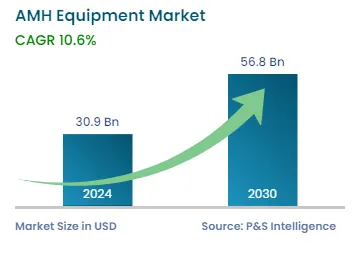
The global automated material handling (AMH) market was valued at USD 30.9 billion in 2024, which is projected to reach USD 68.4 billion by 2032, advancing at a CAGR of 10.6% during 2025–2032.
This is attributed to the rising demand for improved order accuracy, the surging need for high supply chain productivity, the maximizing customer service level, the increasing concept of warehousing, and the growing adoption of robots in material handling.
However, technological advancements, a rise in Industry 4.0 investments, and the growth in end-use industries, including e-commerce, healthcare, and automotive, are also responsible for the expansion of the market.
Additionally, e-commerce companies, such as Amazon, Alibaba, and Flipkart, are investing in AS/RS conveyors and AMRs due to the growing trend of same-day or next-day delivery.
In April 2025, Amazon announced that it was developing a same-day delivery fulfillment center at 1700 Imeson Road, with the project valued at approximately USD 16.6 million. As part of this facility, the company is also installing a conveyor system estimated to cost USD 4 million.
Furthermore, the worsening labor shortages and rising labor expenses in North America, Europe, Japan, and South Korea are driving the adoption of AMH systems to reduce reliance on manual laborers.
Moreover, the technological advancement in automotive and electronics manufacturing is raising the production in these industries, which is further driving the demand for AGVs, robotic arms, and AS/RS.
AMH Equipment Market Growth Factors
Technological Advancements and Automated Solutions Are Key Market Trends
The increasing demand for Industry 4.0, IoT, and industrial automation makes the incorporation of automated equipment simpler into systems, which, in turn, offers favorable opportunities for businesses offering automated material handling (AMH) systems. Companies are investing more to build their systems more reliable, fast, and accurate to increase productivity, reduce assembly line time, and maximize operational efficiency. For this, organizations acquire advanced products and technologies for automation, including robots, ASRS, cranes, AGV, and WMS.
Also, technologies, which are embedded in material handling systems, including data analytics and cloud connectivity, improve asset performance, and deliver real-time actionable information. The integration of these systems in various facilities provides remote-controlled operations, which help in delivering better diagnostics and lessen commissioning time. Moreover, the mounting trend of smart factories will further contribute to the market, where advanced equipment is highly employed for the pick-up, sortation, and transit of goods.
Growing demand for Faster and Real-Time Inventory Management Is Key Driver
The rising demand for real-time and faster inventory management is significantly driving the growth of the automated material handling (AMH) equipment market. The changes in the supply chains and rising order volumes are increasing the demand for automated material handling equipment.
Additionally, in industries such as electronics, pharmaceuticals, and food and beverage, the strong focus on inventory, speed, and traceability create a demand for AMH equipment. This can be integrated with RFID and barcode scanning functionalities for end-to-end tracking of products. This ensures product integrity, regulatory compliance, quicker recalls, and root-cause analysis. Furthermore, the integration of AI and advanced analytics drives AMH integration in inventory management. This helps forecast demand patterns, manage supply chain risk, and optimize reorder points.
In March 2025, Gather AI introduced Material Handling Equipment (MHE) Vision, an AI camera system that monitors pallet movements through real-time video analytics. The system is compatible with forklifts and pallet trucks. It records loading, unloading, putaway, and replenishment, enabling live dashboards and workflow management. MHE Vision does not require modifications to the existing infrastructure, and it is designed to work with any brand of material handling equipment.
Operational Downtime and Maintenance Issues Are Key Challenges
Operational downtime and maintenance issues are the key restraints for the market growth. Even though AMH systems are designed to reduce efficiency, reduce labor dependency, and optimize warehouse and manufacturing operations, they have some unplanned downtime, which can cause financial losses and customer dissatisfaction.
Preventive and predictive maintenance programs are essential for AMH equipment to eliminate the risk of failure, but they can lead to an additional cost. This creates problems for small and mid-sized users, which can further act as market challenge.
Automated Material Handling Equipment Market Segmentation and Category Analysis
Product Insights
The WMS category will witness the fastest growth during the forecast period, advancing at a CAGR of 11.2%. This can be due to the mounting count of warehouse units, the growing concern of retailers regarding the concept of warehouses, the rising freight costs, the increasing number of e-commerce platforms, the surging clod-based solution offerings by companies, the mounting need for multi-channel distribution networks, and the burgeoning global supply chain networks.
The conveyors & sortation systems category accounted for the largest revenue share, of 30%, in 2024. This is because such automated conveyors are highly employed in manufacturing units and distribution centers for conveying raw materials and finished goods; and sortation systems are employed for the identification, induction, separation, and transportation of products to specific locations. Moreover, a rise in the count of industrial operations, including manufacturing, wholesale, retail, and distribution, across all industries will create a high demand for conveyors and sortation systems in the automated material handling equipment market.
In addition, the AGV category held a significant revenue share in 2024, and it is also expected to maintain its position in the coming years. This is attributed to the rising industrialization, the mounting need for customized material handling systems, the increasing demand for timely execution of supply chain operations, and the burgeoning requirement for improving productivity and replacing manual labor in testing, as safety is a major concern. Additionally, the usage of automated forklifts and automated tows/tractors is increasing, due to the rising need for stacking and unstacking of goods, precise handling, and intralogistics operations.
Based on product, the market has the following categories:
Robots
ASRS
Conveyors & Sortation Systems (Largest Category)
Cranes
WMS (Fastest-Growing Category)
AGV
System Type Analysis
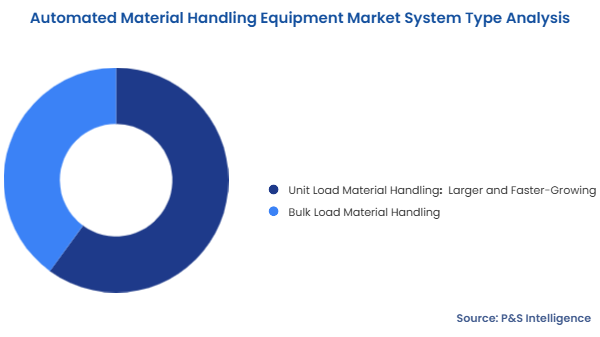
The unit load material handling category accounted for a higher revenue contribution in 2024, and it will grow at the higher CAGR of 11.3%, during the forecast period. This is ascribed to the mounting trend of smart factory and factory automation and the surging requirement to make easier the distribution and storage of products at warehouses. Also, such AMH equipment has several benefits, as it can handle multiple commodities at a time, reducing the trips and time intervals for loading and unloading.
Additionally, in the growing manufacturing industries, including metals & heavy machinery, automotive, and semiconductors & electronics, such systems are primarily employed for ongoing operations to assist prompt delivery and buffer storage in the production processes.
Furthermore, labor shortage and the rising operational cost accelerate the shift to unit load automation. It reduces the dependence on manual labor by automating repetitive tasks, such as the packing, picking, and sorting of individual items or boxes.
Moreover, the bulk load material handling category will witness significant growth in the coming years. This can be because bulk load material handling systems are highly used to transit goods from one place to other without manual labor, and in sorting the goods in huge quantities. Moreover, the burgeoning food & beverages and pharmaceutical industries create a high demand for such equipment.
Based on system type, the market has the following categories:
Unit Load Material Handling (Larger and Faster-Growing Category)
Bulk Load Material Handling
Vertical Insights
Automotive is the largest category with the largest market share of 20%, in 2024. This is due to the high reliance of the sector on automated systems, such as AS/RS, AGVs, and robotics for ensuring accurate and timely material flow across production lines.
Additionally, with the rise in the demand for electric vehicles, manufacturing units are deploying AMH equipment for new needs, such as battery pack logistics, lightweight component handling, and the integration of cleanroom-compatible equipment. Businesses are investing heavily in AMH systems for the high-precision and safe handling of automotive electrical and electronic components. As per the IEA, In 2024, worldwide sales of electric vehicles surpassed 17 million, achieving a market share exceeding 20%.
The e-commerce category will register the fastest growth during the forecast period, advancing at a CAGR of around 11.6%. This can be ascribed to the high demand for automated storage and retrieval systems (ASRSs) in the industry for storing and retrieving products from specific locations, the rising number of e-commerce platforms and online retailers, the growing preference for online shopping, and the improving logistics infrastructure.
Additionally, emerging economies such as China and India are playing a vital role in the expansion of the e-commerce sector, owing to the increasing per capita income, which leads to rising consumer spending. As per the International Trade Administration, online B2C sales around the world could touch USD 5.5 trillion in value by 2027.
Based on vertical, the market has the following categories:
Automotive (Largest Category)
Metals & Heavy Machinery
Food & Beverages
Chemicals
Healthcare
3PL
Semiconductors & Electronics
Aviation
E-Commerce (Fastest-Growing Category)
Drive strategic growth with comprehensive market analysis
Automated Material Handling Equipment Market Regional Growth Dynamics
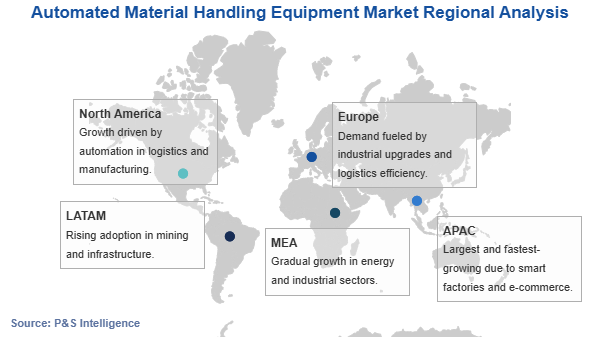
The APAC market accounted for the largest revenue share, of around 50%, in 2024, and it is further expected to maintain its dominance during the forecast period. This is ascribed to the rising number of manufacturing sites as well as manufacturing processes and warehouse units, the emerging trend for smart factories, the rising urbanization, the surging material handling practices to improve production capabilities, and the increasing count of local AMH manufacturers in the region.
Nations such as China, India, Japan, and South Korea generate the majority of revenue share in the regional market. This is due to the rising demand for AMH equipment across industrial verticals, the mounting infrastructure investment by several industries as well as governments, and the increasing foreign investments for setting up warehouses in these countries.
Furthermore, the European market will register significant growth during the predicted period. This can be because of a high acceptance rate of advanced technology, the presence of a large number of key players, the burgeoning manufacturing of industrial robots, the mounting demand for warehouse automation, and the presence of government-supporting policies for automation.
Germany contributes the largest revenue share to the regional market. This is because the nation has expertise in building heavy machinery and advanced technological industrial systems and the presence of a well-developed automotive sector in the country.
Moreover, North America will grow at the highest CAGR, of 11.7%, during the forecast period. This is ascribed to the presence of a large number of well-developed industries as well as industrial operations, a rise in the requirement for timely and accurate order fulfillment, an increase in the need to reduce industrial operational costs such as product handling and product distribution and freight, and the growth in the retail business, in the region.
The U.S. contributes the majority of the revenue share to the regional market, and it is expected to maintain its dominance in the coming years as well. This is due to the presence of a large number of industry players, high R&D spending for innovative technology used in material handling, and a rise in the development of smart solutions for last-mile delivery in the country.
Based on geography, the, the market has the following categories:
North America (Fastest-Growing Regional Market)
U.S. (Larger-Country Market)
Canada (Faster-Growing Country Market)
Europe
Germany (Largest Country Market)
U.K. (Fastest-Country Market)
France
Italy
Spain
Rest of Europe
Asia-Pacific (Largest Regional Market)
Japan
China (Largest Country Market)
India (Fastest-Growing Country Market)
South Korea
Australia
Rest of APAC
Latin America
Brazil (Largest Country Market)
Mexico (Fastest-Growing Country Market)
Rest of LATAM
Middle East and Africa
Saudi Arabia (Largest Country Market)
South Africa
U.A.E. (Fastest-Growing Country Market)
Rest of MEA
Automated Material Handling Equipment Market Share Analysis
The AMH market is fragmented in nature due to the large number of regional players in the market which are offering specialized and low-cost solutions.
Furthermore, there are diverse end users, such as e-commerce, retail, automotive, food and beverage and electronics, which demand customized AMH equipment.
Moreover, there is a rise in the number of system integrators and technology startups offering niche automation, vision systems, and robotic solutions is leading to the market fragmentation.
Key Automated Material Handling Equipment Companies:
Dematic
KION Group
Vanderlande
Swisslog
SSI Schaefer
Honeywell Intelligrated
Fives Group
Mecalux
TGW Logistics Group
Beckhoff Automation
Schaefer Systems International
Daifuku
Automated Material Handling Equipment Market Developments
In June 2025, Daifuku Co. Ltd. launched an updated robotic de-layering and singulation system with improved vision throughout for material handling environments. This update offers improved efficiency at the shop floor with robotics in material handling.
In May 2025, KION Group AG opened a highly automated spare parts distribution center in Kahl am Main, Germany, with the total investment of around EUR 90 million.
In April 2025, Daifuku Co. Ltd. enhanced its local production structure for material handling systems, increasing production space by four times. The new plant in Hyderabad, India, is part of Daifuku's intralogistics business, which offers systems for general manufacturing and distribution industries.
In March 2025, Jungheinrich AG showcased its new ETV 3i reach truck, which offers improved ergonomics and energy efficiency, at LogiMAT 2025.
Want a report tailored exactly to your business need?
Leading companies across industries trust us to deliver data-driven insights and innovative solutions for their most critical decisions. From data-driven strategies to actionable insights, we empower the decision-makers who shape industries and define the future. From Fortune 500 companies to innovative startups, we are proud to partner with organisations that drive progress in their industries.
Client Testimonials
Working with P&S Intelligence and their team was an absolute pleasure – their awareness of timelines and commitment to value greatly contributed to our project's success. Eagerly anticipating future collaborations.
McKinsey & Company
India
Unmatched Standards
Our insights into the minutest levels of the markets, including the latest trends and competitive landscape, give you all the answers you need to take your business to new heights
Complete Data Security
We take a cautious approach to protecting your personal and confidential information. Trust is the strongest bond that connects us and our clients, and trust we build by complying with all international and domestic data protection and privacy laws