Asia Pacific EV Charging Station Market Size & Share Analysis - Trends, Drivers, Competitive Landscape, and Forecasts (2026 - 2032)
This Report Provides In-Depth Analysis of the Asia Pacific EV Charging Station Market Report Prepared by P&S Intelligence, Segmented by Charging Type (AC Charging, DC Charging, Inductive Charging), Charging Infrastructure (Public, Private, Fleet), Vehicle Type (Two-Wheelers, Three-Wheelers, Passenger Cars, Commercial Vehicles), Installation Type (Fixed, Portable), and Geographical Outlook for the Period of 2021 to 2032
Asia Pacific EV Charging Station Market Revenue Insights
Key Highlights
Study Period
2021 - 2032
Market Size in 2025
USD 24.4 Billion
Market Size in 2026
USD 29.1 Billion
Market Size by 2032
USD 87.8 Billion
Projected CAGR
20.1%
Largest Country
China
Fastest-Growing Country
India
Market Structure
Fragmented
Market Size
Explore the market potential with our data-driven report
Asia Pacific EV Charging Station Market Overview
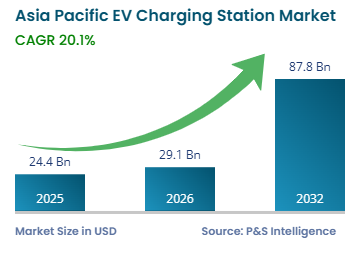
The Asia-Pacific EV charging station market size was USD 24.4 billion for 2025, and it will grow by 20.1% during 2026–2032, to reach USD 87.8 billion by 2032.
This growth is propelled by rapid EV adoption across the region, government-mandated infrastructure deployment, and large-scale public and private investment in charging networks.
The region's expansion is anchored by coordinated policy frameworks across its largest economies. The International Energy Agency confirms that global electric car sales surpassed 17 million units in 2024, representing nearly 20% of total vehicle sales, with China, India, South Korea, and Japan collectively driving the majority of Asia-Pacific's demand momentum. India's PM E-DRIVE Scheme allocates INR 2,000 crore specifically for public charging infrastructure, together reinforcing the region's structural commitment to scaling EV charging networks across passenger cars, two- and three-wheelers, and commercial fleets.
Key Market Insights
The AC charging category holds the largest market share, of 60%, in 2025, reflecting its dominant role in everyday charging across residential, workplace, and urban Level 2 installations.
The public category holds the largest market share of 55% in 2025, driven by government-backed highway deployments, urban fast-charging expansion, and high-utilization commercial installations.
The commercial vehicles category will have the highest CAGR of 20.5%, driven by electric bus procurement, fleet electrification mandates, and expanding depot charging infrastructure across China, India, and Southeast Asia.
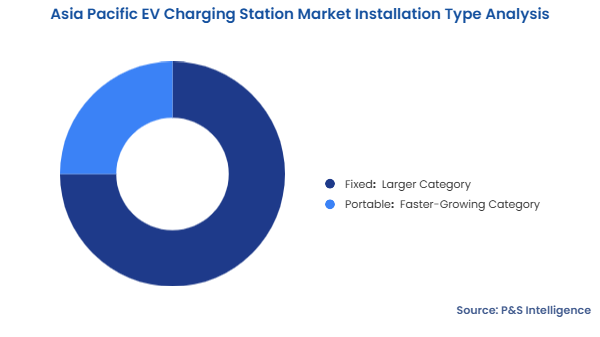
The fixed category holds the largest market share of 75% in 2025, driven by its role as the primary format for public networks, commercial sites, and fleet depots requiring permanent high-capacity connections.
China holds the largest market share, of 40%, in 2025, driven by the world's most extensive public charging network and deep policy integration between central and local governments.
Asia Pacific EV Charging Station Market Emerging Trends
Ultra-Fast and Smart Charging Technologies Are Key Trends
The Asia-Pacific EV charging station market is undergoing a fundamental technological transition, shifting from conventional Level 1 and Level 2 AC installations toward DC fast and ultra-fast charging architectures capable of delivering 150 kW or above. Simultaneously, smart charging, integrating IoT-enabled load management, real-time energy pricing, and vehicle-to-grid (V2G) bidirectional capabilities, is evolving from a niche pilot into a mainstream deployment requirement.
China's NDRC initiated 30 V2G pilot programs across nine cities in April 2025, directly embedding charging stations into national grid balancing infrastructure. This technological evolution is reshaping procurement priorities, supply chain dynamics, and competitive differentiation across the entire Asia-Pacific market as DC charger adoption accelerates and smart grid integration becomes a baseline standard. The International Energy Agency reports that public fast chargers grew by over 50% in 2024, with the global stock exceeding 2 million units.
Government Policy Mandates and Infrastructure Investment Programs Are Biggest Drivers
Coordinated government intervention across Asia-Pacific's largest economies is the primary structural driver of charging station deployment at scale. These compounding policy mandates create non-discretionary infrastructure demand, de-risk private capital, and establish long-duration procurement pipelines that sustain charging station manufacturers' revenues independent of consumer sentiment cycles.
In China, the State Council has mandated the integration of charging infrastructure into urban planning and new residential construction approvals, requiring new developments to incorporate EV charging readiness. According to the National Energy Administration data, by the end of August 2025, the country had approximately 17.35 million EV charging facilities in operation, reflecting a year-on-year increase of 53.5%. Of this total, about 4.3 million were public charging points, demonstrating the scale and effectiveness of coordinated national infrastructure policy.
Moreover, in Japan, the government has set a target to install approximately 30,000 public fast chargers by 2030 under its national Green Growth Strategy, supported through subsidies administered by the Ministry of Economy, Trade and Industry (METI), covering up to one-half of eligible installation costs for public charging infrastructure. Additionally, in South Korea, the government’s Green New Deal and carbon neutrality roadmap prioritize the expansion of nationwide EV charging infrastructure, integrating public fast-charging deployment into urban development and smart-city initiatives to support long-term electrification targets.
Two- and Three-Wheeler Electrification Is Biggest Opportunity
The electrification of two- and three-wheelers across Asia-Pacific's developing economies represents a distinct and underserved charging infrastructure opportunity. Two-wheelers are owned by a large majority of households in Indonesia, Thailand, and Vietnam and constitute the dominant transport mode across densely populated urban centers. According to ICCT estimates, China’s electric two-wheeler sales share reached 54.8% in 2024, while India, the world’s second-largest two-wheeler market, is experiencing rapid growth in electric two-wheeler adoption, reinforcing long-term charging infrastructure demand.
According to the International Energy Agency’s Global EV Outlook 2024, China, India, and ASEAN nations continue to dominate the global electric two- and three-wheeler market. According to the IEA, in 2023, China alone accounted for approximately 78% of electric two-wheeler sales, with nearly 6 million units sold, while India contributed around 880,000 units. Globally, electric 2/3Ws remain the most electrified road transport segment, reinforcing their central role in shaping charging infrastructure demand in Asia-Pacific.
Asia Pacific EV Charging Station Market Segmentation Analysis
Charging Type Analysis
The AC charging category holds the largest market share, of 60%, in 2025, reflecting its dominant role in everyday charging across residential, workplace, and urban Level 2 installations. This leadership is structurally anchored in the lower cost of AC hardware and installation compared to DC systems, a critical advantage in markets such as India, Indonesia, and Vietnam, where affordability directly determines deployment speed. Japan’s residential AC charger deployment is primarily supported through subsidy programs backed by the Ministry of Economy, Trade and Industry (METI), with utilities such as Tokyo Electric Power Company facilitating grid integration. These policy-embedded deployment channels ensure continued AC volume dominance even as higher-power DC infrastructure scales.
The DC charging category will have the highest CAGR, of 20.3%, because it enables rapid charging (typically 50–350 kW), reducing charging time to under 30–40 minutes, which is critical for highway corridors, commercial fleets, and high-utilization urban networks. Moreover, increasing battery capacities in new-generation electric vehicles is further accelerating demand for high-power DC infrastructure capable of supporting faster turnaround times and higher energy throughput.
The charging types analyzed in this report are:
AC Charging (Largest Category)
DC Charging (Fastest-Growing Category)
Inductive Charging
Charging Infrastructure Analysis
The public category holds the largest market share, of 55%, in 2025, driven by large-scale government-backed highway corridor deployments, urban fast-charging network expansion, and high-utilization commercial installations that generate greater per-site revenue compared to residential AC systems. According to the International Energy Agency, public fast chargers globally grew by more than 50% in 2024, reflecting accelerated investment in high-power public infrastructure across major Asia-Pacific markets. Indonesia’s state-owned utility Perusahaan Listrik Negara (PLN) is leading national EV charging deployment, with over 3,233 public charging units (SPKLU) installed by late 2024.
The fleet category will have the highest CAGR, of 20.2%, driven by the electrification of public transit buses, logistics trucks, and ride-hailing fleets across China, India, and Southeast Asia. China's Ministry of Transport targets 100% electrification of urban bus fleets in cities with populations exceeding 1 million by 2030, directly stimulating large-capacity dedicated depot charging infrastructure.
The charging infrastructures analyzed in this report are:
Public (Largest Category)
Private
Residential
Commercial
Fleet (Fastest-Growing Category)
Vehicle Type Analysis
The passenger cars category holds the largest market share, of 45%, in 2025, driven by the rapid electrification of personal mobility across China, South Korea, Japan, and Australia. China recorded over 9 million total NEV sales in 2023, of which BEVs accounted for over 6 million units, according to the country's Ministry of Industry and Information Technology, directly necessitating proportional expansion of supporting charging networks. Ride-hailing platforms, including Didi Chuxing in China and Grab in Southeast Asia, have deployed large-scale electric passenger fleets that require dense, accessible fast-charging access in urban environments, further reinforcing passenger car segment dominance in both public and private charging infrastructure investment decisions.
The commercial vehicles category will have the highest CAGR, of 20.5%, driven by large-scale electric bus procurement programs, fleet electrification mandates for logistics and last-mile delivery operators, and government-backed depot charging infrastructure expansion across China, India, and Southeast Asia. The acceleration of electric bus procurement, including India's PM E-Bus Sewa scheme targeting 10,000 electric buses, creates structured, non-discretionary demand for high-capacity depot and corridor charging solutions.
The vehicle types analyzed in this report are:
Two-Wheelers
Three-Wheelers
Passenger Cars (Largest Category)
Commercial Vehicles (Fastest-Growing Category)
Installation Type Analysis
The fixed category holds the largest market share, of 75%, in 2025, reflecting their structural role as the primary infrastructure format across public networks, commercial premises, and fleet depots where permanent high-capacity power connections are required. Fixed installations are the mandated deployment format under all major government programs in the region, including China's NEA Three-Year Action Plan, India's PM E-DRIVE public station scheme, and Japan's METI highway corridor targets, as they enable the power delivery ratings necessary for Level 2 and DC fast charging applications. The fixed format's compatibility with grid integration, smart metering, and V2G bidirectional systems further entrenches its dominance as the preferred deployment architecture among operators, utilities, and public agencies.
The portable category will have the highest CAGR, of 20.6%, driven by rising demand from residential EV owners in apartment-dense urban markets, particularly across India, South Korea, and Southeast Asia, where permanent fixed installation is structurally constrained by multi-dwelling unit configurations and shared parking arrangements. South Korea's Ministry of Environment's 2025 subsidy guidelines specifically allocated KRW 243 billion for smart-controlled residential chargers, supporting broader home-charging deployment and indirectly reinforcing demand for flexible charging solutions in apartment-dense urban environments.
The installation types analyzed in this report are:
Fixed (Larger Category)
Portable (Faster-Growing Category)
Drive strategic growth with comprehensive market analysis
Asia Pacific EV Charging Station Market Regional Outlook
China EV Charging Station Market Size
China holds the largest market share, of 40%, in 2025, driven by the world's most extensive public charging network and deep policy integration between central and local governments. As of May 2025, China had 14.4 million charging points in operation, roughly one for every 2.2 electric vehicles on the road, reflecting both the scale and maturity of its infrastructure ecosystem. The New Energy Vehicle Industry Development Plan targets NEVs to account for approximately 20% of new vehicle sales by 2025 and promotes technology, market expansion, and supporting infrastructure, contributing to China’s broader long-term goals of carbon neutrality by 2060, creating long-run structural demand for charging capacity.
China's National Energy Administration, in partnership with other ministries, released the Three-Year Action Plan for Doubling EV Charging Service Capacity (2025–2027), targeting 28 million charging facilities nationwide and more than 300 million kilowatts (300 GW) of public charging capacity by 2027, including 14,000 new DC chargers in rural townships and 5,000 bidirectional V2G charging units.
India EV Charging Station Market Size
India will have the highest CAGR, of 20.4%, driven by a decisive shift in government policy from purchase subsidies to large-scale charging infrastructure deployment. Public charging stations exceeded 25,000 operational sites by end-2024, rising sharply from fewer than 1,000 five years prior. The Ministry of Power's September 2024 guidelines for EV charging infrastructure installation and operation established national standards and grid-connection protocols, removing a critical administrative bottleneck by classifying EV charging as a fully de-licensed activity. Complementary state-level mandates, including Karnataka mandates that approximately 20% of parking spaces in new residential and commercial buildings be provisioned for EV charging infrastructure, in line with amendments to the Model Building Bye-Laws.
India's Ministry of Heavy Industries (MHI) notified the PM E-DRIVE scheme in September 2024 with a total outlay of INR 10,900 crore (approximately USD 1.3 billion) for FY 2024–2028, allocating INR 2,000 crore exclusively for the installation of approximately 72,000 public EV charging stations nationwide.
India's Press Information Bureau confirmed that under the FAME-II scheme, INR 839 crore was allocated for EV public charging stations, with 8,885 of 9,332 sanctioned stations installed by June 2025, extending coverage into Tier-2 and Tier-3 cities. India's forward momentum is reinforced by a national target to achieve 80% of two- and three-wheeler sales and 70% of commercial vehicle sales as EVs by 2030, ensuring multi-segment demand growth for charging infrastructure across urban and rural corridors.
The countries of the market are as follows:
China (Largest Country Market)
India (Fastest-Growing Country Market)
Japan
South Korea
Australia
Rest of Asia-Pacific
Asia Pacific EV Charging Station Market Share Analysis
The market is fragmented because it comprises a large number of regional utilities, private charging operators, oil marketing companies, automotive OEM-backed networks, and technology startups operating independently across different countries. While China has relatively concentrated domestic players, no single company controls a dominant share across the broader Asia-Pacific region. India, Japan, Thailand, Indonesia, and Vietnam each have multiple competing networks supported by local policies and partnerships. Additionally, differences in regulatory frameworks, grid infrastructure, business models, and vehicle mix further prevent market consolidation, resulting in a competitive landscape characterized by distributed ownership and diversified deployment strategies.
Key Asia Pacific EV Charging Station Companies:
Schneider Electric SE
ABB Ltd.
Tesla, Inc.
Delta Electronics, Inc.
Wanbang Digital Energy Co., Ltd.
Siemens AG
e-Mobility Power Co., Inc.
Toyota Connected Corporation
Tata Power Company Limited
Charzer Technologies Private Limited
Exicom Telesystems Limited
Wanbang Xingxing Charging Technology Co., Ltd.
BYD Company Limited
ESR Group Limited
Chargecore Global Pte. Ltd.
Asia Pacific EV Charging Station Market News
In May 2025, V-Green signed MOUs with Chargecore Global Pte. Ltd., ChargePoint Holdings, Inc., Amarta Group, and CVS to deploy approximately 63,000 EV charging ports across Indonesia by the end of 2025 in a projected USD 300 million investment.
In March 2025, BYD Company Limited launched its Super e-Platform featuring proprietary megawatt flash charging technology capable of 1,000 kW charging power and a peak charging speed of 2 km of range per second, accompanied by an all-liquid-cooled Megawatt Flash Charging terminal system and plans to establish over 4,000-Megawatt Flash Charging stations across China.
In March 2025, ESR Group Limited launched its first in-park integrated EV charging station at its Taloja Industrial & Logistics Park in Maharashtra, powered by rooftop solar energy.
In August 2024, Delta Electronics, Inc. signed an MoU with Tata Motors Limited and ThunderPlus Solutions to install up to 250 new DC fast charging stations for light commercial vehicles across 50 Indian cities, including Delhi, Mumbai, and Bengaluru, targeting dealer locations and high-traffic logistics routes to accelerate commercial EV adoption.
Frequently Asked Questions About This Report
What is the size of the Asia Pacific EV charging station market?+
The Asia Pacific EV charging station market was valued at USD 24.4 billion in 2025.
What is the growth rate of the Asia Pacific EV charging station market?+
The market is growing at a CAGR of 20.1% during the forecast period.
Which country dominates the Asia Pacific EV charging station market?+
China dominates the Asia Pacific market EV charging station market.
What are the key drivers of the APAC EV charging station market?+
Key drivers include government subsidies, emission reduction targets, increasing EV sales, investments in fast-charging infrastructure, and urbanization.
Want a report tailored exactly to your business need?
Leading companies across industries trust us to deliver data-driven insights and innovative solutions for their most critical decisions. From data-driven strategies to actionable insights, we empower the decision-makers who shape industries and define the future. From Fortune 500 companies to innovative startups, we are proud to partner with organisations that drive progress in their industries.
Client Testimonials
Working with P&S Intelligence and their team was an absolute pleasure – their awareness of timelines and commitment to value greatly contributed to our project's success. Eagerly anticipating future collaborations.
McKinsey & Company
India
Unmatched Standards
Our insights into the minutest levels of the markets, including the latest trends and competitive landscape, give you all the answers you need to take your business to new heights
Complete Data Security
We take a cautious approach to protecting your personal and confidential information. Trust is the strongest bond that connects us and our clients, and trust we build by complying with all international and domestic data protection and privacy laws