API Security Market Size & Share Analysis - Trends, Drivers, Competitive Landscape, and Forecasts (2025 - 2032)
This Report Provides In-Depth Analysis of the API Security Market Report Prepared by P&S Intelligence, Segmented by Component (API Security Platform, Services), Security Capability (API Discovery and Inventory Management, API Threat Analytics and Fraud Detection, API Posture Management, Runtime API Protection, API Security Testing, API Traffic Monitoring and Enforcement), Deployment Mode (Cloud, Hybrid, On-Premises), Organization Size (Large Enterprises, Small and Medium Enterprises), End User (Banking, financial services and insurance, Retail and E-commerce, IT and Telecom, Government, Healthcare, Manufacturing, Media and Entertainment, Energy and Utilities), and Geographical Outlook for the Period of 2021 to 2032
Explore the market potential with our data-driven report
API Security Market Overview
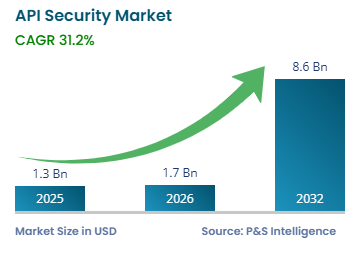
The API Security market size was USD 1.3 billion in 2025, and it will grow by 31.2% during 2026-2032, to reach USD 8.6 billion by 2032.
The API security market is expanding as application programming interfaces become a core component of modern digital infrastructure. Organisations increasingly use APIs to connect applications, cloud environments, business platforms, mobile services, and connected devices while enabling real-time data exchange across customers, partners, and internal operations. The continued adoption of cloud-native architectures, microservices development, DevSecOps practices, and platform-based business models is driving rapid growth in API volumes. As API environments become larger and more complex, organisations are placing greater emphasis on discovering unmanaged APIs, monitoring sensitive data flows, and strengthening visibility across distributed technology ecosystems.
According to the International Telecommunication Union, 5.5 billion people were online globally in 2024, representing 68% of the world's population. This expanding digital user base is increasing the volume of online services, digital transactions, mobile applications, and connected platforms that depend on APIs for communication and functionality. At the same time, organisations are facing more sophisticated attacks targeting authentication processes, business logic, and exposed API endpoints rather than traditional network vulnerabilities. These developments are increasing demand for specialised API security capabilities, including API discovery, runtime protection, behavioural analytics, posture management, and automated threat detection. Organisations across financial services, healthcare, retail, government, telecommunications, and other sectors are integrating API security into broader cybersecurity strategies to support compliance requirements, strengthen digital trust, and protect business-critical services.
Key Market Insights
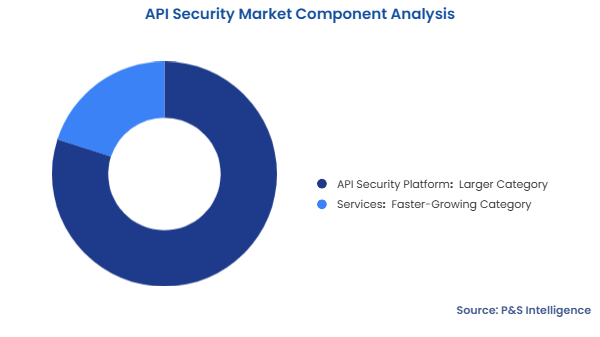
API Security Platform is the larger category, holding a market share of 80.0%, due to demand for unified API discovery, posture management, and runtime protection.
API Threat Analytics and Fraud Detection is the fastest-growing category, registering a CAGR of 31.3%, driven by rising business-logic abuse and unauthorised API calls.
Cloud is the largest category, holding a market share of 65.5%, due to cloud-native development, software-as-a-service adoption, and distributed application architectures.
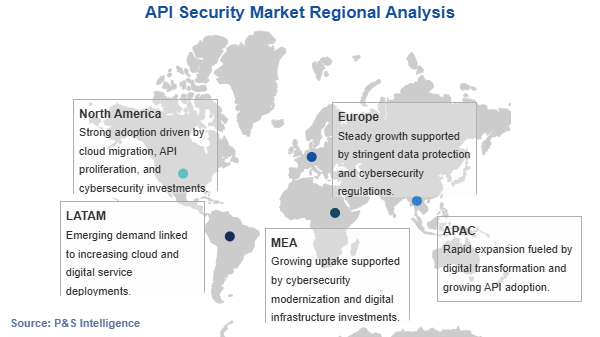
North America holds the largest share of 45.5%, due to cybersecurity vendors, cloud providers, and API-heavy enterprise software environments.
Asia-Pacific is the fastest-growing region, registering a CAGR of 32.5%, driven by digital payments, public API platforms, fintech growth, and cloud applications.
API Security Market Trends and Drivers
AI-Powered API Discovery and Behavioural Threat Detection Is a Major Trend
The API Security Market is increasingly shifting towards AI-driven security platforms that can automatically discover APIs, analyse usage behaviour, and identify suspicious activity in real time. Organisations are adopting these capabilities because API environments are becoming more dynamic across cloud platforms, microservices architectures, and third-party integrations. Traditional rule-based approaches often struggle to keep pace with rapidly changing API ecosystems and evolving attack techniques. According to ISC2, 30% of cybersecurity teams had already integrated AI security tools in 2025, while 42% were evaluating or testing them. In 2025, Salt Security launched Autonomous Threat Hunting within its API Protection Platform to connect related API activity and identify business-logic attacks. Growing adoption of AI-assisted security operations is encouraging vendors to strengthen behavioural analytics, automated threat detection, runtime protection, and API posture management capabilities. This is increasing the role of intelligent and adaptive security controls across modern API environments.
Rising API-Centric Digital Transformation Across Enterprises Drives Market
The API Security Market is growing as organisations increasingly adopt API-first strategies to accelerate digital transformation, enable seamless application integration, and support real-time data exchange across cloud, mobile, and enterprise environments. APIs have become the foundation of modern software development, connecting customer-facing applications, partner ecosystems, internal business systems, and third-party services. As enterprises expand their digital footprints, the number of APIs handling sensitive business information and critical transactions continues to rise, increasing the need for comprehensive security, governance, and continuous monitoring. According to the International Telecommunication Union (ITU), the world recorded 95 mobile-broadband subscriptions per 100 inhabitants in 2024, reflecting the continued expansion of digitally connected users and services. In addition, the Cloud Native Computing Foundation (CNCF) reported that 15.6 million developers worldwide used cloud-native technologies in 2025, while API gateways and microservices were adopted by 50% and 46% of backend developers, respectively.
Shortage of API Security Expertise and Management Complexity Restrains Market Growth
Managing API security remains a significant challenge as organisations operate increasingly complex application environments spanning multiple cloud platforms, on-premises infrastructure, microservices, and third-party integrations. APIs are continuously created, updated, and retired throughout the software development lifecycle, making it difficult for security teams to maintain complete visibility and consistent governance across all interfaces. The rapid growth of shadow APIs, undocumented endpoints, and misconfigured interfaces further increases the risk of security vulnerabilities and data exposure.
Many organisations also face a shortage of skilled cybersecurity professionals with expertise in API security, secure application development, and API governance. According to ISC2, the global cybersecurity workforce gap remained 4.8 million professionals in 2024, limiting organisations' ability to effectively identify, monitor, and secure expanding API ecosystems. As API environments become larger and more dynamic, the lack of specialised expertise makes it difficult to implement consistent security policies, conduct continuous monitoring, and respond quickly to emerging threats.
Expansion of API Security Requirements Across AI and Connected Digital Ecosystems Creates Market Opportunities
The rapid adoption of artificial intelligence, intelligent automation, and interconnected digital ecosystems is creating significant growth opportunities for API security providers. APIs serve as the foundation for communication between AI models, enterprise applications, cloud platforms, IoT devices, and third-party services, enabling seamless data exchange and automated workflows. As organisations expand the use of AI-driven applications and digital platforms, securing API interactions has become essential to protect sensitive information, maintain service integrity, and ensure regulatory compliance. According to Microsoft, 16.3% of the global population used generative AI tools in 2025, reflecting the rapid mainstream adoption of AI-powered technologies. This growing reliance on AI-driven services is increasing API traffic and expanding the number of machine-to-machine interactions, creating greater demand for solutions that can identify API vulnerabilities, monitor abnormal behaviour, and secure data exchanges across distributed environments.
API Security Market Segmentation Analysis
Component Analysis
API Security Platform is the larger category, holding a market share of 80.0%, because organisations primarily invest in unified platforms for API discovery, posture management, runtime protection, monitoring, and threat detection. Enterprises need these platforms to secure APIs across development and production environments while reducing tool fragmentation and operational complexity. According to Akamai Technologies, global web attacks reached 311 billion in 2024. This attack volume is strengthening demand for platform-based API security solutions that can improve visibility, centralise monitoring, detect suspicious activity, and protect API traffic across complex digital and cloud-native environments.
Services are the faster category, registering a CAGR of 31.7%, as organisations seek expert assistance to deploy, optimise, and manage increasingly complex API security environments. Many enterprises face skill shortages and integration challenges when implementing advanced security controls across cloud-native and hybrid infrastructures. Demand for consulting, implementation, training, and ongoing support services is rising as businesses aim to improve security effectiveness, accelerate deployment timelines, and align API protection strategies with evolving operational and compliance requirements.
The components analysed in this report are:
API Security Platform (Larger Category)
Services (Faster-Growing Category)
Design and Implementation
Consulting
Training and Education
Support and Maintenance
Security Capability Analysis
API Discovery and Inventory Management is the largest category, holding a market share of 30.5%, because organisations require complete visibility into their API assets before implementing advanced security controls. The rapid expansion of cloud computing, microservices, third-party integrations, and digital applications has significantly increased the number of APIs deployed across enterprise networks. Many organisations continue to struggle with undocumented, unmanaged, or shadow APIs that can expose sensitive data and create security vulnerabilities.
API Threat Analytics and Fraud Detection is the fastest-growing category, registering a CAGR of 31.3%, due to the increasing sophistication of API-targeted cyberattacks, including business logic abuse, credential misuse, and unauthorised API requests. Organisations are adopting advanced analytics and AI-driven detection capabilities to identify anomalous behaviour, detect malicious activity in real time, and minimise the risk of fraud across digital services. According to Postman, 51% of developers expressed concern about unauthorised or excessive API calls from AI agents in 2025.
The security capabilities analysed in this report are:
API Discovery and Inventory Management (Largest Category)
API Threat Analytics and Fraud Detection (Fastest-Growing Category)
API Posture Management
Runtime API Protection
API Security Testing
API Traffic Monitoring and Enforcement
Others
Deployment Mode Analysis
Cloud is the largest category, holding a market share of 65.5%, because modern applications, digital services, and enterprise workloads are increasingly deployed in cloud environments. Organisations prefer cloud-based API security due to scalable deployment, centralised management, and stronger support for distributed application architectures. According to the Cloud Native Computing Foundation, 15.6 million developers globally used cloud-native technologies in 2025. This cloud-native development base is increasing demand for API security tools that can protect distributed APIs, monitor activity across changing environments, and support consistent governance across software-as-a-service, microservices, and hybrid cloud deployments.
Hybrid is the fastest-growing category, registering a CAGR of 31.9%, as many organisations operate a combination of on-premises infrastructure and cloud-based applications. Businesses increasingly require security solutions that can deliver unified API protection across diverse technology environments without disrupting existing operations. Hybrid deployments offer greater flexibility for managing regulatory requirements, data residency considerations, and modernisation initiatives. As enterprises continue balancing legacy systems with digital transformation efforts, demand for hybrid API security architectures is expanding rapidly.
The deployment modes analysed in this report are:
Cloud (Largest Category)
Hybrid (Fastest-Growing Category)
On-Premises
Organisation Size Analysis
Large Enterprises are the larger category, holding a market share of 85.5%, because these organisations manage extensive API ecosystems that support customer services, partner integrations, internal applications, and digital business operations. Their complex technology environments create substantial requirements for API visibility, governance, and threat protection. Large enterprises also possess greater cybersecurity budgets and dedicated security teams, enabling broader adoption of advanced API security platforms. High exposure to operational, financial, and reputational risks further strengthens investment in comprehensive API protection capabilities.
Small and Medium Enterprises are the faster category, registering a CAGR of 32.0%, as growing digitalisation is increasing API usage across smaller businesses. Cloud-based deployment models and managed security services are making API security more accessible for organisations with limited cybersecurity staff and budgets. In 2024, only 27% of small and medium-sized enterprises in the OECD D4SME survey had robust or advanced digital security frameworks. This security gap is supporting demand for scalable and easier-to-manage API security tools that help SMEs protect customer data, meet compliance expectations, and secure expanding digital operations.
The organizations size analysed in this report are:
Large Enterprises (Larger Category)
Small and Medium Enterprises (Faster-Growing Category)
End User Analysis
Banking, Financial Services and Insurance is the largest category, holding a market share of 25.0%, because the sector relies extensively on APIs to support digital banking, payment processing, open banking, mobile financial services, customer authentication, and real-time financial data exchange. Financial institutions manage large volumes of sensitive customer information and high-value digital transactions, making APIs a critical component of their digital infrastructure. According to the World Bank, 79% of adults globally had an account with a bank, financial institution, or mobile money provider in 2024, reflecting the continued expansion of digital financial services worldwide.
Retail and e-commerce are the fastest-growing category, registering a CAGR of 31.5%, as digital commerce platforms increasingly depend on APIs to connect online storefronts, payment gateways, inventory management systems, logistics providers, and third-party marketplaces. The rapid growth of omnichannel retailing, mobile shopping, and personalised customer experiences has significantly increased API traffic and data exchange across digital commerce ecosystems.
The end users analysed in this report are:
Banking, financial services and insurance (Largest Category)
Retail and E-commerce (Fastest-Growing Category)
IT and Telecom
Government
Healthcare
Manufacturing
Media and Entertainment
Energy and Utilities
Others
Drive strategic growth with comprehensive market analysis
API Security Market Regional Analysis
North America API Security Market Analysis
North America holds the largest share, of 45.5%, because the region has one of the most mature API ecosystems and a high concentration of organisations that rely on APIs for cloud computing, enterprise software, digital banking, healthcare applications, and connected digital services. The widespread adoption of cloud-native architectures, microservices, DevSecOps practices, and API-first development has significantly increased the need for advanced API security solutions to protect sensitive data, secure application interfaces, and support regulatory compliance across diverse industries. According to the Cybersecurity and Infrastructure Security Agency (CISA), the Known Exploited Vulnerabilities (KEV) Catalog contained more than 1,300 actively exploited vulnerabilities in 2024, reflecting the rapidly evolving cyber threat landscape and the growing need for proactive cybersecurity measures across enterprise environments.
U.S. API Security Market Analysis
The United States is a major contributor to the API security market due to extensive API use across cloud platforms, digital banking, healthcare applications, and enterprise software environments. The country has a strong base of cybersecurity vendors, cloud service providers, and technology companies that support API-heavy business operations. According to the Federal Bureau of Investigation’s Internet Crime Complaint Centre, 859,532 suspected internet-crime complaints were received in 2024, with phishing, extortion, and personal data breaches among the top categories. This threat exposure is increasing demand for API security solutions that protect distributed software architectures, strengthen DevSecOps practices, and improve monitoring across interconnected digital services.
Canada API Security Market Analysis
Canada is seeing growing adoption of API security solutions as organisations expand digital service delivery, cloud transformation, and secure data exchange. Financial institutions, public agencies, healthcare providers, and mid-sized businesses are using APIs to improve service access and connect digital platforms more efficiently. According to the Communications Security Establishment Canada, Canada’s Cyber Centre blocked an average of 6.6 billion potentially malicious actions per day across protected government cyber systems in 2024. This level of threat activity is encouraging organisations to strengthen API governance, improve visibility into data flows, and deploy security tools that protect cloud-based applications and connected digital services.
Asia-Pacific API Security Market Analysis
Asia-Pacific has the highest CAGR, of 32.5%, as the region is witnessing rapid expansion of digital platforms, cloud-native applications, fintech ecosystems, e-commerce, and mobile-first services that depend extensively on APIs for secure data exchange and seamless connectivity. Governments and enterprises across emerging and developed economies are accelerating digital transformation initiatives, increasing investments in cloud infrastructure, and modernising enterprise applications, which is driving demand for advanced API security solutions. According to the GSMA, the number of mobile internet users in Asia-Pacific is projected to reach approximately 1.4 billion by 2030, supported by expanding 5G networks, rising smartphone penetration, and increasing adoption of digital services. This rapid growth in digital connectivity is significantly increasing API traffic across financial services, healthcare, retail, public platforms, and enterprise applications, creating a greater need for API discovery, runtime protection, behavioural analytics, and governance solutions.
China API Security Market Analysis
China’s API security market is supported by its large digital economy, extensive e-commerce ecosystem, and widespread use of platform-based services. APIs are central to online payments, digital marketplaces, super-app ecosystems, and enterprise software integration, where high transaction volumes require secure data exchange. According to the State Council of the People’s Republic of China, China’s online payment users surpassed 1 billion in 2024. This large payment user base is increasing the need for API protection solutions that monitor transaction flows, secure sensitive financial data, detect abnormal access patterns, and support safe application development across consumer and enterprise digital platforms.
India API Security Market Analysis
India is emerging as an important growth market as digital public services, fintech platforms, online commerce, and cloud-based enterprise applications expand rapidly. APIs connect financial institutions, businesses, government platforms, and consumers, making them essential to the country’s digital infrastructure. According to the Press Information Bureau, India’s API Setu published more than 6,000 APIs and facilitated over 312.01 crore transactions across government digital systems in 2024. This direct API usage is increasing demand for security solutions that support API discovery, governance, continuous monitoring, and protection of high-volume data exchanges across public and private digital ecosystems.
Europe API Security Market Analysis
Europe represents a significant market for API security, supported by stringent data protection regulations, increasing digitalisation, and the widespread adoption of cloud-based enterprise applications across both public and private sectors. As APIs become essential for financial services, healthcare systems, manufacturing, e-government platforms, and digital commerce, organisations are strengthening their application security strategies to safeguard sensitive data, ensure business continuity, and maintain regulatory compliance. According to Eurostat, 93% of EU enterprises implemented at least one ICT security measure in 2024, highlighting the region’s strong emphasis on protecting digital infrastructure and business systems. This growing focus on cybersecurity is encouraging organisations to invest in advanced API security solutions that provide continuous visibility, threat detection, runtime protection, and governance across increasingly interconnected digital environments.
The regions and countries analysed in this report are:
North America (Largest Regional Market)
U.S. (Larger Country)
Canada (Faster-Growing Country)
Europe
Germany (Largest Country)
U.K.
France (Fastest-Growing Country)
Italy
Spain
Rest of Europe
Asia-Pacific (Fastest-Growing Regional Market)
China (Largest Country)
India (Fastest-Growing Country)
Japan
South Korea
Australia
Rest of APAC
Latin America
Brazil (Largest Country)
Mexico
Rest of LATAM (Fastest-Growing Country)
Middle East and Africa
Saudi Arabia (Largest Country)
U.A.E. (Fastest-Growing Country)
South Africa
Rest of MEA
API Security Market Competitive Landscape
The API security market is fragmented in nature, with a broad mix of cybersecurity vendors, cloud security providers, application security specialists, API-focused security companies, and emerging startups competing across different customer segments. The market continues to attract new participants because API security requirements vary significantly based on industry, deployment environment, and organisational security maturity. Vendors are differentiating themselves through capabilities such as API discovery, runtime protection, posture management, threat analytics, and integration with broader security platforms. Continuous innovation in cloud-native security, artificial intelligence, and application protection is also encouraging the entry of specialised providers with targeted offerings. Strategic partnerships, platform integrations, and product expansion remain common competitive approaches as companies seek to strengthen their positions.
Leading Companies in the API Security Market:
Alphabet Inc.
Palo Alto Networks, Inc.
Fortinet, Inc.
Akamai Technologies, Inc.
Thales S.A.
Salt Security, Inc.
Traceable, Inc.
Data Theorem, Inc.
Wallarm, Inc.
Cequence Security, Inc.
Cloudflare, Inc.
F5, Inc.
42Crunch Limited
Broadcom Inc.
Axway Software SA
API Security Market News
In June 2026, Salt Security launched Salt Code, a component of its Agentic Security Platform designed to enforce security policies across AI-generated code workflows. The solution enables policy governance throughout code generation, CI/CD validation, and runtime operations while identifying APIs, MCP servers, and AI agent integrations across code repositories and cloud environments.
In March 2026, Cloudflare launched the open beta of its Web and API Vulnerability Scanner as part of its API Shield platform. The solution introduced dynamic application security testing (DAST) capabilities to proactively identify API vulnerabilities, including Broken Object Level Authorization (BOLA), strengthening API discovery, security testing, and runtime protection for enterprise applications.
In July 2025, Palo Alto Networks completed the acquisition of Protect AI for approximately USD 500 million to strengthen its AI security portfolio. The acquisition expanded the company's capabilities in AI model security, AI runtime protection, posture management, AI red teaming, and AI agent security through its Prisma AIRS platform, enabling organisations to secure AI applications and modern cloud-native environments more effectively.
In April 2025, Cequence Security entered into a strategic partnership with Inspira Enterprise to deliver an advanced API security solution. The collaboration combines Cequence's Unified API Protection platform with Inspira's cybersecurity expertise to help organisations defend against API-based threats, including malicious bots, business logic abuse, and automated attacks, while ensuring secure and seamless digital experiences.
In June 2024, Akamai Technologies completed the acquisition of API security company Noname Security for approximately USD 450 million. The acquisition expanded Akamai's API Security portfolio by strengthening capabilities in API discovery, posture management, runtime protection, and threat detection, enabling organisations to secure APIs across hybrid, multi-cloud, and on-premises environments.
Frequently Asked Questions About This Report
What does the API security market include for organizations?+
It includes tools that discover, protect, test, monitor, and control APIs used by applications, partners, and digital services.
What factors are driving demand in the API security market?+
Growth is driven by API based applications, cloud platforms, mobile services, open banking, and rising attacks on exposed endpoints.
Why are organizations adopting API security solutions across operations?+
Organizations adopt API security to prevent unauthorized access, data exposure, abuse, and attacks that target business logic.
How do API security solutions improve decision making and efficiency?+
These solutions improve protection by mapping API assets, enforcing authentication, detecting abnormal traffic, and blocking risky requests.
What challenges affect adoption of API security solutions today?+
Adoption is affected by shadow APIs, complex authorization, fast development cycles, inconsistent documentation, and limited visibility across environments.
Want a report tailored exactly to your business need?
Leading companies across industries trust us to deliver data-driven insights and innovative solutions for their most critical decisions. From data-driven strategies to actionable insights, we empower the decision-makers who shape industries and define the future. From Fortune 500 companies to innovative startups, we are proud to partner with organisations that drive progress in their industries.
Client Testimonials
Working with P&S Intelligence and their team was an absolute pleasure – their awareness of timelines and commitment to value greatly contributed to our project's success. Eagerly anticipating future collaborations.
McKinsey & Company
India
Unmatched Standards
Our insights into the minutest levels of the markets, including the latest trends and competitive landscape, give you all the answers you need to take your business to new heights
Complete Data Security
We take a cautious approach to protecting your personal and confidential information. Trust is the strongest bond that connects us and our clients, and trust we build by complying with all international and domestic data protection and privacy laws