This Report Provides In-Depth Analysis of the Anatomic Pathology Market Report Prepared by P&S Intelligence, Segmented by Product (Consumables, Instruments), Test Type (Histopathology, Cytopathology, Surgical Pathology), Technique (Special Staining, Immunohistochemistry, Electron Microscopy, Genetic Testing), Application (Disease Diagnosis, Drug Discovery), End User (Hospitals and Clinics, Diagnostic Laboratories, Ambulatory Surgical Centers, Academic and Research Organizations), and Geographical Outlook for the Period of 2021 to 2032
Explore the market potential with our data-driven report
Anatomic Pathology Market Future Outlook
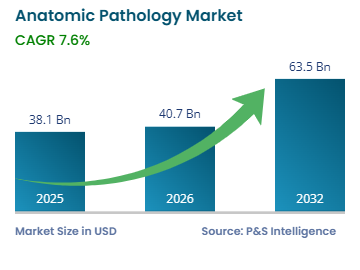
The anatomic pathology market size will be an estimated USD 38.1 billion for 2025, and it will grow by 7.6% during 2026–2032, to reach USD 63.5 billion by 2032.
The market growth is primarily driven by the growing need for precision and speed in diagnosing cancer and other chronic conditions, which are expanding the global burden of disease. Therefore, the demand for anatomic pathology to examine tissues and organs through microscopy will continue to grow, as it currently represents one of the most direct methods to achieve this goal.
New technologies are changing how anatomic pathology workflows are conducted and evaluated through the use of artificial intelligence, digital image systems, and automated analytical platforms. And, as such, they offer a means to enhance the efficiency and accessibility of pathology services and to reduce the time required for the provision of diagnostic information. The availability of biomarker-based diagnostic testing and companion diagnostic testing platforms also has the potential to expand the market for anatomic pathology by providing a mechanism for delivering targeted treatments to individual patients based on their unique molecular characteristics.
Anatomic Pathology Market Dynamics
Digital Pathology and AI Integration Are Key Trends
The rapid development of digital pathology represents a paradigm shift in how pathologists examine tissue samples.
The technology behind whole slide imaging (WSI) allows for high-resolution scanning of glass slides, which creates opportunities for remote consulting, telepathology services and international collaboration amongst pathologists.
The approval of several digital pathology systems by the FDA for use as a primary diagnostic tool has facilitated the adoption of these technologies in a clinical setting and acceptance of these technologies by regulatory bodies.
AI-based technologies are transforming the ability of pathologists to accurately diagnose diseases and improve efficiency in their workflow.
AI-based image analysis tools have shown a high accuracy in identifying cancerous cells in breast tissues; this has reduced the number of diagnostic errors made by pathologists and improved patient care.
Machine learning algorithms can help pathologists identify subtle morphological characteristics within tissue samples, quantify levels of biomarkers, and predict the effectiveness of treatments.
The investment into AI enabled pathology solutions continues to expand at a rapid pace. Companies such as Deciphex have raised approximately EURO 31 million to develop AI enabled diagnostic platforms.
In addition to addressing many of the issues associated with shortages of pathologists, workflow bottlenecks and variability in diagnoses, these technologies will also enhance the quality and consistency of pathological assessments in healthcare settings.
Growing Cancer Burden Is Biggest Driver
The ever-increasing number of people being diagnosed with cancer is driving the growth of the anatomic pathology industry worldwide.
Cancer has become the second most common cause of death world-wide; approximately one out of every five individuals will develop cancer during their life time.
The World Health Organization estimates that there were 20 million new cancer cases in 2022 and that there were 9.7 million cancer-related deaths around the globe.
The increasing prevalence of cancer, including demographic trends such as an increase in the size of global populations, are expected to increase cancer incidence by approximately 77% by 2050.
Older adults experience a much higher risk for cancer than younger populations and, as such, require more comprehensive pathology assessments to diagnose and stage them, as well as develop treatment plans for them.
There are also geographic disparities in cancer outcomes that illustrate the need for developing pathology infrastructures.
High income countries are typically able to provide superior diagnostic services and cancer treatment outcomes compared to lower and middle income countries that have significant gaps in pathology services.
These differences in cancer outcomes and access to pathology services have created an increased investment in pathology laboratory technology, training programs, and other diagnostic technologies to improve access to diagnostic services and ultimately cancer care on a global basis.
Anatomic Pathology Market Segmentation Analysis
Product Analysis
The consumables category holds the largest market share, of 65%, in 2025, due to the majority of consumable products, such as reagents, antibodies, stains, and specialized kits used in routine pathological testing, being repeatedly used in various types of anatomic pathology tests, such as histopathology, immunohistochemistry, and molecular, performed in all pathology laboratories. The repeated purchase of consumables is a reflection of their necessary use in anatomic pathology testing workflows across all pathology laboratories.
The instruments category will have the highest CAGR, due to increased use of technology and upgrades to laboratory infrastructure. Digital pathology scanners, automated tissue processors and high-resolution imaging systems represent large capital expenditures which increase the efficiency of laboratory operations and improve the ability to conduct diagnostics in pathology laboratories. Additionally, the incorporation of artificial intelligence (AI) enabled analytical tools and telepathology platforms into pathology laboratories will also drive the adoption of new instruments in health care institutions.
The products analyzed in this report are:
Consumables (Larger Category)
Reagents
Fixatives
Stains & dyes
Others
Antibodies
Kits
Probes
Others
Instruments (Faster-Growing Category)
Tissue processors
Slide stainers
Microtomes
Centrifuges
Cryostats
Others
Type Analysis
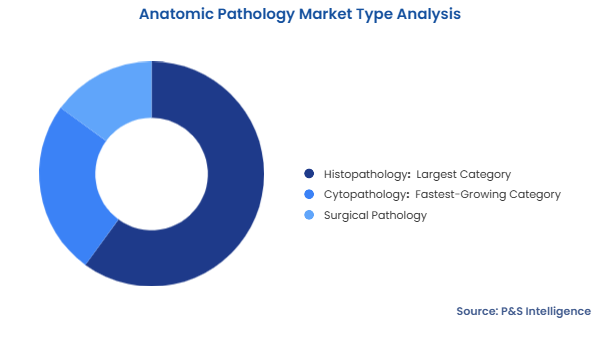
The histopathology category holds the largest market share, of 60%, in 2025, and is considered to be the most widely used anatomic pathology technique. Histopathology is the microscopic examination of tissue samples to determine if there are any structural changes or disease-related changes present in the tissue sample being examined. Histopathology is essential for diagnosing diseases and conditions of tissues and organs and is used across all areas of medical specialties and is therefore expected to generate strong demand for products and services associated with this technique.
The cytopathology category will have the highest CAGR, of 7.9%, as it has been increasingly used in the early detection of cancers and other conditions using minimally invasive diagnostic methods. The use of liquid-based cytology techniques, fine needle aspiration procedures, cervical cancer screening programs, and the increased use of molecular testing with cytological samples will drive the growth of the cytopathology segment.
The types analyzed in this report are:
Histopathology (Largest Category)
Cytopathology (Fastest-Growing Category)
Surgical Pathology
Technique Analysis
The special staining category holds the largest market share, of 45%, in 2025, due to the importance of special staining techniques in the characterization of tissues and the diagnosis of diseases. Special staining techniques provide pathologists with the capability to highlight specific structures of cells, identify microorganisms, and differentiate between different tissue components utilizing selective staining protocols. Due to the variety and specificity of special staining techniques they are a necessary tool utilized by pathologists in all pathology subspecialties.
The immunohistochemistry category will have the highest CAGR, as it uses the interaction between an antibody and an antigen to detect specific proteins in tissue samples, thereby providing pathologists with the ability to precisely identify cellular markers that are important for the diagnosis, classification, and selection of therapy for cancers. The development of new antibodies and automated staining platforms will further expand the capabilities of immunohistochemistry.
The techniques analyzed in this report are:
Special Staining (Largest Category)
Immunohistochemistry (Fastest-Growing Category)
Electron Microscopy
Genetic Testing
Others
Application Analysis
The disease diagnosis category holds the largest market share, of 70%, in 2025, due to widespread use of anatomic pathology in the diagnosis of cancer, inflammation, infections and degenerative diseases will result in continuous demand for diagnostic services. Anatomic pathology provides critical information for treatment planning, assessment of prognosis and management of patients across all medical specialties.
The drug discovery category will have the highest CAGR, of 7.8%, reflecting increased investment by the pharmaceutical industry in research on biomarkers and development of companion diagnostics. Anatomic pathology supports preclinical research, endpoints for clinical trials, and regulatory submissions utilizing standard protocols for analyzing tissue samples. Integration of digital pathology and AI-enabled analysis platforms will further support the capabilities of pharmaceutical companies and accelerate the time it takes to develop drugs.
The applications analyzed in this report are:
Disease Diagnosis (Larger Category)
Cardiology
Oncology
Hepatology
Nephrology
Others
Drug Discovery (Faster-Growing Category)
Others
End User Analysis
The hospitals & clinics category holds the largest market share, of 50%, in 2025. Hospitals and clinics are the major providers of pathology services to integrated healthcare delivery systems. As part of these systems, hospitals and clinics operate large pathology departments supporting the clinical activities, patient care, and diagnostic needs of multiple medical specialties. The quantity and diversity of pathology samples processed in hospital-based laboratories will create a consistent need for products and services related to anatomic pathology.
The diagnostic laboratories category will have the highest CAGR, driven by increasing contracting of pathology services and the need for specialized testing. Independent pathology laboratories provide expert services in complex molecular testing, digital pathology services and subspecialty consultation that supplement the capabilities provided by hospital-based pathology laboratories. The efficiency and cost effectiveness of centralizing laboratory operations will support continued growth in the independent diagnostic laboratory segment.
Drive strategic growth with comprehensive market analysis
Anatomic Pathology Market Geographical Analysis
North America Anatomic Pathology Market Size
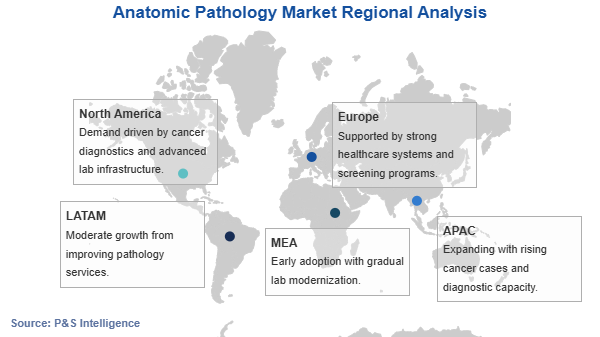
North America holds the largest market share, of 45%, in 2025, due to the fact that North America has a well-developed healthcare system, a large number of research studies are being conducted there, and a high rate of adoption of innovative anatomic pathology technologies and methods. The presence of several major players such as Quest Diagnostics, LabCorp, and key instrument vendors provides a strong competitive advantage in the region.
U.S. Anatomic Pathology Market Size
In North America, the United States is the largest market. Based on estimates provided by the American Cancer Society, approximately 2 million cancer patients will be diagnosed in the United States in 2025; therefore, the demand for pathology services is expected to be very strong.
The U.S. Food and Drug Administration(FDA) has been providing regulatory support for digital pathology and artificial intelligence (AI)-enabled diagnostic tools; thereby accelerating the adoption of these technologies. In addition, several platforms have received FDA clearance for primary diagnosis. Furthermore, the Federal Government has established two programs that provide funding for genomic research and personalized medicine development: the Precision Medicine Initiative and the Cancer Moonshot Program. These programs have strengthened the overall market fundamentals in the anatomic pathology space.
Canada Anatomic Pathology Market Size
Canada is also a significant growth opportunity within North America, as Canada is growing healthcare investments, and aging population demographics are expected to create strong demand for pathology services. A universal healthcare system exists in Canada; therefore, comprehensive cancer screening programs and diagnostic services are available to all Canadian citizens, which will provide consistent demand for anatomic pathology products and services across each province's network of health organizations.
Asia-Pacific Anatomic Pathology Market Size
Asia-Pacific will have the highest CAGR, of 7.7%, due to the rapidly expanding healthcare infrastructure and increasing disease burdens in the region. With approximately 60 percent of the world's population residing in the Asia-Pacific region, along with rapidly developing economies such as China and India, the anatomic pathology market presents a substantial business opportunity for pathology service providers.
China Anatomic Pathology Market Size
China reported the largest patient population in the region and one of the largest healthcare systems by total volume; therefore, it has the largest market share in the Asia-Pacific region. The World Health Organization (WHO) reported that China had the largest global cancer burden at 4.57 million new cancer diagnoses in 2020. The Chinese government has committed to modernizing and digitizing the country's healthcare systems, which will result in continued market growth in terms of diagnostic infrastructure.
Japan Anatomic Pathology Market Size
Japan has a mature pathology market; however, there is a focus on technological innovation and precision medicine applications. Japan's aging population and high standards for healthcare result in a need for highly advanced pathology services, and Japanese companies play a significant role in the global development of instruments and technologies for pathology.
The regions and countries of the market are as follows:
North America (Largest Regional Market)
U.S. (Larger and Faster-Growing Country)
Canada
Europe
Germany (Largest Country)
U.K.
France (Fastest-Growing Country)
Italy
Spain
Rest of Europe
Asia-Pacific (Fastest-Growing Regional Market)
China (Largest Country)
India (Fastest-Growing Country)
Japan
South Korea
Australia
Rest of APAC
Latin America
Brazil (Largest Country)
Mexico (Fastest-Growing Country)
Rest of LATAM
Middle East and Africa
Saudi Arabia (Largest Country)
South Africa
U.A.E. (Fastest-Growing Country)
Rest of MEA
Anatomic Pathology Market Share
The market is a fragmented, competitive environment that includes many large, well-established players as well as smaller, newer technology-based companies. Leading market participants maintain their positions through continuous investment in digital pathology platforms, AI-enabled diagnostics, and automated laboratory workflows. As a result of the need for laboratories, technology companies and pharmaceutical companies to create comprehensive diagnostic platforms, strategic alliances among these types of entities have increased in importance. By partnering with each other, they can utilize their respective capabilities to create a comprehensive solution, as well as share the cost of research and development and the associated risk.
Key Anatomic Pathology Companies:
Thermo Fisher Scientific Inc.
Danaher Corporation
F. Hoffmann-La Roche Ltd.
Quest Diagnostics Incorporated
Bio-Rad Laboratories Inc.
Agilent Technologies Inc.
NeoGenomics Laboratories Inc.
Abbott Laboratories
Sonic Healthcare Limited
Anatomic Pathology Market News
In June 2025, Leica Biosystems unveiled its new generation of digital pathology products, which include high-performance scanners and intelligent software to facilitate rapid image analysis, increase interoperability, and support telepathology initiatives.
In May 2025, NeoGenomics Inc. released c-MET CDx for the use in the testing of advanced non-small cell lung cancer, which allows for a rapid 48-hour test turnaround time to support clinicians making prompt treatment decisions that can lead to improved patient outcomes.
In March 2025, Metropolis Healthcare Limited completed the acquisition of Scientific Pathology to increase its diagnostic services capabilities within western Uttar Pradesh and to strengthen its position in India’s rapidly developing health care marketplace.
In April 2024, Medline Industries, LP stated it is positioned as the exclusive direct distributor for Epredia, the world’s leading provider of anatomical pathology solutions, to enhance patients’ access to precision cancer diagnosis capabilities.
Frequently Asked Questions About This Report
What is the anatomic pathology market size in 2025?+
The market for anatomic pathology market values USD 38.1 billion in 2025.
What factors are driving the adoption of digital pathology and AI in the anatomic pathology market?+
The anatomic pathology industry is driven by the rising prevalence of cancer and chronic diseases, along with increasing adoption of digital pathology and AI-based diagnostic tools.
Which product category holds the largest share in the anatomic pathology market?+
Consumables dominate the anatomic pathology market.
What is the anatomic pathology market analysis by region, and which region is growing the fastest?+
North America is the largest anatomic pathology market, while Asia-Pacific is the fastest-growing region.
Who are the major players in the anatomic pathology market, and how is the competitive landscape evolving?+
The anatomic pathology market is fragmented, with the presence of large multinational companies and specialized diagnostic service providers.
Want a report tailored exactly to your business need?
Leading companies across industries trust us to deliver data-driven insights and innovative solutions for their most critical decisions. From data-driven strategies to actionable insights, we empower the decision-makers who shape industries and define the future. From Fortune 500 companies to innovative startups, we are proud to partner with organisations that drive progress in their industries.
Client Testimonials
Working with P&S Intelligence and their team was an absolute pleasure – their awareness of timelines and commitment to value greatly contributed to our project's success. Eagerly anticipating future collaborations.
McKinsey & Company
India
Unmatched Standards
Our insights into the minutest levels of the markets, including the latest trends and competitive landscape, give you all the answers you need to take your business to new heights
Complete Data Security
We take a cautious approach to protecting your personal and confidential information. Trust is the strongest bond that connects us and our clients, and trust we build by complying with all international and domestic data protection and privacy laws