AI Model Risk Management Market Size & Share Analysis - Trends, Drivers, Competitive Landscape, and Forecasts (2026 - 2032)
This Report Provides In-Depth Analysis of the AI Model Risk Management Market Report Prepared by P&S Intelligence, Segmented by Offering (Software, Services), Deployment Mode (Cloud, On-Premises), Model Type (Statistical Models, Machine Learning Models, Deep Learning Models), Risk Category (Security Risk, Ethical Risk, Operational Risk, Compliance & Regulatory Risk), Application (Fraud Detection & Risk Reduction, Model Inventory Management, Regulatory Compliance Monitoring), Industry Vertical (BFSI, Retail & E-commerce, IT & Telecommunications, Manufacturing, Healthcare & Life Sciences, Media & Entertainment, Government & Public Sector), and Geographical Outlook for the Period of 2021 to 2032
Explore the market potential with our data-driven report
AI Model Risk Management Market Overview
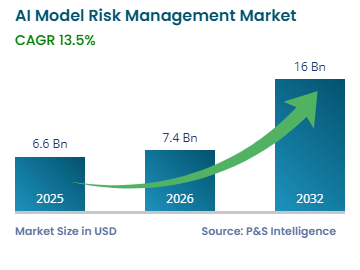
The AI model risk management market size was USD 6.6 billion for 2025, and it will grow by 13.5% during 2026–2032, to reach USD 16.0 billion by 2032.
The market growth is driven by the movement of machine learning and generative AI systems from pilot environments into credit underwriting, claims adjudication, network operations, and clinical decision support, where model failure carries direct financial and legal consequences. Legacy model governance relied on spreadsheet inventories and periodic validation cycles built for static statistical models. Deep learning architectures and foundation-model APIs have invalidated that approach, as these systems drift continuously, resist interpretation, and often originate with third-party vendors outside the deploying institution's control.
The increasing formalization of AI governance through internationally recognized standards and regulatory frameworks is further accelerating enterprise investment in AI model risk management solutions. Organizations are adopting structured governance frameworks to standardize model validation, risk assessment, documentation, and continuous monitoring while preparing for evolving regulatory requirements across industries. ISO/IEC 42001 was published in December 2023 as the world's first artificial intelligence management system standard, providing requirements for organizations to identify, assess, and treat AI-specific risks throughout the AI lifecycle. Moreover, NIST released its AI Risk Management Framework in January 2023, organizing AI risk management around four core functions, Govern, Map, Measure, and Manage, to provide enterprises with a common framework for auditable model oversight.
Key Market Insights
The software category holds the larger market share, of 75%, in 2025, due to growing demand for AI model governance, monitoring, and compliance platforms.
The cloud category holds the larger market share, of 80%, in 2025, and will record the higher CAGR, of 13.8%, due to scalable AI governance and cloud-native deployment.
The security risk category holds the largest market share, of 40%, in 2025, driven by rising concerns over AI model security and cyber threats.
The ethical risk category will have the highest CAGR, of approximately 14.1%, due to growing demand for responsible AI, fairness, and transparency.
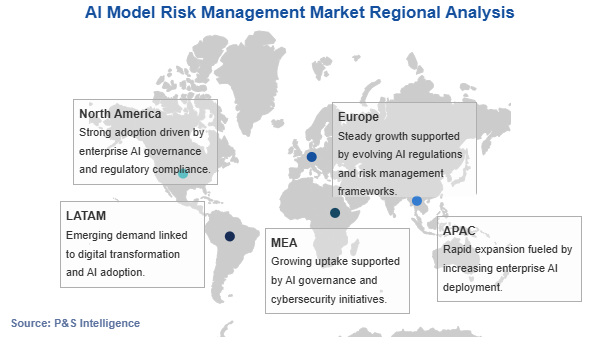
North America holds the largest market share, of 40%, in 2025, driven by its mature regulatory framework and early adoption of model risk management practices.
AI Model Risk Management Market Trends and Drivers
Generative and Agentic Systems Are Key Trends
The rapid adoption of generative and agentic AI across enterprises is reshaping governance requirements as organizations deploy increasingly autonomous and dynamic AI systems. Traditional model validation was designed for bounded models with fixed inputs, measurable error rates, and periodic retraining. Generative AI systems challenge traditional validation approaches by producing open-ended outputs, exhibiting dynamic behavior, and relying on third-party foundation models beyond organizations' direct control, increasing the need for continuous governance and oversight. Agentic AI also increases oversight complexity by enabling autonomous, multi-step decision-making and tool execution, requiring organizations to extend oversight beyond model performance to operational behavior. This shift also increases concerns related to explainability, accountability, and continuous risk monitoring across AI deployments.
Vendors are redesigning AI model risk management platforms to incorporate output evaluation, provenance tracking, guardrail enforcement, continuous monitoring, and incident management rather than relying solely on statistical model validation. The National Institute of Standards and Technology (NIST) reinforced this shift through the Generative AI Profile (NIST AI 600-1), which identifies 12 risk categories unique to or exacerbated by generative AI and recommends more than 400 actions to help organizations govern, map, measure, and manage these risks. This evolution is expanding enterprise investment in AI model risk management solutions, with enterprises increasingly adopting generative and agentic AI governance capabilities as enhancements to existing model governance frameworks rather than complete replacements.
Supervisory Mandates and Systemic Risk Designations Are Biggest Drivers
Model governance has evolved from an internal quality function into a regulatory and supervisory priority, increasing enterprise investment in AI model risk management. As financial authorities place greater emphasis on model risk, governance, and AI oversight, organizations are strengthening governance frameworks to demonstrate regulatory compliance, improve model transparency, and maintain auditable records throughout the AI lifecycle. This shift is accelerating demand for platforms that support model validation, documentation, approval workflows, continuous monitoring, and performance tracking. In Europe, the AI Act introduced obligations for providers of general-purpose AI (GPAI) models from August 2025. Additionally, GPAI models trained with more than 10²⁵ FLOPs are presumed to present systemic risk and are subject to enhanced requirements, including model evaluation, risk assessment, incident reporting, and cybersecurity measures, further increasing enterprise demand for AI governance solutions.
The Financial Stability Board (FSB) identifies model risk, data quality, and governance as one of four AI-related vulnerabilities with the potential to increase systemic risk and calls on authorities to assess whether existing policy frameworks are sufficiently comprehensive while strengthening regulatory and supervisory capabilities. The four vulnerabilities identified by the FSB are third-party dependencies, market correlations, cyber risks, and model risk, data quality, and governance. In response, financial institutions are expanding model validation functions and replacing static document repositories with AI governance platforms that maintain live model inventories, automated monitoring, and auditable compliance records. As supervisory expectations continue to expand beyond banking into insurance, healthcare, and critical infrastructure, enterprise investment in AI model risk management platforms is expected to accelerate.
Immature Assurance Methods and Scarce Specialist Talent Are Key Restraints
Immature AI assurance methodologies and the shortage of skilled professionals remain key restraints on the AI model risk management market. Organizations increasingly recognize the need for AI governance, but effective implementation depends on robust model evaluation techniques and personnel capable of validating complex AI systems against technical, security, and regulatory requirements. Current approaches for testing robustness against adversarial attacks, hallucinations, and autonomous agent behavior are still evolving, making it difficult for enterprises to consistently assess model reliability and operational risk before deployment. Organizations often delay or limit the rollout of AI governance solutions, particularly for large-scale or business-critical AI applications.
The National Institute of Standards and Technology (NIST) documents adversarial attacks specific to large language models (LLMs), retrieval-augmented generation (RAG) systems, and agent-based AI, while noting that existing mitigation techniques have important limitations. In addition, effective model assurance requires expertise across machine learning, cybersecurity, statistical validation, and regulatory compliance, a combination that remains in limited supply. These challenges increase implementation complexity, extend deployment timelines, and raise the cost of operationalizing AI governance frameworks. Although evaluation methodologies and managed AI assurance services are expected to mature over time, these technical and talent constraints are likely to remain significant barriers to broader market adoption during the early years of the forecast period.
Supplier Concentration and Substitutability Gaps Are Biggest Opportunities
The increasing reliance on third-party foundation models, specialized AI compute, and cloud infrastructure has created a structural gap between organizational accountability and direct oversight. Enterprises remain responsible for the outcomes produced by AI models they neither trained nor fully control, while the market for these technologies remains concentrated among a limited number of providers. This structural gap is driving demand for AI model risk management solutions that provide continuous third-party model assurance, supplier attestation management, model provenance tracking, and concentration risk assessment. These capabilities enable organizations to strengthen oversight of externally sourced AI systems.
The Financial Stability Board (FSB) highlights the dependence of generative AI on a limited number of key suppliers and recommends monitoring indicators that assess the criticality, concentration, and substitutability of third-party AI service providers. Organizations are increasingly investing in AI model risk management platforms that support procurement, third-party risk management, and operational resilience alongside traditional model validation. For instance, IBM introduced new capabilities in June 2025 that integrate watsonx.governance with Guardium AI Security, enabling unified governance and security for agentic AI through third-party AI oversight, agent auditing, and governance controls across externally sourced AI models and applications. As regulatory frameworks increasingly extend third-party risk management and AI governance requirements to external AI suppliers and service providers, demand for these capabilities is expected to strengthen.
AI Model Risk Management Market Segmentation Analysis
Offering Analysis
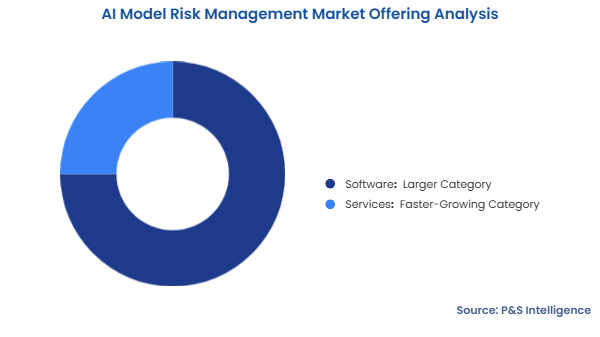
The software category holds the larger market share, of 75%, in 2025, because organizations require centralized platforms to manage AI model inventories, validation, monitoring, explainability, and regulatory compliance throughout the model lifecycle. As enterprises deploy more machine learning and generative AI models, software platforms provide continuous governance and automated risk monitoring. This demand is further supported by the EU AI Act, which introduces mandatory governance, documentation, and transparency requirements for high-risk and general-purpose AI systems, increasing the need for AI governance software.
The services category will have the higher CAGR, of approximately 13.7%, because many organizations lack the internal expertise needed to implement, validate, monitor, and continuously govern increasingly complex AI models. As enterprises expand the use of generative AI and agentic AI, they require consulting, integration, regulatory advisory, and managed services to deploy governance frameworks effectively and maintain ongoing compliance. The continuous evolution of AI regulations and governance standards is further increasing demand for long-term professional and managed services.
The offerings analyzed in this report are:
Software (Larger Category)
Services (Faster-Growing Category)
Deployment Mode Analysis
The cloud category holds the larger market share, of 80%, in 2025, and it will have the higher CAGR, of approximately 13.8%, because it enables organizations to deploy AI governance solutions rapidly, scale model monitoring across distributed environments, and integrate seamlessly with cloud-native AI development and MLOps platforms. Cloud deployment also reduces upfront infrastructure costs while supporting continuous software updates and centralized governance. Supporting this adoption, Eurostat reported that 45.2% of enterprises in the European Union purchased cloud computing services in 2023, up from 38.9% in 2021, reflecting the growing preference for cloud-based enterprise software platforms. As organizations continue migrating AI workloads to the cloud, demand for cloud-based AI model risk management solutions is expected to grow faster than on-premises deployments.
The deployment modes analyzed in this report are:
Cloud (Larger & Faster-Growing Category)
On-Premises
Model Type Analysis
The machine learning models category holds the largest market share, of 60%, in 2025, driven by their widespread adoption across industries such as banking, insurance, healthcare, retail, manufacturing, and telecommunications for applications including fraud detection, credit scoring, predictive maintenance, medical imaging, and demand forecasting. Their extensive enterprise deployment creates sustained demand for model validation, monitoring, explainability, and regulatory compliance throughout the AI lifecycle. Supporting this leadership, the U.S. Food and Drug Administration (FDA) has authorized more than 1,000 AI-enabled medical devices through established premarket pathways, demonstrating the extensive deployment of machine learning technologies in highly regulated environments where robust model governance is essential.
The deep learning models category will have the highest CAGR, driven by the rapid adoption of generative AI, large language models (LLMs), computer vision, speech recognition, and autonomous AI systems across enterprises. Deep learning models are more complex, computationally intensive, and less interpretable, increasing the need for advanced model validation, explainability, bias detection, robustness testing, and continuous monitoring throughout their lifecycle. Supporting this expansion, the U.S. Department of Energy (DOE) identified 16 federal sites in 2025 for AI data center and energy infrastructure development to accelerate deployment of advanced AI technologies, reflecting the growing investment in compute-intensive deep learning applications.
The model types analyzed in this report are:
Statistical Models
Machine Learning Models (Largest Category)
Deep Learning Models (Fastest-Growing Category)
Risk Category Analysis
The security risk category holds the largest market share, of 40%, in 2025, driven by the increasing need to protect AI models from adversarial attacks, data poisoning, model theft, prompt injection, and unauthorized access throughout the AI lifecycle. As enterprises deploy AI in mission-critical operations, securing models and their underlying data has become a fundamental requirement for maintaining business continuity and protecting sensitive information. This growing focus on AI security is reflected in the UK Government's Cyber Security Breaches Survey 2025/2026, which found that 45% of large businesses and 39% of medium-sized businesses had adopted AI tools, while only 24% of businesses using or adopting AI had implemented security practices to manage AI-related risks, highlighting the significant need for AI security risk management solutions.
The ethical risk category will have the highest CAGR, driven by increasing concerns over algorithmic bias, transparency, fairness, accountability, and the responsible use of generative AI across high-impact applications. Organizations are investing in AI governance solutions to detect bias, improve explainability, and ensure human oversight as AI adoption expands. The European Union's AI Act establishes mandatory requirements for high-risk AI systems, including risk management, transparency, human oversight, and data governance, significantly increasing demand for ethical AI risk management solutions.
The risk categories analyzed in this report are:
Security Risk (Largest Category)
Ethical Risk (Fastest-Growing Category)
Operational Risk
Compliance & Regulatory Risk
Others
Application Analysis
The fraud detection & risk reduction category holds the largest market share, in 2025, driven by the extensive use of AI models in banking, financial services, insurance, and digital payments to detect fraudulent transactions, assess credit risk, and strengthen anti-money laundering (AML) controls. These high-impact applications require continuous model validation, monitoring, explainability, and performance assessment to minimize financial losses and ensure reliable decision-making.
The regulatory compliance monitoring category will have the highest CAGR, of approximately 13.9%, driven by the introduction of AI-specific regulations and increasing governance requirements across industries. Organizations are investing in AI model risk management solutions to automate compliance monitoring, maintain audit trails, generate regulatory documentation, and continuously assess AI models against evolving legal and industry standards. This demand is reinforced by the European Union AI Act, which introduces mandatory risk management, documentation, transparency, and post-market monitoring obligations for high-risk AI systems, accelerating investment in AI compliance monitoring solutions.
The BFSI category holds the largest market share, of 25%, in 2025, driven by the extensive use of AI models for fraud detection, credit risk assessment, anti-money laundering (AML), customer onboarding, algorithmic trading, and regulatory compliance. Financial institutions operate in highly regulated environments where AI models must be continuously validated, monitored, and audited to ensure transparency, fairness, and regulatory compliance. The European Central Bank (ECB) reported that more than 85% of banks under European banking supervision use artificial intelligence, highlighting the widespread deployment of AI in the banking sector and reinforcing the need for robust AI model risk management frameworks.
The IT & telecommunications category will have the highest CAGR, driven by the rapid deployment of generative AI, cloud-native AI services, intelligent network automation, cybersecurity, and AI-powered customer support solutions. As technology providers integrate increasingly complex AI models into digital infrastructure and enterprise platforms, demand for continuous model monitoring, explainability, governance, and security is rising rapidly. This accelerating adoption is reflected in the European Commission's State of the Digital Decade 2025 report, which states that 13.5% of EU enterprises were using AI technologies in 2024, underscoring the expanding adoption of AI across digital industries and the growing need for AI model risk management.
The industry verticals analyzed in this report are:
BFSI (Largest Category)
Retail & E-commerce
IT & Telecommunications (Fastest-Growing Category)
Manufacturing
Healthcare & Life Sciences
Media & Entertainment
Government & Public Sector
Others
Drive strategic growth with comprehensive market analysis
AI Model Risk Management Market Geographical Analysis
North America AI Model Risk Management Market Size
North America holds the largest market share, of 40%, in 2025, driven by its mature regulatory framework and early adoption of model risk management practices. U.S. banking regulators formalized model risk management as a standalone discipline more than a decade before AI entered mainstream enterprise use, providing a strong foundation for AI model governance. North American institutions hold mature model inventories, independent validation functions, and three-lines-of-defense structures that AI-specific tooling extends rather than replaces. Procurement therefore involves incremental capability purchases against established budget lines rather than programme creation from zero. The majority of governance platform providers are headquartered in the region, reinforcing North America's position while compressing implementation timelines and support latency. U.S. Census Bureau Business Trends and Outlook Survey data shows that AI use among U.S. businesses ranged between 17% and 20% from December 2025 through May 2026, while the same survey recorded 20% to 23% of businesses expecting to adopt AI within the following six months.
The Office of the Superintendent of Financial Institutions (OSFI) confirms that Guideline E-23 on Model Risk Management takes effect on 1 May 2027 and applies to all federally regulated financial institutions, including foreign bank branches and insurers, while providing explicit guidance for AI and machine learning models. Additionally, Canada is the fastest-growing country market in the region, as the implementation of OSFI Guideline E-23 expands model risk management expectations across federally regulated financial institutions, including insurers and foreign bank branches.
U.S. AI Model Risk Management Market Size
The U.S. is the largest country market in North America, driven by entrenched prudential expectations in banking and a high concentration of AI-intensive enterprises beyond the financial services sector. The U.S. regulatory landscape is shaped by sectoral regulators and state legislatures rather than a single comprehensive federal AI statute, driving demand for configurable AI model risk management platforms that can address diverse regulatory requirements.
The Board of Governors of the Federal Reserve System established supervisory guidance SR 11-7, which defines expectations for model validation, model inventory, and governance across quantitative models regardless of the underlying methodology. This methodology-neutral scope enables financial institutions to extend established model risk management frameworks to machine learning and AI models without requiring a separate governance regime. Federal Reserve research based on the Survey of Business Uncertainty estimates that 78% of the U.S. labor force works at firms that have adopted AI, while approximately 54% works at firms using large language models. This expansion of AI deployment across the labor force is increasing the need for AI model risk management solutions.
Asia-Pacific AI Model Risk Management Market Size
Asia-Pacific will have the highest CAGR, of approximately 14.4%, driven by rapid enterprise AI adoption and increasing investment in governance capabilities alongside the transition from legacy model validation frameworks. Organizations are increasingly implementing integrated AI governance platforms to support regulatory compliance, model oversight, and risk management. Regulatory frameworks are evolving alongside AI adoption, accelerating enterprise investment in AI model risk management solutions. The Reserve Bank of India (RBI) published the Framework for Responsible and Ethical Enablement of Artificial Intelligence (FREE-AI) in August 2025. FREE-AI is built around seven guiding principles (7 Sutras) and comprises 26 actionable recommendations organized under six strategic pillars.
India is the fastest-growing country market, supported by recommendations for board-approved AI policies and AI incident reporting that are expected to increase demand among banks, non-banking financial companies (NBFCs), and fintech firms. The IndiaAI Mission, with an outlay of more than INR 10,300 crore over five years, is accelerating AI infrastructure, innovation, and responsible AI adoption across the country, creating favorable conditions for increased investment in AI model risk management solutions. Japan, South Korea, and Australia are expected to support market growth through sector-specific AI governance initiatives. Regulatory diversity across the region continues to create opportunities for vendors offering flexible, multi-jurisdiction AI model risk management platforms.
China AI Model Risk Management Market Size
China is the largest country market within Asia-Pacific, driven by a filing and registration regime that is functionally compulsory model governance, where providers of generative AI services with public opinion or social mobilization attributes must complete registration, producing recurring documentation, security assessment, and content control obligations that generate sustained tooling demand independent of voluntary risk appetite. The Cyberspace Administration of China (CAC) reported that as of November 2025, the total number of registered generative AI services reached 611, alongside 306 registered generative AI applications or functions.
Demand skews toward domestic platform vendors given data localization requirements and procurement preferences, limiting addressable share for international suppliers. Successive measures on content labeling and algorithm filing continue to broaden the compliance surface, and growth is expected to remain concentrated in financial services, internet platforms, and state-owned enterprises.
The regions and countries analyzed in this report are:
North America (Largest Regional Market)
U.S. (Larger Country)
Canada (Faster-Growing Country)
Europe
Germany (Largest Country)
U.K. (Fastest-Growing Country)
France
Italy
Spain
Rest of Europe
Asia-Pacific (Fastest-Growing Regional Market)
China (Largest Country)
India (Fastest-Growing Country)
Japan
South Korea
Australia
Rest of APAC
Latin America
Brazil (Largest Country)
Mexico (Fastest-Growing Country)
Rest of LATAM
Middle East and Africa
Saudi Arabia (Fastest-Growing Country)
South Africa
U.A.E. (Largest Country)
Rest of MEA
AI Model Risk Management Market Competitive Landscape
The market is fragmented, with numerous technology companies, analytics providers, AI governance specialists, and consulting firms competing across different segments of the value chain. The market evolved from distinct domains, including banking model risk management, machine learning operations (MLOps), and governance, risk, and compliance, enabling vendors with diverse expertise to establish specialized offerings. No single company dominates the market, and enterprises select vendors based on industry requirements, regulatory needs, and existing technology ecosystems. Competition is further intensified by the rapid emergence of generative AI and evolving regulatory frameworks, which continue to attract new entrants focused on explainability, bias detection, continuous monitoring, and AI governance. Frequent product innovation, partnerships, and acquisitions are expanding solution portfolios while maintaining a diverse and competitive vendor landscape.
Leading Companies in the AI Model Risk Management Market:
IBM Corporation
SAS Institute Inc.
DataRobot, Inc.
H2O.ai, Inc.
ModelOp, Inc.
ValidMind Inc.
Fair Isaac Corporation
Microsoft Corporation
Amazon Web Services, Inc.
Google LLC
Dataiku Inc.
Monitaur, Inc.
AI Model Risk Management Market Developments
In February 2025, ValidMind Inc. partnered with Experian plc to integrate its AI governance platform with the Experian Ascend Platform, automating model documentation, validation, governance, and regulatory compliance for financial institutions.
In May 2024, Amazon Web Services, Inc. partnered with IBM Corporation to integrate Amazon SageMaker with IBM Corporation watsonx.governance, enabling enterprises to automate AI model governance, risk management, and regulatory compliance.
In May 2023, Microsoft Corporation partnered with DataRobot, Inc. to integrate Azure OpenAI Service, Azure Machine Learning, and Azure Kubernetes Service with the DataRobot platform, helping enterprises build, deploy, govern, and monitor AI models more effectively.
Frequently Asked Questions About This Report
Why is AI model risk management becoming essential for enterprises?+
It helps organizations identify, monitor, and mitigate AI risks such as bias, model drift, security vulnerabilities, and regulatory non-compliance, ensuring trustworthy AI deployment.
How do AI regulations impact the adoption of AI model risk management platforms?+
Regulations such as the EU AI Act and the NIST AI Risk Management Framework are driving organizations to adopt AI governance, monitoring, and compliance solutions.
How does generative AI increase model risk management requirements?+
Generative AI introduces risks such as hallucinations, privacy concerns, and biased outputs, increasing the need for governance, validation, and continuous monitoring.
How does AI model risk management support regulatory compliance?+
It provides model validation, documentation, audit trails, monitoring, and governance controls to help organizations meet AI regulatory and compliance requirements.
Want a report tailored exactly to your business need?
Leading companies across industries trust us to deliver data-driven insights and innovative solutions for their most critical decisions. From data-driven strategies to actionable insights, we empower the decision-makers who shape industries and define the future. From Fortune 500 companies to innovative startups, we are proud to partner with organisations that drive progress in their industries.
Client Testimonials
Working with P&S Intelligence and their team was an absolute pleasure – their awareness of timelines and commitment to value greatly contributed to our project's success. Eagerly anticipating future collaborations.
McKinsey & Company
India
Unmatched Standards
Our insights into the minutest levels of the markets, including the latest trends and competitive landscape, give you all the answers you need to take your business to new heights
Complete Data Security
We take a cautious approach to protecting your personal and confidential information. Trust is the strongest bond that connects us and our clients, and trust we build by complying with all international and domestic data protection and privacy laws