This Report Provides In-Depth Analysis of the Agricultural Ventilation Fans Market Report Prepared by P&S Intelligence, Segmented by Product (Circulation Fans, Exhaust Fans, Duct Fans, Portable Fans), Application (Greenhouse, Dairy/Livestock, Equine), and Geographical Outlook for the Period of 2021 to 2032
Explore the market potential with our data-driven report
Agricultural Ventilation Fans Market Overview
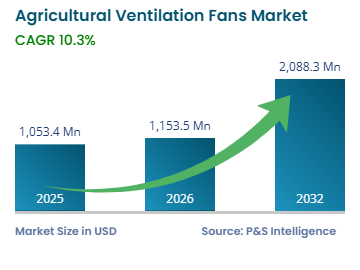
The agricultural ventilation fans market size was USD 1,053.4 million for 2025, and it will grow by 10.3% during 2026–2032, to reach USD 2,088.3 million by 2032.
This growth is driven by the intensifying need for precise climate control across livestock housing and controlled-environment cultivation, where mechanical airflow directly governs animal welfare, crop yield, and biosecurity. As farm operators contend with rising thermal stress and denser stocking densities, ventilation systems have shifted from optional infrastructure to an operational necessity that underpins productivity.
The structural scaling of protected agriculture and intensive livestock production is expanding the market. According to the OECD–FAO Agricultural Outlook 2025–2034, global meat production reached approximately 365 million tonnes in 2024, with poultry leading this growth. The continued expansion of intensive poultry farming is increasing demand for efficient ventilation systems that maintain air quality, regulate temperature, and safeguard animal health. The Food and Agriculture Organization (FAO) estimates that livestock supply chains account for approximately 14.5% of global anthropogenic greenhouse gas emissions. This emissions profile is increasing the emphasis on efficient barn ventilation systems that improve air quality, regulate humidity, and reduce ammonia concentrations. These conditions position energy-efficient, sensor-integrated agricultural ventilation fans as critical enablers of compliant, high-throughput production.
Key Market Insights
The circulation fans category holds the largest market share, of 40%, in 2025, due to their versatile airflow management.
The exhaust fans category will have the highest CAGR, of approximately 10.8%, driven by the rising adoption of mechanical ventilation in intensive livestock farming.
The dairy/livestock category will have the highest CAGR, of approximately 10.6%, driven by increasing investments in modern livestock farming.
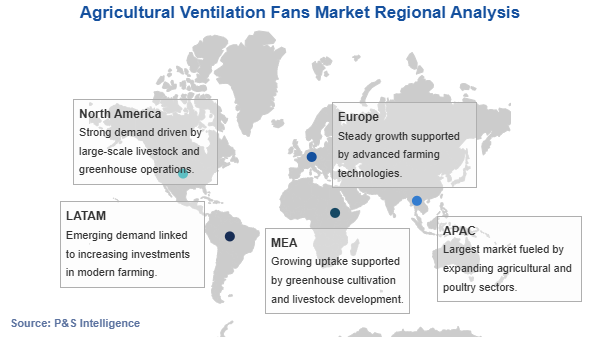
Europe holds the largest market share, of 40%, in 2025, driven by its strong livestock sector and stringent animal welfare regulations.
Asia-Pacific will have the highest CAGR, of approximately 11.2%, driven by expanding livestock production and greenhouse cultivation.
Agricultural Ventilation Fans Market Dynamics
Sensor Integration and Energy-Efficient Motor Adoption Are Key Trends
The agricultural ventilation fans market is witnessing a shift from conventional fixed-speed fans to intelligent, sensor-integrated, variable-speed ventilation systems equipped with energy-efficient electronically commutated (EC) motors. Automated controllers and environmental sensors are redefining ventilation by dynamically adjusting airflow based on real-time temperature, humidity, and ammonia levels rather than operating at a constant speed. This approach reduces energy consumption, the largest lifetime operating cost of ventilation systems, while improving climate precision, animal welfare, and crop-growing conditions inside livestock housing and greenhouses. The transition reflects the broader digitalization of agriculture, where connected equipment enables data-driven environmental management and operational efficiency. This trend is reflected in industry developments such as Munters Group AB's launch of the Speria platform in May 2026, which integrates controllers, sensors, software, analytics, and digital services for livestock and greenhouse operations, reinforcing the industry's transition toward connected climate-control and precision farm management.
Regulatory developments are accelerating this shift, with the European Union's Ecodesign Regulation (EU) 2019/1781 introducing stricter minimum energy efficiency requirements for electric motors and variable speed drives, becoming applicable in phases from July 2021 with additional requirements taking effect from July 2023. These requirements are driving manufacturers to adopt high-efficiency direct-drive and electronically commutated (EC) motor technologies. As energy efficiency standards continue to tighten globally, intelligent, energy-efficient ventilation systems are expected to replace conventional AC fan designs. This transition is strengthening demand for advanced agricultural ventilation fans with integrated controls, monitoring capabilities, and optimized energy performance.
Escalating Heat Stress and Intensive Livestock Density Are Biggest Drivers
Rising thermal load across livestock production regions is compelling farm operators to treat mechanical ventilation as essential infrastructure for biosecurity, animal welfare, and productivity. As stocking densities increase and ambient temperatures climb, heat stress directly suppresses feed conversion efficiency, milk yield, growth rates, and reproductive performance, making effective thermal management an economic necessity. Agricultural ventilation fans help maintain the temperature-humidity index (THI) within acceptable ranges by improving air circulation, reducing heat buildup, controlling humidity, and removing harmful gases such as ammonia. Fan installation has evolved from a discretionary upgrade to a critical investment that supports production efficiency across both new-build and retrofit livestock facilities.
According to the joint Food and Agriculture Organization (FAO) and World Meteorological Organization (WMO) report on Extreme Heat and Agriculture, most livestock species begin to experience negative physiological responses when temperatures exceed approximately 25°C while chickens and swine become susceptible to heat stress above around 24°C. The report highlights that increasingly frequent and intense heat events are reducing livestock productivity and increasing mortality risks. These conditions reinforce the need for efficient ventilation systems that maintain animal welfare, regulate barn temperatures, and sustain commercial livestock production.
High Energy Costs and Capital Intensity Are Key Restraints
Despite structural demand, the high upfront investment and ongoing electricity costs associated with advanced ventilation systems continue to limit adoption among smallholder and resource-constrained farms. Sophisticated fan arrays equipped with automated controls and energy-efficient motors require considerable capital investment, while continuous operation increases electricity expenses. In many developing economies, where farm margins are thin and power supply is costly or unreliable, producers often delay or scale back ventilation investments, slowing modernization despite expanding livestock production. This economic barrier reduces the pace of technology adoption and limits the market potential for advanced agricultural ventilation solutions in price-sensitive regions.
Although the adoption of solar-powered ventilation solutions and lower-cost electronically commutated (EC) motor technologies is expected to improve affordability over time, high capital and operating costs will continue to restrain market penetration in developing economies during the near term.
Controlled-Environment Agriculture Expansion Is Biggest Opportunity
The scaling of protected cultivation, including greenhouses, vertical farms, and indoor growing facilities, is opening an adjacent demand pool beyond traditional livestock housing. As food security concerns, climate variability, and urbanization drive investment in controlled-environment agriculture (CEA), each new facility requires precise airflow management for temperature regulation, humidity control, and CO₂ distribution, generating first-fit demand for agricultural ventilation fans. This opportunity is pronounced in water-scarce and climate-vulnerable regions where open-field farming is becoming increasingly challenging.
According to the Food and Agriculture Organization of the United Nations (FAO), for every 1°C increase in global warming, average yields of major staple crops such as maize and wheat are projected to decline by approximately 4–10%, highlighting the growing need for climate-resilient agricultural production systems. This need is encouraging greater investment in controlled-environment agriculture, where advanced ventilation systems help regulate temperature, humidity, and air circulation to maintain optimal growing conditions, improve crop quality, and enhance production reliability. This investment creates a durable growth pathway for fan suppliers able to serve horticultural airflow specifications alongside livestock applications.
The circulation fans category holds the largest market share, of 40%, in 2025, due to their versatility in providing uniform airflow across livestock housing and greenhouses. They provide uniform airflow, improve cooling efficiency, and maintain optimal indoor conditions. Their widespread use across naturally and mechanically ventilated facilities has established them as the most extensively deployed ventilation product. Their ability to enhance animal comfort and environmental conditions reinforces this position. The University of Wisconsin–Madison Division of Extension, The Dairyland Initiative, reports that circulation fans are essential for enhancing evaporative cooling and maintaining adequate air movement in dairy heat-abatement systems.
The exhaust fans category will have the highest CAGR, of approximately 10.8%, driven by the increasing adoption of mechanical and tunnel ventilation systems in intensive poultry and swine production. As livestock housing becomes more densely populated, exhaust fans play a critical role in removing excess heat, moisture, dust, and ammonia while maintaining the high air exchange rates required for animal health and productivity. The Pennsylvania State University Extension reports that tunnel ventilation systems using large exhaust fans can achieve complete barn air exchange in less than 45 seconds, demonstrating their effectiveness in modern livestock ventilation.
The products analyzed in this report are:
Circulation Fans (Largest Category)
Exhaust Fans (Fastest-Growing Category)
Duct Fans
Portable Fans
Others
Application Analysis
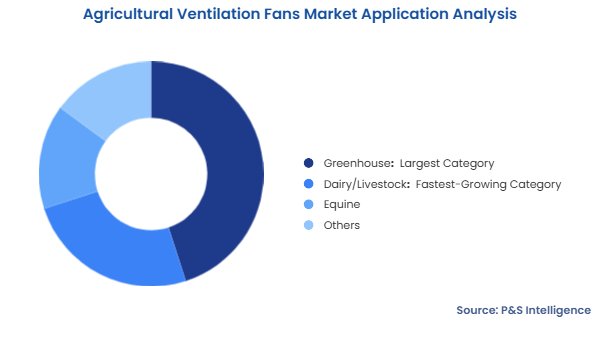
The greenhouse category holds the largest market share, of 45%, in 2025, driven by the expanding adoption of controlled-environment agriculture and the critical role of ventilation in maintaining optimal growing conditions. Effective airflow regulates temperature, humidity, and CO₂ distribution, supporting plant health, crop quality, and productivity while preventing heat buildup and excess moisture. The increasing cultivation of high-value fruits, vegetables, and ornamental crops in greenhouses has strengthened demand for advanced ventilation solutions. The integration of automated climate-control systems reinforces this demand, making greenhouse cultivation the largest application for agricultural ventilation fans.
The dairy/livestock category will have the highest CAGR, driven by expanding livestock production and an increasing emphasis on mitigating heat stress to improve animal welfare, milk yield, and overall productivity. As producers adopt more intensive housing systems, effective ventilation has become essential for maintaining healthy indoor environments by regulating temperature, controlling humidity, and removing excess heat and harmful gases. Growing investments in modern livestock housing and precision livestock farming are expected to accelerate the adoption of advanced ventilation systems across dairy and livestock operations.
The applications analyzed in this report are:
Greenhouse (Largest Category)
Dairy/Livestock (Fastest-Growing Category)
Equine
Others
Drive strategic growth with comprehensive market analysis
Agricultural Ventilation Fans Market Regional Outlook
Europe Agricultural Ventilation Fans Market Size
Europe holds the largest market share, of 40%, in 2025, driven by dense dairy and livestock infrastructure, stringent animal welfare regulations, and a substantial protected-cultivation base. The concentration of specialist dairy and cattle operations across the region creates durable, regulation-led demand for circulation and exhaust ventilation systems. EU animal welfare and livestock housing requirements that promote proper ventilation and environmental control reinforce this demand. Northwest Europe's temperate, high-rainfall livestock belts and the Mediterranean's extensive greenhouse clusters broaden the application base.
According to Eurostat, the European Union had 8.8 million agricultural holdings in 2023. Specialist livestock farms accounted for 20.6% of these holdings. The EU's bovine herd totalled 71.9 million head and its pig population reached 132.1 million head in December 2024. This scale of livestock production relies on efficient ventilation systems that maintain air quality, regulate temperature, and support animal welfare. Moreover, Germany is the largest country market, supported by its position as the European Union's leading raw milk producer and its extensive commercial dairy farming sector, which generates strong demand for agricultural ventilation systems. France is the fastest-growing country market, driven by expanding poultry meat production, increasing investments in modern poultry housing, and the rising adoption of advanced ventilation solutions.
Asia-Pacific will have the highest CAGR, of approximately 11.2%, driven by the modernization of livestock production and greenhouse expansion across China, India, and Southeast Asia. The transition from backyard farming to technology-driven, capital-intensive agricultural operations is generating large-scale demand for mechanical ventilation systems. Rising protein consumption and government initiatives to strengthen food security are accelerating investment in modern livestock housing and controlled-environment agriculture.
According to the Ministry of Fisheries, Animal Husbandry and Dairying, Government of India, India's livestock sector grew at a CAGR of 12.99% from 2014–15 to 2022–23. Milk production reached 239.30 million tonnes in 2023–24. The continued expansion and modernization of livestock farming across the region are increasing the adoption of agricultural ventilation fans that maintain optimal air quality, regulate temperature and humidity, and improve animal health and productivity.
China Agricultural Ventilation Fans Market Size
China is the largest country market within Asia-Pacific and a primary engine of global demand, driven by the world's largest livestock complex and an accelerating shift toward vertically integrated, industrial-scale housing. The consolidation of swine and poultry production into large, capital-intensive facilities directly drives adoption of high-capacity exhaust and circulation ventilation systems for climate control, air quality management, and biosecurity.
According to the National Bureau of Statistics of China, total red meat and poultry production reached 96.63 million tonnes in 2024. During the year, 702.56 million pigs were slaughtered and the national pig inventory stood at 427.43 million head at the end of 2024. The scale and continued modernization of China's commercial livestock and poultry sectors are driving sustained demand for agricultural ventilation fans that regulate temperature, control humidity, reduce harmful gases, and support animal health and productivity.
North America Agricultural Ventilation Fans Market Size
North America represents a mature, high-penetration market, driven by large-scale confined animal feeding operations and expanding controlled-environment agriculture. The scale of U.S. dairy, poultry, and swine housing propels adoption, where mechanical ventilation is standard for thermal management and ammonia control. A well-established retrofit cycle for energy-efficient EC-motor systems adds to this demand. Regional demand also benefits from established distribution networks and domestic manufacturing capabilities, while growth is expected to remain steady as operators upgrade legacy fans to improve energy efficiency, enhance animal welfare, and comply with evolving environmental and ventilation standards.
According to the U.S. Department of Agriculture (USDA), the United States produced approximately 9.4 billion broiler chickens in 2024. This scale of intensive poultry production depends on reliable ventilation systems that maintain air quality, regulate temperature, and support animal health. The region's ongoing investment in modern livestock housing and automated environmental control systems continues to strengthen demand for agricultural ventilation fans.
The regions and countries analysed in this report are:
The market is fragmented, with competition distributed among a large number of international, regional, and specialized manufacturers rather than concentrated among a few companies. The market serves diverse applications, including poultry houses, dairy barns, swine facilities, greenhouses, and equine stables. Each application requires different airflow capacities, fan configurations, and environmental control capabilities. This application diversity enables specialized manufacturers to compete effectively alongside larger climate-control companies. Regional differences in climate, farming practices, and regulatory requirements enable local suppliers with established dealer networks and after-sales service capabilities to compete effectively, while product performance, energy efficiency, durability, smart ventilation technologies, and customer support remain the primary competitive differentiators. These factors allow numerous companies to maintain competitive positions across different geographic and application-specific markets.
Leading Companies in the Agricultural Ventilation Fans Market:
Munters Group AB
Big Dutchman International GmbH
Vostermans Ventilation B.V.
TERMOTECNICA PERICOLI S.r.l.
American Coolair Corporation
Schaefer Ventilation Equipment, LLC
SKOV A/S
Grain & Protein Technologies
Canarm Ltd.
Osborne Industries, Inc.
EXAFAN S.A.U.
Hired-Hand, Inc.
Agricultural Ventilation Fans Market Developments
In June 2026, Munters Group AB acquired Optifarm, a UK-based provider of AI-driven livestock monitoring technology with 14 employees and customers across 18 countries. The acquisition integrates real-time animal health intelligence into Munters' Speria platform, strengthening its connected ventilation and climate-control solutions for predictive, data-driven livestock management.
In June 2025, Grain & Protein Technologies completed the acquisition of Munters FoodTech Equipment for approximately EUR 97.5 million, adding five production facilities across Italy, Germany, China, and the U.S., along with approximately 400 employees. The acquisition strengthens its portfolio of ventilation, air-treatment, and evaporative-cooling solutions for livestock and greenhouse applications.
Frequently Asked Questions About This Report
Why are agricultural ventilation fans important in livestock and greenhouse operations?+
Agricultural ventilation fans regulate temperature, humidity, and airflow to improve livestock health, crop quality, and productivity.
What factors are driving the growth of the agricultural ventilation fans market?+
The market is driven by expanding intensive livestock farming, increasing greenhouse cultivation, rising demand for precision climate control, stricter animal welfare standards, and growing adoption of energy-efficient automated ventilation systems.
How do energy-efficient agricultural ventilation fans benefit farm operations?+
Energy-efficient agricultural ventilation fans reduce energy consumption and operating costs while maintaining optimal airflow.
What technological trends are shaping the agricultural ventilation fans market?+
Key trends include IoT-enabled climate monitoring, sensor-integrated ventilation systems, variable-speed fan controls, EC motors, automated environmental management, and smart ventilation solutions.
How do agricultural ventilation fans improve animal health and productivity?+
Agricultural ventilation fans maintain optimal temperature, humidity, and air quality to reduce heat stress, improve animal health, and enhance feed efficiency, milk yield, and productivity.
Want a report tailored exactly to your business need?
Leading companies across industries trust us to deliver data-driven insights and innovative solutions for their most critical decisions. From data-driven strategies to actionable insights, we empower the decision-makers who shape industries and define the future. From Fortune 500 companies to innovative startups, we are proud to partner with organisations that drive progress in their industries.
Client Testimonials
Working with P&S Intelligence and their team was an absolute pleasure – their awareness of timelines and commitment to value greatly contributed to our project's success. Eagerly anticipating future collaborations.
McKinsey & Company
India
Unmatched Standards
Our insights into the minutest levels of the markets, including the latest trends and competitive landscape, give you all the answers you need to take your business to new heights
Complete Data Security
We take a cautious approach to protecting your personal and confidential information. Trust is the strongest bond that connects us and our clients, and trust we build by complying with all international and domestic data protection and privacy laws