This Report Provides In-Depth Analysis of the Zinc Battery Market Report Prepared by P&S Intelligence, Segmented by Battery Type (Zinc-Air, Nickel-Zinc, Zinc-Ion, Zinc-Bromine), Rechargeability (Primary, Secondary), Application (Healthcare, Utilities, Automotive & Transportation, Industrial, Consumer Devices), and Geographical Outlook for the Period of 2019 to 2032
Explore the market potential with our data-driven report
Zinc Battery Market Future Outlook
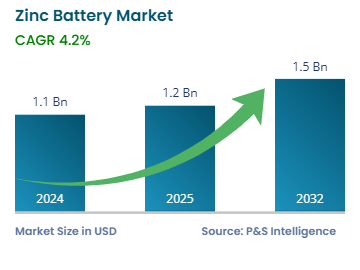
The global zinc battery market generated an estimated revenue of USD 1.1 billion in 2024, which is expected to witness a CAGR of 4.2% during 2025–2032, to reach USD 1.5 billion by 2032.
This growth can be attributed to the increasing demand for affordable, sustainable, and high-performance energy storage solutions. Zinc batteries, known for their environmentally friendly composition, are gaining traction as a cost-effective alternative to traditional battery technologies such as lithium-ion batteries.
Over 6 billion people worldwide use smartphones, and over 2 billion own laptops or tablets, driving massive demand for portable power. Zinc batteries are favored in many consumer devices for their safety, cost-effectiveness, and environmental benefits, supporting the growing need for reliable, affordable energy storage in everyday electronics.
Additionally, the growing focus on renewable energy integration and the need for efficient energy storage solutions are fueling the market's expansion. As technological advancements continue to improve the efficiency and performance of Zinc batteries, coupled with a shift towards more sustainable energy storage solutions, the global zinc battery market is expected to witness significant growth over the forecast period.
Zinc Battery Market Growth Factors
Advantages of Zinc Batteries over Batteries Utilizing Other Chemistries Is Key Driver
One of the key drivers for the growth of the global zinc battery market is the advantages of zinc batteries over batteries using other chemistries, such as lithium-ion or lead-acid batteries.
Zinc batteries offer several benefits, including improved safety, sustainability, and cost-effectiveness, making them increasingly attractive to industries and consumers seeking environment-friendly and efficient energy storage solutions.
Zinc batteries are safer than many alternatives because they are less prone to overheating, leakage, or catching fire, which reduces the risk of hazardous accidents.
Their non-toxic nature and environmentally friendly composition also contribute to their growing appeal, particularly in regions with stringent environmental regulations.
Their recyclability rate exceeds 90%, making them environmentally superior.
Unlike lithium-ion batteries, which require complex recycling processes, Zinc batteries are easier to recycle, and their materials are more abundant and less expensive, which makes them a more cost-effective option for both consumers and manufacturers.
Zinc batteries are up to 30% cheaper than lithium-ion batteries due to abundant raw materials.
Zinc batteries also operate efficiently in a wider temperature range (-30°C to 60°C), ideal for extreme environments.
Unlike lithium or cobalt, zinc poses fewer geopolitical supply risks, as it is widely mined across continents.
Additionally, zinc-air and zinc-ion chemistries provide high energy density, suitable for hearing aids, remote sensors, and backup systems with low standby loss.
Rising Global Demand for Data Centers Is a Key Opportunity
As digitalization continues to accelerate across industries, the need for reliable and sustainable power solutions to support the growing number of data centers has never been greater.
Global data center capacity has surpassed 1,200 Megawatts in key markets, with hyperscale operators, such as Amazon, Google, and Microsoft, driving aggressive expansion.
Over 300 new data centers are under construction worldwide, significantly increasing power and backup demands.
Data centers, which house critical IT infrastructure, require uninterrupted power supply to ensure consistent service and avoid downtime.
This has led to an increasing demand for advanced energy storage systems, including Zinc batteries, which offer a safe, efficient, and environmentally friendly alternative to traditional backup power systems.
Zinc batteries are well-suited for data center applications due to their long lifespan, enhanced safety features, and ability to provide stable and reliable energy storage.
Moreover, Zinc batteries can effectively support the growing energy needs of data centers, which are becoming increasingly energy-intensive due to the rise in cloud computing, big data, and AI applications.
Traditional lithium-ion UPS systems raise fire safety concerns and have recycling challenges.
Zinc-based batteries offer a safer, cost-effective, and environmentally sustainable alternative, with high thermal stability and long cycle life suited for stationary backup applications.
As the global digital economy grows—with rising cloud, AI, and edge computing needs—zinc batteries present a strong opportunity for integration into green data center infrastructure.
As the demand for data centers expands globally, especially in regions with strict environmental regulations, Zinc batteries present a significant opportunity for growth.
Easy Availability of Substitute Battery Products Poses Challenges
A significant challenge facing the global zinc battery market is the easy availability of substitute battery products, particularly from established technologies such as lithium-ion, lead-acid, and sodium-ion batteries.
These alternative battery chemistries have long been dominant in the energy storage market and benefit from well-established manufacturing processes, extensive supply chains, and significant research and development investments.
As a result, they are often more readily available and come with a proven track record of performance, making them the preferred choice for many industries and consumers.
Although Zinc batteries offer advantages in terms of safety, cost, and environmental impact, they face stiff competition from these established alternatives, which have already achieved economies of scale and robust market acceptance.
Zinc battery adoption faces pressure from a growing range of substitute chemistries.
Lithium-ion remains dominant due to high energy density and declining costs, especially in consumer electronics and electric vehicles.
Sodium-ion batteries are emerging as a viable alternative for grid storage, with abundant raw materials and lower costs.
Vanadium redox flow batteries offer scalability and long lifespans for large-scale energy storage.
Solid-state batteries promise superior safety and performance for high-end applications.
These alternatives—some with better charging efficiency, energy density, or infrastructure readiness—limit zinc battery demand, especially in markets prioritizing fast charging, lightweight design, or established supply chains.
Zinc Battery Market Segmentation Analysis
Battery Type Insights
The zinc–air battery type category is projected to grow at the highest CAGR, of 5.1%, during 2025–2032, after holding the largest market share, of 40%. This is due to several key advantages over other battery chemistries. Zinc-air batteries are known for their high energy density, lightweight design, and cost-effectiveness, making them an attractive option for a wide range of applications, including portable electronics, electric vehicles, and renewable energy storage.
One of the primary factors driving the growth of zinc-air batteries is their superior energy density compared to traditional zinc-based batteries. This allows zinc-air batteries to store more energy in a smaller and lighter package, making them ideal for applications where space and weight are critical considerations. Furthermore, zinc-air batteries are more environmentally friendly than lithium-ion and lead-acid batteries, as they use abundant and non-toxic materials, positioning them as a sustainable alternative in an increasingly eco-conscious market.
During the study, we have analyzed the following battery types in the report:
Zinc–Air (Largest and Fastest-Growing Category)
Nickel–Zinc
Zinc-Ion
Zinc–Bromine
Rechargeability Analysis
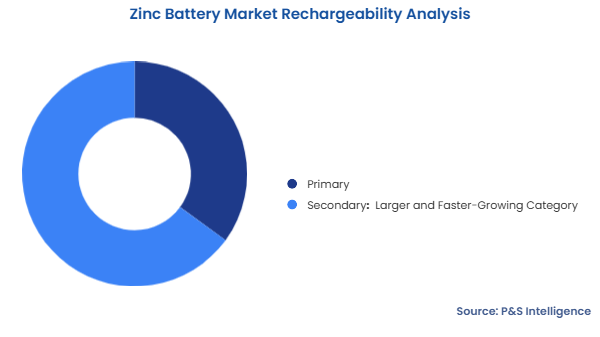
The secondary category holds the largest market share, of 65%, in 2024, and it also has the higher CAGR, of 4.8%. This is because these batteries are highly versatile and widely used across various industries. Secondary batteries, also known as rechargeable batteries, have gained significant traction in applications such as electric vehicles (EVs), consumer electronics, renewable energy storage, and industrial backup systems.
Their ability to be recharged and reused multiple times, offering a long lifecycle and reducing the overall cost per use compared to primary (non-rechargeable) batteries. The growing demand for energy storage solutions, particularly for electric vehicles and renewable energy systems, has significantly contributed to the expansion of the secondary battery market.
Below are the rechargeability analyzed:
Primary
Secondary (Larger and Faster-Growing Category)
Application Insights
The automotive & transportation category accounts for the largest share in 2024. This is primarily driven by the rapid shift toward electric vehicles (EVs) and the growing need for sustainable transportation solutions. The automotive industry, particularly the electric vehicle sector, is experiencing significant growth as governments and consumers increasingly prioritize eco-friendly alternatives to traditional gasoline and diesel-powered vehicles.
This transition to electric mobility is spurring a substantial demand for high-performance, long-lasting batteries, which are essential for EVs to offer sufficient driving range and reliability. Additionally, the automotive sector is also adopting battery-powered solutions in other transportation segments, such as electric scooters, bicycles, and public transit systems, further contributing to the market's expansion.
Consumer devices are the fastest-growing category, with a CAGR of 4.9%, due to their safety, cost-effectiveness, and environmental friendliness. They are widely used in hearing aids, remote controls, flashlights, and medical devices, where long shelf life and stable voltage are critical. Unlike lithium-ion, zinc batteries pose no fire risk, making them ideal for compact, enclosed devices.
Their ability to operate under extreme temperatures and resist leakage adds to their reliability. Rechargeable zinc-based chemistries, such as zinc-air and zinc-ion, are also being explored for wearables and IoT devices. As the push for sustainable and safe energy grows, zinc batteries offer a dependable alternative.
The following applications are included in the report:
Healthcare
Utilities
Automotive & Transportation (Largest Category)
Industrial
Consumer Devices (Faster-Growing Category)
Others
Drive strategic growth with comprehensive market analysis
Zinc Battery Market Geographical Analysis
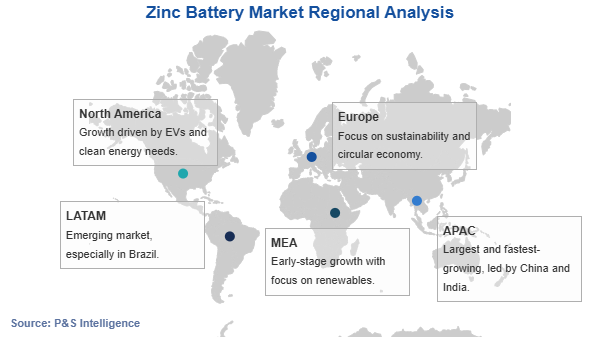
APAC is the largest and fastest-growing market, with a share of 55% in 2024 and 2025–2032 CAGR of 5.6%, respectively. This is primarily due to the strong growth in the automotive and consumer electronics sectors. China produced over 30 million vehicles in 2023, while India’s output crossed 5.7 million, reflecting expanding domestic demand and global exports. The shift toward electric mobility has intensified interest in alternative battery chemistries like zinc for auxiliary power and backup systems, thanks to their thermal stability and safety.
In consumer electronics, APAC remains the manufacturing powerhouse—China, Vietnam, and South Korea account for a large share of the over 1.3 billion smartphones shipped globally each year. With rising middle-class populations and increased digital consumption, demand for portable and safe energy storage continues to grow.
Other sectors are also contributing. Industrial electronics and energy storage solutions are expanding due to growing power reliability concerns and renewable integration. In 2022, Asia accounted for over 50% of global electronics exports, highlighting the scale of regional production.
Meanwhile, governments across APAC are investing in battery innovation and local manufacturing to reduce import dependency. These factors, combined with environmental concerns and regulatory shifts, are creating a favorable landscape for zinc battery adoption across multiple sectors, with automotive and electronics leading the charge.
Further, regions and countries analyzed for this report include:
North America
U.S. (Larger and Faster-Growing Country Market)
Canada
Europe
Germany (Largest Country Market)
UK (Fastest-Growing Country Market)
France
Italy
Spain
Rest of Europe
Asia-Pacific (APAC) (Largest and Fastest-Growing Regional Market)
China (Largest Country Market)
Japan
India (Fastest-Growing Country Market)
South Korea
Australia
Rest of APAC
Latin America (LATAM)
Brazil (Largest and Fastest-Growing Country Market)
Mexico
Rest of LATAM
Middle East and Africa (MEA)
Saudi Arabia (Largest Country Market)
South Africa
U.A.E. (Fastest-Growing Country Market)
Rest of MEA
Zinc Battery Market Share
The market is fragmented, with numerous players operating across different regions and segments. While large companies are investing in the development of advanced Zinc battery technologies, there are also a considerable number of smaller players focused on niche applications and regional markets. The fragmented nature of the market is further influenced by the diverse applications Zinc batteries are being developed for, including electric vehicles, consumer electronics, and renewable energy storage. Different industries have varying needs, which drives innovation and customization within the market, resulting in a broad range of Zinc battery offerings tailored to specific use cases.
Key Zinc Battery Companies:
Eastman Kodak Company
Panasonic Holdings Corporation
Duracell Inc.
Energizer Holdings Inc.
ZincFive Inc.
Gold Peak Technology Group
ABOUND Energy Inc.
ZAF Energy Systems Inc.
The Swatch Group Ltd.
Enerpoly AB
Zhejiang Mustang Battery Co. Ltd.
Primus Power
Zinc Battery Market News
In April 2024, Panasonic Energy Co. Ltd., a subsidiary of Panasonic Holdings Corporation, completed the construction of a new R&D facility at its Suminoe site in Osaka, Japan.
In March 2024, ABOUND Energy Inc. signed an MOU with a technology company to introduce an eco-friendly green energy solution, akin to Zaeras.
In November 2023, ZincFive Inc. introduced two new models in its BC Series of UPS battery cabinets: the BC 2 – 500 and BC 2 – 300X. The company also unveiled the Z5 13-90 advanced ultra-high-rate battery, which will power the new battery cabinets.
Want a report tailored exactly to your business need?
Leading companies across industries trust us to deliver data-driven insights and innovative solutions for their most critical decisions. From data-driven strategies to actionable insights, we empower the decision-makers who shape industries and define the future. From Fortune 500 companies to innovative startups, we are proud to partner with organisations that drive progress in their industries.
Client Testimonials
Working with P&S Intelligence and their team was an absolute pleasure – their awareness of timelines and commitment to value greatly contributed to our project's success. Eagerly anticipating future collaborations.
McKinsey & Company
India
Unmatched Standards
Our insights into the minutest levels of the markets, including the latest trends and competitive landscape, give you all the answers you need to take your business to new heights
Complete Data Security
We take a cautious approach to protecting your personal and confidential information. Trust is the strongest bond that connects us and our clients, and trust we build by complying with all international and domestic data protection and privacy laws