Zero Trust Security Market Size & Share Analysis - Trends, Drivers, Competitive Landscape, and Forecasts (2026 - 2032)
This Report Provides In-Depth Analysis of the Zero Trust Security Market Report Prepared by P&S Intelligence, Segmented by Component (Solutions, Services), Deployment (Cloud, On-Premises), Organization Size (Large Enterprises, Small and Medium Enterprises), Authentication Type (Multi-Factor Authentication, Single-Factor Authentication), Application (Network Access Control, Cloud Workload Security, Data Protection, Endpoint Security, Identity Verification), End User (IT and Telecom, Healthcare, Banking, Financial Services and Insurance, Government and Defense, Manufacturing, Retail, Energy and Utilities), and Geographical Outlook for the Period of 2021 to 2032
Explore the market potential with our data-driven report
Zero Trust Security Market Future Outlook
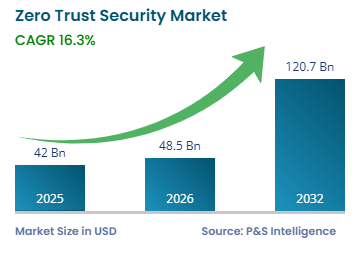
The zero trust security market size was USD 42.0 billion for 2025, and it will grow by 16.3% during 2026-2032, to reach USD 120.7 billion by 2032.
The market is expanding as organizations increasingly operate beyond traditional network boundaries. This shift is driven by growing reliance on cloud platforms, remote work models, and mobile access, which require stronger control over user and system access. Instead of protecting only the network perimeter, enterprises are securing every user, device, workload, application, and data exchange regardless of location. Identity verification, least-privilege access, continuous authentication, and policy-based authorization have become essential as employees, contractors, and third-party partners connect through multiple endpoints and cloud environments. Organizations are also replacing broad network trust with granular access controls that reduce lateral movement and improve visibility across distributed IT infrastructure. According to the International Telecommunication Union, approximately 6 billion people, representing 74% of the global population, used the internet in 2025. This expanding digital footprint is accelerating the adoption of identity-based, continuously verified security frameworks across enterprise environments.
The rapid growth of internet-connected users is increasing the number of identities, devices, applications, and digital interactions that organizations must secure every day. Enterprises are managing hybrid cloud deployments, software-as-a-service platforms, operational technology networks, and remote endpoints within a unified security architecture, making continuous verification more practical than traditional perimeter-based security. Access decisions are increasingly based on user identity, device health, location, application sensitivity, and real-time risk signals rather than static credentials alone. Furthermore, security teams are integrating identity governance, endpoint detection, multi-factor authentication, and network segmentation to strengthen protection while maintaining operational efficiency. These capabilities improve visibility into user activity, reduce unauthorized access, support regulatory compliance, and help organizations protect critical business systems as digital operations continue expanding across geographically distributed environments.
Key Market Insights
Solutions are the larger category, holding a market share of 75%, due to strong reliance on integrated platforms for access control and threat monitoring.
Multi-Factor Authentication is the larger and faster-growing category, registering a CAGR of approximately 16.5%, driven by its effectiveness in preventing identity-based cyberattacks across enterprise systems.
Healthcare is the fastest-growing end-user, registering a CAGR of approximately 17.0%, driven by increasing digitalisation of patient data and rising exposure to cyber threats.
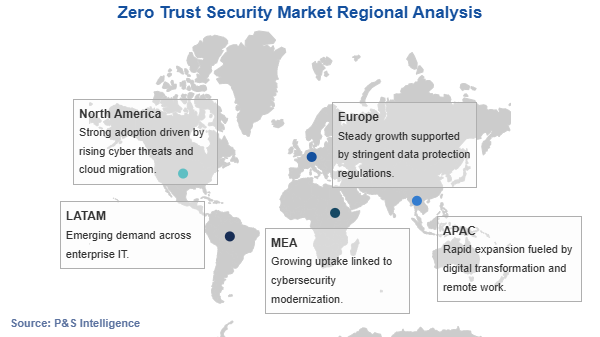
North America is the largest region, holding a market share of 40%, due to high cybercrime incidence and strong adoption of advanced security frameworks.
Asia-Pacific is the fastest-growing region, registering a CAGR of approximately 17.2%, driven by rapid digital infrastructure expansion and increasing enterprise cybersecurity investments.
Zero Trust Security Market Dynamics
Rise of Identity-Centric Security Models Is a Major Trend
The industry is shifting towards identity-focused security models where every user and device must be continuously verified before access is granted. This transition is driven by the limitations of perimeter-based systems and the need to secure hybrid and multi-cloud environments with real-time monitoring and adaptive controls. Organizations are strengthening identity governance, least-privilege access, continuous authentication, and policy-based security to reduce unauthorized access across distributed digital environments. According to Microsoft Corporation, identity-based threats generated an average of 38 million risk detections per day in 2025, while the average cost of a data breach reached $4.67 million, and malicious insider incidents cost $4.92 million in 2025.
These threat patterns are encouraging vendors to develop unified platforms that combine identity, device, network, and access management with continuous risk assessment and automated policy enforcement. Furthermore, enterprises are improving visibility across users, endpoints, and cloud workloads while supporting regulatory compliance and reducing security gaps through centralized access controls and real-time verification.
Growing Cyberattack Surface Across Distributed Environments Drives Market
The market is growing as organizations expand across cloud platforms, remote devices, and interconnected systems, significantly increasing potential attack surfaces. This complexity reduces the effectiveness of traditional security approaches and forces businesses to adopt stricter access controls and continuous verification mechanisms. Organizations are strengthening identity verification, least-privilege access, device authentication, and continuous monitoring to secure users, workloads, and applications across hybrid and multi-cloud environments. According to Microsoft Corporation, 80% of incidents investigated by Microsoft's security teams involved data theft or leakage between 2024 and 2025, while global active IoT connections reached 18.5 billion in 2024, reflecting the rapid expansion of connected endpoints.
The growing number of connected devices and increasing exposure of sensitive business data are encouraging enterprises to deploy unified zero trust architectures that integrate identity, endpoint, network, and application security. Furthermore, organizations are improving real-time visibility into user behavior, enforcing adaptive access policies, and reducing lateral movement across distributed environments, enabling stronger protection for critical systems while supporting secure cloud adoption and digital operations..
Complex Integration with Legacy Systems and Operational Disruption
Adoption of zero trust security is constrained by the complexity of integrating it with existing IT environments built on legacy systems. These systems often lack compatibility with continuous verification and identity-based access controls, making implementation technically demanding and resource intensive. According to the World Economic Forum, 49% of public-sector organizations lacked the necessary cybersecurity talent to meet their cybersecurity goals in 2025. This shortage limits the ability to deploy, configure, and manage zero trust architectures alongside existing infrastructure. Organizations must modernize legacy environments, strengthen identity management, and expand cybersecurity expertise, increasing deployment costs and extending implementation timelines across critical sectors.
Expansion of Zero Trust Adoption in Emerging Digital Economies
The market presents strong growth opportunities as countries expand digital infrastructure and accelerate the shift toward online services. Emerging economies are building modern IT environments, allowing organizations to adopt zero trust architectures without replacing extensive legacy systems. According to the International Telecommunication Union, 5G networks covered 55% of the global population in 2025, reflecting the rapid expansion of high-speed digital connectivity. This broader network availability supports greater adoption of cloud applications, connected devices, and digital business services that require continuous identity verification and secure access controls. This means that as more businesses and users rely on connected systems and cloud-based services, there is a growing need for advanced security solutions, creating opportunities for vendors to offer scalable, cloud-native zero trust platforms tailored to rapidly digitizing enterprise environments.
Zero Trust Security Market Segmentation Analysis
Component Analysis
Solutions are the larger category, holding a market share of 75%, because organizations prioritize platforms that directly manage identity, network, endpoint, cloud, and application access within a unified zero trust architecture. This connects strongly with cloud deployment, multi-factor authentication, ZTNA, and cloud workload security, as these categories all depend on integrated policy enforcement and continuous verification. In June 2025, Zscaler launched new Zero Trust solutions that expanded security across branches, multi-cloud environments, cloud workloads, and business-to-business access, reflecting continued innovation in integrated zero trust platforms. This ongoing product development is encouraging organizations to adopt comprehensive security solutions that simplify management while strengthening protection across modern digital infrastructure.
Services are the faster-growing category, because organizations need external support to design, integrate, and manage zero trust systems across cloud, endpoint, identity, and application environments. This demand is linked with small and medium enterprises, which often adopt managed services to simplify deployment, and with large enterprises, which require consulting and integration support for complex global IT networks. As zero trust adoption expands across healthcare, IT and telecom, government, and financial services, companies increasingly rely on consulting, implementation, managed monitoring, training, and support services to align identity controls, cloud security, and access policies with existing infrastructure.
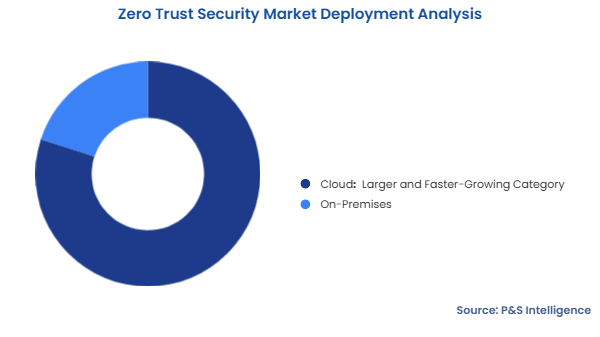
Cloud is the larger and faster-growing category, holding a market share of 80% and registering a CAGR of approximately 16.7%, because organizations are rapidly shifting operations to cloud-based environments for scalability and flexibility. This deployment model is closely connected with cloud workload security, small and medium enterprise adoption, and managed services, as cloud platforms allow faster implementation of identity verification, access control, and continuous monitoring. According to Cisco Systems, only 4% of companies reached the Mature stage in the Cloud Reinforcement pillar of the 2025 Cybersecurity Readiness Index. This limited level of cloud security maturity is increasing demand for zero trust architectures that strengthen identity verification, secure cloud workloads, and improve continuous protection across expanding digital environments.
The deployments analysed in this report are:
Cloud (Larger and Faster-Growing Category)
On-Premises
Organisation Size Analysis
Large Enterprises are the larger category, because these organizations operate complex IT environments with large volumes of sensitive data, cloud workloads, endpoints, and internal applications. Their adoption is strongly connected with solutions, on-premises systems, ZTNA, multi-factor authentication, and cloud workload security, as large companies require full-scale zero trust architectures across global operations. They also face strict compliance requirements across banking, healthcare, IT and telecom, manufacturing, and government-linked operations. Their financial capacity and technical resources allow wider deployment of identity governance, microsegmentation, endpoint protection, and continuous monitoring tools across users, devices, applications, and networks.
Small and medium enterprises are the faster-growing category, because these organizations are increasingly strengthening cybersecurity as digital operations, cloud adoption, and remote access continue to expand. They are adopting zero trust models through cloud-based and managed security services that simplify deployment while improving identity verification and access control. According to the World Economic Forum, 35% of small organizations believed their cyber resilience was inadequate in 2025. This preparedness gap is encouraging greater investment in scalable zero trust platforms that enhance continuous authentication, secure access management, and data protection across growing business environments.
The organization sizes analysed in this report are:
Large Enterprises (Larger Category)
Small and Medium Enterprises (Faster-Growing Category)
Authentication Type Analysis
Multi-Factor Authentication is the larger and faster-growing category, registering a CAGR of approximately 16.5%, because it strengthens identity verification through multiple authentication layers beyond passwords. This category is directly connected with ZTNA, cloud deployment, healthcare security, and small and medium enterprise adoption, as every zero trust model starts with confirming user identity before granting access. Organizations use multi-factor authentication to protect cloud applications, internal systems, privileged accounts, and remote access points. According to Microsoft Corporation, multi-factor authentication can prevent over 99% of identity-based cyberattacks in 2025. This high effectiveness is driving widespread deployment of advanced authentication mechanisms across enterprise systems and applications to strengthen access security.
The authentication types analysed in this report are:
Multi-Factor Authentication (Larger and Faster-Growing Category)
Single-Factor Authentication
Application Analysis
Network Access Control (ZTNA) is the largest category, holding a market share of 40%, because it directly manages how users connect to systems and applications, which is a core part of zero trust architecture. This category connects with multi-factor authentication, large enterprise adoption, cloud deployment, and IT and telecom end use, as secure access depends on verifying users before allowing connections. Organizations prioritize ZTNA to secure internal applications, remote workers, third-party users, and hybrid infrastructure. Its granular access control supports identity-based policies across cloud and on-premises systems, making it a key component in modern security strategies.
Cloud Workload Security is the fastest-growing category, registering a CAGR of approximately 16.8%, because organizations are increasingly hosting applications and sensitive workloads across hybrid and multi-cloud environments that require dedicated runtime protection. This category is strongly connected with cloud deployment, solutions, services, and healthcare adoption, as cloud workloads often carry sensitive business, patient, financial, and operational data. In December 2025, CrowdStrike introduced real-time Cloud Detection and Response capabilities within Falcon Cloud Security, adding cloud Indicators of Attack and automated response workflows for cloud environments. This expansion reflects growing demand for advanced cloud workload security platforms that provide continuous visibility and protection across distributed cloud infrastructure.
IT and Telecom is the largest category, holding a market share of 30%, because this sector manages vast digital infrastructure, cloud platforms, communication networks, and large volumes of sensitive customer and enterprise data. Its adoption connects with ZTNA, cloud deployment, multi-factor authentication, and solutions, as telecom operators and IT service providers must secure users, devices, applications, and network access at scale. Companies in this sector are early adopters of advanced technologies and require continuous monitoring to maintain service reliability. The need to secure networks, data centers, cloud systems, and communication platforms makes zero trust a core part of their security strategy.
Healthcare is the fastest-growing category, registering a CAGR of approximately 17.0%, because the sector is rapidly digitizing patient records, medical devices, hospital systems, and connected care platforms. This growth is linked with cloud workload security, multi-factor authentication, data protection, and managed services, as healthcare organizations need secure access across doctors, staff, third-party vendors, and medical applications. According to the Office for Civil Rights, over 80% of large healthcare data breaches involved hacking or IT incidents in 2025. This high breach concentration is driving demand for robust identity-based security frameworks to protect critical healthcare infrastructure and patient information.
The end users analysed in this report are:
IT and Telecom (Largest Category)
Healthcare (Fastest-Growing Category)
Banking, Financial Services and Insurance (BFSI)
Government and Defense
Manufacturing
Retail
Energy and Utilities
Others
Drive strategic growth with comprehensive market analysis
Zero Trust Security Market Regional Outlook
North America Zero Trust Security Market Analysis
North America holds the largest share, of 40%, because its enterprises were early adopters of advanced cybersecurity frameworks and maintain substantial budgets for security modernization. The region has strict data protection regulations, mature cybersecurity governance, and high awareness of evolving cyber threats, encouraging organizations to replace perimeter-based security with zero trust architectures. Strong adoption of cloud computing, hybrid work environments, and software-as-a-service platforms has further increased demand for identity-centric security. The presence of leading cloud service providers, cybersecurity vendors, and managed security service providers accelerates product innovation and deployment. Enterprises across finance, healthcare, government, manufacturing, and technology continue investing in identity governance, privileged access management, microsegmentation, and continuous authentication, making zero trust a long-term strategic priority for protecting distributed digital environments and meeting compliance requirements.
U.S. Zero Trust Security Market Analysis
The U.S. market holds a leading position due to its advanced cybersecurity environment and widespread adoption of zero trust frameworks. Organizations invest heavily in securing complex IT infrastructure, driven by strict regulatory requirements, extensive cloud adoption, and increasing digital operations across government and private sectors. According to the Federal Bureau of Investigation, 859,532 internet crime complaints were reported in 2024, including nearly 4,900 complaints involving critical infrastructure organizations. This high volume of cyber activity is strengthening enterprise investment in identity verification, continuous authentication, privileged access management, and policy-based access controls, supporting broader deployment of zero trust security across critical business and government environments.
Canada Zero Trust Security Market Analysis
Canada is experiencing steady growth in zero trust adoption as organizations strengthen cybersecurity programs across public institutions and private enterprises. Expanding digital services, cloud migration, and hybrid work environments are increasing demand for stronger identity governance and secure access management. According to Statistics Canada, police recorded 225.1 cybercrime incidents per 100,000 population in 2024, more than double the comparable rate recorded in 2018. This growing cyber activity is encouraging organizations to modernize access controls, improve continuous verification, and deploy identity-centric security frameworks that protect distributed users, applications, and sensitive business information across digital environments.
Asia-Pacific Zero Trust Security Market Analysis
Asia-Pacific has the highest CAGR, of approximately 17.2%, because many countries are rapidly expanding digital infrastructure and modernizing enterprise technology across public and private sectors. Organizations are adopting cloud-first strategies, digital payment platforms, connected manufacturing, and smart government services, creating strong demand for flexible security architectures that protect distributed users and applications. Governments are strengthening cybersecurity regulations and data protection requirements while encouraging digital transformation across critical industries. Rapid growth in startups, technology companies, financial services, and telecommunications is increasing demand for scalable identity and access management solutions. Expanding mobile connectivity, remote work, and cloud adoption are also driving investment in continuous authentication, endpoint security, and policy-based access controls that align with zero trust security principles across diverse enterprise environments.
China Zero Trust Security Market Analysis
China is advancing rapidly due to large-scale digital transformation and the strong government focus on cybersecurity development. Organisations are investing in secure infrastructure to protect expanding volumes of data across connected systems and digital platforms. According to the Government of China, 4.838 million 5G base stations were operational in 2025, covering more than 95% of administrative villages. This extensive digital connectivity is increasing the need for scalable security solutions capable of managing access and protecting data across complex, high-density digital environments.
South Korea Zero Trust Security Market Analysis
South Korea is witnessing strong growth driven by its highly digitalized economy and advanced information technology infrastructure. Organizations are strengthening security across telecommunications networks, smart city platforms, financial services, and connected digital ecosystems that process large volumes of sensitive information. According to the Ministry of Science and ICT, cybersecurity breaches increased by 26% to 2,383 incidents in 2025. The growing volume of sophisticated cyber activity is encouraging enterprises and government agencies to expand zero trust deployments, strengthen identity verification, and improve continuous monitoring across cloud platforms, high-speed networks, and data-intensive digital operations.
Europe Zero Trust Security Market Analysis
Europe shows steady growth supported by comprehensive regulatory frameworks focused on data privacy, cybersecurity, and digital resilience. Organizations across the region prioritize compliance with evolving legal requirements, encouraging investment in structured security models that strengthen identity verification and access governance. Many enterprises are modernizing legacy infrastructure while integrating hybrid cloud environments and protecting sensitive business data across multiple locations. Cross-border operations require consistent authentication policies, centralized identity management, and secure access controls to maintain compliance and reduce operational risk. Enterprises are also working closely with cybersecurity vendors, cloud providers, and technology partners to improve threat visibility, automate policy enforcement, and strengthen zero trust deployments while maintaining business continuity across highly regulated industries.
The regions and countries analysed in this report are:
North America (Largest Regional Market)
U.S. (Larger Country)
Canada (Faster-Growing Country)
Europe
Germany (Largest Country)
U.K. (Fastest-Growing Country)
France
Italy
Spain
Rest of Europe
Asia-Pacific (Fastest-Growing Regional Market)
China (Largest Country)
South Korea (Fastest-Growing Country)
Japan
India
Australia
Rest of APAC
Latin America
Brazil (Largest Country)
Mexico (Fastest-Growing Country)
Rest of LATAM
Middle East and Africa
Saudi Arabia (Largest Country)
U.A.E. (Fastest-Growing Country)
South Africa
Rest of MEA
Zero Trust Security Market Competitive Landscape
The market is fragmented, with global cybersecurity companies, cloud platform providers, networking firms, and specialized security vendors collectively supporting different layers of zero trust architecture. Organizations typically build zero trust environments by integrating identity and access management, endpoint security, network segmentation, cloud workload protection, data security, and security analytics from multiple technology providers. This encourages interoperability, open integration, and API-based security ecosystems across enterprise environments. Vendors continue expanding their portfolios through product development, strategic partnerships, technology integrations, and platform enhancements to deliver broader zero trust capabilities. Continuous innovation in identity verification, privileged access management, cloud security, device trust, and policy-based access control enables organizations to deploy flexible security architectures that align with their operational, compliance, and digital transformation requirements.
Leading Companies in the Zero Trust Security Market:
Palo Alto Networks Incorporated
Broadcom Incorporated
Zscaler Incorporated
Akamai Technologies Incorporated
Microsoft Corporation
Cisco Systems Incorporated
International Business Machines Corporation
Cloud Software Group Incorporated
Check Point Software Technologies Limited
Trellix Limited Liability Company
Forcepoint Limited Liability Company
CrowdStrike Incorporated
Cloudflare Incorporated
Fortinet Incorporated
Okta Incorporated
Zero Trust Security Market News
In March 2026, Palo Alto Networks, Inc. added the Zero Trust Posture Center dashboard to Strata Cloud Manager. The feature brought zero trust findings for Next-Generation Firewall and Prisma Access deployments into one dashboard. It covered posture review, risk visibility, and security task follow-up inside Palo Alto Networks, Inc.’s cloud management console.
In February 2026, Cloudflare, Inc. added post-quantum encryption support across Cloudflare One SASE. The update covered Zero Trust access and wide-area networking paths, including Cloudflare IPsec and Cloudflare One Appliance. The news fits zero trust security because it changed how enterprise traffic is encrypted across access and network connections within one platform.
In January 2026, Okta, Inc. launched in-country Okta Platform tenants in India. The release covered local data residency and enhanced disaster recovery for the Okta identity platform. The news is linked to zero trust security because identity controls and access governance are common parts of zero trust programs for enterprise users.
In December 2025, International Business Machines Corporation made IBM Verify Identity Access generally available as a maintenance release. The release added updates for protocol support, reverse proxy export, audit controls, session caching, and access management components. The news fits zero trust security because it relates to identity verification and controlled application access for business environments.
In November 2025, Fortinet, Inc. launched its Secure AI Data Center solution and introduced FortiGate 3800G with the release. The launch covered security for AI infrastructure, model traffic, applications, and data center firewalls. It connects with zero trust security through segmentation, traffic inspection, and controlled access across AI workloads and systems.
Frequently Asked Questions About This Report
What is zero trust security and why is it important?+
Zero Trust security verifies every user, device, and request, helping organizations reduce unauthorized access, limit breach impact, and protect distributed digital systems.
How does zero trust security differ from traditional network security?+
Traditional security trusts users inside the network, while Zero Trust treats every request as untrusted and verifies identity, device health, and context.
What are the main principles of zero trust security today?+
The main principles are verify explicitly, use least privilege access, assume breach, continuously monitor activity, and restrict access based on real time risk.
How does zero trust network access protect business applications securely?+
Zero Trust Network Access protects applications by granting access only to verified users and devices, reducing exposure from public networks and stolen credentials.
Why do companies adopt zero trust for cloud environments today?+
Companies adopt Zero Trust for cloud environments because users, applications, and data are spread across locations, requiring stronger identity control and continuous verification.
Want a report tailored exactly to your business need?
Leading companies across industries trust us to deliver data-driven insights and innovative solutions for their most critical decisions. From data-driven strategies to actionable insights, we empower the decision-makers who shape industries and define the future. From Fortune 500 companies to innovative startups, we are proud to partner with organisations that drive progress in their industries.
Client Testimonials
Working with P&S Intelligence and their team was an absolute pleasure – their awareness of timelines and commitment to value greatly contributed to our project's success. Eagerly anticipating future collaborations.
McKinsey & Company
India
Unmatched Standards
Our insights into the minutest levels of the markets, including the latest trends and competitive landscape, give you all the answers you need to take your business to new heights
Complete Data Security
We take a cautious approach to protecting your personal and confidential information. Trust is the strongest bond that connects us and our clients, and trust we build by complying with all international and domestic data protection and privacy laws