Zero Trust Network Access Market Size & Share Analysis - Trends, Drivers, Competitive Landscape, and Forecasts (2026 - 2032)
This Report Provides In-Depth Analysis of the Zero Trust Network Access Market Report Prepared by P&S Intelligence, Segmented by Component (Solutions, Services), Deployment Mode (Cloud-based, On-premises), Organization Size (Large Enterprises, Small & Medium Enterprises), Access Type (Agent-based, Agentless), Application (Remote Workforce Access, Third-party / Vendor Access, Private Application Access, Web & SaaS Application Access), End-User (IT & Telecommunications, Healthcare, BFSI, Government & Public Sector, Retail & E-commerce, Manufacturing, Energy & Utilities), and Geographical Outlook for the Period of 2021 to 2032
Explore the market potential with our data-driven report
Zero Trust Network Access Market Overview
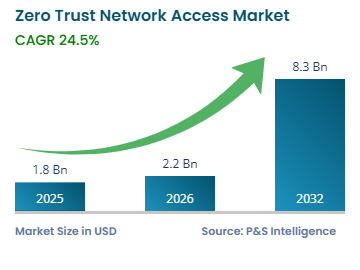
The zero trust network access market size was USD 1.8 billion for 2025, and it will grow by 24.5% during 2026-2032, to reach USD 8.3 billion by 2032.
The market is expanding as organizations adopt zero trust network access to strengthen security frameworks and modernize enterprise access management. Traditional network security models were designed around trusted internal networks, but growing reliance on cloud applications, remote workforces, third-party contractors, and distributed business operations has reduced the effectiveness of perimeter-based security approaches. Organizations are increasingly requiring continuous identity verification and context-based access controls to ensure that users can only access authorized resources. This shift is encouraging enterprises to replace legacy virtual private networks and broad network access privileges with more granular and policy-driven security architectures.
Additionally, cybercriminals are increasingly targeting user credentials, remote access pathways, and interconnected digital environments to gain unauthorized access to sensitive systems and data. Organizations are responding by implementing security models that verify every access request based on user identity, device posture, location, and risk level before granting connectivity. According to the Federal Bureau of Investigation, reported losses from internet crime exceeded USD 16 billion in 2024, highlighting the financial impact of evolving cyber threats. The growing focus on reducing unauthorized access, limiting lateral movement within networks, and protecting cloud-based resources is driving investment in zero trust network access solutions that provide secure connectivity while supporting modern workforce and digital transformation requirements across enterprise environments.
Key Market Insights
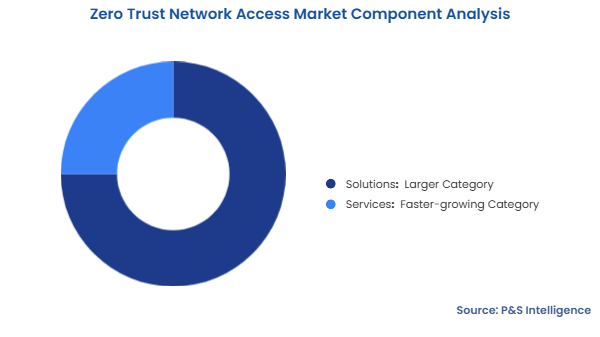
Solutions are the larger segment, holding a market share of 75%, due to enterprise preference for integrated identity-based access control platforms.
Agentless is the faster-growing segment, registering a CAGR of approximately 24.8%, driven by demand for simplified deployment across remote users and third-party access.
Remote workforce access is the largest segment, holding a market share of 45%, due to widespread adoption of hybrid work requiring secure remote connectivity.
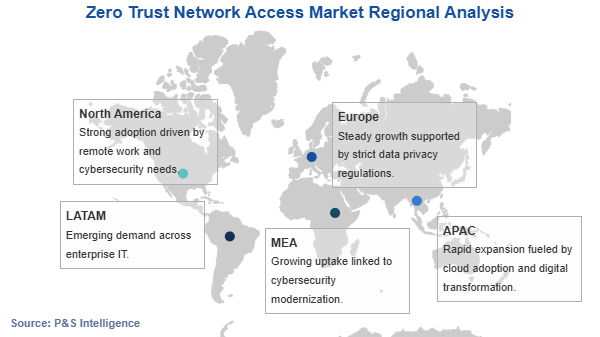
North America is the largest region, holding a market share of 40%, due to high enterprise cybersecurity spending and early adoption of zero trust frameworks.
Asia-Pacific is the fastest-growing region, registering a CAGR of approximately 25.4%, driven by rapid digitalisation and expanding cloud adoption across developing economies.
Zero Trust Network Access Market Trends and Drivers
Shift Toward Cloud-Native and Identity-Centric Access Platforms Is Major Trend
The market is witnessing a shift toward cloud-delivered security models that replace traditional network-based access with identity-focused controls. Organizations are increasingly moving away from broad network trust frameworks and adopting security architectures that verify users and devices before granting access to applications and resources. Vendors are integrating zero trust network access with endpoint security, threat detection, identity management, and security analytics to improve visibility and simplify security operations. Furthermore, enterprises are showing growing interest in browser-based and agentless access approaches that reduce deployment complexity and support a wider range of users and devices. According to Microsoft, security systems blocked over 600 million identity-based attacks daily in 2024, highlighting the scale of identity-related threats. This environment is accelerating adoption of unified zero trust architectures that strengthen access governance, improve risk-based decision making, and support secure connectivity across distributed enterprise environments.
Rising Cyberattacks and Need for Stronger Access Control Drive Market
The market is expanding due to the rising frequency and sophistication of cyberattacks targeting enterprise networks, applications, and digital identities. Organizations are facing growing risks from stolen credentials, insider threats, compromised accounts, and unsecured remote access pathways that can provide attackers with entry into critical business systems. The increasing use of cloud applications, hybrid work models, and third-party access has further reduced the effectiveness of traditional perimeter-based security approaches. According to the International Telecommunication Union, 132 countries maintained a formal National Cybersecurity Strategy in 2024, reflecting the growing global focus on cybersecurity resilience. Furthermore, IBM reported that credential-based attacks accounted for 16% of global data breaches in 2024. These evolving threats are encouraging organizations to adopt zero trust network access solutions that continuously verify users and devices, strengthen access controls, and reduce the risk of unauthorized access across distributed enterprise environments.
Complex Integration with Legacy Systems and Existing Security Setups
The market faces constraints due to the complexity of integrating zero trust network access into existing IT environments. Many organizations continue to operate legacy applications, network architectures, and security frameworks that were not designed for identity-centric access controls and continuous verification models. Transitioning to zero trust often requires policy redesign, infrastructure adjustments, and coordination across multiple technology teams, which can increase implementation challenges. According to the European Union Agency for Cybersecurity, exploitation of software vulnerabilities accounted for 21% of cybersecurity incidents in 2025. The prevalence of vulnerabilities across interconnected systems highlights the difficulty of modernizing security environments, slowing adoption among enterprises with complex infrastructures and extensive legacy technology dependencies.
Growing Demand from Cloud Adoption and Remote Workforce Expansion
The market presents strong opportunities driven by the expansion of cloud computing and evolving work models. Organizations are increasingly moving applications, workloads, and business data to cloud environments, creating greater demand for secure access that is independent of location or network boundaries. Remote and hybrid work structures are also becoming a long-term operating model across many industries, increasing the need for scalable security frameworks. According to the International Telecommunication Union, fixed broadband penetration reached 20 subscriptions per 100 inhabitants globally in 2025. Expanding digital connectivity is enabling broader adoption of cloud-based security architectures, creating growth opportunities for zero trust network access solutions across distributed enterprise environments.
Zero Trust Network Access Market Segmentation Analysis
Component Analysis
Solutions are the larger category, holding a market share of 75%, as organisations prefer integrated platforms that directly manage access across users, devices, and applications. These systems enforce identity verification and restrict access based on defined policies, improving security control. Additionally, enterprises favour unified solutions over fragmented tools to simplify deployment and management. According to the World Bank, at least 2.8 billion people lacked access to a government-recognised digital identity in 2024, highlighting the need for robust authentication systems, which is increasing reliance on comprehensive zero-trust solutions.
Services are the faster-growing category, registering a CAGR of approximately 24.7%, because many organisations lack the internal expertise to design and manage zero trust environments. Companies often need external support for planning, deployment, and ongoing monitoring. As systems become more complex, businesses prefer managed services to handle security operations. Consulting and integration services are also in demand as firms move away from legacy systems. This growing dependence on expert support is driving rapid expansion in this segment.
The component analysed in this report are:
Solutions (Larger Category)
Identity & access-based secure access platforms
Application-level access control systems
Secure remote access frameworks (VPN replacement)
Cloud access security integration
Policy enforcement & trust evaluation engines
Services (Faster-growing Category)
Managed security and monitoring services
Implementation & integration services
Consulting and risk assessment services
Support & maintenance services
Deployment Mode Analysis
Cloud-based is the larger category, because most organisations are shifting their applications and workloads to cloud environments. These setups require flexible and scalable access control that can work from anywhere. Cloud-based deployment also reduces the need for heavy infrastructure and allows faster updates. Businesses prefer this model as it supports remote work and distributed teams. The ease of integration with modern IT systems further strengthens its position in the market.
On-premises is the faster-growing category, because certain industries still require full control over their data and infrastructure. Organisations handling sensitive information often choose on-site deployment to meet strict compliance needs. Some companies are also upgrading their existing systems rather than moving fully to the cloud. This creates demand for modern zero-trust solutions that can work within traditional setups. The need for data control and customisation is supporting growth in this segment.
The deployment mode analysed in this report are:
Cloud-based (Largest Category)
On-premises (Fastest-growing Category)
Organisation Size Analysis
Large enterprises represent the larger category, holding a market share of 80%, due to their complex IT environments spanning multiple users, locations, applications, and devices. These organizations manage extensive access privileges across employees, contractors, and third-party partners, creating greater requirements for identity verification and access governance. Their larger cybersecurity budgets also support investments in advanced security architectures and continuous monitoring capabilities. According to the Fortune Global 500, the world's 500 largest companies employed 70.1 million people in 2024, highlighting the scale of workforce access management requirements across major enterprises. This complexity continues to support demand for zero trust network access solutions.
Small & Medium Enterprises (SMEs) are the faster-growing category, registering a CAGR of approximately 25.2%, because these businesses are becoming more aware of cybersecurity risks. Many SMEs are moving to cloud-based tools, which increases the need for secure access. They are also adopting cost-effective and easy-to-deploy solutions. As cyber threats target smaller firms more frequently, demand for simple yet effective security systems is rising. This shift is driving rapid growth in this segment.
The organization size analysed in this report are:
Large Enterprises (Larger Category)
Small & Medium Enterprises (SMEs) (Faster-growing Category)
Access Type Analysis
Agent-based is the larger category, because it provides deeper visibility and control over user devices. These solutions install software on endpoints, allowing continuous monitoring and enforcement of security policies. Organisations prefer this approach when they need detailed insights into device health and user behaviour. It is widely used in environments where strict control is required. This level of security makes agent-based access a common choice across enterprises.
Agentless are the faster-growing category, registering a CAGR of approximately 24.8%, as it eliminates the need to install software on end-user devices. This approach simplifies deployment, particularly for third-party users and remote workers requiring temporary access. Additionally, it reduces maintenance complexity and compatibility constraints across diverse device environments. According to the International Telecommunication Union (ITU), approximately 6 billion people used the internet in 2025, representing 74% of the global population, which is accelerating demand for flexible and easily deployable access solutions such as agentless zero trust models.
The access type analysed in this report are:
Agent-based (Larger Category)
Agentless (Faster-growing Category)
Application Analysis
Remote workforce access is the largest category, holding a market share of 45%, driven by the widespread adoption of remote and hybrid work models across enterprises. Employees increasingly require secure access to corporate applications, data, and cloud resources from multiple locations and devices, creating greater demand for identity-based security controls. Traditional perimeter-focused security approaches and VPN architectures are often less effective in managing distributed workforce environments. According to Stanford Institute for Economic Policy Research, approximately 100 million workers worldwide followed hybrid work arrangements in 2024. This expanding hybrid workforce is strengthening demand for scalable zero trust network access solutions that provide secure and controlled connectivity across distributed enterprise environments.
Third-party / Vendor Access is the fastest-growing category, because companies are increasingly working with external partners who need limited system access. Managing these users securely has become a key concern. Businesses want to ensure that vendors can only access specific applications without exposing the full network. This creates demand for controlled and temporary access solutions. As supply chains and partnerships grow, this segment is expanding quickly.
IT & Telecommunications is the largest category, holding a market share of 30%, because companies in this sector manage large volumes of data and complex network systems. They are often early adopters of new security technologies. These organisations also support remote services and cloud platforms, which require strong access control. Frequent cyber threats in this sector further increase the need for advanced security solutions. This makes it a leading adopter of zero-trust access systems.
Healthcare is the fastest-growing category, registering a CAGR of approximately 25.0%, due to increasing focus on protecting sensitive patient data and digital health systems. Healthcare providers are expanding electronic records and remote care services, which raises the need for secure access controls. Additionally, regulatory requirements are pushing organisations to strengthen data protection frameworks. According to the American Hospital Association, 444 cyber incidents affected the healthcare sector in 2024, the highest among critical infrastructure industries, which is accelerating the adoption of zero-trust network access solutions in this sector.
The end-user analysed in this report are:
IT & Telecommunications (Largest Category)
Healthcare (Fastest-growing Category)
BFSI
Government & Public Sector
Retail & E-commerce
Manufacturing
Energy & Utilities
Others
Drive strategic growth with comprehensive market analysis
Zero Trust Network Access Market Geographical Analysis
North America Zero Trust Network Access Market Analysis
North America holds the largest share, of 40%, because organizations across the region have adopted advanced cybersecurity frameworks and invested heavily in modern identity and access management strategies. Enterprises operate complex hybrid IT environments that span cloud platforms, remote workforces, third-party users, and on-premises infrastructure, creating a strong need for secure and granular access controls. Regulatory requirements related to data protection, privacy, and cybersecurity governance are also encouraging continuous security modernization. In addition, the region benefits from the presence of major cybersecurity vendors, extensive technology ecosystems, and ongoing product innovation. Organizations are increasingly replacing legacy VPN architectures with zero trust network access solutions that provide stronger identity verification, reduced lateral movement risk, and more secure connectivity across distributed enterprise environments.
U.S. Zero Trust Network Access Market Analysis
The U.S. market is driven by widespread adoption of advanced cybersecurity architectures across enterprises managing complex cloud, hybrid, and third-party environments. Organizations are prioritizing identity-based access controls to secure users, devices, and external partners while reducing unauthorized access risks. According to the Identity Theft Resource Center, 3,158 data breaches were reported in the United States in 2024, highlighting the scale of security threats facing businesses. Furthermore, the high volume of breach activity is encouraging enterprises to replace legacy access methods with continuous verification models. Companies are expanding investments in zero-trust network access solutions to strengthen authentication, improve visibility, and protect critical systems across distributed operations.
Canada Zero Trust Network Access Market Analysis
Canada is experiencing steady growth in zero-trust network access adoption as organizations strengthen cybersecurity measures across critical infrastructure, government networks, and cloud-based operations. Enterprises are modernizing legacy IT environments and implementing identity-centered security frameworks to better manage user access across distributed systems. According to the Canadian Centre for Cyber Security, 1,406 incidents impacted critical infrastructure and 1,155 targeted the Government of Canada in 2024, demonstrating persistent cybersecurity pressures. Additionally, increasing threats against essential services are driving demand for stronger access governance and continuous authentication capabilities. Organizations are adopting zero-trust network access platforms to improve security oversight, reduce unauthorized access risks, and support resilient digital operations.
Asia-Pacific Zero Trust Network Access Market Analysis
Asia-Pacific has the highest CAGR, of approximately 25.4%, because businesses across the region are rapidly expanding digital infrastructure, cloud deployments, and internet-based services. Many enterprises are modernizing legacy systems or building new IT environments, creating favorable conditions for the adoption of identity-centric security architectures. Growing use of mobile devices, remote work arrangements, and cloud applications is increasing the need for secure access management across distributed networks. Governments are also advancing digital transformation programs that encourage wider technology adoption across public and private sectors. Furthermore, organizations are becoming more aware of cybersecurity risks associated with expanding digital operations. This environment is increasing demand for zero trust network access solutions that strengthen identity verification, improve access governance, support secure cloud connectivity, and protect business resources across increasingly complex enterprise ecosystems.
China Zero Trust Network Access Market Analysis
China’s market is expanding as enterprises strengthen cybersecurity controls to align with national data governance requirements and support large-scale digital transformation initiatives. Organizations are deploying secure access frameworks to manage growing volumes of users, applications, and cloud-based resources across interconnected environments. According to the State Council of China, the country had 1.125 billion internet users in 2025, with an 80.1% penetration rate, reflecting the scale of digital connectivity. Furthermore, expanding online activity is increasing the need for identity-driven access management and continuous user verification. Enterprises are investing in zero-trust network access solutions to improve security control, manage access privileges, and support secure digital operations across complex infrastructures.
Europe Zero Trust Network Access Market Analysis
Europe shows steady growth due to its strict data privacy environment and increasing emphasis on securing digital operations across interconnected economies. Organizations across the region are strengthening cybersecurity frameworks to protect sensitive data, cloud applications, and remote access environments while meeting evolving regulatory requirements. Adoption of modern security architectures is often guided by compliance obligations, risk management strategies, and long-term digital transformation initiatives. The region is also experiencing a growing number of cyber incidents targeting critical sectors such as financial services, healthcare, government, and public infrastructure. Furthermore, enterprises are gradually moving away from traditional network-centric security models and adopting identity-based access controls. Differences in regulatory frameworks, technology investment levels, and cybersecurity maturity across countries contribute to varied adoption patterns while continuing to support demand for advanced zero trust network access solutions.
The regions and countries analysed in this report are:
North America (Largest Regional Market)
U.S. (Larger Country)
Canada (Faster-Growing Country)
Europe
Germany (Largest Country)
U.K. (Fastest-Growing Country)
France
Italy
Spain
Rest of Europe
Asia-Pacific (Fastest-Growing Regional Market)
China (Largest Country)
India (Fastest-Growing Country)
Japan
South Korea
Australia
Rest of APAC
Latin America
Brazil (Largest Country)
Mexico (Fastest-Growing Country)
Rest of LATAM
Middle East and Africa
Saudi Arabia (Largest Country)
U.A.E. (Fastest-Growing Country)
South Africa
Rest of MEA
India Zero Trust Network Access Market Analysis
India is witnessing rapid growth in zero-trust network access adoption as enterprises expand digital services, cloud deployments, and mobile-enabled business operations. Organizations increasingly require secure access controls to manage employees, contractors, and applications across geographically distributed environments. According to the Indian Computer Emergency Response Team, more than 2.94 million cybersecurity incidents were handled in 2025, highlighting the growing scale of cyber threats affecting digital infrastructure. Moreover, rising incident volumes are encouraging businesses to strengthen identity verification and access governance practices. Enterprises are deploying zero-trust network access platforms to improve security monitoring, reduce unauthorized access exposure, and support secure connectivity across expanding digital ecosystems.
Zero Trust Network Access Market Share Analysis
The market is fragmented, with a broad mix of cybersecurity vendors, cloud security providers, identity security specialists, and network security companies competing across different areas of zero trust architecture. Organizations often select solutions based on existing infrastructure, cloud strategy, regulatory requirements, and identity management needs rather than adopting a single vendor approach. Furthermore, innovation in cloud-native access control, identity verification, and secure remote connectivity continues to attract new market participants. Established cybersecurity companies are expanding their zero trust portfolios through acquisitions, partnerships, and platform integration strategies, while emerging vendors focus on specialized capabilities for cloud environments and distributed workforces. The presence of multiple technology approaches, evolving enterprise requirements, and continuous product development sustains a highly competitive landscape where differentiation is driven by functionality, interoperability, scalability, and integration with broader security ecosystems.
Leading Companies in the Zero Trust Network Access Market:
Palo Alto Networks Incorporated
Zscaler Incorporated
Cloudflare Incorporated
Microsoft Corporation
Cisco Systems Incorporated
Fortinet Incorporated
Check Point Software Technologies Limited
Netskope Incorporated
Akamai Technologies Incorporated
Broadcom Incorporated
Okta Incorporated
Ivanti Incorporated
Forcepoint Limited Liability Company
Versa Networks Incorporated
Hewlett Packard Enterprise Company
Zero Trust Network Access Market News
In April 2025, Ericsson expanded its NetCloud SASE platform by introducing a clientless Zero Trust Network Access (ZTNA) capability, enabling secure, isolated access to enterprise applications and resources without requiring software installation on user endpoints.
In June 2025, Sophos released updates to its Zero Trust Network Access (ZTNA) solution, including enhancements to deployment and performance, along with end-of-life announcements for older gateway versions, requiring users to upgrade to newer versions to maintain support and compatibility.
Frequently Asked Questions About This Report
What is zero trust network access in enterprise cybersecurity programs?+
Zero trust network access is a security model that verifies users and devices before allowing access to specific applications instead of entire networks.
Why are organizations replacing virtual private networks with zero trust access?+
Organizations are replacing virtual private networks because zero trust access limits users to approved applications and reduces broad network exposure after login.
How does zero trust access support remote and hybrid workforces?+
It allows employees to securely reach business applications from different locations while applying identity checks, device posture rules, and access policies.
What makes zero trust network access different from traditional firewalls?+
Traditional firewalls protect network boundaries, while zero trust network access verifies each request and grants application-level access based on defined policies.
Which factors drive adoption of zero trust network access solutions?+
Adoption is driven by cloud migration, remote work, identity threats, third-party access needs, and the limits of perimeter-based security models.
What are the key challenges in implementing zero trust access?+
Common challenges include legacy systems, policy design, user access mapping, identity integration, device visibility, and managing change across large organizations.
Want a report tailored exactly to your business need?
Leading companies across industries trust us to deliver data-driven insights and innovative solutions for their most critical decisions. From data-driven strategies to actionable insights, we empower the decision-makers who shape industries and define the future. From Fortune 500 companies to innovative startups, we are proud to partner with organisations that drive progress in their industries.
Client Testimonials
Working with P&S Intelligence and their team was an absolute pleasure – their awareness of timelines and commitment to value greatly contributed to our project's success. Eagerly anticipating future collaborations.
McKinsey & Company
India
Unmatched Standards
Our insights into the minutest levels of the markets, including the latest trends and competitive landscape, give you all the answers you need to take your business to new heights
Complete Data Security
We take a cautious approach to protecting your personal and confidential information. Trust is the strongest bond that connects us and our clients, and trust we build by complying with all international and domestic data protection and privacy laws