This Report Provides In-Depth Analysis of the Zeolites Market Report Prepared by P&S Intelligence, Segmented by Product Type (Synthetic Zeolites, Natural Zeolites), Application (Catalysis, Detergent Builders, Adsorbents, Building Materials, Animal Feed, Water & Wastewater Treatment, Soil Remediation), Form (Powder, Granules / Pellets), and Geographical Outlook for the Period of 2021 to 2032
Explore the market potential with our data-driven report
Zeolites Market Overview
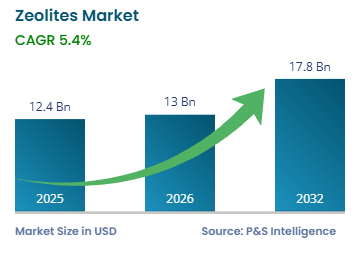
The zeolites market size was USD 12.4 billion for 2025, and it will grow by 5.4% during 2026–2032, to reach USD 17.8 billion by 2032.
Zeolites are microporous aluminosilicates that have crystalline structures with precise pore sizes that provide molecular sieving capabilities, high-capacity ion exchange and selective catalysis. The primary use of zeolites is in fluid catalytic cracking (FCC) units in petroleum refineries. There are more than 300 refineries around the world that utilize FCC technology that rely on Y-type zeolites to convert heavy gas oils into gasoline, diesel fuel and petrochemical feedstocks. As indicated by a peer-reviewed article located on PubMed Central (PMC), there are nearly 840,000 metric tons of FCC catalysts manufactured each year in the world, and zeolites make up a large portion of the global zeolite catalyst consumption.
Additionally, there is a parallel increase in demand in the water treatment area, where zeolites act as highly effective adsorbent agents to remove ammonium ions, heavy metals and organic pollutants from municipal and industrial wastewater systems. Research conducted by Nature/Scientific Reports validates the effectiveness of engineered zeolites for ammonium exchange in high concentration applications, demonstrating that they can exchange up to 4.5 to 4.7 meq NH4+-N per gram of media in such applications. This verifies their technical performance in tertiary treatment processes under increasingly stringent environmental discharge standards.
Zeolites Market Dynamics
Catalyst Technology Advancement and Process Optimization Are Key Trends
Advancements in zeolite catalyst formulations and in fluid catalytic cracking (FCC) process design are key trends influencing their ability to increase conversion efficiency, product selectivity, and overall economic feasibility.
According to International Energy Agency (IEA) projections, petrochemicals will account for approximately 45–50% of all future oil demand growth through 2050.
Refineries/petrochemical complexes will be increasingly incentivized to optimize chemical feedstock yield from FCC units and other refinery units; rather than focusing on gasoline production as they traditionally have.
Mesoporously structured zeolites can efficiently process heavy residue feedstocks and vacuum gas oils by providing greater access to active site locations within these feedstocks for improved molecular conversion rates while also reducing catalyst deactivation through reduced coke formation.
Y-type zeolites stabilized with rare earth elements can withstand the hydrothermal deactivation associated with high-severity FCC regeneration cycles, thereby increasing catalyst service life from 30 days to up to 60 days in commercial refinery operations.
In secondary cracking operations, ZSM-5 zeolite additives can selectively crack gasoline range molecules into propylene and butylene product streams that command premium prices as petrochemical intermediates.
In some cases, propylene yields have reached 20% or higher in proprietary zeolite-based olefin production processes.
Environmental Compliance and Water Scarcity Pressures Are Biggest Drivers
Increasingly stringent regulatory frameworks governing industrial wastewater discharges and municipal water quality standards create growing demand for zeolite-based ion exchange and adsorption technologies.
Heavy metals, including lead, cadmium, mercury, chromium, and arsenic, resulting from metal plating, mining, battery manufacturing, and chemical synthesis represent a consistent problem in industrial wastewaters, as their concentrations frequently exceed regulatory discharge limits.
Regulatory agencies have established maximum permissible contamination level standards for toxic heavy metals in drinking water and surface water discharges as a chronic exposure cam cause neurotoxicity, carcinogenicity, and organ damage.
Zeolites are particularly effective as cation exchangers because they can remove dissolved metal ions through electrostatic attraction to negative charge sites on the aluminosilicate framework.
Removal efficiencies for target species have exceeded 90% in both batch and continuous column operations using zeolites.
Clinoptilolite zeolites exhibit high selectivity for ammonium ions and can therefore provide a means for tertiary nitrogen removal from municipal wastewater treatment plants where total nitrogen discharge limits have been tightened to prevent eutrophication of receiving water bodies.
Engineered synthetic zeolites with controlled pore sizes and Si/Al ratios can also provide improved capacity and selectivity for specific contaminant profiles found in wastewater streams generated by pharmaceutical, electronics, and petrochemical industries.
Water conservation issues in Asia, the Middle East and North Africa propel the demand for zeolite-based wastewater treatment systems for the reuse/recycling of water, thereby conserving fresh water resources.
Globally, water scarcity and lack of safe drinking water remain major challenges: about 2.1–2.2 billion people (roughly 1 in 4 worldwide) do not have access to safely managed potable water.
Around 106 million people still rely on untreated surface water, and approximately 1.7 billion use drinking water sources contaminated with feces, increasing the risk of disease.
Beyond access, scarcity is also about availability and reliability—over 2 billion people live in water-stressed countries, and about 3.6 billion experience inadequate water access for at least one month each year.
Zeolites Market Segmentation Analysis
Product Type Analysis
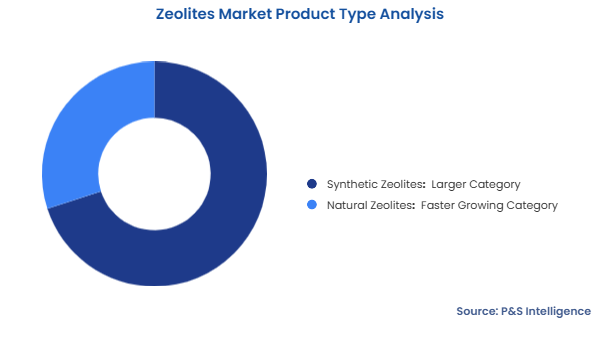
The synthetic category holds the largest market share, of 70%, in 2025, due to better catalytic activity than natural zeolites. They can be engineered with a wide range of pore structures and have good consistency of composition to meet the needs of many demanding industrial applications.
Synthetic zeolite A has the highest market share of detergent applications in which the ion-exchange capacity ranges from 300 to 350 milliequivalents/100 g to soften water by removing calcium and magnesium ions that interfere with surfactant function. Control over silicon-to-aluminum ratios, crystal morphology, and selective incorporation of rare earth elements allows synthetic zeolite manufacturers to tailor products to specific requirements.
The natural category will have the highest CAGR, of 5.6%, due to increasing uses of natural zeolites in agriculture, aquaculture, and construction, for which natural clinoptilolite and mordenite deposits are favored based on low cost. Clinoptilolite exhibits excellent selectivity for removing ammonium ions from agricultural soils and feeds for livestock; it also has cation exchange capacities ranging from 180 to 220 milliequivalents/100 g to meet the lesser stringent needs of agriculture and aquaculture applications.
The product types analyzed in this report are:
Synthetic Zeolites (Larger Category)
Natural Zeolites (Faster Growing Category)
Application Analysis
The catalysis category holds the largest market share, of 45%, in 2025, due to the continuing dependence of the petroleum refining industry on zeolite-based FCC catalysts to convert heavy gas oils into gasoline and petrochemical feedstocks. The main active site for cracking C-C bonds in hydrocarbon molecules using acidic catalysis in petroleum refining is provided by Y-type zeolites embedded in FCC catalyst microspheres. Commercial FCC catalysts contain 30 to 50% zeolite by weight along with active matrix materials and binders. ZSM-5 zeolite additives used at 3 to 10% loading level are selective to crack gasoline range molecules into propylene and butylene products. They achieve higher market pricing as petrochemical building blocks to move from producing transportation fuels to producing light olefins. This is because transportation fuel demand continues to decline in developed countries.
The water & wastewater treatment category will have the highest CAGR, due to the stringent regulations for the disposal of industrial effluent and municipal treatment plant expansion in developing countries to address the shortage of freshwater. Dissolved ammonium ions, heavy metals, and radioactive isotopes can be removed from contaminated water streams by ion exchange applications using either natural clinoptilolite or synthetic zeolite A. Extended service cycles before requiring regeneration can be achieved with high breakthrough capacities. Nitrogen removal efficiencies greater than 90% for total ammonium-nitrogen can be attained by tertiary treatment systems incorporating zeolite filters in municipal wastewater treatment plants, allowing them to meet the requirements of regulatory agencies to prevent eutrophication in sensitive receiving waters.
The applications analyzed in this report are:
Catalysis (Largest Category)
Detergent Builders
Adsorbents
Building Materials
Animal Feed
Water & Wastewater Treatment (Fastest Growing Category)
Soil Remediation
Others
Form Analysis
The powder category holds the largest market share, of 55%, in 2025, as zeolite A powder with particle sizes between 1 and 10 micrometers can be dispersed evenly throughout spray-dried detergent granules and provide optimal dispersion in washing solutions. Fluid catalytic cracking catalyst microspheres with uniform particle size distributions between 60 and 75 micrometers required for fluidized bed reactor operations can be manufactured using zeolite powders that are mixed with precursor chemicals and binder chemicals and then spray-dried. Soil amendments and animal feed supplements for agriculture utilize natural zeolite powder milled to 100 to 300 mesh sizes to allow for even distribution of the zeolite among the other inputs. This maximizes the surface area of the zeolite available for ion exchange reactions.
The granules/pellets category will have the highest CAGR, as new water treatment facilities that use granular zeolite media that exhibit the best hydraulic properties and ease of handling in fixed bed filtration columns and ion exchange reactors. Granular zeolites with diameters of 0.5 to 3 mm provide an ideal balance between hydraulic resistance, void volume, and residence time in continuous flow treatment systems. This permits large volumes of water to be treated rapidly while achieving the desired removal rates. Compared to loose powder, pelletized zeolites made by extruding or pelletizing zeolites have improved mechanical strength. This reduces attrition and the formation of fines in industrial applications that involve mechanical agitation, pneumatic transport, or multiple regenerations that may impart mechanical stresses on the zeolite material.
The forms analyzed in this report are:
Powder (Largest Category)
Granules/Pellets (Fastest Growing Category)
Drive strategic growth with comprehensive market analysis
Zeolites Market Geographical Analysis
Asia-Pacific Zeolites Market Size
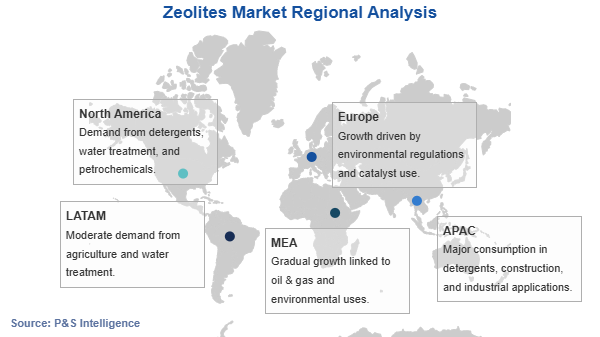
Asia-Pacific holds the largest market share, of 40%, in 2025, and it will have the highest CAGR, of 5.5%, primarily due to the region's concentration of petroleum refining capacity, increasing industrial activity and large-scale investments in water treatment systems. China's 14th Five-Year Plan has designated significant amounts of funding for catalyst innovation and emission control technologies, thus supporting increased demand for zeolite-based FCC catalysts in propylene rich cracking units and advanced wastewater treatment facilities.
India's rapidly developing industrial base and government mandated restrictions on the amount of pollutants that may be discharged into municipal treatment plants and soils has been driving the adoption of natural and synthetic zeolites in municipal treatment plants and soil remediation projects.
Japan and South Korea also drive steady demand through established petrochemical sectors and through strict environmental compliance frameworks that emphasize low emission catalytic processes and high-performance water purification technologies. Additionally, Australia's mining and resource processing sectors are increasingly utilizing zeolite based solutions to treat process waters and mitigate emissions from their respective processes.
China Zeolites Market Size
In 2025, China represented the largest country level zeolites market in Asia Pacific and represents a majority of the regional consumption due to its status as both the world's largest producer and consumer of zeolites. China has extensive operations for mining natural zeolites in addition to producing synthetic zeolites using advanced synthesis methods for supplying domestic FCC catalyst producers, detergent manufacturers and environmental technology providers. Petroleum refining operations within China process significant volumes of crude oil through FCC units that rely heavily on Y-type zeolites for gasoline and chemical feedstock production, while the transition of the detergent industry towards zeolite-based builders aligns with regulations eliminating phosphorus from major urban areas.
China's Environmental Protection Agency has issued tighter limits for allowable pollutant discharges for industrial and municipal wastewater, leading to increased installations of zeolite-based ion exchange and adsorption systems in treatment plants servicing the most populous areas. Applications of zeolites in the construction sector are expanding as zeolites are being used in the formulation of pozzolanic cements, light weight aggregates and insulation materials to meet green building standards and energy efficiency objectives. Agricultural applications include cadmium contaminated soil remediation programs in major grain producing provinces where natural zeolites effectively immobilize heavy metals and improve soil structure.
Moreover, domestic catalyst manufacturers are developing hierarchically structured zeolites to enhance the performance of zeolite-based FCC catalysts and water treatment providers are commercializing zeolite-carbon composites for the removal of pharmaceutical compounds.
India Zeolites Market Size
The Indian zeolites market is the fastest-growing country market in Asia Pacific due to rapid industrialization, increased refinery production capacity, and the accelerated deployment of water treatment technology to mitigate freshwater shortages and enforce pollution controls. Initiatives under the National Clean Ganga Mission and state level wastewater treatment programs have resulted in an increase in the number of municipal plants installing zeolite based filtration/ion exchange systems to treat industrial effluent containing ammonium and/or heavy metals prior to release into rivers.
As the Indian refining industry expands its fluid catalytic cracking (FCC) capacity to meet the rising demand for transport fuels, it will also drive up the consumption of synthetic zeolite catalyst for processing both domestic and imported crude oil feedstocks. Zeolites are being used as supplementary cementitious materials in concrete production to improve durability and thermal properties of concrete in addition to lower carbon footprint in construction activities resulting from urban housing and commercial infrastructure projects.
Additionally, agricultural applications include the use of zeolites in precision farming systems for slow release fertilizers and soil conditioners to improve water retention in areas prone to drought and meet the dual goals of improving productivity and sustainability. Animal feed applications are gaining acceptance as livestock producers begin to utilize zeolite supplements to improve nutrient utilization and minimize odors in confined animal feeding operations.
India faces severe water stress, with 17–18% of the world’s population but only 4% of global freshwater resources. Per-capita water availability has fallen to about 1,486 m³ (2021) and is projected to drop to 1,140 m³ by 2050, well below the water-scarcity threshold. Total water demand is estimated at 1,093 billion cubic meters (bcm) in 2025, rising to 1,447 bcm by 2050, driven largely by agriculture (85% of use). Pollution worsens scarcity: less than 30% of sewage is treated, and widespread groundwater contamination (arsenic, fluoride, nitrates) affects millions, reducing safe potable water supplies.
Europe Zeolites Market Size
Europe represented a significant global zeolites market in 2025 driven by strict environmental regulations, well-developed water treatment infrastructure, and significant government support for sustainable industrial processes. Germany, France, and the U.K. were the three largest country markets for zeolites and each had large established detergent manufacturing industries that had completed their transition to zeolite-based builders as a result of the European Union's directives to limit phosphorus content in household and industrial cleaning products.
The zeolite FCC catalysts employed in European refining operations process North Sea crude and imported feedstocks, and many of these operators are increasingly utilizing more specialized catalyst formulations that can maximize middle distillates to meet the diesel-heavy fuel demand profiles prevalent throughout Europe. Water treatment applications in Europe focus on tertiary treatment systems that can remove trace contaminants from industrial wastewater prior to discharging into rivers and align with the ambitious water quality targets defined in the EU Water Framework Directive.
Moreover, municipal treatment plants in densely populated areas employ zeolite filtration for nitrogen removal and heavy metal sequestration, and industrial facilities in the automotive, chemical, and metal processing sectors employ zeolite-based systems for process water recycling and zero liquid discharge configurations. Construction applications are expanding as a result of increasing green building regulations that incentivize the use of supplementary cementitious materials to reduce the amount of Portland cement required and to improve thermal mass properties in buildings designed to be energy efficient. Automotive emission control systems provide a specialized application for zeolites as copper exchanged zeolite catalysts are utilized to perform selective catalytic reduction (SCR) of nitrogen oxides in diesel vehicles to enable compliance with Euro 6 and upcoming Euro 7 emission standards.
The regions and countries of the market are as follows:
North America
U.S. (Largest and Fastest-Growing Country Market)
Canada
Europe
Germany (Largest Country Market)
U.K.
France
Italy
Spain (Fastest-Growing Country Market)
Rest of Europe
Asia Pacific (Largest and Fastest-Growing Region)
China (Largest Country Market)
India (Fastest-Growing Country Market)
Japan
South Korea
Australia
Rest of Asia Pacific
Latin America
Brazil (Largest Country Market)
Mexico (Fastest-Growing Country Market)
Rest of Latin America
Middle East & Africa
U.A.E. (Largest Country Market)
Saudi Arabia (Fastest-Growing Country Market)
South Africa
Rest of MEA
Zeolites Market Share
The market is semi-consolidated, with established catalyst manufacturers, chemical companies, and natural zeolite producers maintaining stable market shares as a result of their technical competence, large-scale manufacturing capability, and historical customer relationships. Barriers to entry into the catalyst market include proprietary rights related to zeolite synthesis methodologies and formulation methods, as well as significant performance validation testing required prior to commercial deployment of zeolite-based products in refinery operations. Additionally, substantial R&D investment is required to develop zeolite-based products with performance characteristics comparable to existing commercial formulations.
Competitors in the natural zeolite market serve a range of non-catalyst applications, including construction, agriculture, water treatment, and animal feed. These markets are generally less consolidated than the catalyst industry, with multiple local, regional, and national players rather than a few dominant firms. Competition is driven by the quality of zeolite deposits that companies own or control, as well as their processing capabilities and logistical advantages. Success also depends on the ability to develop products specifically tailored to the requirements of each targeted application.
Key Zeolites Companies:
BASF SE
Honeywell International Inc.
Arkema S.A.
Clariant AG
Tosoh Corporation
Albemarle Corporation
W. R. Grace & Co.
Zeolyst International
Zeochem AG
Chemiewerk Bad K
PQ Corporation
KNT Group
Zeolites Market News
In August 2024, BASF SE launched a new fluid catalytic cracking (FCC) catalyst designed for gasoil to mild resid feedstocks. The new catalyst combines the latest advancements in matrix design and multi-zeolite architecture to enhance butylene yield, raise naphtha octane and increase LPG olefinicity. This supports refiners in maintaining flexibility in product slatesto maintain flexibility in their product slate by permitting them to dynamically adjust the output between transportation fuels and petrochemical feedstocks in response to changes in the market environment.
In February 2024, W. R. Grace & Co. announced that China Coal Shaanxi Energy & Chemical Group Co., Ltd. had doubled its license agreement for Grace's UNIPOL PP process technology with Grace. The company increased the capacity of polypropylene production at its Yulin City facility in Shaanxi Province from 300 to 600 kilotons per year to meet the growing demand for propylene-derived polymer products in China's automotive, packaging and consumer products industries.
In January 2023, Albemarle Corporation strengthened its wholly-owned catalysts subsidiary, Ketjen Corporation, as an independent business unit, to further develop its commitment to delivering high-quality catalyst solutions for fluid catalytic cracking, hydroprocessing and specialty chemical applications. This reorganization will enable Albemarle to continue to develop customized zeolite-based catalyst products to address the evolving demands of the energy transition and the increasing complexity of refinery feedstock profiles globally.
Frequently Asked Questions About This Report
What is the Zeolites Market?+
The zeolites market covers natural and synthetic zeolite materials used mainly as adsorbents, catalysts, and ion-exchangers across industries such as detergents, petrochemicals, water treatment, and agriculture.
What is the market size of the zeolites market in 2025?+
The zeolites market size in 2025 is valued at USD 12.4 billion.
What is the growth rate of the zeolites market?+
The zeolites market is growing at a CAGR of 5.4% during the forecast period.
What are the key factors driving the zeolites market?+
Key factors include demand for water & wastewater treatment, use in detergents and catalysts, and growth in refining and petrochemical applications.
Which application dominates the zeolites market?+
Catalysis dominates the zeolites market.
What is the nature of the zeolites market?+
The zeolites market is semi-consolidated.
Want a report tailored exactly to your business need?
Leading companies across industries trust us to deliver data-driven insights and innovative solutions for their most critical decisions. From data-driven strategies to actionable insights, we empower the decision-makers who shape industries and define the future. From Fortune 500 companies to innovative startups, we are proud to partner with organisations that drive progress in their industries.
Client Testimonials
Working with P&S Intelligence and their team was an absolute pleasure – their awareness of timelines and commitment to value greatly contributed to our project's success. Eagerly anticipating future collaborations.
McKinsey & Company
India
Unmatched Standards
Our insights into the minutest levels of the markets, including the latest trends and competitive landscape, give you all the answers you need to take your business to new heights
Complete Data Security
We take a cautious approach to protecting your personal and confidential information. Trust is the strongest bond that connects us and our clients, and trust we build by complying with all international and domestic data protection and privacy laws