Wound Care Biologics Market Size & Share Analysis - Emerging Trends, Growth Opportunities, Competitive Landscape, and Forecasts (2026 - 2032)
This Report Provides In-Depth Analysis of the Wound Care Biologics Market Report Prepared by P&S Intelligence, Segmented by Product (Skin Substitutes, Growth Factors, Collagen-Based, Cell-Based, Enzyme-Based), Durability (Permanent, Temporary), Formulation (Topical, Sheet / Matrix-Based, Injectable), Application (Chronic, Acute), End User (Hospitals & Specialty Clinics, Inpatient settings, Outpatient settings, Ambulatory Surgical Centers (ASCs), Home Care), and Geographical Outlook for the Period of 2021 to 2032
Explore the market potential with our data-driven report
Wound Care Biologics Market Overview
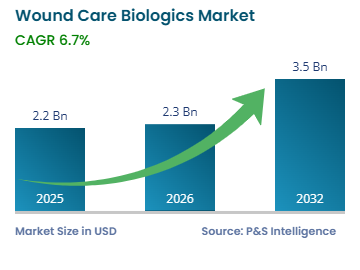
The wound care biologics market size was USD 2.2 billion for 2025, and it will grow by 6.7% during 2026–2032, to reach USD 3.5 billion by 2032.
This growth is supported by advancing adoption of skin substitutes, growth factors, and cell-based therapies across chronic and acute wound management, positioning biologics as critical alternatives to conventional dressings in complex wound healing protocols. The integration of human donor-tissue derived matrices, acellular animal-derived scaffolds, and biosynthetic formulations enables accelerated tissue regeneration, reduced infection risk, and improved closure rates in diabetic foot ulcers, pressure ulcers, and surgical wounds.
Escalating diabetes prevalence drives sustained demand for biologic wound interventions. This creates a substantial unmet need for advanced wound care solutions that address diabetic foot ulcers and related complications. Moreover, many human tissue allografts, such as placental membrane products, are regulated as HCT/Ps under 21 CFR Parts 1270 and 1271, with different regulatory criteria. Globally, heterogeneous regulatory requirements and uneven reimbursement coverage influence biologics adoption, with broader utilization often limited by affordability outside well-funded healthcare systems.
Wound Care Biologics Market Trends & Drivers
Technological Innovation in Formulations and Delivery Systems Is Key Trend
Continuous technological advancement in biologic formulations, delivery mechanisms, and product configurations opens differentiated market categories addressing specific clinical needs and enabling broader wound care applications. In the U.S., more than 6.5 million patients are affected by chronic wounds annually, creating sustained demand for advanced biologic therapies that reduce healing time and lower recurrence risk, particularly in diabetic and elderly populations.
Comparable chronic wound burdens in Europe, Latin America, and MEA, driven by diabetes, vascular disease, and aging demographics, are similarly supporting demand for innovative biologic wound care products across regions. Innovation encompasses fish-skin xenografts offering intact extracellular matrix architecture without human tissue sourcing constraints. Peer-reviewed clinical studies report statistically significant improvements in wound area reduction and faster granulation compared to standard care in diabetic foot ulcer treatment.
Dehydrated amniotic membranes provide convenient ambient storage eliminating cold chain requirements, while spray-on formulations enable coverage of irregular wound geometries unsuitable for sheet-based products. Players engineer injectable biologics incorporating platelet-rich plasma or mesenchymal stem cells for delivery into deep tissue defects, supported by growing clinical adoption of autologous PRP therapies.
Clinical documentation standards used in U.S. reimbursement reviews emphasize complete wound closure within 12–20 weeks, reduction in wound size by at least 50% within the first four weeks, and decreased frequency of dressing changes. These metrics are increasingly supported by advanced biologic products.
Rising Prevalence of Diabetes and Chronic Wound Conditions Is Biggest Driver
Escalating global diabetes prevalence creates sustained structural demand for biological wound care interventions addressing diabetic foot ulcers, pressure ulcers, and venous leg ulcers that represent substantial clinical and economic burdens across healthcare systems. According to the International Diabetes Federation, approximately 589 million adults worldwide were living with diabetes in 2024, a figure projected to rise to 643 million by 2030, 783 million by 2045, and 853 million by 2050. This indicates a rapidly expanding population at risk for chronic wound complications.
Globally, diabetes-related healthcare spending exceeded USD 966 billion in 2021 and further reached USD 1 trillion in 2024. This reflects the scale of economic pressure driving adoption of advanced wound therapies across both developed and emerging healthcare systems. In Europe, the European Wound Management Association estimates that chronic wounds affect 1–2% of the population in developed countries, with prevalence increasing among aging populations and individuals with diabetes and venous insufficiency, reinforcing demand for advanced wound care technologies.
The World Health Organization estimates that the African region has approximately 24 million people living with diabetes, with many cases undiagnosed and prevalence projected to increase substantially by 2045, while the Pan American Health Organization reports that approximately 62 million people in Latin America and the Caribbean have diabetes, with prevalence continuing to rise due to urbanization, aging populations, and increasing obesity, collectively expanding the global addressable population for biologic wound care interventions.
International clinical guidelines increasingly recommend escalation to advanced wound therapies, including biologic matrices and cellular products, when diabetic ulcers fail to demonstrate significant size reduction within four weeks of standard treatment. Healthcare systems respond through dedicated wound care centers, multidisciplinary diabetic foot clinics, and specialized protocols integrating biologics after documented failure of basic wound management.
The aging global population compounds this dynamic, as elderly individuals demonstrate higher incidence of chronic wounds from multiple etiologies, including pressure injuries in long-term care settings, venous insufficiency from reduced mobility, and surgical wounds healing more slowly due to age-related metabolic changes. The United Nations projects that the global population aged 65 and older will double from 761 million in 2021 to over 1.6 billion by 2050, significantly expanding the population vulnerable to chronic wound formation.
Demand is expected to accelerate as diabetes prevalence continues rising across Asia-Pacific nations undergoing rapid urbanization and dietary transitions, while aging demographics across developed economies expand the population vulnerable to chronic wound complications requiring advanced biological interventions.
Wound Care Biologics Market Segmentation and Category Analysis
Product Analysis
The skin substitutes category holds the largest market share, of 45%, in 2025, driven by established clinical evidence demonstrating superior wound closure rates compared to conventional dressings, comprehensive Centers for Medicare & Medicaid Services reimbursement coverage for diabetic foot ulcer and venous leg ulcer treatment pathways. The U.S. Food and Drug Administration regulates skin substitutes and wound care biologics through multiple frameworks depending on product composition and risk profile. Human tissue-based products meeting criteria for minimal manipulation and homologous use are regulated under 21 CFR Part 1271 as HCT/Ps without requiring premarket approval, while acellular skin substitutes and wound matrices are typically cleared as medical devices through the 510(k) pathway.
The cell-based category will have the highest CAGR, of 6.8%, propelled by technological advances in viable cell preservation maintaining cellular viability during storage and transport, emerging clinical applications addressing complex wounds unresponsive to acellular products, and regulatory precedents establishing approval pathways for living cellular constructs as evidenced by FDA Premarket Approvals granted to products containing viable fibroblasts and keratinocytes.
The products analyzed in this report are:
Skin Substitutes (Largest Category)
Human donor-tissue derived
Acellular animal-derived
Biosynthetic
Growth Factors
Platelet-derived growth factors (PDGF)
Fibroblast growth factors (FGF)
Epidermal growth factors (EGF)
Transforming growth factor-beta (TGF-β)
Insulin-like growth factors (IGF)
Others
Collagen-Based
Viable
Non-viable
Cell-Based (Fastest-Growing Category)
Enzyme-Based
Others
Durability Analysis
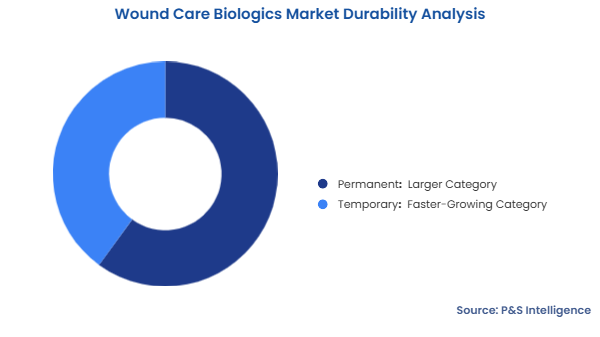
The permanent category holds the largest market share, of 60%, in 2025, reflecting clinical preference for definitive wound closure solutions that integrate permanently into host tissue rather than requiring secondary grafting procedures. Permanent products incorporating dermal matrices, cellular components, or biosynthetic scaffolds designed for complete tissue integration address the most challenging chronic wound presentations where temporary measures have proven insufficient.
The temporary category will have the highest CAGR, of 7.1%, driven by expanded applications in acute trauma and burn stabilization, where rapid deployment and subsequent autografting represent standard care. Additionally, cost-effectiveness advantages appeal to ambulatory surgical centers and emergency departments seeking to minimize immediate procedure expenses while preparing wound beds for definitive reconstruction. Further, and product innovation delivers improved handling characteristics and extended wear time, enabling longer intervals between dressing changes. International burn and trauma care guidelines support the use of temporary biologic dressings during the acute phase to reduce fluid loss, bacterial contamination, and pain prior to definitive surgical closure.
The U.S. Department of Defense supports the development of temporary biological dressings for battlefield trauma management, with findings increasingly informing civilian emergency, disaster response, and mass-casualty wound management protocols.
The durability analyzed in this report are:
Permanent (Larger Category)
Temporary (Faster-Growing Category)
Formulation Analysis
The topical category holds the largest market share, of 45%, in 2025, supported by ease of application, requiring minimal specialized training, enabling use across diverse clinical settings from hospital wound centers to outpatient clinics. Formulation versatility accommodates delivery as gels, ointments, creams, or sprays matching wound characteristics and provider preferences. Established clinical workflows integrate topical biologic application into standard dressing change protocols without requiring procedural suites or anesthesia. The FDA regulates many topical biologic products for bone and soft tissue regeneration under established biologics and combination product pathways, facilitating predictable approval and post-market surveillance.
The injectable category will have the highest CAGR, enabled by clinical advantages addressing deep tissue defects, tunneling wounds, and undermined ulcers where sheet-based products cannot achieve adequate coverage, technological improvements in delivery systems including precision applicators and controlled-release formulations extending therapeutic duration, which are increasingly supported by regulatory pathways for injectable biologics and combination products defined by the U.S. FDA, and expanding applications incorporating platelet-rich plasma, mesenchymal stem cells, and growth factor concentrates targeting cellular-level wound healing mechanisms.
The formulations analyzed in this report are:
Topical (Largest Category)
Gels
Ointments
Creams
Sprays
Sheet / Matrix-Based
Films
Membranes
Scaffolds
Injectable (Fastest-Growing Category)
Intradermal
Subcutaneous
Others
Application Analysis
The chronic category holds the largest market share, of 70%, in 2025, reflecting substantial disease burden from diabetic foot ulcers, pressure ulcers, and venous leg ulcers affecting millions of patients globally, established reimbursement frameworks supporting biologic utilization after documented standard care failure, and dedicated wound care infrastructure including specialized centers and multidisciplinary teams focused exclusively on managing non-healing wounds.
The acute category will have the highest CAGR, of 7.0%, propelled by expanding biologic utilization in surgical wound complication management, trauma reconstruction, and burn treatment where rapid wound closure reduces infection risk and hospital length-of-stay, growing evidence that early biologic intervention in acute presentations prevents chronic wound development by establishing optimal healing trajectories from injury onset, and ambulatory surgery center adoption supporting outpatient biologic application for same-day surgical procedures. Coverage and payment policies of the CMS emphasize the reduction of surgical site infections, complications, and avoidable readmissions, creating financial incentives for providers to adopt advanced wound management strategies in acute care settings.
The applications analyzed in this report are:
Chronic (Larger Category)
Diabetic foot ulcers (DFUs)
Pressure ulcers
Venous leg ulcers (VLUs)
Acute (Faster-Growing Category)
Surgical injuries, traumatic wounds, and burn injuries
Others
End User Analysis
The hospitals & specialty clinics category holds the largest market share, of 60%, in 2025, underpinned by comprehensive wound care infrastructure including dedicated centers employing multidisciplinary teams of physicians, nurses, and therapists. Hospital-based wound centers benefit from integrated care coordination connecting inpatient surgical services, outpatient follow-up, and home healthcare transitions creating seamless patient management across care continuum. Specialty clinics focusing exclusively on wound management develop concentrated expertise, support complex case management and clinical research participation, generate real-world evidence, and validate biologic effectiveness.
The ambulatory surgical centers category will have the highest CAGR, driven by healthcare delivery transformation shifting procedures from hospital outpatient departments to ASC settings offering substantial cost advantages. Data from the Medicare Payment Advisory Commission indicates that many surgical procedures performed in ASCs are reimbursed at significantly lower rates than in hospital outpatient departments while demonstrating comparable clinical outcomes for appropriately selected patients.
Drive strategic growth with comprehensive market analysis
Wound Care Biologics Market Geographical Analysis
North America Wound Care Biologics Market Size
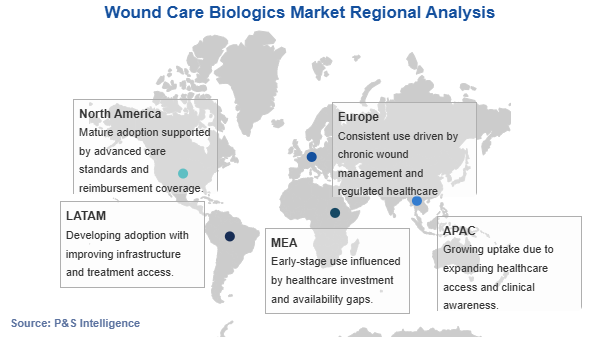
North America holds the largest market share, of 35%, in 2025, sustained by well-established regulatory frameworks, comprehensive reimbursement coverage, and extensive clinical adoption across inpatient and outpatient care settings. Medicare and private insurance reimbursement policies support utilization of biological wound care products in diabetic foot ulcer management, burn treatment, and surgical wound healing, creating favorable economic conditions for both manufacturers and healthcare providers.
The CDC reports that over 38 million Americans have diabetes, with approximately one in five unaware of their condition, generating substantial demand for advanced wound care interventions that prevent complications such as diabetic foot ulcers and lower extremity amputations.
The competitive landscape features established players, including Smith & Nephew, Organogenesis, and Integra LifeSciences, operating comprehensive distribution networks serving hospital systems, ambulatory surgical centers, and specialized wound care clinics. Recent product launches incorporating fish-skin xenografts, amniotic membranes, and bioengineered collagen matrices reflect ongoing innovation targeting chronic wound segments.
U.S. Wound Care Biologics Market Size
The United States dominated the North American wound care biologics market. This leadership position stems from multiple structural advantages including the world's largest installed base of advanced wound care centers, extensive clinical research infrastructure supporting biologics development, and sophisticated health technology assessment mechanisms that evaluate product performance across diverse wound types. The U.S. market benefits from CMS’s coverage decisions, which establish reimbursement precedents adopted by commercial payers, creating nationwide access for approved biological wound care products.
The American Diabetes Association estimates that diabetes-related medical costs and lost productivity totaled USD 413 billion annually in the United States, with chronic wound management representing a significant component of this economic burden. This reinforces healthcare system incentives to adopt effective biologic interventions that reduce healing time and prevent amputations.
Asia-Pacific Wound Care Biologics Market Size
Asia-Pacific will have the highest CAGR of 6.9%, driven by rapidly expanding healthcare infrastructure, rising diabetes prevalence across populous nations, and increasing health expenditure enabling adoption of advanced medical technologies. The International Diabetes Federation reported that approximately 206 million adults in the Western Pacific region had diabetes in 2021, a figure projected to increase substantially by 2030, creating urgent demand for effective wound care solutions that prevent diabetic foot complications and reduce amputation rates across densely populated urban and rural communities.
India Wound Care Biologics Market Size
India emerged as the fastest-growing country market within Asia-Pacific, based on favorable demographic trends, expanding diabetes prevalence, and healthcare infrastructure development. The Indian market benefits from a large and growing middle class with increasing healthcare purchasing power, proliferation of multi-specialty hospitals in tier-1 and tier-2 cities offering advanced wound care services, and government initiatives promoting medical device manufacturing under the Make in India program that encourages domestic biologics production.
The International Diabetes Federation estimated that approximately 74 million adults in India had diabetes in 2021, representing one of the world's largest diabetic populations, with projections indicating continued growth driven by urbanization, dietary changes, and aging demographics, thereby creating substantial demand for diabetic foot ulcer treatments including biological skin substitutes and growth factor therapies.
The regions and countries of the market are as follows:
North America (Largest Regional Market)
U.S. (Larger Country Market)
Canada (Faster-Growing Country Market)
Europe
Germany (Largest Country Market)
U.K.
France
Italy
Spain (Fastest-Growing Country Market)
Rest of Europe
Asia-Pacific (Fastest-Growing Regional Market)
China (Largest Country Market)
India (Fastest-Growing Country Market)
Japan
South Korea
Australia
Rest of APAC
Latin America
Brazil (Largest Country Market)
Mexico (Fastest-Growing Country Market)
Rest of LATAM
Middle East and Africa
Saudi Arabia (Largest Country Market)
South Africa
U.A.E. (Fastest-Growing Country Market)
Rest of MEA
Wound Care Biologics Market Share
The market is semi-consolidated with leading multinational medical device companies holding substantial collective market positions alongside specialized biologic manufacturers focusing exclusively on regenerative wound care portfolios. This structural configuration reflects multiple factors including significant research and development investment requirements for developing tissue-based products with robust clinical evidence, regulatory pathway complexity demanding expertise in human cell and tissue regulatory frameworks established by the U.S. FDA and equivalent international agencies, and distribution infrastructure necessitating specialized handling for temperature-sensitive biological materials.
Established players leverage global commercial reach, comprehensive clinical education programs training wound care specialists on product application, and strategic relationships with group purchasing organizations securing formulary placement across integrated delivery networks. The market demonstrates signs of ongoing consolidation as larger medical device corporations acquire specialized biologics firms seeking to expand advanced wound care offerings, recent examples include strategic acquisitions aimed at integrating placental-derived products and amniotic membrane technologies into broader product portfolios serving hospital wound care centers and ambulatory surgical facilities.
Key Wound Care Biologics Companies:
Smith & Nephew plc
Organogenesis Inc.
MiMedx Group Inc.
Integra LifeSciences Corporation
Vericel Corporation
Kerecis Limited
LifeNet Health
BioTissue Inc.
Stratatech Corporation
Tissue Regenix Group plc
Skye Biologics Inc.
Applied Biologics LLC
Wound Care Biologics Market Developments
In November 2024, Organogenesis Holdings Inc. opened a 122,000-square-foot biomanufacturing facility in Smithfield, Rhode Island, expanding production capacity for advanced wound care and surgical biologic products. The facility strengthens the company's ability to meet growing demand for living cellular constructs and tissue-engineered skin substitutes across hospital and ambulatory care settings.
In September 2023, MiMedx Group Inc. announced the launch of EPIEFFECT, a lyophilized human placental-based allograft intended to support healing in both acute and chronic wounds, including difficult-to-heal conditions such as diabetic foot ulcers and venous leg ulcers.
In April 2023, Kerecis hf. announced the launch of MariGen Shield, a wound care product that integrates its medical-fish-skin graft with a silicone contact layer to provide advanced treatment for chronic and complex wounds, including diabetic and pressure ulcers.
Frequently Asked Questions About This Report
What is the market size for wound care biologics market?+
The wound care biologics market was valued at USD 2.2 billion in 2025.
What is driving the growth of the wound care biologics market?+
The market is driven by rising prevalence of diabetes and chronic wounds, increasing use of advanced skin substitutes, growing elderly population, and strong clinical outcomes compared to conventional wound dressings.
Which products dominate the wound care biologics market?+
Skin substitutes dominate the wound care biologics market.
Which application holds the largest share in the wound care biologics market?+
Chronic wounds hold the largest share in the wound care biologics market.
Which region leads the wound care biologics market?+
North America leads the wound care biologics market.
Want a report tailored exactly to your business need?
Leading companies across industries trust us to deliver data-driven insights and innovative solutions for their most critical decisions. From data-driven strategies to actionable insights, we empower the decision-makers who shape industries and define the future. From Fortune 500 companies to innovative startups, we are proud to partner with organisations that drive progress in their industries.
Client Testimonials
Working with P&S Intelligence and their team was an absolute pleasure – their awareness of timelines and commitment to value greatly contributed to our project's success. Eagerly anticipating future collaborations.
McKinsey & Company
India
Unmatched Standards
Our insights into the minutest levels of the markets, including the latest trends and competitive landscape, give you all the answers you need to take your business to new heights
Complete Data Security
We take a cautious approach to protecting your personal and confidential information. Trust is the strongest bond that connects us and our clients, and trust we build by complying with all international and domestic data protection and privacy laws