Explore the market potential with our data-driven report
Workplace Safety Market Overview
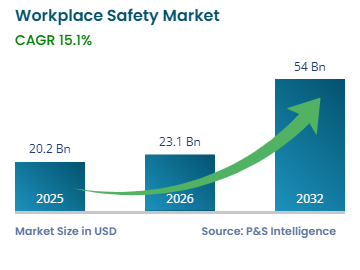
The workplace safety market size was USD 20.2 billion for 2025, and it will grow by 15.1% during 2026-2032, to reach USD 54.0 billion by 2032.
The workplace safety market is expanding as organizations across industries place greater emphasis on protecting employees, reducing workplace incidents, and complying with evolving occupational health and safety requirements. Safety management is becoming a strategic priority as employers seek to create safer working environments while minimizing operational disruptions and financial losses associated with workplace injuries. This trend is encouraging broader adoption of safety technologies, monitoring systems, and risk management platforms across manufacturing, construction, healthcare, logistics, and energy sectors. The growing use of connected devices, wearable technologies, environmental sensors, and data-driven safety platforms is improving the ability of organizations to identify hazards before they lead to incidents. Companies are increasingly using real-time monitoring and predictive analytics to track workplace conditions, employee exposure, equipment performance, and compliance status. These capabilities are helping organizations strengthen preventive safety measures and improve decision-making across complex work environments.
According to the International Labour Organization, 2.41 billion workers were exposed to excessive heat in 2024, highlighting the scale of occupational risks associated with changing workplace conditions. The widespread exposure of workers to heat-related hazards is increasing attention on monitoring solutions, environmental risk assessment tools, and employee protection programs designed to reduce health and safety risks. This growing focus on workplace risk management is increasing demand for integrated safety solutions that combine monitoring, reporting, incident management, and compliance functions. Organizations are also investing in technologies that provide greater visibility into workplace conditions, support proactive intervention, and help maintain safer environments across diverse operational settings.
Key Market Insights
Hardware is the largest component, holding a market share of 60%, due to reliance on physical protective equipment and real-time hazard response systems.
Software is the fastest-growing component, registering a CAGR of approximately 15.4%, driven by increasing adoption of data-driven platforms for risk analysis and compliance management.
Manufacturing is the largest end-user, holding a market share of 30%, due to extensive machinery use and continuous need for worker protection in complex operations.
North America holds the largest share of 40%, due to strict regulatory enforcement, high safety awareness, and early adoption of advanced monitoring technologies.
Asia-Pacific is the fastest-growing region, registering a CAGR of approximately 16.0%, driven by rapid industrial expansion and strengthening workplace safety regulations across developing economies.
Workplace Safety Market Trends and Drivers
Integration of AI and Wearable Technologies in Workplace Safety Is a Major Trend
The market is shifting toward smart safety systems that integrate connected wearables and artificial intelligence-based monitoring tools for real-time worker oversight. Industries such as construction, mining, manufacturing, and oil and gas are deploying smart helmets, connected safety vests, and wearable sensors to monitor worker location, detect falls, measure fatigue levels, and track exposure to hazardous conditions. These technologies help safety teams identify unsafe situations more quickly and improve response times during workplace incidents.
According to the International Data Corporation, 611.5 million wearable devices were shipped globally in 2025, indicating a large and expanding base of connected hardware. The growing availability of wearable technologies is supporting the deployment of workplace safety platforms that combine worker tracking, environmental monitoring, and predictive risk analysis. Organizations are increasingly using these systems to manage heat exposure, restricted-area access, and lone-worker safety, particularly across high-risk industrial operations where continuous monitoring is becoming an important part of daily safety management.
Strict Workplace Safety Regulations and Compliance Pressure Drive Market
The market is growing due to stricter enforcement of workplace safety regulations across manufacturing, construction, energy, mining, logistics, and healthcare sectors. Regulatory agencies are increasing inspections, reporting requirements, and compliance obligations, prompting employers to strengthen hazard identification, incident prevention, and workforce protection programs. Organizations are also investing in safety management systems to improve compliance performance and reduce workplace injuries that can lead to operational disruptions, compensation costs, and legal liabilities.
According to the International Labour Organization, approximately 395 million workers sustain non-fatal work-related injuries each year worldwide. The organization also estimates that around 2.4 billion workers are exposed to climate-related occupational health hazards. These risks are increasing demand for certified personal protective equipment, workforce safety training, exposure monitoring systems, and digital safety management platforms. Employers are using these tools to track workplace conditions, document compliance activities, and address safety risks across both routine operations and high-risk job functions.
High Implementation Costs and Integration Challenges Limit Adoption
The market faces restraints due to the high cost and complexity associated with implementing advanced workplace safety systems. Many organizations, particularly small and medium enterprises, struggle to invest simultaneously in safety hardware, software platforms, system integration, and employee training. According to the World Bank, small and medium enterprises account for approximately 90% of businesses and over 50% of global employment, representing a large customer base with limited financial resources. Cost concerns are further amplified when organizations must integrate new safety technologies with existing operational and information systems. Workforce training and adaptation requirements can also extend deployment timelines, making it more difficult for companies to realize the full benefits of modern workplace safety solutions within a short period.
Rising Demand from Emerging Economies and Untapped Industrial Sectors Creating Growth Potential
The market presents strong opportunities as developing economies continue to expand industrial production, manufacturing capacity, and infrastructure projects. These activities increase the number of workplaces exposed to operational, mechanical, and environmental hazards, creating greater demand for structured safety management systems. According to the United Nations Industrial Development Organization, manufacturing output in middle-income industrializing economies increased by 0.73% in the third quarter of 2025. Expanding industrial operations are encouraging employers to strengthen hazard monitoring, workforce protection, and regulatory compliance practices. Additionally, improving awareness of occupational safety requirements and growing regulatory oversight are supporting adoption of workplace safety software, monitoring technologies, and protective equipment designed for large and geographically dispersed workforces.
Workplace Safety Market Segmentation Analysis
Component Analysis
Hardware is the largest category, holding a market share of 60%, because workplace safety still depends heavily on physical protection and real-time hazard control in high-risk operations. Personal protective equipment, safety sensors, fire systems, and emergency alarms remain essential across manufacturing, construction, mining, and energy facilities where immediate response is required. According to the International Federation of Robotics, 4,664,000 industrial robots were operational globally in 2024, reflecting expanding automated environments. This growth is increasing demand for integrated safety hardware that supports worker protection, machine guarding, proximity detection, and human-machine interaction controls.
Software is the fastest-growing category, registering a CAGR of approximately 15.4%, because organizations are moving from paper-based safety records to digital systems that track incidents, inspections, compliance tasks, and corrective actions. Environmental health and safety platforms, risk assessment tools, and analytics software help safety teams connect hardware alerts, workforce monitoring data, and regulatory documentation in one system. This is especially important for large enterprises and multi-site operations that need consistent safety reporting. Software adoption is also rising among small and medium enterprises as cloud-based tools reduce manual work and support faster hazard identification.
The components analysed in this report are:
Hardware (Largest Category)
Personal Protective Equipment (PPE)
Safety Sensors & Monitoring Devices
Fire Safety & Emergency Systems
Software (Fastest-Growing Category)
Environmental Health & Safety (EHS) Platforms
Risk Assessment & Compliance Management
Incident Tracking & Analytics Tools
Services
Safety Training & Consulting
Auditing & Inspection Services
Emergency Response & Risk Management Services
Application Analysis
Incident & Emergency Management is the largest category, holding a market share of 35%, because every high-risk workplace requires systems to manage fires, chemical leaks, worker injuries, equipment failures, and evacuation events. These solutions connect emergency alarms, response workflows, incident reporting, and compliance documentation, making them central to workplace safety programs. Their demand is strong across manufacturing, healthcare, construction, chemicals, and energy facilities where delays can increase injury severity and operational downtime. This category also supports hardware and software adoption because emergency response depends on reliable detection devices, communication tools, and structured incident records.
Workforce Safety Monitoring is the fastest-growing category, as organizations increasingly seek real-time insight into worker health, location, and exposure to workplace hazards across high-risk operations. Industries such as construction, mining, manufacturing, and oil and gas are adopting connected wearables, environmental sensors, and monitoring platforms to identify unsafe conditions before incidents escalate. According to the International Labour Organization, nearly 2.93 million workers die each year as a result of work-related factors worldwide. This is increasing investment in fall detection, fatigue monitoring, heat stress tracking, lone-worker protection, and emergency response systems.
Manufacturing is the largest category, as production sites operate heavy machinery, automated systems, material handling equipment, and large workforces that create multiple safety risks. These facilities require protective equipment, machine safety controls, emergency systems, and workforce monitoring to reduce injuries without interrupting production schedules. According to the United Nations Industrial Development Organization, global manufacturing output grew by 2.5% in 2024, indicating sustained industrial activity. This expansion supports demand for safety hardware, incident management software, compliance reporting tools, and training programs across factories and connected production environments.
Construction & Engineering is the fastest-growing category, registering a CAGR of approximately 15.7%, because infrastructure expansion, urban development, and large project pipelines are increasing worker exposure to falls, moving equipment, confined spaces, and changing site conditions. Safety needs in this sector differ from fixed industrial facilities because worksites shift frequently and involve multiple contractors. Companies are adopting wearable devices, mobile inspection tools, geofencing systems, and digital training platforms to manage on-site risks. Rising enforcement of safety rules is also pushing contractors to document hazards, improve emergency readiness, and monitor worker activity across dispersed project locations.
The end-users analysed in this report are:
Manufacturing (Largest Category)
Construction & Engineering (Fastest-Growing Category)
Energy & Utilities
Chemicals & Materials
Healthcare
Food & Beverage
Mining
Others
Technology Analysis
IoT-enabled Safety Systems is the largest category, because connected devices are widely used to monitor workplace conditions, equipment status, and worker exposure in real time. Sensors can track gas levels, temperature, vibration, restricted-zone access, and machine proximity, giving safety teams faster alerts than manual inspections. These systems are strongly connected with hardware demand, workforce monitoring, and incident management because they provide the data needed for quick intervention. Adoption is high across manufacturing, oil and gas, chemicals, mining, and utilities where continuous environmental monitoring supports safer operations.
Artificial Intelligence & Predictive Analytics is the fastest-growing category, registering a CAGR of approximately 15.5%, as organizations use data-driven tools to detect safety patterns before incidents occur. These systems analyze inspection records, equipment alerts, worker movement, near-miss reports, and environmental data to identify high-risk tasks or locations. According to the Stanford Institute for Human-Centered Artificial Intelligence, 78% of organizations used artificial intelligence in at least one business function in 2024. This adoption is supporting predictive workplace safety platforms that improve risk scoring, maintenance planning, fatigue detection, and targeted safety interventions across industrial operations.
Virtual Reality (VR) & Augmented Reality (AR)-based Safety Training
Others
Deployment Mode Analysis
On-premises is the largest category, holding a market share of 65%, because organizations in manufacturing, energy, chemicals, defense, and critical infrastructure often prefer direct control over safety systems and operational data. This deployment model supports facilities that run sensitive equipment, legacy systems, and site-specific safety controls where reliability and customization are important. According to the Uptime Institute, more than 45% of workloads remained on-premises in 2024, showing continued reliance on internal infrastructure. Demand remains steady for on-premises safety solutions that support compliance, secure data handling, and integration with plant-level monitoring systems.
Cloud-based is the fastest-growing category, because organizations need safety platforms that can be deployed quickly across multiple facilities, project sites, and mobile workforces. Cloud systems support incident reporting, digital inspections, compliance dashboards, and training records without requiring heavy internal infrastructure. This model is especially useful for small and medium enterprises, construction firms, and multi-location service providers that need flexible access to safety data. Cloud-based deployment also connects well with wearable devices, mobile applications, and workforce monitoring tools, helping safety teams manage risks across distributed operations.
The deployment modes analysed in this report are:
On-premises (Largest Category)
Cloud-based (Fastest-Growing Category)
Hybrid
Organization Size Analysis
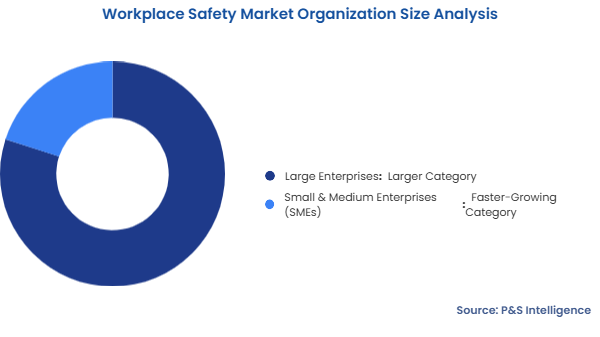
Large Enterprises are the larger category, holding a market share of 80%, because they operate large workforces, multiple facilities, complex supply chains, and high-risk industrial processes that require structured safety systems. These organizations have stronger budgets for hardware, software, training, audits, and compliance management across manufacturing, energy, chemicals, healthcare, and logistics operations. Their safety programs often combine incident management, workforce monitoring, risk assessment, and emergency response tools. Large enterprises also adopt on-premises and hybrid systems where data control, regulatory audits, and integration with operational technology are important for daily safety management.
Small & Medium Enterprises (SMEs) are the faster-growing category, as smaller organizations increasingly recognize the importance of workplace safety in maintaining workforce productivity, reducing operational disruptions, and meeting regulatory requirements. Adoption is rising due to greater availability of cost-effective safety software, mobile inspection tools, digital training platforms, and cloud-based compliance solutions that require lower upfront investment. According to the United Nations, micro, small, and medium-sized enterprises account for 90% of businesses, 60%–70% of employment, and 50% of global GDP worldwide. The scale of this business segment is creating significant demand for practical workplace safety solutions that support hazard reporting, workforce training, incident management, and compliance monitoring, particularly among organizations formalizing their safety programs as operations expand.
The organization sizes analysed in this report are:
Large Enterprises (Larger Category)
Small & Medium Enterprises (SMEs) (Faster-Growing Category)
Drive strategic growth with comprehensive market analysis
Workplace Safety Market Geographical Analysis
North America Workplace Safety Market Analysis
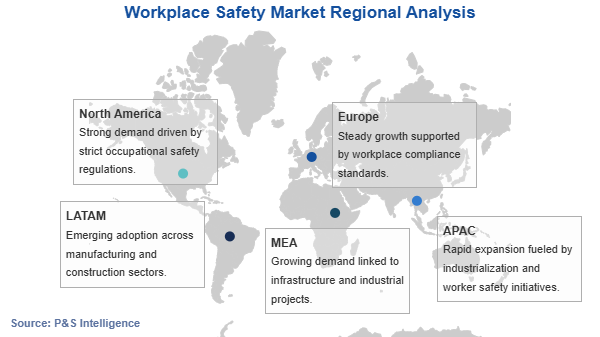
North America holds the largest share of 40%, because workplace safety adoption is strongly supported by strict occupational safety standards, active enforcement, and mature compliance practices. Employers across manufacturing, energy, construction, healthcare, and logistics invest in certified protective equipment, incident reporting systems, emergency response tools, and safety audits to reduce injury risks and avoid regulatory penalties. The region also has early adoption of connected safety technologies, including wearable monitoring devices, gas detection systems, EHS platforms, and automated alert systems. These tools are being integrated into daily plant, warehouse, and field operations to improve hazard visibility and response speed. Strong vendor presence, higher safety budgets, and established training practices continue to support demand for both hardware and software solutions across regulated workplaces.
U.S. Workplace Safety Market Analysis
The U.S. workplace safety market is driven by strict regulatory enforcement, established occupational safety standards, and strong employer accountability across industries. Companies invest in workforce training, hazard assessment programs, incident management systems, and digital monitoring technologies to reduce workplace risks and maintain operational continuity. Compliance requirements are especially important in manufacturing, construction, transportation, energy, and logistics, where safety incidents can lead to financial penalties and operational disruptions. According to the U.S. Bureau of Labor Statistics, 5,070 fatal work injuries were recorded in the United States in 2024. This is increasing adoption of connected safety devices, compliance platforms, and workforce monitoring solutions that help employers identify hazards earlier and improve workplace oversight.
Canada Workplace Safety Market Analysis
The Canada workplace safety market is supported by established occupational safety regulations and coordinated efforts between employers, industry bodies, and government authorities to reduce workplace risks. High-risk sectors such as mining, oil and gas, utilities, construction, and manufacturing require continuous use of protective equipment, safety inspections, and workforce training programs to maintain compliance and prevent injuries. According to Statistics Canada, 54.3% of workers were frequently exposed to ergonomic risk factors in 2024–2025. This level of exposure is encouraging organizations to strengthen hazard assessment practices, improve workplace ergonomics, and deploy monitoring solutions that help identify physical risks. Employers are also investing in structured safety programs that support worker protection across operational environments.
Asia-Pacific Workplace Safety Market Analysis
Asia-Pacific has the highest CAGR, of approximately 16.0%, because industrial expansion, infrastructure development, and manufacturing growth are increasing worker exposure to machinery, construction hazards, chemicals, and environmental risks. Countries across the region are strengthening workplace safety rules as production sites, logistics networks, and urban development projects expand at a rapid pace. Many organizations are moving from basic compliance practices to structured safety programs supported by monitoring devices, digital inspection tools, and workforce training platforms. Demand is rising across construction, manufacturing, mining, energy, and transportation, where large workforces often operate in complex and changing environments. Growing awareness among employers, pressure to reduce workplace injuries, and wider use of affordable cloud-based safety systems are creating stronger adoption opportunities across both large enterprises and SMEs.
China Workplace Safety Market Analysis
China's workplace safety market is driven by its extensive manufacturing base and large-scale industrial operations requiring continuous safety improvements. The government is strengthening regulatory frameworks to reduce accidents and enforce standardised practices across factories and construction sites. According to China Daily, workplace accidents declined by 8.7%, and fatalities fell by 7% in 2025, reflecting improved safety enforcement. This regulatory focus is encouraging companies to upgrade from basic measures to structured safety systems, supporting broader adoption of monitoring tools and compliance-driven solutions.
India Workplace Safety Market Analysis
India's workplace safety market is expanding due to rapid infrastructure development, industrial construction activity, and growth in manufacturing operations across the country. Organizations are strengthening safety practices to address regulatory requirements and reduce workplace risks associated with large project sites, heavy equipment, and expanding workforces. According to ICRA, around 3,500 projects under the National Infrastructure Pipeline were valued at approximately ₹25 trillion in 2025, indicating substantial infrastructure activity. The scale of these projects is increasing demand for worker training, hazard monitoring, personal protective equipment, and incident management systems. Companies are investing in structured safety frameworks to improve site-level risk control and support safer operations across construction, industrial, and engineering environments.
Europe Workplace Safety Market Analysis
Europe shows stable growth due to its long-established worker protection frameworks, strict labor laws, and strong emphasis on occupational health standards. Organizations across manufacturing, healthcare, chemicals, logistics, and public-sector operations maintain structured safety programs to meet regulatory inspections, employee welfare requirements, and workplace risk reduction targets. The region is also focusing on safer operations in aging industrial facilities, where equipment modernization, hazard monitoring, and emergency preparedness are important. Companies are investing in EHS platforms, protective equipment, exposure monitoring tools, and safety training to reduce incident rates and maintain compliance across multiple worksites. Sustainability-linked workplace policies and employee well-being goals are supporting steady demand for safety systems that improve reporting accuracy, strengthen preventive controls, and support safer daily operations.
The regions and countries analysed in this report are:
North America (Largest Regional Market)
U.S. (Larger Country)
Canada (Faster-Growing Country)
Europe
Germany (Largest Country)
U.K. (Fastest-Growing Country)
France
Italy
Spain
Rest of Europe
Asia-Pacific (Fastest-Growing Regional Market)
China (Largest Country)
India (Fastest-Growing Country)
Japan
South Korea
Australia
Rest of APAC
Latin America
Brazil (Largest Country)
Mexico (Fastest-Growing Country)
Rest of LATAM
Middle East and Africa
Saudi Arabia (Largest Country)
U.A.E. (Fastest-Growing Country)
South Africa
Rest of MEA
Workplace Safety Market Share Analysis
The market is fragmented, with numerous companies competing across hardware, software, and workplace safety services. The competitive landscape includes multinational corporations, regional suppliers, safety equipment manufacturers, software providers, and specialized firms focused on workforce monitoring, compliance management, industrial safety, and emergency response solutions. Demand differs significantly across construction, manufacturing, mining, healthcare, energy, and logistics sectors, preventing any single company from establishing dominant control over the market. Competition is further increasing as new entrants introduce wearable safety devices, artificial intelligence-based analytics, connected monitoring platforms, and cloud-based safety management systems. Vendors are focusing on product innovation, industry-specific customization, system integration capabilities, and support services to strengthen their market position. Continuous technological advancements and evolving workplace safety requirements are creating opportunities for both established companies and emerging providers to expand their presence across diverse end-user industries.
Leading Companies in the Workplace Safety Market:
3M Company
Honeywell International Incorporated
International Business Machines Corporation
Microsoft Corporation
Appian Corporation
Cority Software Incorporated
Hexagon Aktiebolag
ABB Limited
Siemens Aktiengesellschaft
Schneider Electric Societas Europaea
Emerson Electric Company
Rockwell Automation Incorporated
MSA Safety Incorporated
Ansell Limited
DuPont de Nemours Incorporated
Workplace Safety Market News
In January 2026, Blackline Safety released the G8 connected safety wearable, designed for continuous gas detection and worker monitoring in industrial environments. The device integrates communication features and real-time alerts for hazard exposure.
In March 2026, VelocityEHS launched a new EHS training library within its safety platform, offering structured, expert-built courses for workplace safety. The update integrates ready-to-use, regulation-aligned training into its existing environmental health and safety software system.
In October 2025, VelocityEHS introduced new AI-powered capabilities within its incident management system, enabling improved hazard detection, root cause analysis, and smarter safety insights within its existing safety platform.
Frequently Asked Questions About This Report
What is the main purpose of workplace safety management systems?+
Workplace safety management systems help organizations identify hazards, reduce workplace incidents, improve compliance, and protect workers across daily operations.
How do organizations identify and assess workplace safety risks effectively?+
Organizations assess safety risks by inspecting worksites, reviewing incident records, evaluating job tasks, and prioritizing hazards based on severity and exposure.
Why is personal protective equipment important in high risk industrial jobs?+
Personal protective equipment helps reduce worker exposure to physical, chemical, electrical, and environmental hazards when risks cannot be fully removed.
How does workplace safety software help organizations improve compliance performance?+
Workplace safety software supports incident tracking, inspection scheduling, audit records, corrective actions, and compliance reporting across multiple worksites.
Why are wearable safety devices gaining adoption in industrial workplaces?+
Wearable safety devices monitor worker location, fatigue, falls, heat stress, and hazardous exposure, helping supervisors respond faster to unsafe conditions.
Want a report tailored exactly to your business need?
Leading companies across industries trust us to deliver data-driven insights and innovative solutions for their most critical decisions. From data-driven strategies to actionable insights, we empower the decision-makers who shape industries and define the future. From Fortune 500 companies to innovative startups, we are proud to partner with organisations that drive progress in their industries.
Client Testimonials
Working with P&S Intelligence and their team was an absolute pleasure – their awareness of timelines and commitment to value greatly contributed to our project's success. Eagerly anticipating future collaborations.
McKinsey & Company
India
Unmatched Standards
Our insights into the minutest levels of the markets, including the latest trends and competitive landscape, give you all the answers you need to take your business to new heights
Complete Data Security
We take a cautious approach to protecting your personal and confidential information. Trust is the strongest bond that connects us and our clients, and trust we build by complying with all international and domestic data protection and privacy laws