Explore the market potential with our data-driven report
Wireless Connectivity Market Future Outlook
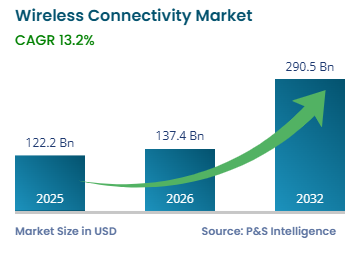
The wireless connectivity market size was USD 122.2 billion for 2025, and it will grow by 13.2% during 2026-2032, to reach USD 290.5 billion by 2032.
The market is expanding because wireless connectivity has become a fundamental requirement for digital communication, business operations, and connected technologies across both developed and emerging economies. Enterprises increasingly rely on wireless networks to support cloud applications, remote collaboration, industrial automation, and real-time data exchange, while consumers expect seamless connectivity for streaming, online services, smart devices, and mobile applications. The growing integration of connected devices across workplaces, homes, healthcare facilities, transportation systems, and public infrastructure is creating sustained demand for dependable and high-performance wireless communication solutions. As organisations continue to digitalise operations, the need for networks that can support larger data volumes, broader coverage, and consistent performance is becoming more important.
This demand is further reinforced by the rapid expansion of internet access and digital participation worldwide. According to the International Telecommunication Union, global internet users reached approximately 6 billion in 2025, representing nearly three-quarters of the world’s population. The increasing number of connected users is placing greater pressure on network operators, enterprises, and technology providers to strengthen wireless infrastructure and improve connectivity quality. At the same time, advancements in technologies such as the Internet of Things, edge computing, and intelligent devices are increasing the amount of data transmitted across wireless networks. These developments are encouraging continued investment in next-generation connectivity solutions, network modernisation programmes, and expanded coverage capabilities, supporting wider adoption of wireless technologies across commercial, industrial, and public sector environments.
Key Market Insights
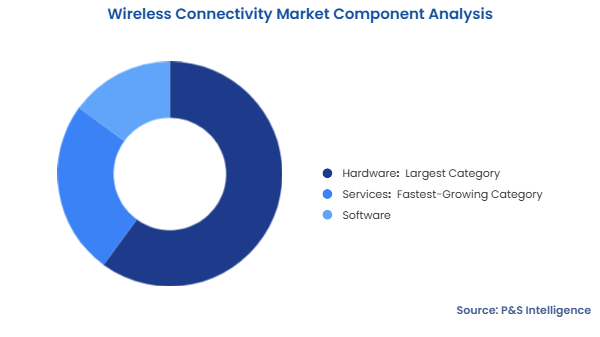
Hardware is the largest component, holding a market share of 60%, due to widespread deployment across devices and network infrastructure.
LPWAN is the fastest-growing connectivity technology, registering a CAGR of approximately 13.4%, driven by rising adoption of IoT-based monitoring and tracking systems.
Consumer devices are the largest application, holding a market share of 35%, due to high global usage of smartphones and connected home electronics.
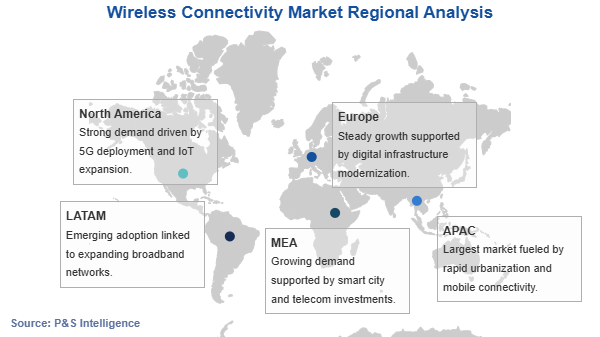
North America is the largest region, holding a market share of 40%, due to advanced telecom infrastructure and early adoption of next-generation wireless technologies.
Asia-Pacific is the fastest-growing region, registering a CAGR of approximately 14.1%, driven by expanding 5G rollout and increasing deployment of smart infrastructure projects.
Wireless Connectivity Market Trends and Drivers
Shift Toward 5G Integration and Multi-Standard Connectivity Is a Major Trend
The wireless connectivity industry is moving toward 5G integration and multi-standard connectivity as devices, networks, and digital platforms require smoother communication across different environments. Enterprises no longer depend on one wireless technology for every use case, because industrial systems, vehicles, smart buildings, and consumer devices often need Wi-Fi, Bluetooth, cellular, and low-power networks to work together. According to the International Telecommunication Union, global 5G coverage reached 51% of the world population in 2024. According to GSMA Intelligence, the enterprise segment accounted for 10.7 billion IoT connections in 2024, compared with 10.5 billion consumer IoT connections. This shift is increasing demand for chipsets, modules, gateways, and network platforms that support multiple standards. It also helps companies reduce connectivity gaps, improve device interoperability, and build more reliable wireless systems for high-density and mobile operating conditions.
Rising Demand for Connected Devices and Data Usage Drives Market
The wireless connectivity market is growing as connected devices and high-volume data usage become central to consumer, enterprise, and industrial applications. Smartphones, wearables, connected appliances, cloud platforms, and monitoring systems require fast and continuous wireless access, while businesses need stable networks to support automation, remote operations, video communication, and real-time analytics. According to the International Telecommunication Union, global 5G subscriptions reached nearly 3 billion in 2025. According to Ericsson, monthly global mobile data traffic reached 200 exabytes in 2025. This rising load is pushing telecom operators, device makers, and enterprises to invest in higher-capacity wireless infrastructure. It is also increasing the need for spectrum-efficient technologies, upgraded access points, and advanced network management tools that can maintain service quality as more users and machines connect at the same time.
Network Security Risks and Interference Challenges
The wireless connectivity market is facing restraints from rising network security risks and interference challenges across connected environments. As more devices operate through shared, open, and distributed wireless networks, enterprises face higher exposure to unauthorized access, data theft, malware, and service disruption. Signal interference from crowded frequency bands can also reduce network stability, especially in factories, hospitals, transport systems, and smart buildings where wireless performance supports critical operations. According to the Federal Bureau of Investigation Internet Crime Complaint Center, 859,532 complaints of suspected internet crime were received in 2024, with reported losses exceeding USD 16 billion. These risks are making buyers more cautious when deploying wireless systems for sensitive workloads. They are also increasing demand for encryption, device authentication, secure network design, and interference management, which can raise implementation costs and slow adoption in mission-critical applications.
Expansion of Smart Infrastructure and Industry 4.0 Adoption
The wireless connectivity market is creating opportunities through the expansion of smart infrastructure and Industry 4.0 adoption across manufacturing, transport, utilities, and public services. Smart cities, connected factories, intelligent logistics, and digitally managed energy systems need wireless networks that can link sensors, robots, cameras, meters, and control platforms without limiting mobility or scalability. According to the International Federation of Robotics, the number of operational industrial robots reached 4,664,000 units in 2024, reflecting a 9% annual increase. This growth is increasing demand for low-latency communication, reliable device pairing, and secure machine-to-machine connectivity inside industrial environments. It is also opening opportunities for wireless service providers, module suppliers, and infrastructure vendors as rural coverage expansion, private networks, and smart public infrastructure projects require dependable connectivity across wider and more complex deployment areas.
Hardware is the largest category, holding a market share of 60%, because it forms the foundation of wireless connectivity across smartphones, routers, gateways, IoT devices, and network infrastructure. Demand remains strong as enterprises expand connected systems and consumers adopt more wireless-enabled devices. According to the World Semiconductor Trade Statistics, global semiconductor sales reached USD 795.6 billion in 2025, representing 26.2% year-over-year growth. This continued component demand supports investments in advanced chipsets and communication modules, while also enabling growth across software and service segments that depend on a robust hardware base for deployment and network performance.
Services are the fastest-growing category, registering a CAGR of approximately 13.6%, because organizations increasingly require external expertise to deploy, integrate, secure, and manage complex wireless environments. The expansion of IoT networks, cloud-connected systems, and enterprise mobility solutions is increasing operational complexity. Businesses are turning to managed connectivity, maintenance, and support providers to improve network reliability and reduce internal resource requirements. This trend is strengthening long-term service contracts and creating recurring revenue opportunities, while supporting the performance of hardware and software platforms operating within connected ecosystems.
The components analysed in this report are:
Hardware (Largest Category)
Services (Fastest-Growing Category)
Software
Integration & Deployment
Maintenance & Support
Managed Connectivity Services
Connectivity Technology Analysis
Cellular is the largest category, holding a market share of 30%, because it provides extensive coverage, supports mobility, and serves as the primary communication technology for smartphones, connected vehicles, and enterprise applications. Ongoing network upgrades and broader deployment of advanced cellular technologies continue to strengthen its position. Cellular networks also support many IoT and smart infrastructure applications that require reliable long-distance communication. This widespread adoption encourages continued investment from operators and enterprises, while creating a strong connectivity foundation that complements technologies such as LPWAN, Wi-Fi, and satellite communication.
LPWAN is the fastest-growing category, due to its ability to deliver long-range communication with low power consumption for large-scale IoT deployments. Industries are increasingly using connected sensors for asset tracking, smart metering, environmental monitoring, and agricultural applications where battery efficiency is critical. According to the GSMA, global NB-IoT and LTE-M LPWAN connections surpassed 1 billion by the end of 2025. Growing deployment of connected devices is increasing demand for scalable and cost-efficient connectivity solutions, while expanding the role of LPWAN alongside cellular networks within broader wireless ecosystems.
The connectivity technologies analysed in this report are:
Cellular (Largest Category)
LPWAN (Fastest-Growing Category)
Wi-Fi
Bluetooth
Near Field Communication (NFC)
Zigbee, Z-Wave
Satellite Connectivity
Others
Application Analysis
Consumer Devices is the largest category, because smartphones, tablets, smart home products, and connected entertainment devices rely on wireless connectivity for everyday digital activities. High device ownership levels and continuous product innovation are sustaining demand across global markets. According to the International Telecommunication Union, an estimated 5.8 billion people, equivalent to 71% of the world's population, used the Internet in 2024. Expanding internet access and connected device usage continue to increase network traffic, encouraging investments in wireless infrastructure while supporting growth across connectivity technologies and service offerings.
Industrial IoT & Automation Systems is the fastest-growing category, registering a CAGR of approximately 13.5%, because manufacturers are increasingly adopting connected machines, sensors, and automated systems to improve operational efficiency and visibility. Wireless communication enables real-time monitoring, predictive maintenance, and faster decision-making across production environments. As industrial facilities become more digital, demand is rising for reliable and secure connectivity capable of supporting large numbers of connected assets. This shift is strengthening adoption of advanced wireless technologies while creating new opportunities for hardware suppliers, connectivity providers, and managed service companies.
The applications analysed in this report are:
Consumer Devices (Largest Category)
Industrial IoT & Automation Systems (Fastest-Growing Category)
Wearables & Personal Connected Devices
Connected Vehicles & Transportation Systems
Healthcare Devices & Remote Monitoring
Smart Infrastructure
Others
End-User Analysis
IT & Telecommunications is the largest category, because it provides the network infrastructure required to support wireless communication across all end-user industries. Telecom operators and technology providers continuously invest in network expansion, capacity upgrades, and service quality improvements to meet growing connectivity requirements. Rising mobile data consumption, cloud adoption, and connected device deployment are sustaining demand within this sector. Its central role in enabling communication across consumer, industrial, healthcare, and transportation applications reinforces its position as the primary contributor to wireless connectivity spending.
Healthcare & Life Sciences is the fastest-growing category, registering a CAGR of approximately 13.7%, due to increasing adoption of connected medical devices, remote patient monitoring systems, and digital healthcare platforms. Healthcare providers are using wireless technologies to improve access to patient information, support telemedicine services, and enhance care delivery efficiency. According to the World Health Organization and International Telecommunication Union, digital health interventions could save more than two million lives and prevent approximately seven million acute health events and hospitalizations worldwide over a ten-year period. Growing digital healthcare investments are increasing reliance on secure and reliable wireless connectivity, supporting broader adoption of connected healthcare ecosystems.
The end-users analysed in this report are:
IT & Telecommunications (Largest Category)
Healthcare & Life Sciences (Fastest-Growing Category)
Automotive & Transportation
Aerospace & Defense
Manufacturing & Industrial
Energy & Utilities
Consumer Electronics Industry
Others
Drive strategic growth with comprehensive market analysis
Wireless Connectivity Market Regional Outlook
North America Wireless Connectivity Market Analysis
North America holds the largest share of 40%, because the region has one of the most advanced wireless connectivity ecosystems, supported by extensive network infrastructure, strong enterprise technology adoption, and early deployment of next-generation communication technologies. Telecommunications operators continue investing in network modernization, private wireless networks, and expanded 5G coverage to meet growing connectivity requirements. The region also benefits from the presence of major cloud providers, semiconductor companies, and connectivity solution vendors that drive innovation across the value chain. Demand remains strong across healthcare, automotive, manufacturing, and enterprise IT sectors, where reliable wireless communication supports connected operations and real-time data exchange. Furthermore, increasing adoption of IoT platforms, edge computing environments, and smart devices is strengthening demand for advanced connectivity solutions across both commercial and industrial applications.
U.S. Wireless Connectivity Market Analysis
The U.S. wireless connectivity market leads due to early deployment of advanced network technologies and the strong presence of major telecom operators and semiconductor companies. This leadership is driven by widespread enterprise adoption of private networks, IoT platforms, and edge-based connectivity across sectors such as healthcare, defence, and enterprise IT. According to the Wireless Infrastructure Association, by the end of 2024, just over 651,000 structures supported wireless infrastructure in the United States, including cellular towers, rooftops, utility poles, water towers, and other structures. Additionally, dense infrastructure deployment is supporting high-capacity networks. Moreover, continuous investment in next-generation connectivity is strengthening large-scale adoption across consumer and enterprise applications.
Canada Wireless Connectivity Market Analysis
The Canadian wireless connectivity market is expanding steadily due to a strong focus on extending network coverage across rural and remote regions. This growth is supported by government-led initiatives to enhance broadband infrastructure and improve nationwide connectivity access. According to the Canadian Radio-television and Telecommunications Commission, 99.5% of Canadian households had access to the latest generally deployed mobile wireless technology (LTE) in 2023. Furthermore, industries such as energy, mining, and transportation are increasing the adoption of wireless systems for remote operations. Moreover, expanding coverage and industrial demand are strengthening the need for reliable and long-range connectivity solutions.
Asia-Pacific has the highest CAGR of approximately 14.1%, because countries across the region are rapidly expanding digital infrastructure and accelerating adoption of connected technologies. Governments and private organizations are investing heavily in 5G networks, industrial digitalization, smart city initiatives, and broadband expansion projects. Large manufacturing bases in countries such as China, Japan, South Korea, and India are increasing demand for wireless communication across factories, logistics networks, and supply chain operations. Rising smartphone penetration and broader internet accessibility are also expanding the connected user base. Additionally, businesses are adopting IoT-enabled systems, cloud applications, and automation technologies at a faster pace to improve operational efficiency. These developments are creating strong demand for scalable wireless networks capable of supporting growing data traffic, connected devices, and digitally enabled services across both urban centers and developing regions.
China Wireless Connectivity Market Analysis
The Chinese wireless connectivity market dominates due to strong government-led digital infrastructure development and a large-scale manufacturing ecosystem supporting connected technologies. This dominance is driven by rapid 5G deployment and integration of wireless systems across industrial automation, logistics networks, and smart city infrastructure. According to the State Council of China, the number of 5G base stations reached 4.838 million by the end of 2025, covering all towns and over 95% of administrative villages. Additionally, large-scale infrastructure rollout is enabling widespread connectivity adoption. Moreover, strong domestic production and deployment capacity are accelerating wireless ecosystem expansion across industries.
India Wireless Connectivity Market Analysis
The Indian wireless connectivity market is expanding rapidly due to increasing mobile internet penetration and aggressive rollout of next-generation telecom networks across regions. This growth is supported by government initiatives promoting digital services and infrastructure, along with rising adoption of connected platforms in sectors such as education, healthcare, and financial services. According to the Press Information Bureau, telecom service providers had installed 518,854 5G Base Transceiver Stations (BTSs) across India as of 2025, and 5G services were available in 99.9% of the country's districts. Furthermore, rapid network deployment is improving nationwide connectivity access. Moreover, expanding digital usage is strengthening demand for scalable wireless communication solutions.
Europe Wireless Connectivity Market Analysis
Europe shows steady growth due to its strong industrial base, established telecommunications infrastructure, and increasing adoption of connected technologies across key sectors. Manufacturers, automotive companies, utilities, and transportation operators are integrating wireless solutions to support automation, predictive maintenance, and intelligent operational management. The region's focus on data privacy, cybersecurity, and network resilience is influencing deployment strategies and encouraging investment in secure connectivity frameworks. Furthermore, smart grid projects, connected mobility initiatives, and digital infrastructure upgrades are supporting broader wireless adoption across public and private sectors. Businesses are also expanding the use of industrial IoT systems and connected equipment to improve productivity and resource efficiency. These trends continue to strengthen demand for reliable wireless communication technologies that can support complex operational environments and evolving digital requirements.
The regions and countries analysed in this report are:
North America (Largest Regional Market)
U.S. (Larger Country)
Canada (Faster-Growing Country)
Europe
Germany (Largest Country)
U.K. (Fastest-Growing Country)
France
Italy
Spain
Rest of Europe
Asia-Pacific (Fastest-Growing Regional Market)
China (Largest Country)
India (Fastest-Growing Country)
Japan
South Korea
Australia
Rest of APAC
Latin America
Brazil (Largest Country)
Mexico (Fastest-Growing Country)
Rest of LATAM
Middle East and Africa
Saudi Arabia (Largest Country)
U.A.E. (Fastest-Growing Country)
South Africa
Rest of MEA
Wireless Connectivity Market Share Analysis
The market is fragmented, with a large number of global and regional players competing across different layers such as hardware, software, and services. No single company controls the space because the ecosystem includes chipset makers, network providers, device manufacturers, and platform developers. Many firms focus on specific technologies like Wi-Fi, cellular, or IoT connectivity, which spreads competition further. New entrants and niche providers continue to emerge, especially in specialised applications and industrial use cases. This creates a competitive environment where companies differentiate through innovation, performance, and integration capabilities rather than market dominance.
Leading Companies in the Wireless Connectivity Market:
Qualcomm Incorporated
Broadcom Incorporated
Intel Corporation
Texas Instruments Incorporated
MediaTek Incorporated
NXP Semiconductors N V
STMicroelectronics N V
Microchip Technology Incorporated
Renesas Electronics Corporation
Infineon Technologies Aktiengesellschaft
Samsung Electronics Company Limited
Murata Manufacturing Company Limited
Skyworks Solutions Incorporated
Marvell Technology Incorporated
Nordic Semiconductor ASA
Sercomm Corporation
Infinix Mobility
Wireless Connectivity Market News
In March 2026, Sercomm showcased its latest connectivity innovations at MWC 2026, including an end-to-end fixed wireless access (FWA) architecture and next-generation Wi-Fi 8–enabled CPE platforms, designed to deliver scalable connectivity solutions for both residential and enterprise network environments.
In February 2026, Broadcom released an enterprise-focused Wi-Fi 8 access point and switching platform built for advanced wireless environments, supporting next-generation connectivity requirements across enterprise networks.
In January 2026, MediaTek launched its Filogic 8000 chipset family at CES, designed to support upcoming Wi-Fi 8 standards and enable connectivity across consumer devices and network infrastructure.
In January 2026, Infinix introduced a new smartphone series featuring satellite-enabled wireless communication, allowing devices to maintain connectivity beyond traditional terrestrial network coverage.
Frequently Asked Questions About This Report
What is driving growth in the wireless connectivity market?+
Growth is driven by rising connected device use, higher mobile data traffic, IoT adoption, smart infrastructure projects, and stronger demand for reliable wireless networks.
Which technology is widely used in the wireless connectivity market?+
Cellular connectivity is widely used because it supports mobility, wide coverage, smartphones, connected vehicles, enterprise systems, and long distance communication requirements.
Why is Wi Fi important in wireless connectivity applications?+
Wi Fi remains important because homes, offices, factories, and public spaces depend on it for high speed local wireless access and connected device usage.
How does 5G support the wireless connectivity market?+
5G supports the market by improving speed, lowering latency, increasing network capacity, and enabling advanced applications across IoT, automation, mobility, and smart infrastructure.
Which applications create demand for wireless connectivity solutions?+
Consumer devices, industrial automation, connected vehicles, healthcare monitoring, smart homes, wearables, and public infrastructure create strong demand for wireless connectivity solutions.
Want a report tailored exactly to your business need?
Leading companies across industries trust us to deliver data-driven insights and innovative solutions for their most critical decisions. From data-driven strategies to actionable insights, we empower the decision-makers who shape industries and define the future. From Fortune 500 companies to innovative startups, we are proud to partner with organisations that drive progress in their industries.
Client Testimonials
Working with P&S Intelligence and their team was an absolute pleasure – their awareness of timelines and commitment to value greatly contributed to our project's success. Eagerly anticipating future collaborations.
McKinsey & Company
India
Unmatched Standards
Our insights into the minutest levels of the markets, including the latest trends and competitive landscape, give you all the answers you need to take your business to new heights
Complete Data Security
We take a cautious approach to protecting your personal and confidential information. Trust is the strongest bond that connects us and our clients, and trust we build by complying with all international and domestic data protection and privacy laws