Wind Turbine Power Converter Market Size & Share Analysis - Trends, Drivers, Competitive Landscape, and Forecasts (2025 - 2032)
This Report Provides In-Depth Analysis of the Wind Turbine Power Converter Market Report Prepared by P&S Intelligence, Segmented by Converter type (DFIG (partial-scale) converter, Full-scale converter), Conversion type (AC-DC converters, DC-AC converters, DC-DC converters), Application (Onshore, Offshore), End-user (Utilities, Industrial, Commercial & residential), Voltage (Low voltage, Medium voltage, High voltage), and Geographical Outlook for the Period of 2021 to 2032
Wind Turbine Power Converter Market Size Estimation
Key Highlights
Study Period
2021 - 2032
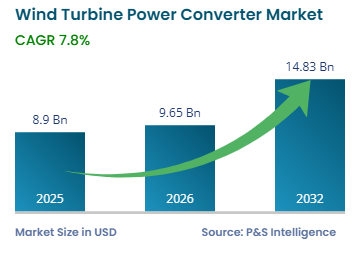
Market Size in 2025
USD 8.90 Billion
Market Size in 2026
USD 9.65 Billion
Market Size by 2032
USD 14.83 Billion
Projected CAGR
7.8%
Largest Region
Asia-Pacific
Fastest Growing Region
Asia-Pacific
Market Structure
Moderately Fragmented
Market Size
Explore the market potential with our data-driven report
Wind Turbine Power Converter Market Overview
The global wind turbine power converter market reached USD 8.90 billion in 2025, with revenue estimated at USD 9.65 billion in 2026. The market is projected to reach USD 14.83 billion by 2032, growing at a CAGR of 7.8% during 2026-2032. Turbine builders and grid operators are specifying higher-rated converters as new projects move toward larger turbines and offshore sites, while owners of older wind farms are swapping out original drivetrain electronics once those units reach the point where a converter upgrade restores lost output.
Growth tracks the pace of new wind capacity coming online, since a converter ships with every turbine sold, whether it pairs with a doubly fed induction generator or a full-scale drivetrain. The International Energy Agency reports that global wind capacity additions rose nearly 40% in 2025 to around 160 GW, as developers in China, the U.S., and Europe pushed a large pipeline of projects toward completion. Each gigawatt commissioned adds a proportional volume of conversion hardware to supplier order books, a link that holds regardless of which OEM wins a given turbine contract.
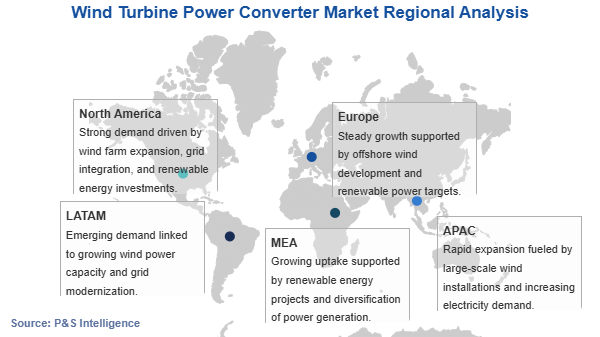
Asia-Pacific held 40% of Wind Turbine Power Converter Market share in 2025. The region is also expanding at the fastest pace among regions, growing at a CAGR of 8.2% through 2032. China's turbine manufacturing base and dense grid-connection pipeline anchor demand in the region, while India adds utility-scale onshore capacity and Japan advances offshore projects, keeping the region ahead of the slower, more replacement-driven markets in North America and Europe.
Key market insights
By converter type, DFIG (partial-scale) converter held 40.0% share in 2025. Full-scale converter is climbing fastest in this category, at a 15.0% CAGR from 2026 to 2032.
By conversion type, DC-AC converters held 42.3% share in 2025. They also lead growth among conversion types, adding volume at an 8.1% CAGR from 2026 to 2032.
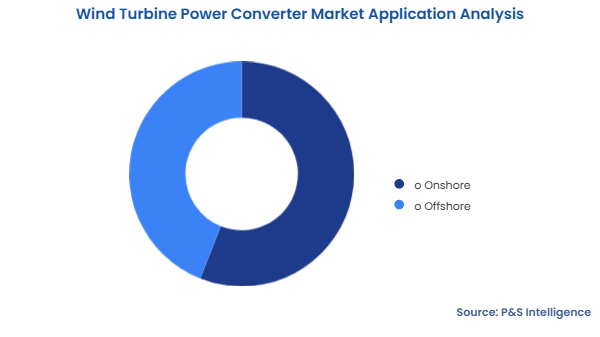
By application, onshore held 56.0% share in 2025. Offshore is the quickest-growing category, climbing at a 13.4% CAGR from 2026 to 2032.
By end-user, utilities held 50.0% share in 2025. Commercial & residential is growing fastest in this category, at a 9.2% CAGR from 2026 to 2032.
By geography, Asia-Pacific held 40.0% share in 2025. The region also leads growth, climbing at an 8.2% CAGR from 2026 to 2032.
Wind Turbine Power Converter Market Trends and Growth Drivers
Rising turbine ratings are redefining converter sizing requirements
Turbine rated capacity keeps climbing as OEMs push larger rotors and taller towers onto both onshore and offshore platforms, and the converter has to scale with it, since a full-scale unit carries the entire generator output through the power stage. A turbine sold today needs a converter rated well above what a comparable unit needed a decade ago, which lifts the value of the power electronics bundled into each order even when unit volumes stay flat.
The U.S. Department of Energy reports that average rated capacity for newly installed turbines has moved from roughly 1.8 MW for projects built between 2011 and 2020 toward about 5 MW for current land-based units, with offshore turbines running higher still. Suppliers that qualify higher-voltage, higher-current power modules capture a larger share of turbine value as fleets upgrade, not relying on unit volume alone for growth. That shift shows up most clearly on newer, larger turbine platforms, where the power stage accounts for a growing share of total order value.
Aging turbine fleets are fueling repowering-linked converter replacement
A meaningful share of the installed wind fleet in mature markets is approaching the end of its original service life, and owners increasingly swap out drivetrain components rather than decommission sites that still have usable land leases and grid connections. Converters are one of the parts replaced during a repowering campaign, since older partial-scale units often fall short of current grid-code requirements for fault ride-through and reactive power.
The U.S. Energy Information Administration notes that repowering adds generating capacity at existing sites by replacing aging turbine components, including power electronics, without requiring a new interconnection process. Suppliers with retrofit-qualified converter platforms gain a second sales channel beyond new-build OEM contracts, selling directly into projects that never needed a full turbine replacement. Retrofit programs can bundle converter replacement with blade and gearbox refurbishment, spreading the cost of new power electronics across a broader repowering budget instead of treating it as a standalone purchase.
Offshore wind buildout is opening a higher-value growth pathway
Offshore wind projects use larger turbines than onshore sites and standardize on full-scale converter topologies to meet stricter grid-connection codes, creating a growth pathway for suppliers as offshore capacity additions accelerate faster than onshore ones. Each offshore turbine typically carries a converter rated well above the onshore average, so offshore capacity growth adds more converter value per unit than an equivalent volume of onshore build.
The Global Wind Energy Council reports that 9.3 GW of new offshore wind capacity was grid-connected in 2025, 16% more than the year before, lifting cumulative offshore capacity to 92.5 GW worldwide, the third-highest annual total on record. Suppliers positioned in offshore-qualified full-scale designs stand to capture a growing share of a segment expanding faster than the broader market, particularly as new offshore basins in Asia and North America add capacity that had little installed base a decade ago.
Power semiconductor capacity constraints are limiting converter production schedules
Converter output depends on securing IGBT and silicon carbide modules from a concentrated group of semiconductor suppliers, and lead times for these components have stretched well beyond pre-pandemic norms in recent years, delaying converter assembly and, in turn, turbine commissioning schedules. Demand from electric vehicles, battery storage, and industrial drives competes with wind converter manufacturers for the same wafer capacity, so a shortage in one sector spills into another.
SEMI reports that global 200mm wafer fab capacity for power semiconductors is expanding by around 35% between 2023 and 2026 as manufacturers add new lines, though near-term supply remains tight while those lines ramp to volume. Converter suppliers that lock in multi-year component contracts or qualify a second module vendor avoid the schedule risk that smaller, single-sourced assemblers face. Diversifying component sourcing across foundries in multiple regions can give converter makers a buffer against a disruption concentrated in any single supply base, a hedge more OEMs are beginning to ask suppliers to demonstrate.
Wind Turbine Power Converter Market Segmentation Analysis
Converter Type
The DFIG (partial-scale) converter category accounted for 40% of Wind Turbine Power Converter Market revenue in 2025. DFIG converters remain attached to the largest installed base of doubly fed induction generator turbines built over the past 15 years, and their partial-scale design only needs to carry a fraction of total turbine output through the power stage. Ingeteam's engineering documentation indicates that a DFIG converter is typically sized to about 30% of a turbine's rated power, since only the rotor-side power passes through it, keeping component costs and footprint lower than a full-scale design.
Full-scale converter is climbing fastest in this category, at a 15.0% CAGR from 2026 to 2032. Full-scale converters carry the entire generator output and pair with permanent-magnet synchronous generators, a combination turbine OEMs are standardizing on for larger platforms because it simplifies compliance with tightened fault-ride-through and reactive-power grid codes. As average turbine ratings climb past what partial-scale designs can economically support, new orders are shifting toward full-scale units even as DFIG converters continue to dominate the installed base.
Conversion Type
DC-AC converters accounted for 42.3% of segment revenue in 2025. Every turbine sold carries a DC-AC stage regardless of converter topology, since it performs the final conversion to grid-compliant power, while DC-DC stages only appear in specific bus architectures and AC-DC stages handle generator-side rectification alone. The DC-AC stage is also subject to the most demanding grid-code compliance testing, which pushes buyers toward more sophisticated, higher-value control electronics on this stage specifically.
DC-AC converters are also projected to post the fastest growth among conversion types, expanding at an 8.1% CAGR during 2026-2032. Growth here tracks directly with turbine unit shipments and with the rising stringency of grid codes in every region, as reactive-power and voltage-support obligations are added to interconnection agreements. Those obligations apply specifically to the grid-facing AC stage, not to generator-side rectification, concentrating incremental value on this segment as codes tighten.
Application
Onshore held 56% of segment revenue in 2025. Onshore projects represent the far larger global installed base, and most repowering and life-extension activity is concentrated in onshore fleets across mature markets such as the U.S. and Germany, where turbines installed during the 2000s and 2010s are reaching mid-life and being fitted with new power electronics instead of being decommissioned outright.
Offshore is the quickest-growing category here, expanding at a 13.4% CAGR from 2026 to 2032. Offshore projects use larger turbines that require higher-rated, full-scale converters, and new offshore capacity is being added in markets, including parts of Asia and North America, that had little or no offshore fleet a decade ago, so nearly all of that demand is new-unit business, not replacement.
End-User
Utilities accounted for 50% of segment revenue in 2025. Utility-scale wind farms buy converters in bulk as part of broader turbine supply contracts, and utilities' project financing and interconnection requirements tend to standardize converter specification across large fleets, giving utility-OEM contracts more purchasing weight than smaller, one-off buyers can generate.
Commercial & residential end-users are growing fastest in this category, at a 9.2% CAGR from 2026 to 2032. Falling costs for smaller turbine and hybrid systems are extending wind power into commercial sites and distributed-generation projects that previously ran on solar or diesel alone, a smaller but faster-growing buyer base that purchases its own on-site converters separately from utility tenders.
Voltage
Medium voltage converters represent the largest category in this segment. Most utility-scale turbines interconnect through medium-voltage collector systems, so medium-voltage converter designs match the electrical architecture used across the majority of onshore and offshore wind farms, giving this voltage class the broadest platform fit across OEM turbine ranges and the deepest installed base to draw replacement demand from.
High voltage converters are set to post the quickest growth in this category over the forecast period. Larger offshore turbines and longer subsea and underground cable runs favor higher-voltage conversion, since it cuts transmission losses and cable costs over distance, pushing newer offshore platforms toward high-voltage converter designs even as medium voltage continues to anchor the broader installed base.
The following segments are analysed in this report.
Converter Type
DFIG (partial-scale) converter
Full-scale converter
Others
Conversion Type
AC-DC converters
DC-AC converters
DC-DC converters
Application
Onshore
Offshore
End-User
Utilities
Industrial
Commercial & residential
Voltage
Low voltage
Medium voltage
High voltage
Drive strategic growth with comprehensive market analysis
Wind Turbine Power Converter Market Geographical Analysis
Asia-Pacific Wind Turbine Power Converter Market growth
Asia-Pacific held 40% of regional market share in 2025. The region is also expanding fastest among all regions, growing at a CAGR of 8.2% during 2026-2032. China's turbine manufacturers build and export at a scale that keeps most converter orders concentrated with domestic and regional suppliers, and local-content requirements attached to wind tenders across China and India route the bulk of converter purchasing away from imported units. Utility-scale wind auctions in India and offshore project approvals moving forward in Japan add further order volume on top of China's own build-out.
China, the region's largest market, anchors regional demand through its scale of turbine production, while India stands out as the region's fastest-growing market for new-build converter purchases as utility-scale tenders expand. IRENA reports that global installed wind capacity reached 1,291 GW by the end of 2025, with Asia accounting for roughly 75% of that installed base. The region's lead is likely to hold through 2032 given the scale of announced onshore and offshore capacity in China's and India's project pipelines, though growth could moderate as the region's fleet matures and shifts toward replacement demand.
Europe holds the second-largest converter base behind Asia-Pacific, sustained by a wind fleet that is older on average than any other region's. Much of Europe's onshore fleet dates to the 2000s and early 2010s, so converter demand here leans toward replacement and repowering over new capacity, particularly in Germany and Spain, where turbines are reaching the end of their original operating permits.
Offshore build-out in the North Sea adds a separate stream of new-unit demand, concentrated among a smaller number of very large converter orders per project. Grid-code compliance testing before a converter can be installed tends to keep Europe's repowering orders with suppliers that already hold local certification, a barrier newer entrants find costly to clear.
The European Commission's offshore renewable energy strategy sets a target of 86 to 89 GW of installed offshore wind capacity by 2030, more than four times the roughly 20 GW installed. Suppliers with retrofit-qualified platforms and offshore-rated full-scale designs are positioned to serve both sides of this market, the steady replacement stream onshore and the concentrated new-build wave offshore. Converter suppliers that already hold North Sea grid-code certifications gain a faster route to new offshore contracts than newcomers still completing qualification testing.
North America trails Asia-Pacific and Europe in overall converter demand but keeps pace with the broader market's expansion, anchored by the U.S.' large operating turbine fleet. Much of that fleet was installed in the 2010s and is now reaching the age where operators weigh repowering against continued operation, a decision that often includes replacing original power electronics to extend production tax credit eligibility. New onshore capacity additions in the U.S. continue at a measured pace even as offshore project timelines in the region have slowed. That timing decision carries real financial stakes for owners.
The American Clean Power Association reports that U.S. developers commissioned 6.9 GW of new onshore wind capacity in 2025, bringing the country's total operating capacity past 161 GW. Repowering activity is likely to remain the larger source of converter orders in the region through the rest of the decade, ahead of new-build volume. Developers weighing new offshore leases face permitting delays that keep near-term offshore converter orders modest, leaving repowering the steadier revenue stream for suppliers serving the region this decade.
Latin America accounts for a smaller share of global converter demand, concentrated almost entirely in Brazil's onshore wind fleet. Brazil's northeast coast hosts the great majority of the region's installed wind capacity, and continued auctions for new onshore projects there keep converter orders flowing even as Mexico's and Argentina's markets add capacity more slowly. Grid-connection queues in Brazil's northeast remain a bigger constraint on near-term build-out than converter supply itself.
ABEEólica reports that Brazil had 34.6 GW of installed wind capacity in operation as of December 2025, ranking it fifth worldwide. Brazil's auction pipeline should keep the region's converter demand tied mainly to new-unit orders over replacement, since its fleet is still comparatively young. Brazil's pipeline of contracted but not-yet-built projects gives converter suppliers relatively clear multi-year revenue visibility, an advantage over markets with thinner project pipelines.
Middle East and Africa remains the smallest of the five regions by converter demand, though new utility-scale projects are beginning to add volume beyond what the region's limited existing fleet generates. Saudi Arabia and South Africa account for most of the region's active and planned wind capacity, and both are early enough in their build-out that nearly all converter demand there is new-unit, not replacement.
Financing and grid-connection timelines for utility-scale renewable projects remain the larger determinant of order timing in the region. Financing tied to state-backed investment vehicles can give Gulf developers more certainty on project timelines than many other emerging markets offer, narrowing the gap between project announcement and converter order placement, a lag that still slows deal flow in several neighboring markets.
Saudi Arabia's Vision 2030 renewable energy program targets 130 GW of total renewable capacity by 2030, with roughly 40 GW of that earmarked for wind. As these programs move from planning into construction, converter suppliers with experience qualifying units for high-temperature, high-dust operating conditions stand to gain an early foothold. Local-content rules attached to Saudi utility-scale tenders could also favor suppliers willing to localize final assembly instead of shipping fully built units from overseas plants.
The following geographies are analyzed in this report:
Asia-Pacific
China
India
Japan
Rest of Asia-Pacific
Europe
Germany
U.K.
France
Italy
Spain
Rest of Europe
Latin America
Brazil
Mexico
Argentina
Rest of Latin America
Middle East and Africa
Saudi Arabia
U.A.E.
South Africa
Rest of Middle East and Africa
North America
U.S.
Canada
Wind Turbine Power Converter Market Competitive Landscape
The Wind Turbine Power Converter Market is moderately fragmented, with roughly 15 to 20 companies holding meaningful share and no single firm dominant across every turbine platform. Fragmentation persists because two distinct groups compete side by side, turbine OEMs that design and build converters in-house as part of their drivetrain package, and independent power-electronics suppliers that sell qualified platforms across multiple OEM customers. Grid-code certification and multi-year qualification cycles keep new entrants out without concentrating share among a smaller group, and the structure has stayed broadly stable even as individual companies expand through acquisition.
Turbine OEMs, including Vestas Wind Systems A/S, Siemens Gamesa Renewable Energy S.A., Nordex SE, and Goldwind Science & Technology Co., Ltd., compete by integrating converter design directly into their turbine platforms, tying converter economics to turbine sales rather than treating the converter as a separate product line. Independent power-electronics suppliers, among them ABB Ltd., Schneider Electric SE, Ingeteam S.A., Danfoss A/S, Woodward Inc., TMEIC Corporation, Delta Electronics Inc., and Sungrow Power Supply Co. Ltd., compete on component performance, certification breadth, and price, selling into multiple OEM programs and directly into the retrofit market.
Consolidation among the independent suppliers has picked up recently as larger industrial groups acquire specialist power-electronics businesses to add wind-qualified designs to their portfolios, a route that lets an acquirer add certified capacity faster than building it internally. That trend is likely to narrow the field of independent suppliers over time even as the OEM segment stays anchored to a similar set of turbine builders.
Leading Companies in the Wind Turbine Power Converter Market:
ABB Ltd.
Schneider Electric SE
GE Vernova Inc.
Ingeteam S.A.
Siemens Gamesa Renewable Energy S.A.
Vestas Wind Systems A/S
Nordex SE
Goldwind Science & Technology Co. Ltd.
Danfoss A/S
Yaskawa Electric Corporation
Emerson Electric Co.
Woodward Inc.
TMEIC Corporation
Hitachi Energy Ltd
Delta Electronics, Inc.
Sungrow Power Supply Co. Ltd.
American Superconductor Corporation
Wind Turbine Power Converter Market Developments
In June 2026, Hitachi Energy Ltd marked the inauguration of Pattern Energy's SunZia Wind transmission project, with its HVDC Light converter stations enabling delivery of up to 3,000 MW of wind power across roughly 885 kilometers from New Mexico to Arizona. The converter stations underpin one of the largest wind-integration transmission projects built in the U.S.
In March 2026, Vestas Wind Systems A/S announced plans to build a nacelle and hub factory in Scotland representing more than EUR 250 million in investment and up to 500 direct jobs, to supply its V236-15.0 MW offshore turbine. The plant would become the company's fifth European factory dedicated to offshore turbine components, adding capacity to meet a growing U.K. offshore order book.
In March 2026, Danfoss A/S acquired the remaining 38% stake in power-electronics specialist Semikron Danfoss from its founding family, taking full ownership of the roughly 3,500-employee business. The acquisition gives Danfoss direct control of a supplier of power modules used in wind and solar conversion equipment, supporting its wider electrification strategy.
In December 2025, ABB Ltd. completed its acquisition of Gamesa Electric's power-electronics business, expanding its serviceable installed base of wind converters by approximately 46 GW. The deal adds utility-scale wind, solar, and battery-storage conversion capability to ABB's existing portfolio, positioning it to bid across a wider range of renewable conversion contracts.
In October 2025, Goldwind Science & Technology Co. Ltd. unveiled its next-generation Ultra Series wind turbine product portfolio at China Wind Power 2025, extending design life to 25 years for onshore models and 30 years for offshore models. The launch signals a shift toward longer-life turbine platforms that require converters engineered for a correspondingly longer service interval.
Frequently Asked Questions About This Report
How does market growth track wind capacity expansion?+
Growth tracks the pace of new wind capacity coming online, since a converter ships with every turbine sold, whether it pairs with a doubly fed induction generator or a full-scale drivetrain.
Which region held the largest market share in 2025?+
Asia-Pacific held 40% of wind turbine power converter market share in 2025. The region is also expanding at the fastest pace among regions, growing at a CAGR of 8.2% through 2032.
By converter type, what was the largest category in 2025?+
By converter type, DFIG (partial-scale) converter held 40.0% share in 2025. Full-scale converter is climbing fastest in this category, at a 15.0% CAGR from 2026 to 2032.
How does converter sizing change with turbine upgrades?+
Suppliers that qualify higher-voltage, higher-current power modules capture a larger share of turbine value as fleets upgrade, not relying on unit volume alone for growth.
What is driving repowering-linked converter replacement?+
Converters are one of the parts replaced during a repowering campaign, since older partial-scale units often fall short of current grid-code requirements for fault ride-through and reactive power.
Why is offshore wind driving higher-value converter demand?+
Each offshore turbine typically carries a converter rated well above the onshore average, so offshore capacity growth adds more converter value per unit than an equivalent volume of onshore build.
What challenges does converter production face?+
Demand from electric vehicles, battery storage, and industrial drives competes with wind converter manufacturers for the same wafer capacity, so a shortage in one sector spills into another.
What role does China play in the converter market?+
China, the region's largest market, anchors regional demand through its scale of turbine production, while India stands out as the region's fastest-growing market for new-build converter purchases as utility-scale tenders expand.
Want a report tailored exactly to your business need?
Leading companies across industries trust us to deliver data-driven insights and innovative solutions for their most critical decisions. From data-driven strategies to actionable insights, we empower the decision-makers who shape industries and define the future. From Fortune 500 companies to innovative startups, we are proud to partner with organisations that drive progress in their industries.
Client Testimonials
Working with P&S Intelligence and their team was an absolute pleasure – their awareness of timelines and commitment to value greatly contributed to our project's success. Eagerly anticipating future collaborations.
McKinsey & Company
India
Unmatched Standards
Our insights into the minutest levels of the markets, including the latest trends and competitive landscape, give you all the answers you need to take your business to new heights
Complete Data Security
We take a cautious approach to protecting your personal and confidential information. Trust is the strongest bond that connects us and our clients, and trust we build by complying with all international and domestic data protection and privacy laws