This Report Provides In-Depth Analysis of the Wi-Fi 6 Market Report Prepared by P&S Intelligence, Segmented by Component (Hardware, Software & Platform, Services), Deployment Environment (Indoor, Outdoor), Enterprise Size (Large Enterprises, Small & Medium Enterprises), Industry (IT & Telecommunications, Retail, Healthcare, Manufacturing, Education, Hospitality, Transportation & Logistics, Government & Public Sector), and Geographical Outlook for the Period of 2021 to 2032
Explore the market potential with our data-driven report
Wi-Fi 6 Market Key Insights
Hardware is the largest component, holding a market share of 60%, due to mandatory replacement of legacy networking infrastructure across enterprises and households.
Software & platform are the fastest-growing component, registering a CAGR of approximately 30.2%, driven by rising demand for network management, security, and cloud-based control solutions.
Outdoor is the faster-growing deployment environment, registering a CAGR of approximately 30.5%, due to increasing demand for high-capacity connectivity across public infrastructure and smart city projects.
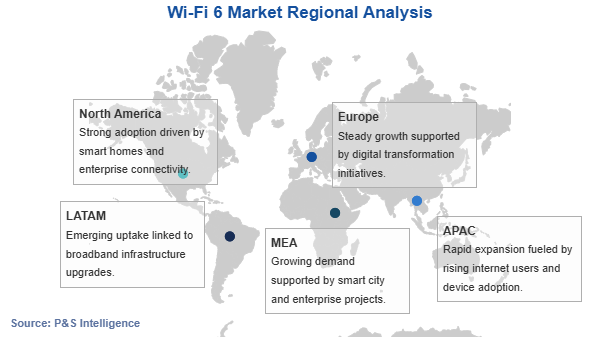
North America is the largest regional market, holding a market share of 40%, due to early adoption of advanced networking technologies and strong enterprise IT infrastructure investments.
Asia-Pacific is the fastest-growing regional market, registering a CAGR of approximately 30.7%, driven by rapid digital infrastructure expansion and increasing demand for high-speed wireless connectivity.
Wi-Fi 6 Market Analysis
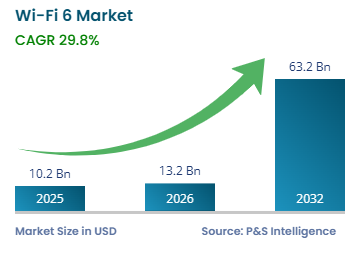
The Wi-Fi 6 market size was USD 10.2 billion for 2025, and it will grow by 29.8% during 2026–2032, to reach USD 63.2 billion by 2032.
The market expands because reliable wireless connectivity has become essential for both households and businesses. The rapid growth in global internet usage continues to increase demand for high-performance Wi-Fi networks that can support multiple connected devices simultaneously. According to the International Telecommunication Union, an estimated 6 billion people globally use the internet in 2025. Organisations and consumers increasingly adopt advanced Wi-Fi technologies to maintain stable, high-capacity network performance.
Wi-Fi 6 Market Trends and Drivers
High-Density, Multi-Device Network Environments Are Major Trends
The shift towards high-density, multi-device network environments is the key Wi-Fi 6 market trend. Organisations increasingly deploy advanced wireless systems in offices, stadiums, and public venues to manage large volumes of simultaneous device connections without performance loss. Additionally, 5G network coverage reached 51% of the global population in 2024, according to the International Telecommunication Union. Consequently, enterprise IT departments deploy high-capacity Wi-Fi 6 access points to ensure stable connectivity across increasingly crowded digital environments.
Rising Need for Faster and More Stable Internet Experience Drives Market
The rising need for faster and more stable internet experiences drives the Wi-Fi 6 market. Applications such as video conferencing, cloud computing, and real-time collaboration require consistent, high-speed connectivity without latency or interruptions. This demand continues to intensify as global internet usage expands, with 74% of the population using the internet in 2025, according to the International Telecommunication Union. Additionally, worldwide broadband connections reached 9.4 billion in 2024, according to the Organisation for Economic Co-operation and Development. Consequently, consumers and enterprises replace legacy routers with advanced Wi-Fi 6 solutions to maintain reliable network performance.
High Upgrade Costs and Compatibility Challenges Hamper Market Growth
High upgrade costs and hardware compatibility challenges strictly limit the global expansion of the Wi-Fi 6 market. Transitioning to this advanced network standard requires households and businesses to replace existing routing infrastructure. However, these mandatory upgrades create a significant financial barrier for populations with limited access to affordable digital devices. Consequently, these equipment cost constraints delay infrastructure upgrades and restrict large-scale adoption of Wi-Fi 6 technology.
Expansion of Smart and Connected Infrastructure Offers Opportunities
The continuous expansion of smart infrastructure and connected environments creates strong growth opportunities for the Wi-Fi 6 market. Smart buildings, industrial automation systems, and urban infrastructure require reliable wireless networks to support large volumes of real-time data transmission. These environments generate dense device ecosystems that legacy hardware cannot efficiently manage. Reflecting this rapid expansion, active short-range internet of things connections are projected to reach 17.5 billion globally by 2025, as per Ericsson. Consequently, enterprises deploy advanced Wi-Fi 6 architectures to ensure seamless connectivity across complex commercial and industrial operations.
Wi-Fi 6 Market Segmentation Analysis
Component Analysis
Hardware is the largest category, holding a market share of 60%, because the transition to Wi-Fi 6 requires the replacement of legacy networking equipment across households and enterprises. Large-scale deployments across corporate campuses further increase demand for physical access points and networking components to manage high device density. According to the Wi-Fi Alliance, 4.1 billion Wi-Fi-connected devices were shipped globally in 2024. The continuous need for compatible routers, chipsets, and access points ensures the dominance of the hardware segment.
Software & platform are the fastest-growing category, registering a CAGR of approximately 30.2%, as networks are becoming more complex and need better control and visibility. Users now want tools to manage traffic, monitor performance, and improve security. Cloud-based platforms are gaining attention because they allow remote management and easier updates. As more devices connect to networks, the need for smart software solutions is rising quickly across both enterprise and residential environments.
The components analysed in this report are:
Hardware (Largest Category)
Wireless Access Points
Wireless LAN Controllers
Routers & Gateways
Network Interface Devices/Adapters
Software & Platform (Fastest-Growing Category)
Network Management & Monitoring Software
Cloud-Based WLAN Management Platforms
Security & Access Control Solutions
Services
Deployment & Integration Services
Managed Wi-Fi Services
Support & Maintenance Services
Deployment Environment Analysis
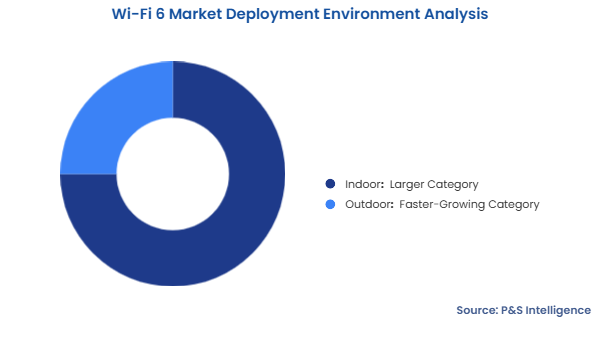
Indoor is the larger category, holding a market share of 75%, because most Wi-Fi usage happens inside homes, offices, malls, and other buildings. These spaces require stable and high-speed connectivity for daily activities like work, streaming, and communication. Indoor environments also need multiple access points to cover different rooms and floors. Since people spend more time indoors using connected devices, this category continues to lead in overall demand.
Outdoor is the faster-growing category, due to the increasing demand for seamless public connectivity across high-density urban environments. Municipalities and enterprises expand wireless infrastructure across stadiums, transport hubs, and city centres to manage large volumes of simultaneous users. These locations experience intense network congestion during public events, which legacy systems cannot efficiently support. According to the International Telecommunication Union, internet usage reached 83% of the urban population in 2024. Consequently, network operators deploy high-capacity outdoor Wi-Fi 6 access points to ensure stable connectivity across crowded public spaces.
The deployment environments analysed in this report are:
Indoor (Larger Category)
Outdoor (Faster-Growing Category)
Enterprise Size Analysis
Large enterprises are the largest category, due to their continuous investment in advanced networking infrastructure to support large-scale digital operations. These organisations manage high volumes of real-time data across multiple offices, campuses, and cloud-based platforms, requiring stable and high-speed connectivity. This demand aligns with the rapid growth in global data traffic, as international bandwidth capacity reached 1,835 Terabits per second in 2024. Consequently, enterprise IT departments deploy high-performance Wi-Fi 6 solutions to ensure reliable connectivity across complex and data-intensive business environments.
Small & medium enterprises (SMEs) are the faster-growing category, registering a CAGR of approximately 30.0%, as smaller businesses are increasingly going digital and upgrading their networks. Many SMEs are adopting cloud tools, online platforms, and remote working models. As their needs grow, they look for better connectivity solutions that are easy to deploy and manage. This shift is driving faster adoption of Wi-Fi 6 among smaller organisations.
The enterprise sizes analysed in this report are:
Large Enterprises (Larger Category)
Small & Medium Enterprises (Faster-Growing Category)
Industry Analysis
IT & telecommunications is the largest category, holding a market share of 25%, because this sector directly depends on strong and high-speed network infrastructure. Companies in this field manage data traffic, communication services, and digital platforms. They require advanced Wi-Fi systems to support operations and ensure smooth service delivery. Continuous upgrades and heavy usage make this industry the biggest user of Wi-Fi 6 solutions.
Retail is the fastest-growing category, due to the increasing adoption of digital store technologies and connected customer experiences. Retailers deploy advanced point-of-sale systems, automated inventory tracking, and contactless payment solutions that require stable and high-speed wireless connectivity. These systems must handle continuous data exchange between devices and backend platforms within store environments. Reflecting the scale of global consumer connectivity, active mobile-broadband subscriptions reached 95 per 100 inhabitants in 2024, according to the International Telecommunication Union. Consequently, retailers install high-capacity Wi-Fi 6 infrastructure to ensure seamless digital operations across modern retail spaces.
The industries analysed in this report are:
IT & Telecommunications (Largest Category)
Retail (Fastest-Growing Category)
Healthcare
Manufacturing
Education
Hospitality
Transportation & Logistics
Government & Public Sector
Others
Drive strategic growth with comprehensive market analysis
Wi-Fi 6 Market Geographical Analysis
North America Wi-Fi 6 Market Analysis
North America holds the largest share, of 40%, because the region has early adoption of advanced networking technologies across enterprises and public infrastructure. Companies here invest heavily in upgrading workplace connectivity to support hybrid work and high data usage. There is also a strong presence of leading technology providers, which speeds up product availability and deployment. High demand from sectors like education, healthcare, and corporate offices keeps network upgrades ongoing. In addition, structured IT spending and focus on performance-driven networks continue to support steady demand for Wi-Fi 6 solutions.
U.S. Wi-Fi 6 Market Analysis
The United States Wi-Fi 6 market grows due to the extensive deployment of high-speed broadband infrastructure and the increasing density of connected devices across enterprise environments. Large organisations upgrade network systems to support hybrid work models, cloud applications, and real-time collaboration tools. Additionally, mobile broadband penetration reached 200 subscriptions per 100 inhabitants in 2024, according to the Organisation for Economic Co-operation and Development. Consequently, enterprises and institutions deploy advanced Wi-Fi 6 networks to ensure stable connectivity across high-traffic digital environments.
Canada Wi-Fi 6 Market Analysis
The Canadian Wi-Fi 6 market grows due to the expansion of broadband infrastructure across both urban and remote regions, which increases the need for reliable wireless connectivity. Organisations and public institutions upgrade network systems to manage growing digital workloads and ensure consistent internet access across large geographic areas. Additionally, 93.5% of Canadian households had access to high-speed Internet in 2023, according to Innovation, Science and Economic Development Canada. Consequently, network operators deploy advanced Wi-Fi 6 solutions to maintain stable connectivity across diverse and widely distributed environments.
Asia-Pacific Wi-Fi 6 Market Analysis
Asia-Pacific has the highest CAGR, of approximately 30.7%, because the region is rapidly expanding its digital and communication infrastructure. Growing urban population and rising smartphone usage are pushing demand for better connectivity in both cities and semi-urban areas. Governments are actively supporting smart city projects and large-scale digital programs, which require strong wireless networks. Businesses are also modernising operations, leading to higher demand for efficient connectivity solutions. This fast-paced development across multiple sectors is driving quick adoption of Wi-Fi 6 technologies.
China Wi-Fi 6 Market Analysis
The Chinese Wi-Fi 6 market grows due to large-scale digital infrastructure expansion and strong domestic manufacturing capabilities that support widespread network deployment. The country continues to build advanced connectivity ecosystems across urban centres, industrial zones, and public facilities, increasing the need for high-performance wireless networks. This infrastructure scale is evident as 5G base stations reached 4.25 million in 2024, according to the State Council Information Office of China. Consequently, enterprises and institutions deploy Wi-Fi 6 solutions to complement high-speed networks and ensure stable connectivity across dense commercial and industrial environments.
India Wi-Fi 6 Market Analysis
The Indian Wi-Fi 6 market grows due to the rapid expansion of internet usage and increasing reliance on digital platforms across businesses and educational institutions. Organisations adopt cloud-based systems and online services, creating high demand for stable and high-speed wireless connectivity across urban and semi-urban areas. This demand is supported by large-scale internet adoption, as broadband subscribers exceeded 1 billion in 2025, according to the Press Information Bureau of India. Consequently, network operators deploy advanced Wi-Fi 6 solutions to maintain reliable performance across expanding digital ecosystems.
Europe Wi-Fi 6 Market Analysis
Europe shows steady development in the Wi-Fi 6 market due to increasing focus on secure and efficient digital infrastructure. Many countries are emphasising data privacy and network reliability, which drives the need for controlled and high-performance wireless systems. Enterprises are upgrading networks to meet strict compliance standards while maintaining service quality. Public sector projects, including smart transport and connected services, also support adoption. The region’s mix of developed and developing markets creates balanced demand, with gradual but consistent deployment of advanced wireless technologies.
The regions and countries analysed in this report are:
North America (Largest Regional Market)
U.S. (Larger Country)
Canada (Faster-Growing Country)
Europe
Germany (Largest Country)
U.K. (Fastest-Growing Country)
France
Italy
Spain
Rest of Europe
Asia-Pacific (Fastest-Growing Regional Market)
China (Largest Country)
India (Fastest-Growing Country)
Japan
South Korea
Australia
Rest of APAC
Latin America
Brazil (Largest Country)
Mexico (Fastest-Growing Country)
Rest of LATAM
Middle East and Africa
Saudi Arabia (Largest Country)
U.A.E. (Fastest-Growing Country)
South Africa
Rest of MEA
Wi-Fi 6 Market Share Analysis
The market is fragmented, with many global and regional players competing across different parts of the value chain. Large technology companies offer complete solutions, while smaller firms focus on specific components like chipsets or software tools. New entrants are also entering with niche offerings, especially in cloud management and smart networking. This wide mix of players creates strong competition and constant innovation. No single company has full control, and customers have multiple options based on their needs, which keeps the market open and diverse.
Leading Companies in the Wi-Fi 6 Market:
Cisco Systems
Qualcomm Incorporated
Broadcom Inc.
Hewlett Packard Enterprise
Extreme Networks
CommScope Holding Company Inc.
Huawei Technologies Co. Ltd.
Intel Corporation
NETGEAR Inc.
TP-Link Technologies Co. Ltd.
Nokia Corporation
Zyxel Communications Corp.
Arista Networks Inc.
Juniper Networks Inc.
D-Link Corporation
Wi-Fi 6 Market News
In February 2026, Phoenix Contact GmbH & Co. KG introduced Wi-Fi 6 access points as part of its industrial wireless portfolio. The release includes WLAN modules designed for automation environments and positions the new access points within its industrial communication product range. The update is product-focused, emphasizing portfolio expansion rather than customer deployment.
In January 2026, Grandstream Networks, Inc. introduced a plug-in Wi-Fi 6 extender and access point for small office and residential use. The GWN7660EM supports extender, access point, and mesh networking functions, expanding the company’s wireless networking portfolio.
In September 2025, NETGEAR, Inc. introduced the WAX610W compact dual-band Wi-Fi 6 access point for hospitality, education, and multi-dwelling environments. The device supports mesh backhaul functionality and compatibility with Wi-Fi 4, Wi-Fi 5, Wi-Fi 6E, and Wi-Fi 7 client devices, expanding the company’s enterprise wireless networking portfolio.
In December 2025, Renesas Electronics Corporation introduced its first Wi-Fi 6 microcontrollers along with Wi-Fi and Bluetooth Low Energy combo MCUs for connected home and IoT applications. The launch expands the company’s RA wireless MCU family and represents a component-level product release targeted at device manufacturers rather than end-user deployment or investment activity.
Frequently Asked Questions About This Report
What is Wi-Fi 6 and how is it different from previous generations?+
Wi-Fi 6 is the latest wireless standard offering faster speeds, improved efficiency, and better performance in crowded networks compared to earlier versions like Wi-Fi 5.
What factors are driving growth in the global Wi-Fi 6 market?+
Rising internet usage, increasing connected devices, demand for high-speed connectivity, and growth in cloud applications and remote work are major drivers of Wi-Fi 6 adoption.
Why are enterprises upgrading to Wi-Fi 6 networking solutions?+
Enterprises upgrade to Wi-Fi 6 to support high device density, ensure stable connectivity, enhance security, and improve performance for cloud, video conferencing, and collaboration tools.
Which industries are adopting Wi-Fi 6 technology the fastest?+
Industries such as IT and telecommunications, retail, healthcare, and education are rapidly adopting Wi-Fi 6 due to increasing reliance on digital and connected systems.
What challenges are limiting the adoption of Wi-Fi 6 globally?+
High upgrade costs, compatibility issues with legacy devices, and limited affordability in developing regions restrict widespread adoption of Wi-Fi 6 technology.
How does Wi-Fi 6 improve performance in high-density environments?+
Wi-Fi 6 uses technologies like OFDMA and MU-MIMO to handle multiple devices simultaneously, reducing congestion and maintaining consistent performance in crowded environments.
Want a report tailored exactly to your business need?
Leading companies across industries trust us to deliver data-driven insights and innovative solutions for their most critical decisions. From data-driven strategies to actionable insights, we empower the decision-makers who shape industries and define the future. From Fortune 500 companies to innovative startups, we are proud to partner with organisations that drive progress in their industries.
Client Testimonials
Working with P&S Intelligence and their team was an absolute pleasure – their awareness of timelines and commitment to value greatly contributed to our project's success. Eagerly anticipating future collaborations.
McKinsey & Company
India
Unmatched Standards
Our insights into the minutest levels of the markets, including the latest trends and competitive landscape, give you all the answers you need to take your business to new heights
Complete Data Security
We take a cautious approach to protecting your personal and confidential information. Trust is the strongest bond that connects us and our clients, and trust we build by complying with all international and domestic data protection and privacy laws