This Report Provides In-Depth Analysis of the Wheelchair Market Report Prepared by P&S Intelligence, Segmented by Type (Manual, Powered), Modality (Standard, Bariatric, Sports), End User (Adult, Pediatric), Application (Personal, Institutional), Distributional Channel (Retail, E-Commerce), and Geographical Outlook for the Period of 2021 to 2032
Explore the market potential with our data-driven report
Wheelchair Market Overview
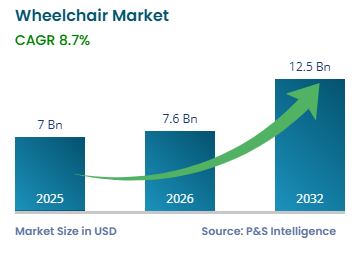
The wheelchair market size was USD 7.0 billion for 2025, and it will grow by 8.7% during 2026–2032, to reach USD 12.5 billion by 2032.
The wheelchair market is growing due to the increasing need for mobility assistance among individuals with disabilities, age-related mobility limitations, injuries, and chronic health conditions. Population aging is further expanding the potential user base, while improvements in healthcare and rehabilitation services are increasing awareness of mobility solutions. According to the World Health Organization (WHO), 1.3 billion people, equivalent to approximately 16% of the global population, experience significant disability, and at least 80 million people require a wheelchair globally. However, access remains limited, with only 5%–35% of people who need a wheelchair having access to one, depending on the country. This substantial unmet need provides a strong foundation for continued market growth.
Technological advancements are also contributing to market expansion, particularly in powered and smart wheelchair solutions. Manufacturers are incorporating improved battery systems, sensors, navigation technologies, connectivity, and advanced user-control features to enhance mobility, safety, comfort, and independence. The increasing emphasis on personalized mobility solutions, independent living, accessibility, and improved quality of life is encouraging users and healthcare providers to adopt more advanced wheelchair products. Together, rising underlying demand and continued product innovation are supporting the expansion of the market.
Key Market Insights
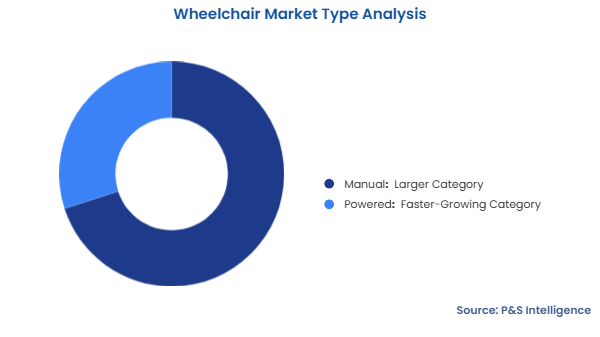
The manual category holds the larger market share, of 70%, in 2025, driven by its affordability, simple design, and easy maintenance.
The bariatric category will have the highest CAGR, of approximately 9.4%, driven by rising obesity rates and demand for high-capacity mobility devices.
The retail category holds the larger market share, of 80%, in 2025, driven by personalized fitting, consultation, and after-sales service.
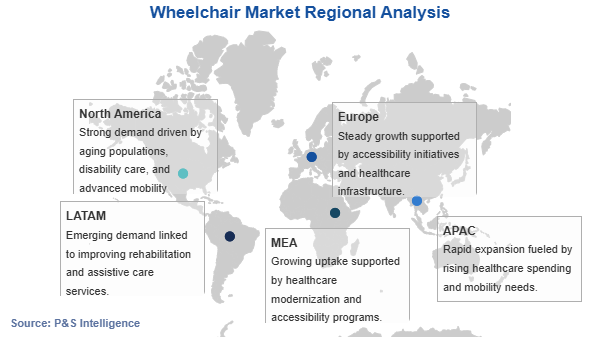
North America holds the largest market share, of 40%, in 2025, driven by aging demographics, high healthcare spending, and strong infrastructure.
Asia-Pacific will have the highest CAGR, of approximately 9.6%, driven by aging populations and expanding healthcare needs.
Wheelchair Market Trends and Drivers
Advanced Powered and Stair-Climbing Wheelchair Technologies Are Key Trends
Wheelchair design is evolving beyond basic mobility solutions toward technologically advanced products that incorporate standing functions, stair-climbing capabilities, and improved battery technologies. These developments are expanding the functionality of powered wheelchairs and enabling users with mobility limitations to navigate a broader range of environments with greater independence. The U.S. Food and Drug Administration (FDA) maintains distinct regulatory classifications for powered, stair-climbing, and standup wheelchairs, reflecting the different technological and functional characteristics of these devices.
The FDA classifies powered wheelchairs under 21 CFR 890.3860, stair-climbing wheelchairs under 21 CFR 890.3890, and standup wheelchairs under 21 CFR 890.3900, with the latter two categories classified as Class II medical devices. The FDA also recognizes standards addressing lithium-ion batteries and battery systems intended for electrically powered wheelchairs, demonstrating the relevance of advanced battery technologies to the development and safety of powered mobility devices.
Aging Populations and Rising Chronic Mobility Conditions Are Biggest Drivers
Sustained demand for wheelchairs is supported by population aging and the growing burden of chronic conditions that can impair mobility and physical functioning. Musculoskeletal conditions such as osteoarthritis and rheumatoid arthritis, as well as neurological and other chronic conditions, can lead to persistent limitations in mobility and increase the need for rehabilitation and assistive products. The World Health Organization (WHO) estimates that approximately 1.71 billion people globally live with musculoskeletal conditions, which are the leading contributor to disability worldwide. WHO also notes that the number of people living with musculoskeletal conditions and associated functional limitations is increasing rapidly because of population growth and aging.
In the U.S., the Centers for Disease Control and Prevention (CDC) estimates that 58.5 million adults have arthritis, including 25.7 million who report an arthritis-attributable activity limitation. CDC projections indicate that the number of adults with arthritis could reach 78 million by 2040, while 34.6 million could experience arthritis-attributable activity limitations. These drivers, together with the aging of populations and the increasing prevalence of chronic conditions that affect physical functioning, are expected to strengthen the underlying need for mobility assistance and wheelchair solutions.
Reimbursement Rate Compression and High Device Costs Are Key Restraints
High costs associated with powered and complex rehabilitation wheelchairs can limit access to advanced mobility solutions, particularly among price-sensitive users and healthcare providers operating within fixed healthcare budgets. Powered wheelchairs typically involve higher acquisition costs than basic manual models because of their motors, batteries, electronic control systems, specialized seating, and additional customization requirements. These cost differences can make advanced wheelchair solutions less accessible to users with limited financial resources or inadequate insurance coverage.
Reimbursement policies and cost-containment measures can create additional pressure on the market by limiting the amount healthcare systems and public payers are willing to reimburse for mobility equipment. Differences in reimbursement policies across countries, restrictions on eligibility, and lengthy approval procedures can also delay wheelchair procurement and replacement. Limited reimbursement for advanced features and customized configurations may further discourage adoption of higher-specification products, particularly in price-sensitive markets. These factors can constrain market penetration of technologically advanced wheelchairs and increase the importance of affordable product development, flexible payment mechanisms, and efficient distribution models.
Assistive Technology Access Gaps in Low- and Middle-Income Countries Are the Biggest Opportunity
Substantial gaps in access to assistive technology across low- and middle-income countries represent an important growth opportunity for wheelchair manufacturers. Limited affordability, inadequate availability of appropriate products, insufficient service infrastructure, and shortages of trained personnel for assessment, fitting, and maintenance continue to restrict access to mobility-assistance products. These gaps create opportunities for manufacturers to develop affordable, durable, locally serviceable wheelchair solutions and expand distribution through partnerships with healthcare providers, governments, and community-based organizations.
According to the World Health Organization (WHO) and UNICEF, access to needed assistive products can range from as low as 3% in some low-income countries to 90% in high-income countries, highlighting the substantial disparity in access. More than 2.5 billion people globally require one or more assistive products, and this number is projected to exceed 3.5 billion by 2050. The large unmet need, particularly in countries where access remains limited, provides manufacturers with opportunities to expand affordable wheelchair offerings and strengthen distribution and service networks.
Wheelchair Market Segmentation Analysis
Type Analysis
The manual category holds the larger market share, of 70%, in 2025, driven by its relatively low cost, simpler design, minimal maintenance requirements, and broad accessibility across institutional procurement programs and individual purchases, particularly in price-sensitive markets. Government-funded assistive-device programs also support access to manual wheelchairs because their comparatively simple design and lower operating requirements make them suitable for a broad range of users. In the U.S., CMS reported a 30.5% improper payment rate for manual wheelchair claims during the 2024 Medicare Fee-for-Service reporting period, representing a projected $28.1 million in improper payments, highlighting the substantial volume of manual-wheelchair activity within the Medicare DME system.
The powered category will have the higher CAGR, of approximately 8.9%, driven by declining lithium-ion battery costs, expanding reimbursement coverage in developed markets, and rising consumer preference for greater user autonomy and reduced physical exertion. This shift is expected to accelerate as manufacturers introduce increasingly compact and modular powered platforms priced closer to premium manual models.
The types analyzed in this report are:
Manual (Larger Category)
Powered (Faster-Growing Category)
Modality Analysis
The standard category holds the largest market share, of 45%, in 2025, reflecting its suitability for the broadest range of users and clinical applications relative to specialized configurations designed for narrower use cases. Standard configurations serve as the default prescription for general mobility impairment across hospital, homecare, and institutional settings, giving this category the widest addressable population and the deepest distribution infrastructure among manufacturers and durable medical equipment providers.
The bariatric category will have the highest CAGR, of approximately 9.4%, supported by the rising prevalence of obesity and the corresponding need for mobility devices designed to accommodate higher user weights. As obesity-related mobility limitations become more prevalent, demand for appropriately designed mobility equipment is increasing across healthcare facilities, rehabilitation centers, and home-care settings. According to the U.S. Centers for Disease Control and Prevention (CDC) National Center for Health Statistics, the age-adjusted prevalence of obesity among U.S. adults aged 20 years and older was 40.3% during August 2021–August 2023, while 9.7% had severe obesity during the same period. This high prevalence of obesity supports the underlying demand for higher-capacity mobility solutions, including bariatric wheelchairs.
The modalities analyzed in this report are:
Standard (Largest Category)
Bariatric (Fastest-Growing Category)
Sports
Others
End User Analysis
The adult category holds the larger market share, of 75%, in 2025, reflecting the cumulative effect of age-related mobility impairment, workplace and traffic injuries, and chronic musculoskeletal and neurological conditions that concentrate disproportionately in the adult and geriatric population relative to children. This demographic weighting is structural and durable, as the conditions driving adult wheelchair use become more prevalent with age rather than resolving over time.
The pediatric category will have the higher CAGR, supported by improving identification of childhood mobility limitations, expanding pediatric rehabilitation services, and increasing access to assistive technologies. Pediatric wheelchair solutions require appropriate sizing, positioning, and adjustment to accommodate children's physical growth and changing functional needs. UNICEF reported that from 2022 to 2024, it provided assistive technologies and disability-inclusive products to nearly 930,000 children with disabilities across more than 90 countries, including wheelchairs and other child-appropriate assistive products. This recent expansion in the provision of assistive technologies highlights increasing institutional efforts to address mobility and functional needs among children with disabilities and supports continued demand for pediatric mobility solutions.
The end users analyzed in this report are:
Adult (Larger Category)
Pediatric (Faster-Growing Category)
Application Analysis
The personal category holds the larger market share in 2025, reflecting sustained global preference for home-based mobility solutions that support daily independence over facility-based care. Rising costs associated with institutional care, combined with a broad cultural and policy shift toward aging and living independently at home, continue to reinforce personal use as the dominant application context across both developed and developing markets.
The institutional category will have the higher CAGR, of approximately 9.2%, driven by expanding long-term care, rehabilitation, hospitals, and residential care services. Additionally, the increasing adoption of institutional wheelchair procurement programs and government-funded healthcare initiatives is expected to further support demand for wheelchairs across hospitals, rehabilitation centers, and long-term care facilities.
The applications analyzed in this report are:
Personal (Larger Category)
Institutional (Faster-Growing Category)
Distributional Channel Analysis
The retail category holds the larger market share, of 80%, in 2025, reflecting the continued importance of in-person fitting, clinical consultation, and after-sales service for a product category requiring individualized configuration. Complex rehab and powered wheelchairs in particular depend on hands-on assessment that purely online transactions cannot fully replicate, reinforcing retail's structural advantage.
The e-commerce category will have the higher CAGR, supported by expanding online purchasing infrastructure and increasing consumer acceptance of purchasing healthcare and mobility products online, particularly standard manual wheelchairs and accessories that require less individualized fitting. According to the U.S. Census Bureau, e-commerce sales accounted for 16.6% of total U.S. retail sales in the fourth quarter of 2025, demonstrating the increasing importance of online retail channels in the broader consumer market.
The distributional channels analyzed in this report are:
Retail (Larger Category)
E-Commerce (Faster-Growing Category)
Drive strategic growth with comprehensive market analysis
Wheelchair Market Regional Analysis
North America Wheelchair Market Size
North America holds the largest market share, of 40%, in 2025, supported by an aging population, high healthcare expenditure, established healthcare and distribution infrastructure, government support programs, and the availability of technologically advanced wheelchair products. The U.S. accounted for the majority of the regional market, while the increasing adoption of powered and technologically advanced wheelchairs is further supporting regional growth.
The region also has a substantial population with mobility limitations, creating a strong underlying demand for wheelchair products. The U.S. Centers for Disease Control and Prevention (CDC) reports that 12.2% of U.S. adults had a mobility disability in 2022, making mobility disability the second most prevalent disability type after cognitive disability. The prevalence of mobility disability, combined with population aging, increasing demand for home healthcare, and continued adoption of advanced powered mobility solutions, supports sustained demand for wheelchairs across North America.
U.S. Wheelchair Market Size
The U.S. represents a major wheelchair market within North America, supported by established healthcare infrastructure, Medicare coverage for medically necessary mobility equipment, and a large and aging population with disabilities. Medicare Part B covers wheelchairs and power-operated vehicles as durable medical equipment when eligibility and medical-necessity requirements are met, supporting access to mobility products through the U.S. healthcare system.
The aging population provides an important underlying source of demand for wheelchair products. According to the U.S. Census Bureau's 2024 American Community Survey, 23.7% of people aged 65–74 and 45.0% of people aged 75 and over have a disability, demonstrating that disability prevalence increases substantially with age. The continued growth of the older population, combined with the high prevalence of disability among older adults and established reimbursement mechanisms, supports sustained demand for mobility-assistance products in the U.S.
Asia-Pacific Wheelchair Market Size
Asia-Pacific will have the highest CAGR, of approximately 9.6%, supported by population aging, expanding healthcare and rehabilitation needs, and increasing emphasis on accessible and age-friendly services. The region's large elderly population creates a substantial underlying need for mobility solutions, particularly as age-related mobility limitations and chronic health conditions become more prevalent. China represents an important market in this context, with the United Nations Development Programme (UNDP) reporting that China's population aged 60 years and above reached 310.31 million by the end of 2024, accounting for 22% of the country's total population.
The growing elderly population is increasing the need for products that support mobility, independence, and quality of life, creating opportunities for wheelchair manufacturers across the region. Demand is further supported by improvements in healthcare infrastructure, rehabilitation services, and access to assistive technology. As governments and healthcare systems place greater emphasis on healthy aging and inclusive care, adoption of both manual and powered wheelchair solutions is expected to increase, particularly in countries with rapidly aging populations.
India Wheelchair Market Size
India is the fastest-growing market for wheelchairs in Asia-Pacific, supported by its expanding elderly population, increasing healthcare needs, and growing government support for assistive technologies. According to the UNFPA India Ageing Report 2023, cited by the Government of India in 2026, people aged 60 years and above accounted for 10.4% of India's population in 2022, and this share is projected to reach 20.8% by 2050. The rapid expansion of the elderly population is expected to increase demand for mobility assistance, rehabilitation, and age-related healthcare services.
Government initiatives are also strengthening access to mobility and assistive products. Under the Rashtriya Vayoshri Yojana, eligible senior citizens with age-related disabilities or infirmities receive physical aids and assisted-living devices. The current Government of India information confirms that wheelchairs are among the assistive devices provided under the scheme.
The regions and countries analyzed in this report are:
North America (Largest Regional Market)
U.S. (Larger Country)
Canada (Faster-Growing Country)
Europe
Germany (Largest Country)
U.K.
France
Italy
Spain (Fastest-Growing Country)
Rest of Europe
Asia-Pacific (Fastest-Growing Regional Market)
China (Largest Country)
India (Fastest-Growing Country)
Japan
South Korea
Australia
Rest of APAC
Latin America
Brazil (Largest Country)
Mexico (Fastest-Growing Country)
Rest of LATAM
Middle East & Africa
Saudi Arabia (Fastest-Growing Country)
South Africa
U.A.E. (Largest Country)
Rest of MEA
Wheelchair Market Competitive Landscape
The market is fragmented, with numerous international, regional, and local manufacturers competing across manual, powered, pediatric, bariatric, and specialized wheelchair categories. The market includes established companies with broad product portfolios alongside smaller manufacturers serving specific geographic markets, customer groups, and clinical requirements. Competition is influenced by product innovation, customization, affordability, distribution reach, after-sales services, and relationships with healthcare providers and reimbursement systems. While leading companies have established strong positions through extensive product offerings, brand recognition, and global distribution networks, the presence of numerous smaller and regional players prevents the market from becoming highly concentrated. The diverse requirements of wheelchair users and differences in healthcare systems and reimbursement structures across countries further support the participation of specialized manufacturers. This fragmented structure provides opportunities for companies to expand through technological innovation, geographic expansion, strategic partnerships, and development of affordable mobility solutions.
Leading Companies in the Wheelchair Market:
Sunrise Medical
Permobil AB
Pride Mobility Products Corp.
Ottobock SE & Co. KGaA
Drive DeVilbiss Healthcare
GF Health Products, Inc.
MEYRA GmbH
Karman Healthcare, Inc.
Karma Medical Products Co., Ltd.
Golden Technologies, Inc.
Hoveround Corporation
Merits Health Products Co., Ltd.
WHILL, Inc.
Nissin Medical Industries Co., Ltd.
LEVO AG
Vermeiren Group
Adaptive Switch Laboratories
Etac AB
Wheelchair Market Developments
In June 2026, Ottobock SE & Co. KGaA signed an agreement to sell its Human Mobility wheelchair business, including manual and power wheelchairs and pediatric specialist brand veldink4Kids, to European mobility group DHCare, with the transaction expected to close in the second half of 2026. The divestiture sharpens Ottobock's strategic focus on prosthetics and neuro-orthotics while consolidating DHCare's position as a major European wheelchair provider.
In June 2026, Permobil AB acquired Medivar, a mobility, disability, and home-care provider based in Hyères, France, with nearly 25 years of operating history. The acquisition became Permobil's fifth French acquisition in 2026, strengthening its local distribution, customer relationships, and after-sales service capabilities.
In December 2025, Adaptive Switch Laboratories, a division of Invacare America, launched the ASL iON Integrated Drive Control System, a wireless-enabled platform integrating connectivity, communications, and navigation features for power wheelchair users. The launch targets enhanced user independence beyond basic mobility, reflecting broader smart-wheelchair technology adoption.
In December 2025, Pride Mobility Products Corp. launched three carbon-fiber travel power wheelchairs; the Jazzy Carbon 27, Jazzy Carbon 27X, and Jazzy Carbon HD. The Jazzy Carbon 27X features vertical folding, while the Carbon HD has a 400-lb weight capacity, extending the lightweight platform to higher-capacity users.
Frequently Asked Questions About This Report
What are the major factors driving the growth of the wheelchair market?+
Population aging, rising disability and chronic disease prevalence, increasing mobility needs, and expanding healthcare and rehabilitation services are driving market growth.
What are the key challenges or restraints affecting the wheelchair market?+
High costs of advanced wheelchairs, limited reimbursement coverage, maintenance expenses, and inadequate accessibility infrastructure are key market restraints.
What are the major trends shaping the wheelchair market?+
Key trends include lightweight designs, powered mobility, customization, smart features, improved batteries, and greater emphasis on user independence.
How are technological advancements transforming the wheelchair market?+
AI, IoT, sensors, navigation systems, connectivity, and advanced control technologies are improving wheelchair safety, functionality, comfort, and independence.
What are the major opportunities for wheelchair manufacturers?+
Smart and connected wheelchairs, lightweight powered models, customized rehabilitation products, and affordable solutions for underserved markets offer major growth opportunities.
How is the growing elderly and disabled population influencing demand for wheelchairs?+
The growing elderly and disabled population is increasing demand for wheelchairs as age-related conditions, chronic diseases, injuries, and mobility impairments become more prevalent.
Want a report tailored exactly to your business need?
Leading companies across industries trust us to deliver data-driven insights and innovative solutions for their most critical decisions. From data-driven strategies to actionable insights, we empower the decision-makers who shape industries and define the future. From Fortune 500 companies to innovative startups, we are proud to partner with organisations that drive progress in their industries.
Client Testimonials
Working with P&S Intelligence and their team was an absolute pleasure – their awareness of timelines and commitment to value greatly contributed to our project's success. Eagerly anticipating future collaborations.
McKinsey & Company
India
Unmatched Standards
Our insights into the minutest levels of the markets, including the latest trends and competitive landscape, give you all the answers you need to take your business to new heights
Complete Data Security
We take a cautious approach to protecting your personal and confidential information. Trust is the strongest bond that connects us and our clients, and trust we build by complying with all international and domestic data protection and privacy laws