This Report Provides In-Depth Analysis of the Water-Based Adhesive Specialty Tapes Market Report Prepared by P&S Intelligence, Segmented by Product Type (Single-Sided Tapes, Double-Sided Tapes, Transfer Tapes, Foam Tapes, Masking Tapes, Medical Tapes, Surface Protection Tapes), Resin Type (Acrylic Polymer Emulsion, Styrene Butadiene Latex, Polyvinyl Acetate Emulsion, Polyurethane Dispersion, Vinyl Acetate Ethylene Emulsion), End Use (Packaging, Automotive, Building & Construction, Electrical & Electronics, Healthcare, Paper & Printing, Consumer Goods, General Manufacturing), and Geographical Outlook for the Period of 2021 to 2032
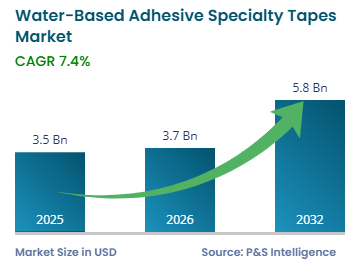
The water-based adhesive specialty tapes market size was USD 3.5 billion for 2025, and it will grow by 7.4% during 2026–2032, to reach USD 5.8 billion by 2032.
The water-based adhesive specialty tapes market is experiencing steady growth, due to the increasing adoption of environmentally friendly, low-VOC adhesive solutions across packaging, automotive, electronics, healthcare, and construction industries. Stringent environmental regulations limiting solvent-based adhesives, coupled with growing demand for sustainable packaging and lightweight bonding materials, are accelerating the shift toward water-based adhesive technologies. These tapes provide excellent adhesion, improved worker safety, and low odor while complying with stringent VOC emission standards, making them a preferred bonding solution across a wide range of industrial applications.
Expanding production across key end-use industries and continuous advancements in adhesive resin technologies are supporting market growth. According to the International Organization of Motor Vehicle Manufacturers (OICA), global motor vehicle production reached 92.5 million units in 2024, driving demand for specialty tapes used in interior trim, battery assembly, wire harnessing, and lightweight component bonding. The United Nations World Population Prospects 2024 estimates that the number of people aged 65 years and older will surpass the number of children under age 18 by the late 2070s. This demographic shift reflects the rapid pace of global population aging and is expected to sustain long-term demand for medical tapes used in wound care, surgical procedures, and wearable medical devices. Advancements in polyvinyl acetate (PVA) and polyurethane dispersion (PUD) technologies are improving adhesion performance, durability, and environmental compliance, thereby strengthening market growth during the forecast period.
Key Market Insights
The foam tapes category will have the highest CAGR, of approximately 7.8%, driven by rising demand in EV battery assembly, consumer electronics, and gap-filling applications.
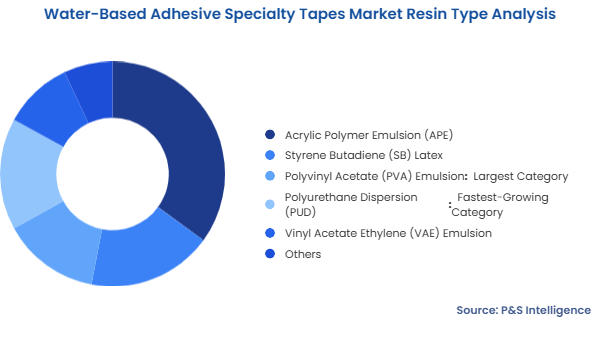
The polyvinyl acetate emulsion category holds the largest market share, of 35%, in 2025, due to its cost-effectiveness and widespread use in paper, packaging, and general bonding applications.
The packaging category holds the largest market share, of 25%, in 2025, driven by strong demand from e-commerce, food packaging, and industrial shipping.
The electrical & electronics category will have the highest CAGR, of approximately 8.1%, driven by rising semiconductor and consumer electronics production.
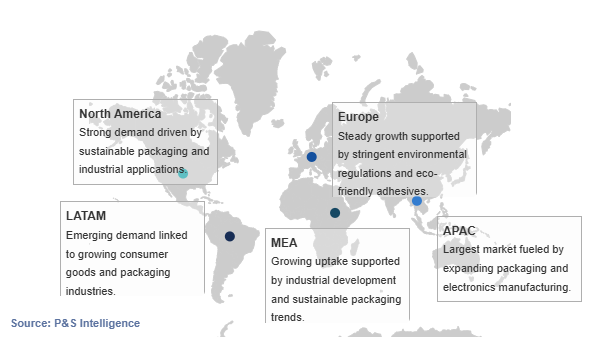
Asia-Pacific holds the largest market share, of 40%, in 2025, and it will have the highest CAGR, of approximately 8.3%, driven by its strong automotive and electronics manufacturing base.
Water-Based Adhesive Specialty Tapes Market Trends and Drivers
Electrification of Vehicle Platforms Is Key Trend
Automotive manufacturing is undergoing a structural shift toward electric vehicle (EV) platforms that is reshaping specialty tape performance requirements. Battery pack assembly, thermal interface bonding, electrical insulation, and wire harnessing in EVs require foam and double-sided tapes with higher-performance adhesion, dielectric strength, thermal resistance, and gap-filling capabilities than those traditionally used in internal combustion engine vehicles. This transition is driving manufacturers toward advanced water-based adhesive formulations, including polyurethane dispersion (PUD) and acrylic polymer emulsion (APE) systems. These formulations are engineered specifically for EV applications and meet increasingly stringent environmental requirements. According to the International Organization of Motor Vehicle Manufacturers (OICA), global motor vehicle production reached approximately 96.4 million units in 2025, reflecting continued expansion in automotive manufacturing and increasing opportunities for specialty adhesive tape applications.
According to the International Energy Agency (IEA), global electric car sales reached more than 20.7 million units in 2025, representing approximately 20% year-over-year growth and accounting for around one-quarter of total global vehicle sales. As EV adoption continues to accelerate across major automotive manufacturing regions, tape converters supplying original equipment manufacturers (OEMs) are increasingly required to qualify water-based specialty tapes for battery safety, thermal management, electrical insulation, and lightweight assembly applications, strengthening demand for high-performance water-based adhesive specialty tapes throughout the forecast period.
Environmental Regulation and VOC Compliance Mandates Are Biggest Drivers
Tightening environmental regulations across major manufacturing economies are accelerating the transition from solvent-based to water-based adhesive technologies. Regulatory authorities are increasingly imposing stringent limits on volatile organic compound (VOC) emissions from industrial and consumer adhesive products. These limits are encouraging manufacturers to reformulate products using low-VOC water-based chemistries, driving the adoption of water-based adhesive specialty tapes across automotive, packaging, construction, electronics, and other industrial applications. Compliance with environmental standards and workplace safety requirements has become increasingly important across these sectors.
According to the U.S. Environmental Protection Agency (EPA), the National Volatile Organic Compound (VOC) Emission Standards for Consumer Products are estimated to reduce VOC emissions by approximately 90,000 tons per year. These standards require manufacturers, importers, and distributors to limit VOC content across regulated product categories. The OECD eChemPortal, which provides access to the European Chemicals Agency's (ECHA) REACH database, reports that ECHA CHEM currently holds information on approximately 25,000 chemical substances. This figure reflects the increasing scope of chemical regulation and is encouraging manufacturers to develop environmentally compliant, low-VOC adhesive formulations. These regulatory developments are accelerating the substitution of solvent-based adhesive tapes with water-based alternatives that provide lower VOC emissions while maintaining high bonding performance, thereby supporting sustained market growth throughout the forecast period.
Raw Material Price Volatility Is Key Restraint
Water-based specialty tape production depends on petrochemical-derived resin inputs whose prices are closely linked to fluctuations in crude oil and chemical feedstock markets. This dependency creates margin pressure for manufacturers and reduces pricing predictability. Resin systems such as acrylic polymer emulsions, polyurethane dispersions, and polyvinyl acetate emulsions account for a large share of production costs. Sustained raw material price volatility can therefore compress margins despite the regulatory and environmental advantages offered by water-based adhesive technologies.
Fluctuating prices of key raw materials continue to challenge manufacturers by increasing production costs and limiting pricing flexibility across highly competitive end-use industries such as packaging, automotive, electronics, and construction. Manufacturers are increasingly adopting long-term procurement agreements to stabilize input costs. Diversifying supplier networks is strengthening supply chain resilience, and vertical integration strategies are helping manufacturers protect profitability as they expand production of water-based adhesive specialty tapes.
Electronics Manufacturing Incentive Programs Are Biggest Opportunities
Government-backed electronics manufacturing incentive programs across Asia-Pacific are creating new growth opportunities for water-based adhesive specialty tapes used in consumer electronics and component manufacturing. Expanding domestic production of smartphones, semiconductors, electronic components, and display modules is increasing demand for surface protection, transfer, masking, and double-sided tapes used in device assembly, display lamination, printed circuit board protection, and precision component bonding. As countries compete to strengthen domestic electronics supply chains, demand for high-performance specialty tapes is expected to rise steadily.
According to India's Ministry of Electronics and Information Technology (MeitY), the Electronics Component Manufacturing Scheme (ECMS) has an approved outlay of INR 40,000 crore (approximately USD 4.53 billion). The scheme aims to strengthen domestic electronics component manufacturing and increase value addition within the country. The expansion of electronics manufacturing capacity under this initiative is expected to create long-term opportunities for manufacturers of water-based adhesive specialty tapes to supply advanced bonding and protection solutions for electronic devices.
The single-sided tapes category holds the largest market share, of 30%, in 2025, driven by the broad usability across packaging, masking, and general-purpose bonding applications. Single-face adhesion is sufficient for these use cases, and production costs remain lower than for other specialty tape formats. Converters favor single-sided tapes for high-volume packaging and carton-sealing operations because they require simpler coating processes and lower resin consumption than double-sided or foam constructions, supporting cost-efficient manufacturing across high-volume operations. The FAO Global Forest Products Facts and Figures 2024 report indicates that global exports of wood and paper products reached USD 486 billion in 2024, up 1.4%. This growth reflects sustained demand for paper and paperboard packaging materials, which supports widespread use of single-sided tapes.
The foam tapes category will have the highest CAGR, of approximately 7.8%, propelled by expanding use in electric vehicle battery pack assembly, gasket replacement, and consumer electronics housing bonding, where superior cushioning, vibration damping, and gap-filling performance provide advantages over conventional flat adhesive tape formats. The Semiconductor Industry Association reports that global semiconductor sales reached USD 791.7 billion in 2025, an increase of 25.6% over 2024, reflecting rapid growth in electronics manufacturing that continues to expand demand for foam tapes used in component mounting, sealing, and thermal management.
The product types analyzed in this report are:
Single-Sided Tapes (Largest Category)
Double-Sided Tapes
Transfer Tapes
Foam Tapes (Fastest-Growing Category)
Masking Tapes
Medical Tapes
Surface Protection Tapes
Others
Resin Type Analysis
The polyvinyl acetate emulsion category holds the largest market share, of 35%, in 2025, driven by its established use in paper, packaging, and general bonding applications. Cost efficiency and adequate bond strength outweigh the need for specialized performance characteristics in these applications. PVA emulsion's compatibility with existing coating lines and its long manufacturing track record have made it the preferred resin choice for converters serving high-volume packaging and paper-based applications. The widespread use of paper and paperboard packaging continues to support demand for PVA-based adhesive tape formulations across packaging and paper-converting operations.
The polyurethane dispersion category will have the highest CAGR, driven by rising demand for high-performance bonding in automotive and electric vehicle applications. These applications require enhanced flexibility, abrasion resistance, and improved adhesion to challenging substrates compared with conventional emulsion systems. According to the International Energy Agency (IEA), total consumer spending on electric cars reached USD 560 billion in 2024. This spending reflects continued investment in EV production, which supports increasing adoption of PUD-based specialty tapes in battery assembly, structural bonding, and lightweight vehicle components.
The packaging category holds the largest market share, in 2025, driven by sustained e-commerce fulfillment volumes, food and beverage carton sealing, and industrial shipping requirements that rely on specialty tapes for carton sealing, labeling, and package protection throughout supply chains. The continued expansion of packaging activities across e-commerce, food and beverage, pharmaceuticals, and consumer goods industries maintains packaging as the primary end-use segment for water-based adhesive specialty tapes.
The electrical & electronics category will have the highest CAGR, of approximately 8.1%, driven by expanding semiconductor and consumer electronics production. This production requires precision transfer tapes, surface protection tapes, and insulating tape solutions for component assembly, display lamination, and electrostatic-sensitive packaging. The Semiconductor Industry Association reports that logic semiconductor product sales increased 39.9% to USD 301.9 billion in 2025, reflecting rapid expansion in electronics manufacturing that continues to drive demand for high-performance specialty tape solutions.
Asia-Pacific holds the largest market share, of 40%, in 2025, and it will have the highest CAGR, of approximately 8.3%, driven by its strong automotive and electronics manufacturing base. Construction activity across the region continues to expand, and a dense concentration of tape and adhesive manufacturers serves both domestic and export markets. Rising disposable incomes continue to increase demand for consumer goods and packaged products, while industrial policies across China, India, and South Korea encourage domestic manufacturing and investments in advanced materials. This momentum is further supported by industry investments. For instance, in September 2025, tesa SE opened a Customer Solution Center in Chennai, India, as part of its "Local for Local" strategy, strengthening its Asia-Pacific innovation network and supporting closer collaboration with automotive and electronics customers in the region.
According to the International Organization of Motor Vehicle Manufacturers (OICA), vehicle production in Asia-Pacific increased by 7.6% to approximately 59.2 million units in 2025, accounting for more than 61% of global vehicle production. This robust manufacturing base continues to drive demand for water-based adhesive specialty tapes used in automotive interiors, battery assembly, wire harnessing, electronics, lightweight component bonding, and surface protection applications. The region's leadership is expected to strengthen as electric vehicle and electronics manufacturing capacity continues to expand. Increasingly stringent environmental regulations in China may encourage the relocation of some lower-value tape manufacturing activities to Southeast Asian countries.
China Water-Based Adhesive Specialty Tapes Market Size
China represents the largest country market within Asia-Pacific, driven by the country's position as the world's largest vehicle and electronics manufacturing base, together with an expanding packaging industry serving both domestic consumption and export-oriented production. The country's extensive automotive, consumer electronics, packaging, and construction materials industries generate demand for water-based adhesive specialty tapes across diverse applications, including carton sealing, EV battery assembly, wire harnessing, and surface protection. Domestic tape and adhesive manufacturers continue to expand production capabilities to reduce reliance on imported specialty materials. Government initiatives promoting advanced manufacturing and industrial upgrading are supporting this expansion.
According to the International Organization of Motor Vehicle Manufacturers (OICA), China produced approximately 34.53 million vehicles in 2025, an increase of 10.4% compared with the previous year. This growth is reinforcing demand for automotive bonding and assembly tapes. According to the State Council of the People's Republic of China, the population aged 60 years and above reached approximately 297 million in 2023. This aging demographic is supporting long-term demand for medical and healthcare-grade adhesive tapes used in wound care, surgical procedures, and wearable medical devices.
India Water-Based Adhesive Specialty Tapes Market Size
India is the fastest-growing country market within Asia-Pacific, driven by expansion of domestic manufacturing across the automotive, consumer electronics, packaging, and construction industries. Government initiatives such as Make in India, the Production Linked Incentive (PLI) Scheme, and the India Semiconductor Mission are accelerating domestic manufacturing of electronics and components. This manufacturing growth is increasing demand for surface protection, transfer, and double-sided tapes used in device assembly. Infrastructure development and housing construction continue to expand across the country, while packaging activity is following the same trajectory, supporting demand for water-based adhesive specialty tapes across industrial and consumer applications.
According to the Ministry of Statistics and Programme Implementation (MoSPI), the Index of Industrial Production (IIP) recorded 8.1% growth in manufacturing in December 2025. This growth reflects industrial expansion in the country. According to the International Organization of Motor Vehicle Manufacturers (OICA), India's vehicle production reached approximately 6.49 million units in 2025. This production growth is reinforcing demand for water-based adhesive specialty tapes used in automotive interiors, wire harnessing, EV battery assembly, and lightweight component bonding.
Europe Water-Based Adhesive Specialty Tapes Market Size
Europe represents a substantial share of the global water-based adhesive specialty tapes market, supported by stringent EU environmental regulations promoting the adoption of water-based adhesive technologies across construction, automotive, packaging, and industrial applications. Germany's large automotive and industrial manufacturing base, together with the region's advanced paper, packaging, and converting industries, continues to drive demand for masking, surface protection, and transfer tapes. EU policies promoting low-VOC materials and sustainable chemical use have encouraged the adoption of water-based resin systems, including acrylic polymer emulsions and polyvinyl acetate emulsions, over solvent-borne alternatives.
According to Eurostat, production in construction increased by 1.5% in the EU in April 2026 compared with April 2025, and this continued building-sector activity supports demand for construction-grade specialty tapes. Eurostat reported that industrial production in the EU increased by 1.2% year over year in December 2025. This broad-based manufacturing activity continues to support demand for water-based adhesive specialty tapes across automotive, packaging, electronics, and industrial applications.
The regions and countries analyzed in this report are:
North America
U.S. (Larger and Faster-Growing Country)
Canada
Europe
Germany (Largest and Fastest-Growing Country)
U.K.
France
Italy
Spain
Rest of Europe
Asia-Pacific (Largest and Fastest-Growing Regional Market)
The market is fragmented, with numerous multinational manufacturers, regional converters, and niche specialty tape producers competing across diverse product categories and end-use industries. The broad application base, including packaging, automotive, electronics, healthcare, construction, and consumer goods, creates opportunities for companies to specialize in specific tape formats, resin technologies, or customer requirements rather than compete across the entire market.
Leading companies including 3M Company, Avery Dennison Corporation, Nitto Denko Corporation, and LINTEC Corporation are pursuing continuous product innovation and sustainable water-based adhesive formulations. These companies are also expanding capacity and forming partnerships with automotive, electronics, packaging, and healthcare manufacturers. Meanwhile, regional manufacturers remain competitive through customized products and cost-effective manufacturing. Strong local customer relationships further reinforce their position. Moderate capital requirements and the availability of established water-based resin technologies continue to encourage new entrants, resulting in a highly fragmented competitive landscape.
Top Companies in the Water-Based Adhesive Specialty Tapes Market:
3M Company
Avery Dennison Corporation
Henkel AG & Co. KGaA
Nitto Denko Corporation
tesa SE
LINTEC Corporation
Bostik SA
Lohmann GmbH & Co. KG
Shurtape Technologies, LLC
Intertape Polymer Group Inc.
Berry Global Inc.
Compagnie de Saint-Gobain S.A.
Water-Based Adhesive Specialty Tapes Market News
In January 2026, Henkel AG & Co. KGaA signed a definitive agreement to acquire ATP Adhesive Systems, a Swiss manufacturer of water-based specialty tapes with expected fiscal 2025 sales of EUR 270 million, extending its Adhesive Technologies business beyond liquid adhesives into the tapes segment through a portfolio in which more than 90% of ATP's products use water-based technologies.
In December 2025, Nitto Denko Corporation announced the construction of a new factory at its Toyohashi Plant in Japan, with an investment of approximately JPY 39 billion (USD 260 million), to expand production capacity for electrical release tapes.
In May 2025, Bostik SA invested USD 27 million in its Middleton, Massachusetts manufacturing plant to increase capacity and reliability of high-molecular-weight polyester production used in its adhesive and tape formulations. The investment supports Bostik's broader strategy of strengthening North American manufacturing capabilities.
In April 2025, Avery Dennison Corporation launched its Flashing and Seaming Portfolio of pressure-sensitive adhesive tapes for building envelope applications, including windows, doors, wall systems, and roofing, with its featured FT 0088 flashing tape meeting AAMA 711-13 requirements. The launch expands Avery Dennison's construction-grade tape offering to address growing building-envelope sealing demand.
Frequently Asked Questions About This Report
What is driving the growth of the Water-Based Adhesive Specialty Tapes Market?+
The market is driven by stringent environmental regulations, increasing adoption of low-VOC adhesive technologies, rising demand for sustainable packaging, expanding automotive and electronics manufacturing, and growing use of water-based specialty tapes across healthcare and construction applications.
Why are water-based adhesive specialty tapes gaining popularity over solvent-based tapes?+
They offer lower VOC emissions, improved workplace safety, reduced odor, compliance with environmental regulations, and strong bonding performance across a wide range of industrial applications.
What are the major challenges faced by the Water-Based Adhesive Specialty Tapes Market?+
Major challenges include volatility in petrochemical-based raw material prices, intense pricing competition, maintaining consistent adhesive performance, and complying with evolving environmental regulations.
Which industries are creating new opportunities for the Water-Based Adhesive Specialty Tapes Market?+
Electric vehicles, consumer electronics, semiconductor manufacturing, medical devices, sustainable packaging, and building & construction are creating significant growth opportunities for the market.
What are the key trends shaping the Water-Based Adhesive Specialty Tapes Market?+
Key trends include increasing adoption of sustainable adhesive technologies, development of high-performance water-based resin systems, rising use of specialty tapes in EV battery assembly and electronics, and expansion of eco-friendly packaging solutions.
Want a report tailored exactly to your business need?
Leading companies across industries trust us to deliver data-driven insights and innovative solutions for their most critical decisions. From data-driven strategies to actionable insights, we empower the decision-makers who shape industries and define the future. From Fortune 500 companies to innovative startups, we are proud to partner with organisations that drive progress in their industries.
Client Testimonials
Working with P&S Intelligence and their team was an absolute pleasure – their awareness of timelines and commitment to value greatly contributed to our project's success. Eagerly anticipating future collaborations.
McKinsey & Company
India
Unmatched Standards
Our insights into the minutest levels of the markets, including the latest trends and competitive landscape, give you all the answers you need to take your business to new heights
Complete Data Security
We take a cautious approach to protecting your personal and confidential information. Trust is the strongest bond that connects us and our clients, and trust we build by complying with all international and domestic data protection and privacy laws