Explore the market potential with our data-driven report
Warehouse Simulation Market Analysis
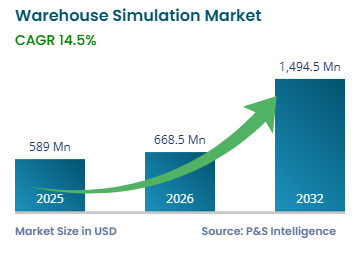
The global warehouse simulation market size is estimated at USD 589.0 million in 2025, which is predicted to reach USD 1494.5 million by 2032, growing at a CAGR of 14.5% during 2026–2032.
The substantial growth of this market is primarily driven by the exponential expansion of e-commerce operations, increasing adoption of warehouse automation technologies, and the critical need for operational optimization in complex supply chain environments to meet evolving consumer demands for faster and more accurate order fulfillment.
The remarkable transformation of global retail through e-commerce has fundamentally reshaped warehouse operations and logistics strategies. U.S. ecommerce sales reached USD 1.192 trillion in 2024, which is more than double what they were five years prior, demonstrating the sustained momentum of digital commerce. This dramatic shift has created unprecedented complexity in warehouse management, as facilities must now handle diverse order profiles ranging from single-item consumer shipments to bulk B2B orders while managing seasonal fluctuations and omnichannel fulfillment requirements. Warehouse simulation software has emerged as an indispensable tool for businesses seeking to model, test, and optimize their operations in a risk-free virtual environment before implementing costly physical changes.
Usage of Digital Twins for Real-Time Warehouse Optimization Is a Key Trend
Digital twin technology creates a virtual replica of a warehouse, enabling real-time monitoring and analysis of operations.
The U.S. Department of Commerce has awarded the University of Central Florida USD 8.8 million to develop a digital twin of NeoCity, a 500-acre technology district in Kissimmee, Florida.
This project aims to enhance supply chain efficiency, improve microchip reliability, and foster cross-disciplinary collaboration.
It allows simulation of various scenarios, such as layout changes, equipment upgrades, or workflow adjustments, before implementing them in the physical warehouse.
According to a study, 52% of warehouse managers anticipate increased spending on automation, signaling a shift toward scalable, long-term solutions that drive economic growth.
Real-time data from sensors, IoT devices, and warehouse management systems feed into the digital twin, providing accurate insights for decision-making.
Companies can identify bottlenecks, optimize inventory placement, and improve labor allocation more efficiently using predictive analytics.
It enhances risk management by simulating potential disruptions and testing mitigation strategies without affecting actual operations.
Integration of AI with digital twins enables continuous learning and automated optimization, leading to higher productivity and reduced operational costs.
The technology supports faster adaptation to market demand fluctuations, ensuring warehouses remain agile and responsive.
E-commerce Growth and Omnichannel Fulfillment Requirements Drive Market Expansion
The rapid growth of e-commerce has increased order volumes, requiring warehouses to operate more efficiently and handle diverse product assortments.
Omnichannel fulfillment, including online, in-store, and curbside pickup, demands flexible warehouse layouts and optimized processes to meet varying delivery timelines.
The Indian government has introduced the NABARD Rural Godown Scheme, which offers subsidies ranging from 20% to 33.33% of the project cost, especially favoring FPOs, co-operatives, and small entrepreneurs.
Warehouse simulation enables businesses to model complex fulfillment workflows and test different strategies without disrupting actual operations.
Companies can identify bottlenecks, optimize inventory placement, and improve order picking and packing efficiency using simulation tools.
Simulation supports labor planning and resource allocation, ensuring warehouses can meet peak demand periods without overstaffing.
By analyzing multiple fulfillment scenarios, businesses can reduce errors, enhance customer satisfaction, and minimize operational costs.
Warehouse Simulation Market Segmentation Analysis
Offering Analysis
The software category dominates the warehouse simulation market in 2025, capturing 75% share, driven by increasing demand for sophisticated simulation and modeling capabilities that can handle complex warehouse operations. The proliferation of cloud-based deployment models and subscription-based pricing has made advanced simulation software accessible to a broader range of organizations, from large enterprises to mid-sized companies. Software solutions encompass discrete event simulation platforms, 3D visualization tools, and integrated analytics capabilities that enable comprehensive warehouse design, testing, and optimization.
The services category is experiencing the faster growth during the forecast period, reflecting the growing complexity of simulation implementations and the need for specialized expertise. As warehouse operations become increasingly sophisticated with automation integration and omnichannel requirements, organizations require professional services for system implementation, customization, and ongoing optimization. Consulting services are particularly in demand as companies seek guidance on simulation methodology, scenario development, and change management strategies to maximize the value of their simulation investments.
The offering categories covered include:
Software (Larger Category)
Simulation & Modeling Software
Integration & Analytics Tools
Visualization & 3D Modeling Solutions
Services (Faster-Growing Category)
Consulting & Implementation Services
Training & Support
Maintenance & Upgrades
Simulation Technology Analysis
The discrete event simulation (DES) category commands the largest market share in 2025, of 45%, as it provides the most effective approach for modeling sequential warehouse operations such as order processing, picking, and shipping. DES technology excels at representing warehouse activities as a series of discrete events occurring at specific points in time, making it ideal for analyzing throughput, identifying bottlenecks, and optimizing resource allocation. The widespread adoption of DES is driven by its proven ability to accurately model complex material flows and provide detailed performance metrics that support data-driven decision-making.
Agent-based simulation (ABS) represents the fastest-growing category through 2032, fueled by the increasing deployment of autonomous systems and the need to model complex interactions between multiple independent entities. ABS technology is particularly valuable for simulating environments with autonomous mobile robots, human workers, and automated systems operating simultaneously, as it can model individual behaviors and emergent system-level patterns. The growing complexity of modern warehouses with multiple automation technologies working in concert drives demand for ABS capabilities that can capture the dynamic interactions and adaptive behaviors of these systems.
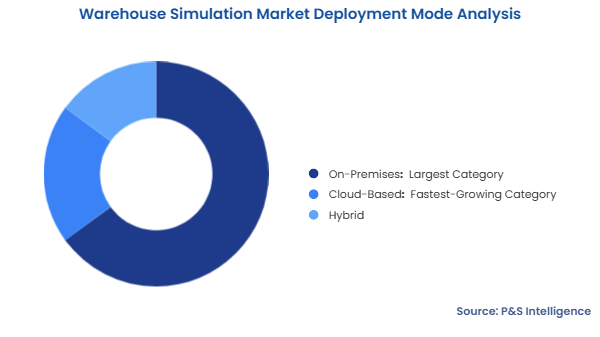
The on-premises category holds the largest market share, of 65%, in 2025, particularly among large enterprises and organizations with stringent data security requirements or complex integration needs with existing warehouse management systems. On-premises solutions offer complete control over data, customization capabilities, and the ability to handle sensitive operational information without external dependencies. The pharmaceuticals, aerospace, and defense industries continue to prefer on-premises deployments due to regulatory compliance requirements and the need for maximum data sovereignty.
Cloud-based deployment is witnessing the highest growth rate during the forecast period, driven by the scalability, accessibility, and cost-effectiveness of software-as-a-service (SaaS) models. Cloud solutions eliminate the need for substantial upfront infrastructure investments and enable real-time collaboration among geographically distributed teams, making them particularly attractive for companies with multiple warehouse locations or those pursuing rapid expansion. The ability to access simulation capabilities from any location, automatic updates, and seamless integration with other cloud-based supply chain applications further accelerates cloud adoption.
Deployment modes covered include:
On-Premises (Larger Category)
Cloud-Based (Faster-Growing Category)
Hybrid
Application Analysis
The warehouse layout & design category holds the largest market share, of 40%, in 2025. This is because optimizing the physical layout of warehouses is a foundational step in enhancing operational efficiency, improving space utilization, and minimizing congestion. Companies, particularly in e-commerce and third-party logistics (3PL) sectors, prioritize simulating spatial configurations, equipment placement, and traffic flow to streamline operations and reduce costs.
Inventory management is witnessing the highest growth rate during the forecast period, as the rise of e-commerce and omnichannel fulfillment has increased the need for real-time inventory tracking and optimization. The integration of technologies such as artificial intelligence, IoT, and digital twins into warehouse simulation tools has significantly improved inventory accuracy, reduced stockouts, and enhanced overall order fulfillment efficiency, driving rapid adoption of simulation solutions in this area.
Applications analyzed include:
Warehouse Layout & Design (Largest Category)
Inventory Management (Fastest-Growing Category)
Order Fulfillment & Distribution
Risk & Safety Analysis
Labor Planning & Optimization
Equipment & Automation Planning
Industry Vertical Analysis
The retail & e-commerce sector dominates the warehouse simulation market in 2025 with a 30% share, driven by the explosive growth of online shopping and the complexity of omnichannel fulfillment operations. Mobile ecommerce accounts for nearly half (44.1%) of the US’s online sales in 2024, representing USD 564.1 billion in order value, creating immense pressure on retailers to optimize their warehouse operations for both speed and accuracy. E-commerce giants and traditional retailers expanding their online presence are leveraging simulation software to design efficient fulfillment centers, optimize inventory placement strategies, and test peak season capacity scenarios.
The automotive industry is witnessing the highest growth rate during the forecast period, utilizing simulation extensively for just-in-time manufacturing support and complex parts distribution management. The automotive sector's intricate supply chains, with thousands of components requiring precise coordination, make simulation essential for optimizing warehouse layouts, testing sequencing strategies, and ensuring timely delivery to production lines. The transition to electric vehicles is adding new complexity with different component requirements and battery handling considerations, further driving simulation adoption.
Industry verticals analyzed include:
Retail & E-commerce (Largest Category)
Automotive (Fastest-Growing Category)
Consumer Electronics
Healthcare & Pharmaceuticals
Food & Beverages
Manufacturing
Third-Party Logistics (3PL)
Others
Organization Size Analysis
Large enterprises dominate the warehouse simulation market in 2025 with 85% share. These organizations often have complex supply chains and multi-location warehouse networks, necessitating advanced simulation tools to optimize operations. They typically have the resources to invest in comprehensive simulation solutions, enabling them to enhance efficiency, reduce costs, and improve scalability across their operations.
The small & medium enterprises (SMEs) category is witnessing the higher growth rate during the forecast period, driven by the need to enhance operational efficiency, reduce costs, and remain competitive, SMEs are increasingly adopting warehouse simulation technologies. The rise of e-commerce and the demand for omnichannel fulfillment have further accelerated this trend, as SMEs seek to optimize their warehouse operations to meet customer expectations and improve service delivery. Additionally, the availability of cloud-based solutions has made these technologies more accessible to SMEs, allowing them to implement simulation tools without significant upfront investment.
Organization sizes analyzed include:
Large Enterprises (Larger Category)
Small & Medium Enterprises (SMEs) (Faster-Growing Category)
Drive strategic growth with comprehensive market analysis
Warehouse Simulation Market Regional Outlook
North America Warehouse Simulation Market Size
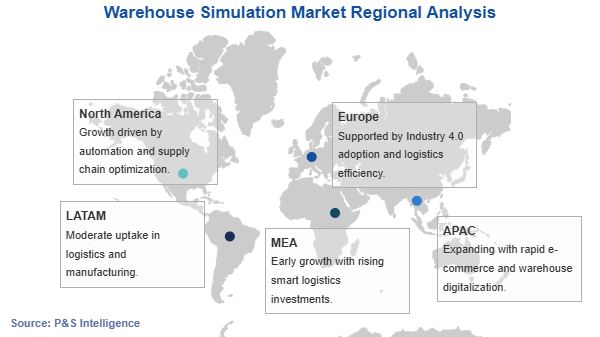
North America holds the largest share of the global warehouse simulation market in 2025, of 40%, due to the region’s advanced adoption of automation technologies, strong presence of leading logistics and technology providers, and the continuous growth of e-commerce and retail sectors. Companies in the U.S. and Canada are heavily investing in warehouse optimization to enhance efficiency, reduce operational costs, and meet the growing demand for fast and accurate order fulfillment.
The region’s early adoption of digital transformation strategies, along with the integration of AI, digital twins, and IoT, drives the use of simulation software for designing, testing, and improving warehouse operations. Additionally, the presence of major market players, robust IT infrastructure, and a high focus on supply chain resilience—particularly after disruptions caused by the COVID-19 pandemic—have accelerated the implementation of warehouse simulation solutions. Supportive government initiatives promoting smart manufacturing and Industry 4.0 practices also contribute to North America’s dominance in the market.
Asia-Pacific Warehouse Simulation Market Growth
Asia-Pacific is projected to be the fastest-growing regional market for warehouse simulation solutions, with a CAGR of approx. 15.0% during 2026–2032, driven by rapid e-commerce expansion, increasing automation adoption, and the region's emergence as a global manufacturing and logistics hub. The region's massive population, rising internet penetration, and growing middle class are fueling unprecedented e-commerce growth that necessitates sophisticated warehouse operations.
The region is witnessing significant investments in warehouse automation and digitalization as companies strive to enhance operational efficiency, reduce labor dependency, and manage growing order volumes. Rising adoption of technologies like AI, IoT, and digital twins in logistics and supply chain operations is also fueling demand for advanced simulation tools.
Moreover, government initiatives supporting smart manufacturing and Industry 4.0 adoption, particularly through the Made in China 2025 and Make in India, are encouraging enterprises to implement simulation-based solutions for better planning and optimization. The increasing presence of global and regional logistics providers, coupled with the expansion of cross-border trade and the proliferation of 3PL (third-party logistics) services, further strengthens APAC’s position as the fastest-growing regional market for warehouse simulation.
The regions and countries analyzed in this report are:
North America (Largest Regional Market)
U.S. (Larger Country Market)
Canada (Faster-Growing Country Market)
Europe
Germany (Largest Country Market)
U.K. (Fastest-Growing Country Market)
France
Italy
Spain
Rest of Europe
Asia-Pacific (Fastest-Growing Regional Market)
Japan
China (Largest Country Market)
India (Fastest-Growing Country Market)
South Korea
Australia
Rest of APAC
Latin America
Brazil (Largest Country Market)
Mexico (Fastest-Growing Country Market)
Rest of LATAM
Middle East and Africa
Saudi Arabia (Largest Country Market)
South Africa
U.A.E. (Fastest-Growing Country Market)
Rest of MEA
Warehouse Simulation Market Share
The global warehouse simulation market exhibits a moderately consolidated structure. The competitive landscape is characterized by a mix of established enterprise software vendors offering comprehensive supply chain suites with embedded simulation capabilities, specialized simulation software providers focusing exclusively on warehouse and logistics applications, and emerging players leveraging cloud-native architectures and AI-powered optimization. The market dynamics reflect intense competition on technological innovation, with vendors continuously enhancing their offerings with advanced features such as digital twin capabilities, machine learning-based optimization, and real-time integration with warehouse management systems.
Market leaders maintain their positions through substantial R&D investments, strategic acquisitions of complementary technologies, and extensive partner ecosystems that ensure broad market reach. The competitive intensity is increasing as new entrants introduce innovative approaches such as AI-driven automatic optimization, no-code simulation platforms, and industry-specific pre-built models that reduce implementation time. Cloud-native startups are disrupting traditional licensing models with flexible subscription-based pricing and rapid deployment capabilities, forcing established players to modernize their offerings. Strategic partnerships between simulation software vendors and warehouse automation providers are becoming increasingly common, as integrated solutions that combine simulation with automation planning and implementation services gain market traction.
Key Warehouse Simulation Companies:
FlexSim Software Products, Inc.
Manhattan Associates
The AnyLogic Company
Rockwell Automation
Siemens
Dassault Syst
Autodesk Inc.
Simio LLC
Lanner
Honeywell International Inc.
ProModel Corporation
Blue Yonder
Oracle
SAP
KUKA
Warehouse Simulation Market News
In March 2025, Honeywell introduced its Warehouse Execution Software (WES) as a cloud-based platform. This advancement enables real-time orchestration of warehouse processes, from picking and routing to order management and capacity planning.
In March 2025, Siemens Digital Industries Software announced it would showcase new digital planning and control tools for logistics and supply chains at Transport Logistic 2025 in Munich. The solutions feature digital twins, control-tower systems, and real-time production–delivery synchronization, highlighting Siemens’ growing focus on warehouse simulation and logistics orchestration.
In March 2025, Rockwell introduced its new digital-twin software capability, Emulate3D Factory Test, at the NVIDIA GTC 2025 event. This tool enables factory-scale virtual controls testing, real-time simulation of automated systems, and stronger digital-twin / simulation capabilities.
Want a report tailored exactly to your business need?
Leading companies across industries trust us to deliver data-driven insights and innovative solutions for their most critical decisions. From data-driven strategies to actionable insights, we empower the decision-makers who shape industries and define the future. From Fortune 500 companies to innovative startups, we are proud to partner with organisations that drive progress in their industries.
Client Testimonials
Working with P&S Intelligence and their team was an absolute pleasure – their awareness of timelines and commitment to value greatly contributed to our project's success. Eagerly anticipating future collaborations.
McKinsey & Company
India
Unmatched Standards
Our insights into the minutest levels of the markets, including the latest trends and competitive landscape, give you all the answers you need to take your business to new heights
Complete Data Security
We take a cautious approach to protecting your personal and confidential information. Trust is the strongest bond that connects us and our clients, and trust we build by complying with all international and domestic data protection and privacy laws