This Report Provides In-Depth Analysis of the Vinyl Ester Market Report Prepared by P&S Intelligence, Segmented by Type (Bisphenol A (DGEBA), Novolac (EPN), Brominated Fire Retardant), Application (Pipes & Tanks, Marine, Wind Energy, FGD & Precipitators, Pulp & Paper), and Geographical Outlook for the Period of 2021 to 2032
Explore the market potential with our data-driven report
Vinyl Ester Market Analysis
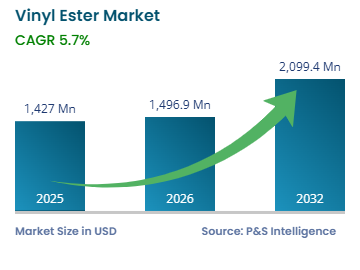
The vinyl ester market size was USD 1,427.0 million for 2025, and it will grow by 5.7% during 2026–2032, to reach USD 2,099.4 million by 2032.
This growth is supported by the expanding installation of flue gas desulfurization systems across coal-fired power plants, chemical processing facilities, and industrial combustion units, positioning vinyl ester resins as critical materials for corrosion-resistant infrastructure applications.
Vinyl ester resins are increasingly deployed in pipes, storage tanks, marine vessels, wind turbine blades, and FGD system components due to their superior chemical resistance, mechanical strength, and low water absorption properties. The material combines the processability of unsaturated polyester resins with the performance characteristics of epoxy systems, enabling applications in highly corrosive environments where traditional materials face accelerated degradation.
According to the U.S. Environmental Protection Agency, wet FGD systems are capable of removing approximately 95% or more of sulfur dioxide from flue gases This drives sustained demand for vinyl ester-based linings and limestone slurry pipes in emission control infrastructure. The European Union’s Industrial Emissions Directive (IED) mandates the application of Best Available Techniques for sulfur removal, further reinforcing demand for vinyl ester resins in FGD absorbers, duct linings, and wastewater handling systems across Europe.
The large-scale infrastructure development further propels market expansion, particularly in applications requiring long-term durability and minimal maintenance. Fiber-reinforced plastic composites utilizing vinyl ester matrices are replacing conventional materials in underground pipelines, wastewater treatment facilities, chemical storage vessels, and offshore structures. The material's resistance to acidic, alkaline, and chloride environments, combined with its ability to withstand thermal cycling and mechanical stress, positions vinyl ester as an essential component in modern industrial infrastructure systems.
The U.S. Environmental Protection Agency reports that the Clean Water State Revolving Fund supports wastewater and stormwater projects with several billion dollars in annual financing, reinforced by more than USD 11 billion allocated under the Infrastructure Investment and Jobs Act.
Vinyl Ester Market Emerging Trends
Infrastructure Lifecycle Extension and Rehabilitation Are Key Trends
In many parts of the world, a significant share of existing infrastructure is aging, with about 30% of global infrastructure assets over 50 years old and over 50% of existing dams worldwide more than 50 years old. Approximately 40% of roads in Europe are in poor or very poor condition, and in the United States, the average age of bridges is over 43 years. Existing infrastructure asset management strategies in developed economies emphasize life extension and performance enhancement over complete replacement.
This creates substantial demand for vinyl ester-based rehabilitation systems across bridges, pipelines, industrial tanks, and marine structures. This approach reduces capital expenditure, minimizes environmental disruption, and extends service life through targeted interventions rather than wholesale reconstruction. Public infrastructure agencies increasingly favor rehabilitation-first strategies as they face aging asset inventories and constrained budgets.
In the United States, transportation and water authorities routinely prioritize repair and lining solutions that extend service life while avoiding prolonged shutdowns, reinforcing demand for corrosion-resistant composite materials such as vinyl ester resins. Private participation in global infrastructure investment reached about USD 100.7 billion in 2024, up from USD 87.1 billion in 2023. The M4 Road Rehabilitation in Zambia covers 61 km under a USD 76.1-million 22‑year concession, with the first 17 km substantially completed by August 2025. Australia’s Regional Rail Revival project has a total estimated cost of USD 4 billion, including USD 2.3 billion from the Commonwealth, with completion targeted around 2024–2025.
In India, the National Mission for Clean Ganga sanctioned 34 new sewerage and wastewater treatment projects worth INR 2,368 crore (USD 284 million) in 2025, while 11 projects with 359 MLD capacity were completed, and the cumulative sanctioned total is 513 projects worth INR 42,019 crore (USD 5 billion). In Delhi, INR 1,471.14 crore (USD 178 million) was allocated for a new elevated corridor and INR 20.2 crore (USD 2.4 million) for repair and rehabilitation of ageing flyovers, with the corridor scheduled for completion by December 2027. In the United Kingdom, a GBP 725 billion (USD 900 billion) 10‑year infrastructure plan includes GBP 1 billion (USD 1.25 billion) for upgrades to roads, bridges, and flyovers, and GBP 6 billion (USD 7.5 billion) annually for hospital repairs and maintenance.
Industrial tank retrofitting addresses storage vessel corrosion in chemical processing, petroleum refining, and water treatment facilities. Rather than replacing entire steel tanks, operators install vinyl ester-based linings that restore containment integrity. This rehabilitation approach gains traction as facility operators balance limited capital budgets against regulatory requirements for leak prevention, creating recurring demand for lining systems across existing industrial infrastructure bases spanning petroleum terminals, chemical distribution centers, and municipal water reservoirs.
In Asia, infrastructure modernization policies under China’s Five-Year Plans and Japan’s national infrastructure maintenance programs emphasize preventive maintenance and life-extension of industrial and municipal assets, reinforcing demand for corrosion-resistant composite materials such as vinyl ester resins in pipes, tanks, and treatment facilities. Moreover, according to the U.S. Environmental Protection Agency (EPA), the drinking water regulations under the Safe Drinking Water Act emphasize infrastructure integrity and corrosion control to prevent contamination, reinforcing demand for corrosion-resistant lining systems in water storage and treatment facilities.
Expanding Wind Energy Infrastructure Drives Market
Offshore wind installations represent a significant growth catalyst for vinyl ester consumption, driven by the material's critical role in turbine blade manufacturing and marine foundation protection systems. The International Energy Agency consistently identifies offshore wind as one of the fastest-growing renewable energy segments globally, with capacity additions accelerating sharply toward 2030 as governments expand clean-energy targets and coastal nations scale large utility-scale projects.
This accelerated deployment creates sustained demand for vinyl ester-based composite materials across multiple turbine components. Wind turbine blades require lightweight, fatigue-resistant materials capable of withstanding decades of cyclic loading, saltwater exposure, and temperature variations, positioning vinyl ester resins as essential materials where mechanical durability and environmental resistance must coexist. Beyond blade manufacturing, offshore foundation structures including monopiles, transition pieces, and jacket platforms require extensive corrosion protection through vinyl ester-lined steel or fiber-reinforced polymer components exposed to submerged marine environments.
In Europe, offshore wind development is reinforced by binding renewable energy targets under the EU Renewable Energy Directive, while environmental permitting under the EU Marine Strategy Framework Directive requires long-term durability of offshore structures to minimize environmental disturbance. In the United States, offshore wind leasing and development overseen by the Bureau of Ocean Energy Management requires design lives typically exceeding 25 years in corrosive marine conditions, favoring high-performance corrosion-resistant materials.
China and Europe continue to dominate global offshore wind deployment, with China maintaining the world’s largest installed offshore wind base and Europe advancing large multi-gigawatt projects in the North Sea and Baltic Sea. This concentration in high-installation regions reinforces large-scale procurement of composite materials for blades, foundations, and corrosion-protection systems.
In mid‑2025, total installed global wind power capacity reached about 1,245 GW, after 72.2 GW of new capacity was added in the first half of the year, and wind power now supplies roughly 12 % of global electricity demand, according to the World Wind Energy Association (WWEA). Global installations for the full year are projected to reach around 150 GW, bringing the world total to over 1,320 GW by year-end 2025, according to the World Wind Energy Association. China added 51.4 GW of wind capacity in the first half of 2025. Europe’s wind capacity stood at 291 GW with 6.8 GW installed in the first half of 2025, and offshore wind capacity reached 83 GW, with 48 GW under construction and 19 GW forecast to be added in 2025, with total sector spending around USD 80 billion, according to GWEC Global Wind Report 2025.
Major projects include the Hornsea Project 3 offshore wind farm in the UK, expected to deliver 2.9 GW by 2027; the Equinor‑Polenergia offshore wind pair in Poland with 1.44 GW capacity and investment of roughly EUR 6.4 billion (USD 7.2 billion), scheduled for 2027–2028; the 412 MW Goyder South Wind Farm in Australia, which has begun operations; and in the UK, contracts were awarded for 8.4 GW of new offshore wind capacity backed by about GBP 22 billion in investment.
As of June 30, 2025, India’s installed wind energy capacity reached about 51.67 GW, with Gujarat leading at 13.816 GW, followed by Tamil Nadu at 11.830 GW and Karnataka at 7.3 GW. During the first nine months of 2025, India added about 4.96 GW of new wind capacity, contributing to a record 34.4 GW of combined solar and wind additions by September 2025. From January to June 2025, India added roughly 3.5 GW of wind capacity, up about 82 % year‑on‑year, raising total renewable capacity to approximately 234 GW, with wind accounting for about 22 % of the mix, as per the IBEF. India’s wind turbine order volumes rose to 8 GW in 2024, with a further 7 GW secured in 2025, and total wind power installations are expected to reach roughly 6.2 GW by end of 2025, making India the third-largest wind market globally.
The Global Wind Energy Council projects India’s wind capacity to reach about 107 GW by 2030 and potentially up to 452 GW by 2050, although only around 4.5 % of its 1,164 GW gross technical potential is currently utilized. Additionally, Indian wind developers Inox Wind and KP Energy announced a joint pact to develop 2.5 GW of wind projects, creating a significant future installation pipeline.
Vinyl Ester Market Segmentation and Category Analysis
Type Analysis
The bisphenol A category holds the largest market share, of 65%, in 2025, driven by established manufacturing infrastructure, broad application compatibility, and favorable cost-to-performance characteristics relative to specialized formulations. This resin type dominates due to its versatile mechanical and chemical resistance properties that satisfy requirements across pipes, tanks, marine vessels, and general corrosion-resistant applications. Additionally, they do not subject customers to premium pricing, which is usually associated with specialty grades.
According to the U.S. Department of Energy National Renewable Energy Laboratory, thermoset resins, including vinyl esters, are extensively used in wind turbine blade manufacturing, with glass and/or carbon fiber composite materials combined with thermoset resin systems representing the dominant blade construction methodology.
The novolac category will have the highest CAGR, of 5.9%, propelled by increasing specifications in severe chemical processing environments, elevated temperature applications, and sectors demanding maximum corrosion resistance exceeding bisphenol A capabilities. This category’s rapid expansion stems from industrial facility upgrades in chemical manufacturing, petroleum refining, and pulp processing operations where aggressive chemical exposure, elevated operating temperatures, or combined environmental stresses mandate superior resistance characteristics.
The types analyzed in this report are:
Bisphenol A (DGEBA) (Largest Category)
Novolac (EPN) (Fastest-Growing Category)
Brominated Fire Retardant
Others
Application Analysis
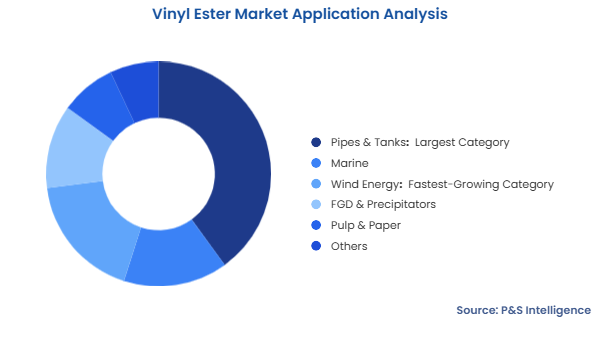
The pipes & tanks category holds the largest market share, of 40%, in 2025. This is because of the extensive adoption of vinyl ester-lined or fiber-reinforced polymer composite piping and storage vessels across water treatment facilities, chemical processing plants, petroleum terminals, and industrial manufacturing operations. This category’s dominance stems from infrastructure replacement cycles, regulatory mandates for corrosion-resistant materials in specific chemical service, and lifecycle cost advantages from extended asset durability compared to traditional metallic construction.
The U.S. Environmental Protection Agency guidance on corrosion control for water distribution systems emphasizes that effective corrosion control treatment and distribution system maintenance reduce corrosion products, lower disinfectant demand, and enable better control of microbial growth, highlighting the critical role of corrosion-resistant materials including vinyl ester linings in protecting water infrastructure quality and system integrity.
The wind energy category will have the highest CAGR. It is driven by accelerating global wind turbine installations, increasing blade lengths requiring high-performance composite matrices, and growing specifications for vinyl ester resins in blade manufacturing processes. This category’s rapid expansion reflects renewable energy capacity targets, offshore wind deployment requiring materials resistant to saltwater environments, and ongoing blade design evolution toward longer, lighter structures demanding advanced resin systems.
The applications analyzed in this report are:
Pipes & Tanks (Largest Category)
Marine
Wind Energy (Fastest-Growing Category)
FGD & Precipitators
Pulp & Paper
Others
Drive strategic growth with comprehensive market analysis
Vinyl Ester Market Regional Outlook
Asia-Pacific Vinyl Ester Market Size
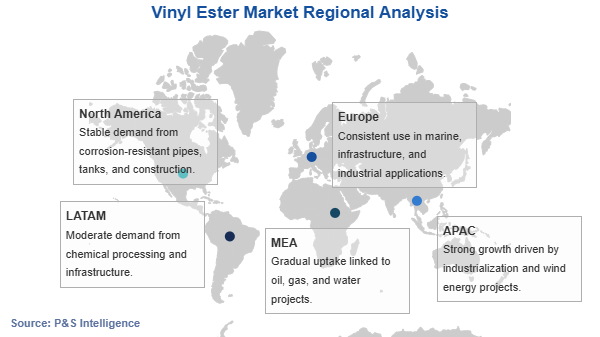
Asia-Pacific holds the largest market share, of 45%, in 2025, and it will have the highest CAGR, of 5.8%, sustained by large-scale infrastructure development, rapid industrialization, and expanding manufacturing capacity across chemical processing, water treatment, marine, and renewable energy sectors. The region's dominance stems from substantial capital deployment in pollution control equipment, underground pipeline networks, and corrosion-resistant storage infrastructure as environmental regulations tighten and industrial output increases. China continues to prioritize large-scale infrastructure and environmental protection spending under national development plans, with sustained investment in transport networks, industrial facilities, and wastewater treatment systems that operate in highly corrosive environments, supporting steady demand for vinyl ester-based pipes, tanks, and linings.
India's Ministry of Finance allocated INR 11.21 lakh crore (USD 128.64 billion) for capital infrastructure investment in the Union Budget 2025–26, representing 3.1% of GDP. A significant portion was directed toward water management, chemical processing, and industrial construction projects. This elevated level of public capital spending supports sustained use of corrosion-resistant composite materials in water supply networks, wastewater treatment facilities, and industrial plants, where vinyl ester resins are favored for durability and lower lifetime maintenance requirements.
China Vinyl Ester Market Size
China represents the largest country within APAC, driven by extensive chemical industry infrastructure, coal-fired power plant modernization, and aggressive environmental compliance mandates requiring FGD system installations. The country's dominance in vinyl ester consumption reflects its position as the world's largest chemical producer and its commitment to reducing sulfur dioxide emissions from industrial facilities. The nation's 14th Five-Year Plan emphasizes green development and pollution reduction, compelling existing and new combustion facilities to install or upgrade emission control systems. This regulatory framework, combined with China's massive industrial base spanning petrochemicals, pulp and paper, metal refining, and power generation, creates sustained demand for vinyl ester-lined equipment, scrubber components, and chemical storage infrastructure capable of withstanding harsh operating environments.
India Vinyl Ester Market Size
India emerges as the fastest-growing country market in APAC, propelled by rapid infrastructure expansion, industrial capacity additions, and increasing environmental awareness driving adoption of pollution control technologies. The country's chemical industry growth, coupled with water infrastructure modernization and marine sector development, positions India as a high-growth market for vinyl ester applications through 2032. The National Infrastructure Pipeline target investments exceeding USD 1.34 trillion by 2025, with substantial allocations toward water supply systems, wastewater treatment facilities, and industrial infrastructure requiring corrosion-resistant materials. India's expanding petrochemical complexes, pharmaceutical manufacturing facilities, and coastal infrastructure projects further accelerate demand for vinyl ester-based pipes, tanks, and protective coatings.
North America Vinyl Ester Market Size
North America maintains substantial market presence, characterized by mature flue gas desulfurization infrastructure, ongoing facility upgrades, and stringent environmental regulations governing industrial emissions. The region's established chemical processing sector, extensive marine industry, and aging infrastructure requiring replacement or rehabilitation support sustained vinyl ester demand across multiple application segments. In the United States, the Infrastructure Investment and Jobs Act commits more than USD 1 trillion toward long-term upgrades of transportation, water, and utility systems, with dedicated funding streams for bridge rehabilitation, drinking water and wastewater infrastructure, and grid resilience. These projects increasingly prioritize materials that extend asset life and reduce maintenance disruptions, supporting adoption of corrosion-resistant vinyl ester composites in pipelines, tanks, and structural rehabilitation applications.
The region's emphasis on asset life extension and reduced lifecycle costs drives adoption of vinyl ester solutions in bridge deck overlays, pipeline rehabilitation, and industrial tank replacements. Environmental compliance requirements enforced by the U.S. Environmental Protection Agency continue to require effective sulfur dioxide control and wastewater management at power and industrial facilities, sustaining replacement and retrofit demand for vinyl ester linings in FGD systems, ductwork, and chemical handling infrastructure.
The regions and countries analyzed the market are as follows:
North America
U.S. (Larger Country Market)
Canada (Faster-Growing Country Market)
Europe
Germany (Largest Country Market)
U.K. (Fastest-Growing Country Market)
France
Italy
Spain
Rest of Europe
Asia-Pacific (Largest and Fastest-Growing Region)
China (Largest Country Market)
India (Fastest-Growing Country Market)
Japan
South Korea
Australia
Rest of Asia-Pacific
Latin America
Brazil (Largest Country Market)
Mexico (Fastest-Growing Country Market)
Rest of Latin America
Middle East & Africa
Saudi Arabia (Largest Country Market)
U.A.E. (Fastest-Growing Country Market)
South Africa
Rest of MEA
Vinyl Ester Market Share Analysis
The market is semi-consolidated, characterized by a mix of established chemical manufacturers with integrated polyester and epoxy capabilities alongside specialized composite resin producers serving niche applications. Market structure reflects the technical complexity of vinyl ester synthesis, which requires both polyester production infrastructure and epoxy chemistry expertise, creating natural barriers that favor companies with diversified resin portfolios and established relationships across end-use industries. This concentration level enables leading producers to influence product development trajectories while maintaining competitive pricing discipline across major application segments.
The competitive landscape reflects ongoing consolidation trends as larger chemical companies acquire specialized vinyl ester producers to broaden product offerings and capture margin across the composite materials value chain. Market participants increasingly differentiate through application-specific product development, technical service capabilities, and sustainability initiatives including bio-based vinyl ester formulations and reduced VOC emissions during processing.
Key Vinyl Ester Market Companies:
AOC (Nippon Paint Holdings Co., Ltd.)
Sino Polymer Co., Ltd.
Ashland Inc.
Changzhou Tianma Group Co., Ltd.
DIC Corporation
Hexion Inc.
Allnex GmbH
Interplastic Corporation
Swancor Ind. Co., Ltd.
Scott Bader Company Ltd.
Polynt-Reichhold Group
Alta Performance Materials (KPS Capital Partners)
Vinyl Ester Market News
In December 2024, KPS Capital Partners agreed to acquire INEOS Composites for USD 1.785 billion, with transaction completion expected in the first half of 2025 subject to regulatory approvals.
In October 2024, Nippon Paint Holdings announced plans to acquire AOC from Lone Star Funds for USD 2.3 billion, pending regulatory approvals with transaction closure anticipated in the first half of 2025. AOC operates 14 manufacturing plants worldwide producing vinyl ester resins and specialty composites with 2023 sales totaling USD 1.5 billion, strengthening Nippon Paint's specialty chemical capabilities and geographic market coverage.
Frequently Asked Questions About This Report
Which applications drive demand in the vinyl ester market?+
The key demand comes from pipes & tanks, marine components, wind energy blades, FGD & orecipitators, and others.
Which region dominates the vinyl ester market?+
Asia-Pacific holds the largest market share.
What factors are driving the growth of the vinyl ester market?+
The growth of the vinyl ester market is primarily driven by increasing demand for corrosion-resistant materials and rising investments in wind energy infrastructure and expanding construction activities.
What are the major challenges in the vinyl ester market?+
The market faces challenges such as volatility in raw material prices, environmental regulations related to styrene emissions, and competition from alternative resins like epoxy and polyester.
Want a report tailored exactly to your business need?
Leading companies across industries trust us to deliver data-driven insights and innovative solutions for their most critical decisions. From data-driven strategies to actionable insights, we empower the decision-makers who shape industries and define the future. From Fortune 500 companies to innovative startups, we are proud to partner with organisations that drive progress in their industries.
Client Testimonials
Working with P&S Intelligence and their team was an absolute pleasure – their awareness of timelines and commitment to value greatly contributed to our project's success. Eagerly anticipating future collaborations.
McKinsey & Company
India
Unmatched Standards
Our insights into the minutest levels of the markets, including the latest trends and competitive landscape, give you all the answers you need to take your business to new heights
Complete Data Security
We take a cautious approach to protecting your personal and confidential information. Trust is the strongest bond that connects us and our clients, and trust we build by complying with all international and domestic data protection and privacy laws