Vietnam Mobile Payment Market Size & Share Analysis - Trends, Drivers, Competitive Landscape, and Forecasts (2026 - 2032)
This Report Provides In-Depth Analysis of the Vietnam Mobile Payment Market Report Prepared by P&S Intelligence, Segmented by Payment Type (Remote, Proximity), Payment Mode (QR Code Payments, NFC/Contactless Payments, Mobile Wallet App Balance Transfers, USSD/SMS Payments), End User (Retail & Consumer Goods, Utilities & Public Services, Transport & Ticketing, Hospitality & Entertainment, Healthcare), Transaction Type (Person-to-Person (P2P), Person-to-Business (P2B), Business-to-Business (B2B)), and Geographical Outlook for the Period of 2021 to 2032
Explore the market potential with our data-driven report
Vietnam Mobile Payment Market Overview
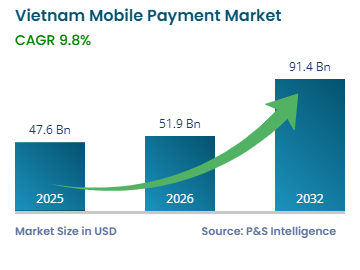
The Vietnamese mobile payment market values USD 47.6 billion in 2025, and it is projected to grow at a CAGR of 9.8% during 2026–2032, reaching USD 91.4 billion by 2032. The market expansion is driven by widespread smartphone penetration, robust government support for digital financial inclusion, and the rapid adoption of cashless transactions across urban and rural areas. Vietnam has emerged as one of the fastest-growing mobile payment markets in Southeast Asia, supported by a young, tech-savvy population and increasing e-commerce activities.
A major trend shaping the Vietnamese mobile payment market size is the explosive growth of QR code-based transactions. According to the State Bank of Vietnam, QR code payments surged by 106.7% in volume and 84.8% in value in 2024, with VietQR standardization unifying merchant acceptance across 2.1 million outlets. E-wallet adoption is driving the cashless economy by offering integrated services including bill payments, peer-to-peer transfers, and retail transactions.
The Vietnamese government's National Digital Transformation Program requires 80% cashless settlement for all public-service fees by 2030, creating sustained demand for mobile payment infrastructure. Vietnam had almost 80 million internet users and over 80 million smartphone users as of early 2025, providing a strong foundation for digital payment adoption. The total value of non-cash transactions reached over VND 295.2 quadrillion in 2024, equivalent to 26 times the country's GDP, underscoring the rapid transformation toward a cashless society. Cross-border QR interoperability with Thailand, Singapore, Cambodia, and Laos further reinforces Vietnam's position as Southeast Asia's payment integration hub.
Vietnam Mobile Payment Market Dynamics
Cashless Payments Are Trending across Vietnam
The Vietnamese government has implemented comprehensive policies to promote a cashless economy, creating favorable conditions for mobile payment expansion.
Decision No. 1813/QD-TTg, issued in October 2021, established the National Strategy on Cashless Payment Promotion for the period 2021–2025, setting ambitious targets to increase non-cash transactions by 20–25% annually.
Decree No. 52/2024/ND-CP, which came into effect in July 2024, updated the legal framework for cashless payments by formally recognizing e-wallets and prepaid cards as legitimate payment instruments.
This regulatory clarity has encouraged innovation among fintech providers and traditional banks alike.
The State Bank of Vietnam has mandated biometric authentication for transactions exceeding 10 million VND since July 2024, enhancing security and promoting digital payments.
According to the State Bank of Vietnam, approximately 86.97% of citizens aged 15 and above now hold bank accounts, demonstrating significant progress in financial inclusion.
The Mobile Money pilot program, extended through 2025, allows customers without bank accounts to make payments using mobile phone subscriptions, particularly benefiting rural communities where traditional banking infrastructure remains limited.
Nearly 10.4 million Mobile Money accounts have been registered, with over 72% held by users in rural, remote, and border areas.
Rising Smartphone and Internet Penetration Drive Market Growth
The widespread penetration of smartphones and internet connectivity serves as a fundamental driver for the Vietnamese mobile payment market growth.
Vietnam's smartphone usage has surged to 84.4%, surpassing the global average of 63%, with the IT and telecommunications sector targeting 100% smartphone penetration.
According to the Ministry of Information and Communications, over 82% of Vietnamese households are now connected to high-speed fiber internet, while mobile internet subscriptions have surpassed 90% of the population.
The affordability of smartphones, combined with low data charges that are approximately half the global average, ensures widespread access to digital payment services across all demographic segments.
The country boasts over 120 million mobile subscriptions, with 100.7 million smartphone users actively engaging with digital services.
Vietnam officially launched its first commercial 5G network in October 2024, with Viettel deploying over 6,500 base stations covering all 63 provinces.
The 4G mobile service network already covered 99.8% of Vietnam's territory, ensuring that rural and remote populations can access mobile payment platforms.
This infrastructure development supports the growing adoption of mobile banking, e-wallets, and QR code payments, as consumers increasingly rely on their smartphones for daily financial transactions.
Vietnam Mobile Payment Market Segmentation Analysis
Payment Type Analysis
The remote category holds the larger share in the Vietnamese mobile payment market in 2025, of 70%, and it is expected to maintain its dominant position throughout the forecast period. This is attributed to the widespread adoption of mobile banking applications, e-wallets, and online payment platforms for e-commerce transactions, bill payments, and peer-to-peer transfers. Remote payments have become integral to daily consumer activities, with the majority being cleared through mobile wallets integrated into super-apps. The convenience of completing financial transactions without physical presence, combined with attractive promotional offers from e-wallet providers, continues to drive preference for remote payment methods.
Proximity payments will witness the higher CAGR during the forecast period, driven by the expanding adoption of NFC-based contactless transactions and in-store QR code payments. The launch of Apple Pay in December 2024, under partnerships with Vietcombank, Techcombank, and VPBank, has accelerated merchant upgrades to NFC readers, particularly in urban retail environments. Public transport operators in Ho Chi Minh City report 70% cashless ridership through tap-to-pay systems, demonstrating the integration of proximity payments into daily commutes. The growing number of contactless payment cards, which reached 10 million by 2023, and the installation of over 741,000 POS/mPOS devices across the country support the infrastructure needed for proximity payment expansion.
These payment types are covered:
Remote (Larger Category)
Proximity (Faster-Growing Category)
Payment Mode Analysis
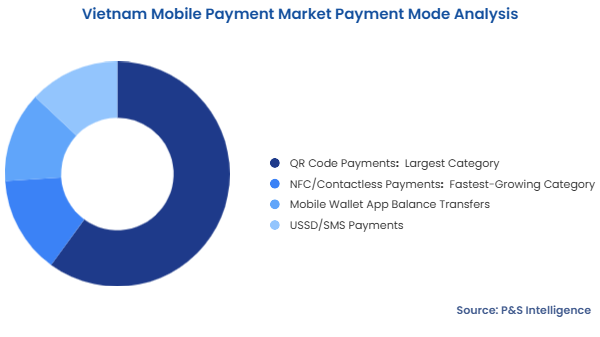
The QR codes category holds the largest share in the Vietnamese mobile payment market in 2025, of 60%, driven by the VietQR standardization that unified disparate payment systems across 2.1 million merchants. The interoperability achieved through VietQR allows consumers to complete transactions using a single QR code regardless of their bank or e-wallet provider, significantly reducing friction in the payment process. VietQR transactions accounted for one-third of NAPAS 247's total transactions in 2024, with over 10 million transactions processed daily during peak periods. The low implementation cost for merchants and the ability to accept payments from any banking app or e-wallet have made QR codes the preferred payment method for small and medium enterprises.
NFC/contactless payments will witness the highest CAGR of 9.9% during the forecast period, supported by Apple Pay's market entry and the growing issuance of contactless-enabled cards. Contactless card usage now accounts for the majority of the Visa transactions in Vietnam, indicating strong consumer acceptance of tap-to-pay functionality. In April 2025, NAPAS partnered with IDEMIA to launch tokenized NFC payments, enabling secure transactions through mobile wallets on both Android devices and Apple Pay. The integration of NFC payments with public transportation systems, including the Ho Chi Minh City metro line, where passengers can use NAPAS cards and international cards for fare payment, demonstrates the expanding use cases for contactless technology.
The retail & consumer goods category holds the largest share in the Vietnamese mobile payment market in 2025, of 45%, driven by the integration of mobile payment acceptance across major retail chains and traditional markets. Retailers including Vinmart, Circle K, and Bach Hoa Xanh have standardized QR and NFC acceptance across 2,800 collective outlets, reducing cash reconciliation requirements and lowering operational costs. Digital payments are penetrating every aspect of Vietnamese life, with consumers using mobile wallets and QR codes for daily purchases ranging from street food to electronics. The convenience of receipt-linked coupons and loyalty programs offered through mobile payment platforms has incentivized retail adoption among both merchants and consumers.
The utilities & public services category will witness the highest CAGR during the forecast period, propelled by mandatory e-payment portals for taxes, electricity bills, and traffic fines. The Vietnamese government's push for 80% cashless settlement of public-service fees by 2030 has created regulatory momentum for mobile payment adoption in this sector. ZaloPay's integration of VNeID verification for in-app government fee payments, launched in March 2025, illustrates the alignment between fintech providers and regulatory requirements. The transport and ticketing segment demonstrates 70% mobile penetration on metro systems, with national rail and intercity buses testing QR boarding passes to further expand cashless transit options.
These end users are covered:
Retail & Consumer Goods (Largest Category)
Utilities & Public Services (Fastest-Growing Category)
Transportation & Ticketing
Hospitality & Entertainment
Healthcare
Others
Transaction Type Analysis
The person-to-person (P2P) category holds the largest share in the Vietnamese mobile payment market in 2025, of 55%, reflecting the widespread use of mobile wallets and banking apps for sending money between individuals. Vietnamese consumers have embraced digital channels for splitting bills, sending gifts, and supporting family members, with mobile banking and e-wallet transfers growing by 39.82% year-on-year. The ability to transfer funds in real-time, 24 hours a day, has made P2P transfers a preferred alternative to traditional cash exchanges.
Person-to-business (P2B) payments will witness the highest CAGR of 10.0% during the forecast period, driven by the expanding merchant acceptance of mobile payments and the growing preference for cashless retail transactions. The integration of mobile payments with e-commerce platforms, food delivery services, and ride-hailing applications has accelerated P2B transaction growth.
Drive strategic growth with comprehensive market analysis
Vietnam Mobile Payment Market Regional Outlook
Southeast Vietnam Mobile Payment Market Size
The Southeast region holds the largest share in the Vietnamese mobile payment market in 2025, of 40%, and is expected to maintain its leadership position throughout the forecast period. This dominance is attributed to the region's high urbanization rate, advanced digital infrastructure, and concentration of economic activity, particularly in Ho Chi Minh City, which serves as the country's commercial hub. The Southeast region benefits from near-universal merchant acceptance of digital payments, with 95% of urban merchants equipped to process mobile transactions. The presence of major fintech headquarters, banking institutions, and e-commerce platforms in the region creates an ecosystem that accelerates innovation in payment technology.
Ho Chi Minh City's metro system reports 70% cashless ridership, demonstrating the successful integration of mobile payments into daily transportation within the Southeast region. The young, tech-savvy demographic of the Southeast, combined with strong foreign direct investment in technology sectors, supports continued growth in mobile payment adoption. The region's e-commerce activity, particularly through platforms like Shopee and TikTok Shop, drives substantial transaction volumes through integrated mobile payment solutions.
Mekong Delta Mobile Payment Market Forecast
The Mekong Delta region is expected to be the fastest-growing market in Vietnam, driven by government initiatives to expand financial inclusion and digital infrastructure to rural areas. The Mobile Money pilot program has demonstrated strong adoption in this region, with 72% of the service's 10.4 million accounts held by users in rural, remote, and border areas. The State Bank of Vietnam's digital literacy programs and telecom rollouts aim to narrow the urban-rural gap in mobile payment adoption, with government-backed fiber projects extending connectivity to underserved communities throughout the Mekong Delta.
Agricultural households in the Mekong Delta represent a significant opportunity for mobile payment providers targeting remittances, agricultural input purchases, and crop sales. According to the State Bank of Vietnam, the expansion of 4G coverage to 99.8% of Vietnam's territory and increasing smartphone affordability are gradually enabling digital payment adoption in agricultural communities. The region's proximity to Cambodia also presents cross-border payment opportunities through the VietQR–LaoQR interoperability system, which allows Vietnamese and Cambodian citizens to make seamless retail payments across borders using QR codes with real-time currency conversion.
These regions are covered:
Southeast (Largest Regional Market)
Red River Delta
Mekong Delta (Fastest-Growing Regional Market)
South Central Coast
Rest of Vietnam
Vietnam Mobile Payment Market Share
The Vietnamese mobile payment market is moderately fragmented and characterized by intense competition among domestic e-wallet providers, traditional banks, and international payment networks. No single player has a major transaction value share, maintaining pricing pressure and spurring continuous innovation in ancillary services. The presence of over 40 active e-wallet platforms, combined with the digital transformation efforts of commercial banks, creates a dynamic competitive environment where providers differentiate through user experience, merchant networks, and integrated financial services.
Competitive strategies focus on expanding payment ecosystems, enhancing security features, and forming partnerships with banks, merchants, and technology providers to capture market share in the rapidly growing digital payment landscape. International players have entered the market through strategic partnerships, creating cross-selling opportunities in data bundles, micro-insurance, and consumer loans, blurring the boundaries between payment providers and financial service institutions.
Key Vietnam Mobile Payment Companies:
M_Service Joint Stock Company (MoMo)
ZION Joint Stock Company (ZaloPay)
VNPAY Joint Stock Company
Viettel Digital Services Corporation (ViettelPay)
Grab Holdings Inc. (GrabPay)
ShopeePay Vietnam
National Payment Corporation of Vietnam (NAPAS)
VietUnion Online Services Corporation (Payoo)
Joint Stock Commercial Bank for Foreign Trade of Vietnam (Vietcombank)
Vietnam Technological and Commercial Joint Stock Bank (Techcombank)
Vietnam Mobile Payment Market News
In April 2025, NAPAS partnered with IDEMIA to launch tokenized NFC payments in Vietnam, enabling secure contactless transactions through mobile wallets on Android devices and Apple Pay, marking a significant advancement in proximity payment technology.
In March 2025, ZaloPay integrated VNeID verification for in-app government fee payments, allowing users to complete tax, licensing, and welfare disbursement transactions through the e-wallet platform while meeting regulatory compliance requirements.
In February 2025, VPBank partnered with MobiFone to integrate banking services for 32 million mobile subscribers, creating cross-selling opportunities in data bundles, micro-insurance, and consumer loans through the telecommunications network.
In January 2025, State Bank of Vietnam and the central bank of Laos launched a bilateral retail payment service using QR codes, enabling Vietnamese customers to pay at merchants in Laos by scanning LaoQR codes with real-time currency conversion.
In January 2025, State Bank of Vietnam extended the Mobile Money pilot program through 2025, allowing customers without bank accounts to make payments using mobile phone subscriptions, benefiting rural communities with limited banking infrastructure.
In December 2024, Apple Pay launched in Vietnam through partnerships with Vietcombank, Techcombank, and VPBank, accelerating NFC payment adoption among premium users and prompting merchant upgrades to contactless readers.
In May 2024, Visa announced strategic partnerships with MoMo, VNPay, and ZaloPay to enhance payment experiences for Visa cardholders at small and medium enterprises, extending card tokenization into wallet applications.
Frequently Asked Questions About This Report
What is the market size of the Vietnam mobile payment market?+
The Vietnam mobile payment market was valued at USD 47.6 billion in 2025.
What are the key drivers of mobile payment adoption in Vietnam?+
Key drivers include rising e-commerce activity, QR-code payments, government cashless initiatives, and high internet penetration.
Which mobile payment methods are most used in Vietnam?+
QR-code payments and digital wallets are the most widely used mobile payment methods in Vietnam.
Who are the major players in the Vietnam mobile payment market?+
The market is dominated by domestic digital wallets, banks, and fintech platforms.
What are the main challenges in the Vietnam mobile payment market?+
Key challenges include cybersecurity risks, regulatory compliance, and user trust in digital transactions.
What is the Vietnam digital payment market nature?+
The mobile payment market in Vietnam is moderately fragmented.
Want a report tailored exactly to your business need?
Leading companies across industries trust us to deliver data-driven insights and innovative solutions for their most critical decisions. From data-driven strategies to actionable insights, we empower the decision-makers who shape industries and define the future. From Fortune 500 companies to innovative startups, we are proud to partner with organisations that drive progress in their industries.
Client Testimonials
Working with P&S Intelligence and their team was an absolute pleasure – their awareness of timelines and commitment to value greatly contributed to our project's success. Eagerly anticipating future collaborations.
McKinsey & Company
India
Unmatched Standards
Our insights into the minutest levels of the markets, including the latest trends and competitive landscape, give you all the answers you need to take your business to new heights
Complete Data Security
We take a cautious approach to protecting your personal and confidential information. Trust is the strongest bond that connects us and our clients, and trust we build by complying with all international and domestic data protection and privacy laws