Vietnam Data Center Market Size & Share Analysis - Emerging Trends, Growth Opportunities, Competitive Landscape, and Forecasts (2026 - 2032)
This Report Provides In-Depth Analysis of the Vietnam Data Center Market Report Prepared by P&S Intelligence, Segmented by Type (Colocation, Cloud/Hyperscale, Enterprise, Edge, Modular, Hybrid), Infrastructure (IT infrastructure, Electrical infrastructure, Mechanical infrastructure, General construction, Support Infrastructure), End User (BFSI, Government & Defense, Energy & Utilities, IT & Telecom, Retail & E-commerce, Education, Healthcare, Entertainment & Media), and Geographical Outlook for the Period of 2021 to 2032
Explore the market potential with our data-driven report
Vietnam Data Center Market Analysis
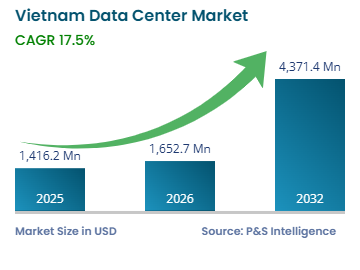
The Vietnam data center market values USD 1,416.2 million in 2025, and it is projected to grow at a CAGR of 17.5% during 2026–2032, to reach USD 4,371.4 million by 2032. The country is experiencing an unprecedented surge in data center investments, driven by rapid digital transformation, favorable regulatory reforms, and surging demand for cloud computing and artificial intelligence infrastructure. Vietnam has emerged as Southeast Asia's newest digital hub, attracting substantial investments from both domestic telecommunications giants and international technology corporations seeking to establish data sovereignty footprints in the region.
A primary driver fueling the Vietnamese data center market growth is the country's accelerating digital economy expansion. According to the Ministry of Information and Communications, Vietnam's digital economy grew at approximately 20% in 2024, contributing 18.3% to GDP. This digital expansion necessitates robust data infrastructure to support cloud platforms, content delivery networks, and enterprise applications.
Vietnam Data Center Market Trends & Drivers
Hyperscale Data Center Investments Are Main Trends in Market
The Vietnamese data center market is witnessing unprecedented hyperscale investment activity, marking a structural shift from traditional colocation facilities to large-scale, AI-optimized infrastructure.
In April 2025, Viettel commenced construction on Vietnam's first hyperscale data center in Ho Chi Minh City's Tan Phu Trung Industrial Park, featuring 140 MW capacity and 10,000 racks.
In July 2025, CMC Corporation received the approval for a USD 250-million hyperscale project in Saigon Hi-Tech Park with an initial 30-MW capacity, expandable to 120 MW.
In July 2025, a consortium comprising UAE-based G42, Microsoft, FPT, and VinaCapital proposed a USD 2-billion hyperscale data center dedicated to AI development in Ho Chi Minh City.
According to the Vietnam Ministry of Science and Technology, Vietnam hosted 41 active data centers with a total power capacity of 221 MW as of August 2025, with upcoming capacity projected to reach nearly 1,000 MW by 2030.
The hyperscale model is gaining massive investments as cloud majors, AI laboratories, and social media platforms rush to establish sovereign zones compliant with data localization requirements.
New hyperscale facilities are designed with average rack densities of 10 kW, with AI-optimized racks supporting up to 60 kW to accommodate the computating demands of large-scale machine learning models.
Digital Transformation and Cloud Adoption Are Driving Market Expansion
The rapid pace of digital transformation across Vietnamese enterprises serves as a fundamental driver for the Vietnamese data center market size expansion.
Vietnam had 78.44 million internet users at the start of 2024, representing 79.1% penetration, with 72.70 million active social media users.
Major Vietnamese conglomerates, including Vingroup, have migrated SAP systems, including supply chain management and enterprise resource planning, to cloud platforms.
The government's National Digital Transformation Program targets expanding the digital economy to contribute over 20% of GDP by 2025.
Financial institutions are digitalizing rapidly, with AI-based risk and compliance workloads demanding secure, high-performance infrastructure.
The State Bank of Vietnam's fintech regulatory sandbox became effective in February 2025, opening controlled pilots for AI credit scoring and open banking APIs.
These converging requirements translate into long-term multi-tenant demand that bolsters revenue visibility for colocation operators and propels wholesale capacity pre-sales to hyperscale anchors.
Regulatory Reforms and Data Sovereignty Requirements Present Growth Opportunities
Vietnam's data sovereignty framework obliges enterprises to store personal data within national borders, creating substantial opportunities for local data center development.
The 2025 Data Law extends restrictions on cross-border transfers, forcing multinational cloud providers to establish local footprints.
These rules drive demand for certified Tier 3 facilities capable of meeting security audits and uptime guarantees.
The National Data Center program reinforces compliance pressure by prioritizing domestic technologies, with the official operation of the National Data Centre from August 2025 carrying strategic significance for government cloud services.
The removal of foreign ownership caps represents a landmark regulatory change attracting hyperscale foreign direct investment.
The policy shift, effective July 2024, turned Vietnam into an attractive alternative to costlier Singapore and Hong Kong locations.
Sweeping reforms effective from July 2025 include simplified processes for data centers and cloud providers, provincial-level licensing for faster local deployment, and a fully digitalized procedure framework.
Tax incentives effective October 2025 further enhance market attractiveness for international investors.
The Digital Telecommunications Law, effective July 2024, abolished foreign ownership caps, allowing international investors to fully own and operate data center facilities.
This policy shift, combined with the Personal Data Protection Law ratified in June 2025 mandating local data storage, has triggered a wave of hyperscale investments.
The government's target of achieving 80% online administrative procedures by the end of 2025 and deploying 10 additional submarine cable routes by 2030 further strengthens Vietnam's position as a regional connectivity hub.
Vietnam Data Center Market Segmentation Analysis
Type Analysis
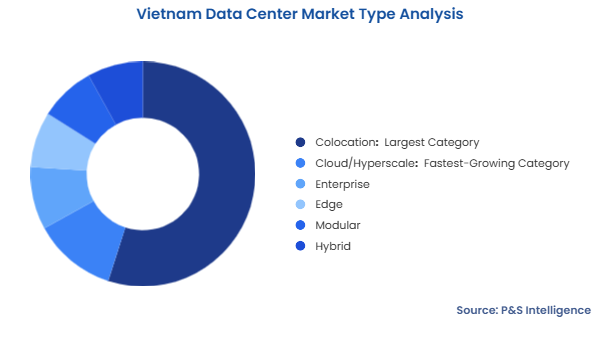
The colocation category holds the largest share, of 55%. This is attributed to Vietnamese enterprises preferring asset-light strategies that minimize capital expenditure while providing scalable, flexible infrastructure solutions. Domestic telecommunications incumbents, including Viettel, VNPT, and FPT, have monetized spare capacity to serve enterprise clients across banking, telecom, and public sector verticals requiring 99.982% availability specifications.
The cloud/hyperscale category is projected to witness the highest CAGR, of 17.6%, during 2026–2032, driven by massive investments from global cloud providers establishing sovereign zones and domestic operators expanding wholesale capacity. Viettel's 140-MW AI-optimized campus represents Vietnam's transition toward hyperscale architecture. Enterprise data centers continue serving organizations requiring dedicated infrastructure control, while edge facilities are multiplying to support 5G backhaul and latency-sensitive IoT applications. Modular and hybrid deployments enable operators to align capacity with demand curves while minimizing oversupply risks.
These data center types are covered:
Colocation (Largest Category)
Cloud/Hyperscale (Fastest-Growing Category)
Enterprise
Edge
Modular
Hybrid
Infrastructure Analysis
IT infrastructure holds the largest share, of 45%, driven by accelerating server deployments and storage system expansions. IT infrastructure receives the most investment and sales revenue in data centres because it directly enables computing, storage, and networking—the core services customers pay for. Rising demand from cloud computing, AI workloads, big data analytics, and digital transformation drives continuous upgrades of servers, GPUs, storage systems, and high-speed networks. Unlike power or cooling, IT infrastructure scales with workload growth, refresh cycles are shorter, and revenue is closely tied to capacity expansion and performance differentiation.
Mechanical infrastructure is expected to register the fastest growth during the forecast period, driven by increasing demand for advanced cooling systems to support high-density AI workloads. New hyperscale facilities require specialized cooling solutions, including liquid cooling and free-air systems, to improve power usage effectiveness. Viettel's Hoa Lac Data Center achieved a PUE below 1.4 through AI-assisted cooling technology. Electrical infrastructure investments continue expanding with UPS systems, generators, and PDUs critical for ensuring continuous operations across Tier 3 and Tier 4 facilities.
Data Center Infrastructure Management/Building Management System (DCIM/BMS) Solutions
Support Infrastructure
End User Analysis
The IT & telecom category holds the largest share, of 40%, as domestic carriers, including Viettel, VNPT, and FPT, continue onboarding internal network, CDN, and cloud workloads. Telecommunications operators are expanding data center capacity to support commercial 5G services, with Viettel's network already blanketing core districts and serving 4 million subscribers across 6,500 base stations. The IT sector's reliance on data centers intensifies as demand for fast, seamless connectivity grows alongside cloud computing adoption.
The BFSI category is forecast to register the highest CAGR, of 17.7%, during 2026–2032, driven by open-banking APIs, AI-driven fraud analytics, and electronic Know Your Customer regulations that multiply computational intensity per transaction. Financial institutions are rapidly digitalizing with mandatory stress testing, real-time settlement, and ISO 27001 audits, pushing banks toward Tier 3 colocation suites with dedicated cages and multi-factor physical security. Government and defense verticals are also experiencing accelerated growth as national database integration requires sovereign cloud hosting capabilities.
These end users are covered:
IT & Telecom (Largest Category)
BFSI (Fastest-Growing Category)
Government & Defense
Energy & Utilities
Retail & E-commerce
Education
Healthcare
Entertainment & Media
Others
Drive strategic growth with comprehensive market analysis
Vietnam Data Center Market Regional Growth Dynamics
Ho Chi Minh City Data Center Market Value
Ho Chi Minh City holds the largest share, of 45%, and it is expected to maintain its dominant position throughout the forecast period. The southern economic hub benefits from multiple submarine cable landings, including AAE-1 and APG, vibrant foreign-invested manufacturing, and proximity to the Mekong industrial corridor. The city hosts 21 operational data centers with substantial upcoming capacity from projects, including Viettel's 140-MW hyperscale facility in Tan Phu Trung Industrial Park and CMC's USD 250-million hyperscale center in Saigon Hi-Tech Park.
The city hosts the majority of e-commerce businesses in Vietnam, driving substantial demand for data center services. Wholesale campuses benefit from 25+ MW blocks, direct access to multiple submarine cables, and colocation demand from regional OTT players seeking low-latency routes into Indochina. Land pricing within Saigon High-Tech Park remains competitive, with solar-rich southern hinterland supporting renewable energy initiatives. Leasing velocity stays strong despite rising land costs, indicating a durable appetite among cloud, gaming, and AI firms seeking to establish regional footprints.
Hanoi Data Center Market Forecast
Hanoi is projected to register the highest CAGR, during 2026–2032, driven by national database hosting requirements and e-government rollouts mandating capital-region data residency for sensitive workloads. The capital city holds approximately 40% market share with 15 operational data centers and is fast narrowing the gap with Ho Chi Minh City as ministries require in-situ hosting for 116 national databases under Resolution 214/NQ-CP. VNPT opened its eighth data center, spanning 23,000 square meters, in Hanoi's Hoa Lac Hi-Tech Park, featuring Tier III Uptime certification and 2,000 racks.
Power reliability in the capital is buttressed by hydroelectric generation and 500-kV backbone upgrades, supporting multi-tenant facilities up to 30 MW per hall. Government-led digitalization initiatives centered in Hanoi necessitate advanced data center facilities. Skill-pool depth around universities, including Vietnam National University, affords operators a steady technical workforce, easing constraints that often plague secondary markets. Proximity to central ministries catalyzes public-sector digitization and houses national champions such as Viettel Solutions.
These provinces are covered:
Ho Chi Minh City (Largest Market)
Hanoi (Fastest-Growing Market)
Da Nang
Binh Duong
Rest of Vietnam
Vietnam Data Center Market Competitive Landscape
The Vietnamese data center market is moderately fragmented, as different players hold expertise in different aspects of such facilities. Domestic telecommunications leverage state-backed fiber backbones and large land banks to maintain competitive advantages. The liberalization of foreign ownership rules effective July 2024 is redrawing the competitive landscape, with international players bringing global standards and substantial capital investments. Strategy centers on vertical differentiation rather than undifferentiated colocation racks. Moreover, international joint ventures signal collaborative market entry strategies.
The market is witnessing increasing competition from new entrants. Operators that combine central-campus scale with regional edge footprints and offer managed compliance services are positioned to capture the next wave of demand as the Vietnamese data center market evolves into a multi-layered ecosystem.
Key Vietnam Data Center Companies:
Viettel IDC
Vietnam Posts and Telecommunications Group (VNPT)
FPT Telecom
CMC Telecom
VNG Cloud
Telehouse (KDDI Corporation)
NTT Global Data Centers
ST Telemedia Global Data Centres
DTS Communication
HTC Telecom International (ECODC)
Vietnam Data Center Market News
In August 2025, FPT Corporation inaugurated the Fornix HCM02 Data Center in Ho Chi Minh City's High-Tech Park, featuring a 10,000-square-meter LEED-certified facility supporting 3,600 racks.
In August 2025, LG CNS announced plans to develop a hyperscale AI data center in collaboration with VNPT and Korea Investment Real Asset Management, targeting Vietnam's digital transformation needs.
In August 2025, IPTP Networks from Cyprus announced a phased USD 200-million AI data center project in Da Nang with construction commencing in Q4 2025, featuring an initial 10-MW capacity, in collaboration with DeCenter AI.
In April 2025, Viettel commenced construction on Vietnam's first hyperscale data center in Tan Phu Trung Industrial Park, Ho Chi Minh City, targeting 140-MW capacity across 10,000 racks, to support AI, 5G, and cloud computing platforms.
In March 2025, Saigon Asset Management announced plans to build a 150 MW data center in Binh Duong Province with a targeted investment of USD 1.5 billion.
In December 2024, CMC Global signed a USD 10-billion data center deal with Samsung C&T Corporation to develop a data center in Ho Chi Minh City.
In July 2024, CMC Corporation established CMC AI Digital Infrastructure (CMC ADI), a subsidiary specializing in hyperscale data center investment and operations, with an initial capital of USD 12.5 million.
Frequently Asked Questions About This Report
Want a report tailored exactly to your business need?
Leading companies across industries trust us to deliver data-driven insights and innovative solutions for their most critical decisions. From data-driven strategies to actionable insights, we empower the decision-makers who shape industries and define the future. From Fortune 500 companies to innovative startups, we are proud to partner with organisations that drive progress in their industries.
Client Testimonials
Working with P&S Intelligence and their team was an absolute pleasure – their awareness of timelines and commitment to value greatly contributed to our project's success. Eagerly anticipating future collaborations.
McKinsey & Company
India
Unmatched Standards
Our insights into the minutest levels of the markets, including the latest trends and competitive landscape, give you all the answers you need to take your business to new heights
Complete Data Security
We take a cautious approach to protecting your personal and confidential information. Trust is the strongest bond that connects us and our clients, and trust we build by complying with all international and domestic data protection and privacy laws