This Report Provides In-Depth Analysis of the Vietnam Cybersecurity Market Report Prepared by P&S Intelligence, Segmented by Component (Solutions, Services), Security Type (Application, Network, Endpoint, Cloud, Enterprise), Deployment (On-Premises, Cloud), Enterprise (Large Enterprises, Small and Medium Enterprises (SMEs)), Use Case (Security Monitoring, Network Traffic Analysis, Threat Hunting, Incident Response, Data Exfiltration), Industry (Aerospace & Defense, Government, Banking Financial Services and Insurance, Healthcare, Retail, Information Technology (IT) & Telecom, Manufacturing), and Geographical Outlook for the Period of 2021 to 2032
Explore the market potential with our data-driven report
Vietnam Cybersecurity Market Overview
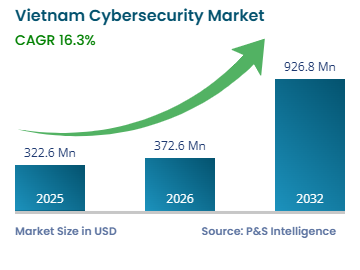
The Vietnamese cybersecurity market values USD 322.6 million in 2025, and it is projected to reach USD 926.8 million by 2032, growing at a CAGR of 16.3% during 2026–2032. The market is driven by escalating cyber threats, stringent data localization regulations, and accelerating digital transformation across government and private sectors. According to the National Cybersecurity Association, approximately 659,000 cyberattacks targeted Vietnamese organizations in 2024, impacting around 46.15% of government agencies and businesses. This alarming surge in cyber incidents, combined with sophisticated attack vectors, including ransomware and advanced persistent threats, is compelling organizations to invest heavily in comprehensive security solutions.
The Vietnamese government's digital transformation agenda is creating unprecedented opportunities for cybersecurity vendors. Vietnam's digital economy grew by over 20% in 2024, accounting for more than 18% of GDP. The government's ambitious goal to rank among the global top 50 in e-government by 2028 requires robust cybersecurity infrastructure. Mandatory biometric authentication for banking transactions, implemented in July 2024, has already reduced fraudulent transactions by 50%, demonstrating the effectiveness of technology-driven security measures. Furthermore, data localization requirements under Decree 53/2022 and Personal Data Protection Decree 13/2023 are driving domestic and foreign enterprises to strengthen their cybersecurity posture to ensure compliance and protect sensitive information.
Vietnam Cybersecurity Market Trends & Drivers
Regulatory Mandates and Data Localization Requirements Are Trending
Vietnam's evolving regulatory landscape is fundamentally reshaping cybersecurity investment priorities across all sectors.
Decree 53/2022 and Personal Data Protection Decree 13/2023 mandate data localization, requiring organizations to store and process personal data within Vietnamese territory.
These regulations compel both domestic and multinational enterprises to establish local data centers with robust security controls, driving demand for encryption, access management, and data loss prevention solutions.
The State Bank of Vietnam implemented Decision No. 2345/QSS-NHNN in July 2024, requiring biometric authentication for high-risk banking transactions exceeding VND 10 million.
This requirement expanded in 2025 to include corporate accounts, with legal representatives mandated to register biometric data by July 1, 2025.
Non-compliant institutions risk service suspensions, creating immediate demand for identity and access management solutions.
As of May 2025, over 55% of corporate accounts completed biometric verification, while banks completed verification for more than 108 million individual customer records.
The New Telecommunications Law extends regulatory scope to cloud computing, data centers, and over-the-top services, establishing stricter data protection rules that further elevate cybersecurity requirements across the digital services ecosystem.
Escalating Cyber Threats Are Driving Market Expansion
The frequency and sophistication of cyberattacks in Vietnam have reached critical levels, creating an urgent demand for advanced cybersecurity solutions.
The Ministry of Public Security reported that critical units alone received over 74,000 cyberattack alerts in 2024, including 83 targeted advanced persistent threat campaigns.
The most-prevalent attacks include APT attacks using spyware malware, accounting for over a quarter of the incidents, and ransomware attacks, which affected nearly 15% of the surveyed organizations.
Major businesses, such as VNDirect, PVOIL, and Vietnam Post, suffered serious cyberattacks, demonstrating that no sector is immune to cyber threats.
Data revealed that in the first six months of 2025, more than 8.5 million user accounts were stolen, accompanied by nearly 530,000 distributed denial-of-service attacks and 191 data breaches involving over 3 billion records.
This represents a threefold increase compared to 2024.
The emergence of AI-driven attacks, including hyper-personalized phishing emails, deepfake impersonations, and self-morphing malware, is challenging conventional defense systems and pushing organizations to adopt next-generation security technologies.
The solutions category holds the larger share, of 70%, due to organizations’ prioritization of comprehensive security infrastructure deployment to address the expanding threat landscape. According to the National Cybersecurity Association, 85.11% of organizations have installed antivirus software for computers and servers, while 75.68% have adopted firewall solutions.
The increasing adoption of multiple security layers, including intrusion detection systems, encryption tools, and unified threat management platforms, drives sustained demand for integrated security solutions. Data localization requirements under Decree 53/2022 necessitate on-premises and private cloud security architectures, while the threat diversity facing Vietnamese organizations requires multi-layered defense mechanisms.
Services will witness the higher CAGR of 16.7% during the forecast period, driven by acute cybersecurity talent shortages and the complexity of managing modern security architectures. Vietnam faces a projected shortage of 700,000 cybersecurity professionals through 2028, making managed security services increasingly attractive. Organizations operating 24/7 security operations centers require at least 8–10 dedicated staff for three-shift coverage. Managed services provide access to specialized expertise, continuous monitoring capabilities, and rapid incident response without the burden of recruiting and retaining scarce cybersecurity talent, making this category the fastest-growing segment.
These product types are covered:
Solutions (Larger Category)
Risk and compliance management
Identity and access management (IAM)
Firewall
Security and vulnerability management (SVM)
Encryption
Intrusion detection system/intrusion prevention system (IDS/IPS)
Unified threat management (UTM)
Distributed Denial of Service (DDoS) attack
Antivirus
Data loss prevention (DLP)
Others
Services (Faster-Growing Category)
Managed
Design and integration
Risk and threat management
Support and maintenance
Consulting
Training and education
Professional
Security Type Analysis
Network security holds the larger share, of 30%, reflecting the critical importance of protecting network infrastructure against the surge in cyberattacks. Vietnam's rapid expansion of digital connectivity, with most households using fiber optic internet, has created vast attack surfaces requiring robust network defenses. The prevalence of distributed denial-of-service attacks, with nearly 530,000 incidents recorded in the first half of 2025, necessitates sophisticated network-level protection mechanisms.
Organizations deploy firewalls, intrusion prevention systems, and network segmentation tools to create defense-in-depth architectures. The Ministry of Public Security uncovered more than 20 million cyberattack alerts in the first quarter of 2024, with network systems of many agencies and enterprises attacked, data stolen, and management rights usurped. This persistent targeting of network infrastructure drives continuous investment in network security solutions across the government and commercial sectors.
Cloud security is expected to witness the highest CAGR of 16.6% during 2026–2032, propelled by accelerating cloud adoption and data localization mandates driving private and hybrid cloud deployments. Cloud-native threats, including misconfiguration vulnerabilities, insecure APIs, and container security risks, require specialized security and workload protection platforms. The shift toward multi-cloud and hybrid architectures necessitates unified security orchestration across cloud, edge, and on-premises environments, for regulatory compliance and operational efficiency.
These security types are covered:
Application
Network (Larger Category)
Endpoint
Cloud (Fastest-Growing Category)
Enterprise
Others
Deployment Analysis
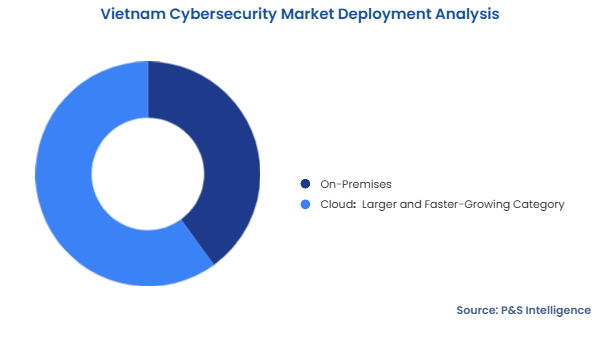
Cloud deployment holds the larger share, of 60%, and it has the higher CAGR, driven by accelerating digital transformation and the need for scalable, flexible security architectures. Vietnamese organizations increasingly recognize cloud-deployed security solutions offer rapid deployment, automatic updates, and reduced capital expenditure compared to traditional on-premises infrastructure. The Vietnamese government's push toward digital services requires elastic security infrastructure, which cloud deployments provide. SMEs particularly favor cloud-based security solutions, as they lack resources for extensive on-premises security infrastructure.
Major cloud service providers have established significant local presence, with data centers complying with data localization requirements. These facilities enable organizations to leverage cloud security benefits while meeting regulatory mandates for in-country data residency. The National Cybersecurity Association reported that organizations implementing cloud-deployed security solutions achieve faster threat detection and response times through automated security orchestration and centralized management capabilities.
These deployment modes are covered:
On-Premises
Cloud (Larger and Faster-Growing Category)
Enterprise Size Analysis
Large enterprises hold the larger share, of 65%, reflecting their greater cybersecurity budgets, complex security requirements, and regulatory compliance obligations. Major corporations and government agencies face sophisticated attacks, prompting the deployment of comprehensive security architectures spanning network perimeter defenses, endpoint protection, cloud security, and security operations centers with dedicated staff.
The banking sector invests heavily in identity and access management, fraud detection, and compliance solutions. State-owned enterprises operate extensive IT infrastructure requiring enterprise-grade security platforms. Large enterprises typically allocate 10% or more of IT budgets to cybersecurity, enabling procurement of integrated security suites, managed services contracts, and specialized consulting engagements. Their scale and resources allow the deployment of advanced technologies, including artificial intelligence-powered threat detection, security information and event management systems, and 24/7 security operations centers.
Small and medium enterprises will witness the higher CAGR of 16.5% during the forecast period, driven by accelerating digitalization and increasing cyber threat targeting of under-protected SME networks. Over 20% of organizations, mostly SMEs, have provided no cybersecurity awareness training to employees. Cybercriminals target SMEs as easier entry points into supply chains and business ecosystems. The Vietnamese government's digital transformation initiatives encourage SMEs to adopt digital platforms, e-commerce solutions, and online payment systems, expanding their attack surfaces.
These enterprise sizes are covered:
Large Enterprises (Larger Category)
Small and Medium Enterprises (SMEs) (Faster-Growing Category)
Use Case Analysis
Security monitoring holds the largest share, of 30%, reflecting the fundamental importance of continuous visibility into security events and potential threats. Security monitoring solutions aggregate and analyze logs from networks, endpoints, applications, and cloud environments to identify anomalous behavior indicative of security incidents. The prevalence of advanced persistent threats, comprising 26.14% of incidents and often remaining undetected for extended periods, necessitates sophisticated monitoring capabilities that establish behavioral baselines and detect subtle deviations.
Organizations are increasingly relying on security information and event management platforms for centralized monitoring, correlation, and alerting. Organizations are exploring centralized SOC solutions, driving the demand for security monitoring platforms for continuous threat surveillance, compliance monitoring, and incident detection across hybrid IT environments.
Incident response is expected to witness the highest CAGR during 2026–2032, propelled by the escalating frequency and severity of cyberattacks requiring rapid containment and remediation capabilities. AI-driven attacks, including self-morphing malware and deepfake impersonation, demand advanced incident response capabilities combining human expertise with automated response orchestration. Ransomware attacks require immediate incident response to minimize operational disruption and prevent data encryption or exfiltration. Organizations now recognize that detection alone is insufficient without corresponding response capabilities to isolate threats, contain breaches, and restore normal operations.
These use cases are covered:
Security Monitoring (Larger Category)
Network Traffic Analysis
Threat Hunting
Incident Response (Fastest-Growing Category)
Data Exfiltration
Others
Industry Analysis
The BFSI sector holds the largest share, driven by stringent regulatory requirements, high-value targets, and extensive digital transformation initiatives. The State Bank of Vietnam's mandatory biometric authentication requirements for individuals and corporations accounts compel financial institutions to deploy advanced identity and access management solutions. Banks completed biometric verification for more than 108 million individual customer records by April 2025, as financial losses due to online scams in Vietnam, reaching approximately VND 8–10 trillion in 2023, create an urgent demand for fraud prevention, transaction monitoring, and customer authentication solutions. Over 85% of the Vietnamese adults have at least one personal payment account, and 50% of the banking operations are conducted fully online, expanding the attack surface. Financial institutions face sophisticated phishing attacks, account takeover attempts, and ransomware targeting customer data and payment systems.
The government category will witness the highest CAGR during the forecast period, propelled by national digital transformation initiatives, cybersecurity mandates, and the need to protect critical infrastructure and citizen data. The government requires at least 10% of IT budgets be allocated to cybersecurity across public agencies, ensuring sustained investment in security solutions. Fully online public service provision requires comprehensive security for e-government platforms, citizen portals, and interagency data exchanges. The launch of the national population database, connecting 18 ministries and 63 localities, has expanded government IT infrastructure significantly, but also created new security imperatives protecting sensitive citizen information.
These industries are covered:
Aerospace & Defense
Government (Fastest-Growing Industry)
Banking, Financial Services, and Insurance (BFSI) (Larger Industry)
Healthcare
Retail
Information Technology (IT) & Telecom
Manufacturing
Others
Drive strategic growth with comprehensive market analysis
Ho Chi Minh City holds the largest share, at approximately 40%, driven by its status as the nation's economic and commercial hub with the highest concentration of enterprises, financial institutions, and technology companies. The city houses major domestic cybersecurity vendors and numerous international security providers. CMC Corporation secured approval for a USD 250 million hyperscale data center in Ho Chi Minh City in July 2025 to support cloud and cybersecurity workloads, demonstrating the scale of security infrastructure investments in the metropolitan area. The city's position as Vietnam's fintech and digital commerce center drives exceptional demand for payment security, fraud prevention, and customer data protection solutions.
The existence of a large IT workforce provides Ho Chi Minh City with skilled talent pool for cybersecurity operations and enables vendors to staff security operations centers and professional service teams. The city's mature technology ecosystem attracts multinational corporations, creating a demand for enterprise-grade security solutions meeting international compliance standards. The city's Intelligent Transportation System Project, Intelligent Operations Center Project, and Security Operating Center Project create substantial opportunities for IoT security, infrastructure protection, and integrated security management platforms.
Hanoi Cybersecurity Market Growth
Hanoi is expected to register the highest CAGR of 16.4% during 2026–2032, propelled by its role as the national capital hosting government ministries, state-owned enterprises, and the headquarters of major domestic cybersecurity champions, including Viettel Cyber Security and BKAV Corporation. Hanoi boasts superior digital awareness, digital institutions, digital economic activities, and digital social activities. The city's digital transformation creates an exceptional demand for security solutions for government systems, smart city infrastructure, and digital services. Over 5,000 community digital technology teams with around 30,000 members operate across communes and wards, expanding digital adoption but also creating new security imperatives.
Hanoi's implementation of major digital utilities, including the iHanoi app, electronic health record system, and judicial record issuance through VNeID, requires comprehensive security architectures protecting citizen data and government operations. The city's proximity to central government ministries provides cybersecurity vendors preferential access to public sector procurement opportunities, with the government's USD 100-million cyber-resilience budget concentrated in Hanoi-based agencies. The capital's smart city initiatives, including the Dong Anh District Smart City Project, require securing IoT networks, data analytics platforms, and integrated command centers.
The Vietnamese cybersecurity market is fragmented, creating substantial opportunities for both domestic specialists and international vendors. The market fragmentation stems from diverse customer requirements spanning government agencies, financial institutions, SMEs, and critical infrastructure operators, each demanding specialized security solutions and service delivery models. Domestic firms combine comprehensive product portfolios with strong government relationships, frequently winning regulated-industry contracts requiring local presence and Vietnamese-language support. They leverage their telecommunications and IT infrastructure backgrounds to deliver integrated security solutions spanning network protection, endpoint security, cloud defenses, and managed services.
However, numerous specialized vendors focus on specific security domains, including threat intelligence, incident response, and compliance consulting. International vendors establish local footprints through technology-transfer agreements, joint laboratories, and Vietnamese-language threat intelligence portals, competing primarily in the enterprise and multinational corporation segments.
Key Vietnam Cybersecurity Market Companies:
Fortinet Inc.
Trend Micro Incorporated
Kaspersky Lab Joint Stock Company
Broadcom Inc.
CrowdStrike Holdings Inc.
Check Point Software Technologies Ltd.
Amazon Web Services Inc.
Google LLC
Oracle Corporation
SAP SE
Accenture plc
Trellix Inc.
Rapid7 Inc.
Sophos Limited
Huawei Technologies Co. Ltd.
Vietnam Cybersecurity Market News
In May 2025, the National Cybersecurity Association launched the Vietnam Security Summit 2025 in Ho Chi Minh City, featuring sessions on AI-driven data protection, cloud security, and IT infrastructure resilience.
In April 2025, Viettel Cyber Security completed its spin-out as an independent entity with 500 cybersecurity specialists and expansion mandates targeting Japan and the Philippines while strengthening its leadership position in the domestic Vietnamese market.
In January 2025, the State Bank of Vietnam implemented mandatory biometric verification for individual banking customers, with customers unable to complete verification restricted to in-person counter transactions only, losing access to online money transfers, withdrawals, bill payments, and ATM operations.
In November 2024, the Vietnamese government implemented strict regulations requiring social media users to verify accounts with local phone numbers or personal identification numbers, effective December 25, 2024, to ensure only verified accounts can post and share information.
Frequently Asked Questions About This Report
What is the current size of the Vietnam cybersecurity market?+
The Vietnam cybersecurity market was valued at USD 322.6 million in 2025.
What is the projected growth rate of the Vietnam cybersecurity market?+
The market is growing at a CAGR of 16.3% during the forecast period.
What are the key drivers of growth in the Vietnam cybersecurity market?+
The major growth drivers include rising cyberattacks and data breaches, government cybersecurity regulations, rapid cloud migration, and expansion of digital banking and e-commerce platforms.
Which industries are driving cybersecurity demand in Vietnam?+
The key industries driving cybersecurity spending include BFSI, government and defense, telecommunications, healthcare, manufacturing, and retail.
What are the major challenges in the Vietnam cybersecurity market?+
The market faces challenges such as shortage of skilled cybersecurity professionals, limited cybersecurity budgets among SMEs, increasing sophistication of cyber threats, and integration complexities with legacy systems.
Want a report tailored exactly to your business need?
Leading companies across industries trust us to deliver data-driven insights and innovative solutions for their most critical decisions. From data-driven strategies to actionable insights, we empower the decision-makers who shape industries and define the future. From Fortune 500 companies to innovative startups, we are proud to partner with organisations that drive progress in their industries.
Client Testimonials
Working with P&S Intelligence and their team was an absolute pleasure – their awareness of timelines and commitment to value greatly contributed to our project's success. Eagerly anticipating future collaborations.
McKinsey & Company
India
Unmatched Standards
Our insights into the minutest levels of the markets, including the latest trends and competitive landscape, give you all the answers you need to take your business to new heights
Complete Data Security
We take a cautious approach to protecting your personal and confidential information. Trust is the strongest bond that connects us and our clients, and trust we build by complying with all international and domestic data protection and privacy laws