This Report Provides In-Depth Analysis of the Vietnam Cloud Computing Market Report Prepared by P&S Intelligence, Segmented by Deployment Model (Public, Private, Hybrid), Service Type (Infrastructure as Service, Platform as a Service (PaaS), Software as a Service (SaaS)), Organization Size (Large Enterprise, Small and Medium Enterprise), Vertical (BFSI, IT & Telecom, Retail & Consumer Goods, Manufacturing, Healthcare, Education, Energy & Utilities, Media & Entertainment, Government & Public Sector), and Geographical Outlook for the Period of 2021 to 2032
Explore the market potential with our data-driven report
Vietnam Cloud Computing Market Outlook
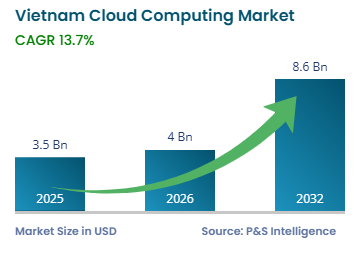
The Vietnamese cloud computing market values USD 3.5 billion in 2025, and it is projected to reach USD 8.6 billion by 2032, growing at a CAGR of 13.7% during 2026–2032. The market expansion is driven by rapid digital transformation initiatives across enterprises, strong government support for Industry 4.0 adoption, and rising demand for scalable IT infrastructure among businesses of all sizes. Vietnam's strategic position as an emerging technology hub in Southeast Asia, combined with increasing foreign direct investment in digital infrastructure, positions the country for sustained cloud computing growth throughout the forecast period.
The Vietnamese government has made digital transformation a national priority through the National Digital Transformation Program to 2025, with an orientation toward 2030. According to the Ministry of Information and Communications, the government aims for 100% of government agencies to use cloud computing by 2025 and targets that 70% of the enterprise cloud computing services are provided by Vietnamese enterprises. The digital economy already contributes over 12% of Vietnam's GDP, with a target of reaching 20% by 2025 and 30% by 2030. This policy environment creates favorable conditions for cloud service providers and accelerates enterprise cloud adoption across multiple sectors.
Vietnam's digital infrastructure has expanded significantly in recent years, supporting cloud computing growth. Internet penetration in Vietnam stood at 79.1% in 2024, with over 78 million internet users. The country has more than 82.4% of households with access to fiber-optic internet, exceeding the 80% target set for 2025. This robust connectivity infrastructure enables enterprises to leverage cloud-based solutions for operations, data storage, and digital services. The expansion of 5G networks and plans to introduce multiple new undersea cable routes by 2030 will further enhance the foundation for cloud computing services.
Vietnam Cloud Computing Market Growth Factors
Rising Enterprise Digital Transformation Is a Major Trend
Enterprises across Vietnam are increasingly adopting cloud-based solutions to enhance operational efficiency, reduce costs, and improve customer experiences.
The shift toward digital transformation gained momentum during the COVID-19 pandemic and has continued as businesses recognize the strategic value of cloud infrastructure.
According to industry surveys, over 65% of large enterprises in Vietnam now use at least two cloud environments, reflecting the growing sophistication of cloud deployment strategies.
Hybrid cloud setups, combining public and private clouds, represent approximately 60% of cloud deployments, particularly in regulated sectors like banking and healthcare.
The BFSI sector has been particularly active in cloud adoption.
In early 2025, more than 90% of transactions at many credit institutions were conducted via digital channels.
Major banks, including Vietnam International Bank and VPBank, have partnered with global cloud providers to modernize their core banking systems and develop digital banking capabilities.
The growing fintech sector continues to drive demand for cloud infrastructure as digital payment platforms, mobile wallets, and online lending services expand their reach.
Government-Led Digital Transformation Initiatives Are Propelling Market Growth
The Vietnamese government has positioned digital transformation as a strategic priority for national development.
The National Digital Transformation Program, approved in 2020, establishes comprehensive goals for digital government, digital economy, and digital society.
Under this program, the government allocated approximately USD 1.6 billion to enhance digital infrastructure and promote digital transformation among enterprises.
The initiative aims to increase the number of SMEs adopting digital solutions from 35% to 55% in the coming years.
Additionally, the government has set targets for the digital economy to contribute 20% of GDP by 2025 and 30% by 2030, creating strong policy incentives for cloud adoption across public and private sectors.
According to the United Nations E-Government Survey released in 2024, Vietnam's ranking improved by 15 places to 71st out of 193 countries and territories, demonstrating significant progress in digital governance efforts.
The Ministry of Information and Communications has issued technical criteria for cloud computing platforms to serve e-government and e-governance, with five Vietnamese companies receiving certification for their cloud platforms.
These developments create a structured framework for cloud adoption in government operations and set standards that influence enterprise cloud strategies.
Expansion of Data Center Infrastructure Supports Cloud Services Growth
Vietnam's data center market is experiencing substantial investment from both domestic and international players, providing the physical infrastructure essential for cloud computing services.
The country currently has over 27 cloud computing centers, with approximately 11 domestic firms having invested in more than 270,000 servers.
A major investment in this space is Viettel Group's groundbreaking of a 140-MW hyperscale data center in Ho Chi Minh City in April 2025.
Similarly, CMC Corporation’s hyperscale data center project is expected to be operational in 2028, with plans to invest USD 500 million in data centers and related infrastructure.
International cloud providers are also expanding their presence in Vietnam.
The revised Telecommunications Law allows full foreign ownership in data center services, opening the market to greater international investment.
ST Telemedia Global Data Centres has announced joint ventures and partnerships for data center development in Ho Chi Minh City, while Alibaba has announced plans to establish a data center complex in Vietnam.
This expansion of data center infrastructure supports the growing demand for infrastructure as a service, platform as a service, and software as a service offerings across the country.
The public cloud category holds the largest share in the Vietnamese cloud computing market in 2025, of 50%. This dominance is attributed to the cost-effectiveness of public cloud solutions, ease of scalability, and the growing availability of public cloud services from both domestic and international providers. SMEs particularly favor public cloud deployments due to lower upfront investment requirements and pay-as-you-go pricing models. The category benefits from a strong demand in sectors, including e-commerce, education, and startups, which require flexible infrastructure without significant capital expenditure.
The hybrid cloud category is expected to witness the highest CAGR of 14.0% during the forecast period, driven by enterprises seeking to balance flexibility with data security and regulatory compliance. According to industry surveys, approximately 60% of cloud deployments in Vietnam follow hybrid models, combining public and private cloud infrastructure. This approach allows organizations to maintain sensitive data on private infrastructure while leveraging public cloud for scalable workloads. Financial services, healthcare, and government sectors particularly favor hybrid architectures to meet data localization requirements under Vietnam's Cybersecurity Law while accessing advanced cloud capabilities. The segment is also supported by multi-cloud adoption strategies, with approximately 18% of businesses using multiple public cloud providers to avoid vendor lock-in.
These deployment models are covered:
Public Cloud (Largest Category)
Private Cloud
Hybrid Cloud (Fastest-Growing Category)
Service Type Analysis
The software as a service (SaaS) category dominates the Vietnamese cloud computing market in 2025 with 45% share. The prominence of SaaS is driven by its flexibility, ease of deployment, and ability to support remote work and collaboration. Vietnamese enterprises increasingly adopt SaaS solutions for customer relationship management, enterprise resource planning, human resources management, and collaboration tools. The segment benefits from the growing number of domestic SaaS providers offering solutions tailored to local business requirements and regulatory compliance. The COVID-19 pandemic accelerated SaaS adoption as businesses rapidly shifted to remote work models requiring cloud-based collaboration tools.
The infrastructure as a service (IaaS) category is projected to record the highest CAGR of 13.9% during 2026–2032, driven by the increasing demand for scalable computing resources and storage capacity. The growth is fueled by digital transformation initiatives across enterprises, expansion of e-commerce operations, and the development of AI and big data applications that require substantial computing infrastructure. Government support for IaaS adoption, particularly through e-government initiatives requiring domestic cloud infrastructure, also contributes to segment growth. The expansion of data center capacity in Vietnam provides the foundation for IaaS growth, with major providers expanding their infrastructure offerings.
These service types are covered:
Infrastructure as a Service (IaaS) (Fastest-Growing Category)
Platform as a Service (PaaS)
Software as a Service (SaaS) (Largest Category)
Organization Size Analysis
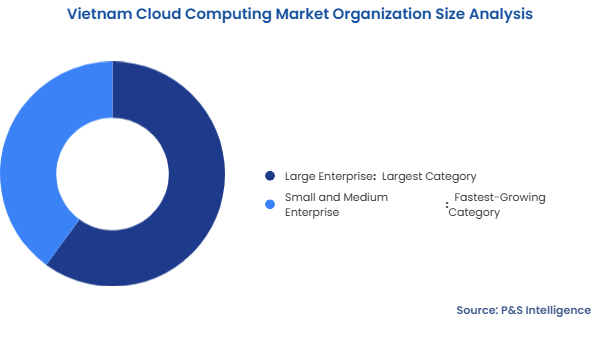
Large enterprise hold the larger share in the Vietnamese cloud computing market in 2025, of 60%. Large enterprises drive significant cloud spending due to their complex IT requirements, need for scalable infrastructure, and resources to invest in comprehensive digital transformation initiatives. Major corporations in banking, telecommunications, manufacturing, and retail sectors have implemented enterprise-wide cloud strategies, often utilizing hybrid and multi-cloud architectures. These organizations typically engage multiple cloud service providers and invest in custom solutions to meet their specific operational and compliance requirements.
Small and medium enterprises (SMEs) are set to grow faster during the forecast period. According to the Ministry of Planning and Investment, over 96% of Vietnam's approximately 857,000 operating enterprises are classified as micro, small, or medium businesses. Government initiatives specifically target SME digital transformation, with programs offering support for cloud adoption, including training, consultancy subsidies, and preferential loans. The average annual IT budget for SMEs is around USD 22,000, with many allocating up to 32% for software solutions. Cloud computing offers SMEs access to enterprise-grade technology without substantial upfront investment, making it an attractive option for businesses seeking operational efficiency and competitiveness.
These organization sizes are covered:
Large Enterprise (Larger Category)
Small and Medium Enterprise (Faster-Growing Category)
Vertical Analysis
The banking, financial services, and insurance (BFSI) category holds the largest share in the Vietnamese cloud computing market in 2025. This is owed to the rapid digital transformation of Vietnam's financial sector, with banks and insurance companies investing heavily in cloud infrastructure to support digital banking, mobile payments, and customer service platforms. According to industry data, more than 90% of transactions at many credit institutions are now conducted via digital channels. The fintech sector's expansion further drives cloud adoption in financial services. Banks are increasingly partnering with cloud providers to develop cloud-native core banking systems, real-time analytics capabilities, and AI-driven fraud detection solutions.
The healthcare category is expected to witness substantial growth during the forecast period, driven by the digitization of medical records, telemedicine uptake, and government initiatives for healthcare modernization. The COVID-19 pandemic accelerated healthcare cloud adoption as providers implemented remote consultation platforms and digital health solutions. Cloud computing in Vietnam’s healthcare sector supports digital transformation by enabling electronic health records, telemedicine, remote patient care, and shared clinical data storage on scalable, secure infrastructure. It helps hospitals and clinics reduce costs, improve data accessibility and exchange, and expand connected care services nationwide, aligning with Vietnam’s health system digitization goals.
These verticals are covered:
BFSI (Largest Category)
IT & Telecom
Retail & Consumer Goods
Manufacturing
Healthcare (Fastest-Growing Category)
Education
Energy & Utilities
Media & Entertainment
Government & Public Sector
Others
Drive strategic growth with comprehensive market analysis
Vietnam Cloud Computing Market Regional Outlook
Ho Chi Minh City Cloud Computing Market Size
Ho Chi Minh City holds the largest share in the Vietnam cloud computing market in 2025, of 40%. The city serves as Vietnam's primary economic center and technology hub, hosting the highest concentration of enterprises, financial institutions, and startup ecosystems in the country. Ho Chi Minh City benefits from multiple submarine cable landings, vibrant foreign-invested manufacturing operations, and proximity to the Mekong industrial corridor. Approximately 80% of the upcoming data center capacity in Vietnam is concentrated in Ho Chi Minh City, reflecting its strategic importance for digital infrastructure investment.
The city's cloud computing market is driven by strong demand from the BFSI sector, with major banks and financial institutions headquartered in Ho Chi Minh City investing heavily in cloud infrastructure for digital transformation. The city hosts over 15 operational data centers of Viettel, VNPT, FPT, and CMC. The Saigon High-Tech Park attracts significant cloud infrastructure investment, with Gaw Capital developing a 20-MW facility and Worldwide DC Solution constructing a 30-MW project in the area.
Hanoi Cloud Computing Market Outlook
Hanoi is projected to witness the highest growth rate during the forecast period, of 13.8%. The capital city's growth is driven by government digital transformation initiatives, with national database hosting and e-government rollouts mandating capital-region residency for sensitive workloads. Approximately 40% of existing rack capacity in Vietnam is concentrated in Hanoi, reflecting the city's importance for government and enterprise cloud deployments. The integration of 116 databases into sovereign clouds by ministries creates sustained demand for cloud infrastructure in the region.
Hanoi's cloud computing market benefits from the concentration of government agencies, state-owned enterprises, educational institutions, and technology companies. The city's power reliability, supported by hydroelectric generation and 500kV backbone upgrades, provides a stable foundation for data center operations. Viettel Group inaugurated an IDC in Hoa Lac High-Tech Park in April 2024. The proximity to leading universities, including Hanoi University of Science and Technology and Vietnam National University, ensures a steady technical workforce for cloud service providers. The Ministry of Public Security inaugurated the first National Data Center in August 2024, responsible for integrating, synchronizing, and storing data from state agencies, reinforcing Hanoi's role as the center for government cloud operations.
The Vietnamese cloud computing market is moderately fragmented due to domestic and international players competing across various service segments. The market hosts more than 40 cloud computing service providers, creating a competitive environment where companies differentiate through service quality, pricing, compliance capabilities, and local presence. International players have established a significant market presence, while domestic providers are expanding their cloud service portfolios to capture growing demand.
Historically, international cloud providers dominated the market; however, recent years have seen domestic providers increase their market presence through substantial infrastructure investments and development of localized solutions. The government's requirement for cloud platforms serving e-government to meet technical criteria certified by the Ministry of Information and Communications has created opportunities for domestic providers. Five Vietnamese companies have received certification for their cloud platforms to serve e-government and e-governance: BizFly cloud computing platform, Viettel cloud platform, VNPT cloud platform, VNG cloud platform, and CMC cloud platform.
Competition in the market is influenced by data localization requirements under Vietnam's Cybersecurity Law and the 2025 Data Law, which require enterprises to store certain categories of personal data within national borders. These regulations create competitive advantages for providers with local data center infrastructure and have prompted international players to establish local presence through partnerships and direct investment. Strategic partnerships between domestic and international players have emerged as a common market strategy, combining local market knowledge with global technology capabilities. The market is expected to become increasingly competitive as the revised Telecommunications Law allows full foreign ownership in data center services, attracting additional international investment.
Key Vietnam Cloud Computing Companies:
Adobe Inc.
Alibaba Group Holding Limited
Amazon.com Inc.
Oracle Corporation
Google LLC
Microsoft Corporation
SAP SE
Salesforce Inc.
IBM Corporation
Tencent Holdings Ltd.
Rackspace Technology Inc.
Viettel Group
Vietnam Posts and Telecommunications Group
FPT Corporation
CMC Corporation
VNG Corporation
Appota Corporation
Hewlett Packard Enterprise Development LP
Workday Inc.
Vietnam Cloud Computing Market Developments
In May 2025, Vietnam Airlines partnered with FPT to co-develop cloud-based digital transformation solutions for operational efficiency and customer experience enhancement.
In April 2025, Da Nang International Data Centre opened a major hub with a 1,000-rack system, including cloud services and AI applications.
In December 2024, CMC Global sealed a USD 1-billion data center deal with Samsung C&T, creating one of Southeast Asia's largest facilities.
In June 2024, VNG Cloud launched the first multi-region cloud infrastructure in Vietnam.
Frequently Asked Questions About This Report
What is the market size of the Vietnam cloud computing market?+
The Vietnam cloud computing market was valued at USD 3.5 billion in 2025.
What is the growth rate of the Vietnam cloud computing market?+
The market is growing at a CAGR of 13.7% during the forecast period.
What are the key drivers of the Vietnam cloud computing market?+
Key growth drivers include accelerating digital transformation, expansion of e-commerce and fintech, rising adoption among SMEs, increasing data consumption, and national digital infrastructure development programs.
Which deployment mode segment dominates the Vietnam market?+
Public cloud services dominate the Vietnam cloud computing market.
Who are the major players in the Vietnam cloud computing market?+
The market features a mix of global cloud service providers and domestic players, with competition centered on pricing, local data center availability, security compliance, and industry-specific cloud solutions.
Which industries are driving cloud adoption in Vietnam?+
Key adopting industries include banking and financial services, e-commerce, telecommunications, manufacturing, healthcare, and government, where cloud platforms support data analytics, digital services, and operational efficiency.
Want a report tailored exactly to your business need?
Leading companies across industries trust us to deliver data-driven insights and innovative solutions for their most critical decisions. From data-driven strategies to actionable insights, we empower the decision-makers who shape industries and define the future. From Fortune 500 companies to innovative startups, we are proud to partner with organisations that drive progress in their industries.
Client Testimonials
Working with P&S Intelligence and their team was an absolute pleasure – their awareness of timelines and commitment to value greatly contributed to our project's success. Eagerly anticipating future collaborations.
McKinsey & Company
India
Unmatched Standards
Our insights into the minutest levels of the markets, including the latest trends and competitive landscape, give you all the answers you need to take your business to new heights
Complete Data Security
We take a cautious approach to protecting your personal and confidential information. Trust is the strongest bond that connects us and our clients, and trust we build by complying with all international and domestic data protection and privacy laws