This Report Provides In-Depth Analysis of the Vietnam B2B Payment Market Report Prepared by P&S Intelligence, Segmented by Payment Type (Domestic Payments, Cross-Border Payments), Payment Mode (Traditional, Digital), Enterprise Size (Large Enterprises, Small and Medium-sized Enterprises), Industry (BFSI, Manufacturing, IT & Telecom, Metals & Mining, Energy & Utilities), and Geographical Outlook for the Period of 2021 to 2032
Explore the market potential with our data-driven report
Vietnam B2B Payment Market Analysis
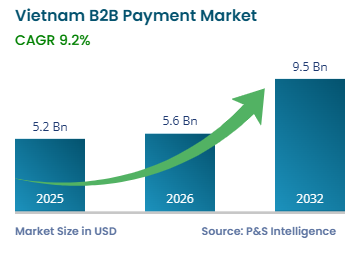
The Vietnamese B2B payments market reached USD 5.2 billion in 2024 and is expected to grow at a compound annual growth rate (CAGR) of 9.2% during 2026–2032, reaching an estimated USD 9.5 billion by 2032.
This is due to the rising use of B2B payment solutions with enterprise resource planning (ERP) software; mandatory e-invoicing via Decree No. 52/2024/ND-CP; and growing digitalization of corporate treasury operations in manufacturing, banking, finance & insurance (BFSI), and export-oriented sectors.
Vietnam’s B2B payment landscape is transitioning from traditional wire transfers and checks towards automated digital payables platforms, however, adoption is currently low, with less than 15% of large corporates using integrated payment engines.
According to the State Bank of Vietnam (SBV), non-cash transactions in Vietnam reached VND 295.2 quadrillion in 2024, or 26 times Vietnam’s gross domestic product (GDP). As well, 87% of adults in Vietnam now have bank accounts, providing a solid foundation of digital infrastructure supporting B2B transaction growth.
Digital Payment Infrastructure and VietQR Standardization Are Key Trends
Vietnam’s B2B payment ecosystem is structurally transforming as VietQR standardization achieves 85% merchant reach nationwide, allowing instant inter-bank transfers that compress settlement cycles from days to seconds.
The National Payment Corporation of Vietnam (NAPAS) has established inter-connection with Thailand’s PromptPay, Singapore’s PayNow, and Cambodia’s Bakong systems, creating seamless cross-border QR payment corridors reducing correspondent banking fees for export-oriented enterprises.
By mid-2025, more than 90% of transactions at major credit institutions will be processed through digital channels; and the inter-bank electronic payment system will process approximately VND 820 trillion daily.
As such, the maturity of this digital infrastructure is shifting corporate treasury operations from manual reconciliation towards automated real-time payables management that is integrated with ERP systems.
Government-Mandated E-Invoicing Requirements and Strengthened Digital Transaction Frameworks Drive Market
Vietnam’s regulatory environment is providing strong support for accelerating B2B payment digitalization via mandatory e-invoicing requirements and strengthened digital transaction frameworks.
Decree No. 52/2024/ND-CP on cashless payments provides comprehensive legal foundations for electronic payment services, adding prepaid cards and e-wallets to recognized instruments while expanding payment service provider categories to include public postal services.
The State Bank of Vietnam (SBV) mandated biometric authentication for all financial transactions effective July 2024, with over 110.8 million personal records and 711,000 organizational records verified to date.
These compliance requirements are forcing enterprises—particularly small and medium-sized enterprises (SMEs) approaching e-invoicing thresholds—into automated accounts-payable workflows that integrate payment execution with tax documentation.
Substantial Unmet Demand In Underserved Segments and B2B Automation Gap Create Opportunities
Although consumer payment digitalization in Vietnam has been rapid, B2B payment automation remains nascent, with only approximately 15% of large corporates utilizing integrated payables engines — revealing substantial white space for solution providers.
The SME segment, comprising over 800,000 registered enterprises, represents particularly attractive market expansion opportunities, given government programs under Decree No. 80/2021 provide digital transformation support and e-invoicing compliance approaches mandatory thresholds.
In addition, the high cash-on-delivery rate (77.5%) in e-commerce signals untapped B2B digitalization potential as supply chain payments modernize.
Open-API frameworks under development are expected to reduce B2B payment onboarding timeframes from months to days, further accelerating SME adoption.
Behavioral and Security Factors Constrain B2B Payments
Although digital payment infrastructure has expanded rapidly, behavioral and security factors continue constraining B2B digitalization velocity.
The Vietnam Banking Association (VNBA) reports that 77.5% of e-commerce transactions still use cash-on-delivery, reflecting persistent trust concerns that extend into B2B contexts where payment verification remains critical.
Sophisticated cybercrime targeting digital payment channels has prompted the SBV to implement fraud detection systems that warn of suspected accounts before transactions, reducing money-loss risk by approximately 40%.
From July 2025, businesses face mandatory biometric authentication requirements for transactions, adding compliance complexity that may temporarily slow adoption among smaller enterprises lacking technical infrastructure.
These friction factors moderate the otherwise accelerating trajectory of B2B payment digitalization.
Vietnam B2B Payment Market Segmentation Analysis
Payment Type Analysis
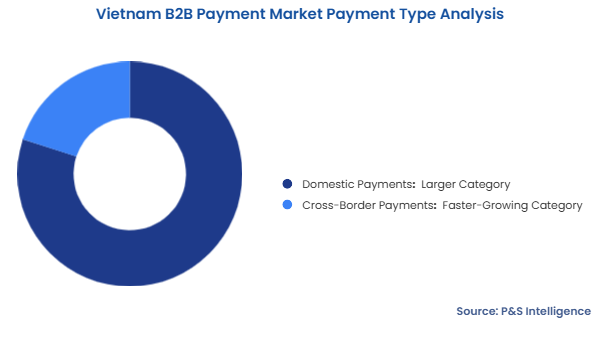
Domestic payments made up the greatest portion of Vietnam’s B2B payments market in 2025, of 80%, due to the majority of B2B commerce occurring between local enterprises operating within Vietnam’s domestic economy. The vast majority of domestic payments occur between local enterprises due to the concentration of B2B commerce within local enterprises, the presence of established banking relationships allowing for VND-denominated transfers, and the existence of mature VietQR infrastructure that enables instant domestic settlement via NAPAS 247, which processed 9.56 billion transactions in 2024. The State Bank of Vietnam (SBV) reported that domestic interbank transfers increased by 33.8% year-over-year, indicating continued corporate payment volume growth.
Cross-border payments are projected to experience the greatest growth between 2026 and 2032, due to Vietnam’s growing trade relationships under CPTPP and RCEP agreements, ASEAN QR interoperability enabling instant transfers with Thailand, Singapore, Cambodia, and Laos, and mandatory e-invoicing requirements encouraging exporters to automate payment solutions. The VIB-Flywire collaboration for cross-border B2B transactions and NAPAS-UnionPay connectivity with China are also contributing to the rapid growth of this segment.
The market segments into the following payment types:
Domestic Payments (Larger Category)
Cross-Border Payments (Faster-Growing Category)
Payment Mode Analysis
Traditional payment methods held the larger portion of the B2B payments market share, of 80%, in 2025 due to long-standing corporate treasury practices, legacy ERP integrations, and enterprise preferences for familiar settlement mechanisms supporting conventional payment channels. Only approximately 15% of large Vietnamese corporates utilize integrated digital payables engines, indicating manual and semi-automated traditional processes remain widespread across most enterprise segments. State-owned banks including Vietcombank, VietinBank, BIDV, and Agribank process the majority of high-value B2B transactions using traditional banking rails.
Accelerated by mandatory biometric authentication requirements taking effect July 2024, mandatory e-invoicing requirements under Decree No. 52/2024/ND-CP, and open-API frameworks allowing for rapid integration of fintech solutions, digital payment methods are anticipated to experience the greatest growth during the forecast period. The Vietnam Banking Association (VNBA) reports that QR code payments increased by 66.7% in volume and 159.6% in value during the first seven months of 2025, reflecting increasing digital adoption in B2B contexts as enterprises modernize their accounts-payable workflows.
The market segments into the following payment modes:
Traditional (Larger Category)
Digital (Faster-Growing Category)
Enterprise Size Analysis
Large enterprises accounted for the largest portion of the market share in 2025, of 85%, due to higher transaction volumes and values associated with multinational operations, complex supply chains, and large procurement requirements. Due to the presence of dedicated treasury functions, sophisticated ERP systems, and established banking relationships generating proportionately greater B2B payment flows compared to smaller entities, large corporates generate larger portions of total B2B payment volumes. Foreign-invested enterprises operating in Vietnam’s manufacturing hubs located primarily in Ho Chi Minh City, Hanoi, Binh Duong, and Hai Phong produce considerable portions of the highest-value transactions.
Small- and medium-sized enterprises (SMEs) are expected to show the greatest amount of growth between 2026 and 2032, supported by government digitalization programs under Decree No. 80/2021, VNPAY’s October 2024 launch of B2B payables tools targeting SME e-invoice compliance, and expanding fintech solutions designed for smaller business segments. Based on estimates provided by the Ministry of Planning and Investment, over 97% of Vietnam’s 900,000 operational businesses are classified as SMEs presenting considerable opportunity for B2B payment digitalization as SMEs approach mandatory e-invoicing thresholds.
The market segments into the following enterprise sizes:
Large enterprises (Largest Category)
Small and medium-sized enterprises (Fastest-Growing Category)
Industry Analysis
Banking, financial services, and insurance (BFSI) represented the largest industry vertical in 2025, with 35% share, due to the highly transactional nature of financial services, investments in digital banking modernization, and its role as both payment processor and generator of corporate payment volumes. Vietnamese banks have implemented over 110 million biometric verifications and process approximately VND 820 trillion daily through inter-bank systems — generating considerable intra-sector B2B payment volumes for correspondent banking, inter-bank settlement, and corporate treasury services.
Manufacturing is expected to show the greatest growth between 2026 and 2032 due to expansion of B2B commerce platforms in industrial clusters, digitized invoicing adoption in export-oriented facilities, and supply chain payment automation requirements.
Manufacturing B2B e-commerce in Vietnam is expanding, as industrial zones in Binh Duong, Dong Nai, Bac Ninh, and Hai Phong are developing digital procurement and payment systems to facilitate just-in-time inventory management and cross-border supplier relationships.
The market segments into the following industries:
BFSI (Largest Category)
Manufacturing (Fastest-Growing Category)
IT & Telecom
Metals & Mining
Energy & Utilities
Others
Drive strategic growth with comprehensive market analysis
Vietnam B2B Payment Market Geographical Analysis
Ho Chi Minh City
Ho Chi Minh City is the dominant province when it comes to B2B payment activity and holds approximately 40% of the nation’s total B2B payment value. Ho Chi Minh City is also Vietnam’s largest economy and financial center with a GDP of USD 70 billion in 2024; with over 69% of regional output being generated from its service industry. The city is home to major banks, payment platforms, and multinational corporations that drive the bulk of B2B payment volume within Vietnam. Additionally, Ho Chi Minh City has an extremely dense merchant network and 5G coverage as well as a high rate of digital payment acceptance among local businesses (over 95%), which further reinforces its position in the B2B payments ecosystem.
Da Nang
Da Nang is quickly becoming the fastest-growing provincial market in Vietnam and is outperforming other provinces when it comes to business expansion and growth of the B2B payments market. Foreign companies operating in Da Nang have experienced average expansion rates of 42.9% since 2024 and are creating a strong need for B2B payment solutions. Da Nang’s strategic location along the East-West Economic Corridor, its presence of six functional industrial zones, and its developing high-tech park provide a strong foundation for the growth of manufacturing-related B2B payments.
Provinces included in this study:
Ho Chi Minh City (largest province market)
Hanoi
Da Nang (fastest growing province market)
Hai Phong
Rest of Vietnam
Vietnam B2B Payment Market Share
The competitive structure of Vietnam’s B2B payments market is moderately fragmented and involves the participation of state-owned commercial banks, private digital-first institutions, mobile wallet operators, and specialized payment platforms. The fragmented competitive structure is a result of the transitional nature of the market where traditional banking infrastructure exists in conjunction with emerging fintech solutions, regulatory environments that allow for multiple types of providers, and the geographic distribution of economic activity across different provincial markets. State-owned institutions generate significant B2B payment volume as a result of their long-standing relationships with major corporate entities and their role in processing government payments. Private providers compete through innovative technologies and user experience differentiation.
Increasing competitive pressure is occurring as a result of mandatory e-invoice requirements and cross-border QR interoperability creating a sense of urgency for solution providers to gain enterprise client commitments from organizations transitioning from manual payment processes. Collaboration between banks and fintechs for cross-border B2B payments—indicates emerging competitive models that combine banking licenses with technology platforms. The upcoming open-API framework is anticipated to amplify competition by lowering switching costs and allowing new market entrants to gain access to payment infrastructure without establishing their own proprietary networks.
Key Vietnam B2B Payment Companies:
Vietnam Payment Solution Joint Stock Company (VNPAY)
M_Service Joint Stock Company (MoMo)
VNG Corporation (ZaloPay)
National Payment Corporation of Vietnam (NAPAS)
Viettel Digital Services Corporation (ViettelPay)
Joint Stock Commercial Bank for Industry and Trade of Vietnam (VietinBank)
Vietnam Bank for Agriculture and Rural Development (Agribank)
Bank for Investment and Development of Vietnam (BIDV)
Joint Stock Commercial Bank for Foreign Trade of Vietnam (Vietcombank)
Tien Phong Commercial Joint Stock Bank (TPBank)
Vietnam B2B Payment Market News
On December 2025, the National Payment Corporation of Vietnam (NAPAS), UnionPay International (UPI), Industrial and Commercial Bank of China (ICBC), and the Joint Stock Commercial Bank for Foreign Trade of Vietnam (Vietcombank) conducted a pilot cross-border QR payment program that allowed Chinese tourists to make VietQR Global payments at over 30,000 Vietnamese merchants using UnionPay partner bank apps. The pilot program created two-way payment connectivity between Vietnam and China and is intended to be expanded to all NAPAS member institutions by 2026.
In March 2025, the National Payment Corporation of Vietnam (NAPAS) and Network for Electronic Transfers Singapore Pte. Ltd. (NETS) entered into a memorandum of understanding to establish cross-border QR payment connectivity between Vietnam and Singapore. The memorandum of understanding was executed and witnessed by the prime ministers of Vietnam and Singapore, enabling customers of NAPAS member banks to make payments at NETS merchant locations in Singapore and vice versa, enhancing ASEAN payment interoperability.
In January 2025, the State Bank of Vietnam and the Bank of the Lao PDR implemented a bilateral retail payment system utilizing QR codes, linking seven Vietnamese banks (VietinBank, Sacombank, BIDV, Vietcombank, BVBank, Nam A Bank, TPBank) with fourteen Laotian banks in the LAPNet network. The service allows Vietnamese visitors to make payments at Lao merchants using VND with real-time currency conversion, expanding ASEAN cross-border payment infrastructure.
In October 2024, Vietnam Payment Solution Joint Stock Company (VNPAY) launched VNPAYB2B, a business payment solution provider (BPSP) platform utilizing Visa Inc. to enable B2B payment acceptance infrastructure. The platform enables enterprises to make payments to non-card accepting suppliers using Visa commercial cards, focusing on corporations that are subject to mandatory e-invoice compliance requirements under Decree No. 52/2024/ND-CP.
In May 2024, Visa Inc. formed partnerships with M_Service Joint Stock Company (MoMo), Vietnam Payment Solution Joint Stock Company (VNPAY), and VNG Corporation (ZaloPay) to extend card tokenization into Vietnam’s three largest e-wallet platforms. The partnerships allow Visa card holders to utilize cards as funding sources at over 200,000 QR-accepting merchants, providing Visa with embedded infrastructure throughout Vietnam’s digital payment ecosystem.
Frequently Asked Questions About This Report
What will be was Vietnamese B2B payments market 2025 size?+
In 2032, the B2B payments market in Vietnam will value USD XX million.
Which payment type dominates the Vietnamese B2B payments industry?+
Domestic payments dominate the Vietnamese B2B payments industry with XX% revenue.
Which province has largest Vietnamese B2B payments market share?+
Ho Chi Minh City is the largest B2B payments market in Vietnam, with XX share%.
What are the key Vietnamese B2B payments industry drivers?+
The Vietnamese B2B payments industry is driven by rising use with enterprise resource planning (ERP) software; mandatory e-invoicing, and digitalization of corporate treasury operations in manufacturing, BFSI, and export-oriented sectors.
What is the Vietnamese B2B payments market nature?+
The B2B payments market in Vietnam is moderately fragmented
Want a report tailored exactly to your business need?
Leading companies across industries trust us to deliver data-driven insights and innovative solutions for their most critical decisions. From data-driven strategies to actionable insights, we empower the decision-makers who shape industries and define the future. From Fortune 500 companies to innovative startups, we are proud to partner with organisations that drive progress in their industries.
Client Testimonials
Working with P&S Intelligence and their team was an absolute pleasure – their awareness of timelines and commitment to value greatly contributed to our project's success. Eagerly anticipating future collaborations.
McKinsey & Company
India
Unmatched Standards
Our insights into the minutest levels of the markets, including the latest trends and competitive landscape, give you all the answers you need to take your business to new heights
Complete Data Security
We take a cautious approach to protecting your personal and confidential information. Trust is the strongest bond that connects us and our clients, and trust we build by complying with all international and domestic data protection and privacy laws