This Report Provides In-Depth Analysis of the Vanadium Market Report Prepared by P&S Intelligence, Segmented by Product Type (Ferrovanadium, Vanadium Pentoxide, Vanadium Chemicals, Vanadium Metal, Vanadium Alloys), Application (Steel Production, Chemicals & Catalysts, Titanium Alloys), End-Use Industry (Construction, Automotive, Aerospace & Defense, Energy & Power), and Geographical Outlook for the Period of 2019 to 2032
Explore the market potential with our data-driven report
Vanadium Market Future Outlook
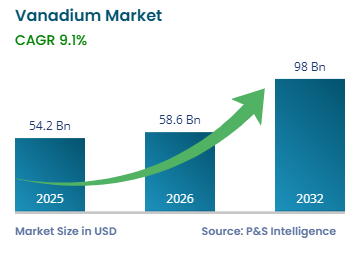
The global vanadium market size is estimated at USD 54.2 billion in 2025, which is predicted to reach USD 98.0 billion by 2032, growing at a CAGR of 9.1% during 2026–2032.
The global vanadium market is experiencing steady growth, driven by increasing demand from both traditional and emerging sectors. It significantly enhances the strength, durability, and corrosion resistance of steel, making it essential for infrastructure development, construction, and automotive applications. However, what is notably driving a new wave of growth in the vanadium market is the accelerating global transition to clean energy. Vanadium redox flow batteries (VRFBs), which use vanadium electrolytes, are becoming increasingly important in large-scale, long-duration energy storage systems needed to stabilize power grids that depend on intermittent renewable energy sources like solar and wind. These batteries offer advantages such as long cycle life, scalability, and safety, making vanadium an attractive option for energy storage solutions in both developed and developing economies.
In addition to demand-side growth, various regulatory and environmental factors are contributing to the market's expansion. Governments worldwide are tightening building codes and steel quality standards, while simultaneously promoting decarbonization and net-zero targets—developments that encourage the adoption of vanadium-based materials and technologies.
Furthermore, vanadium is now considered a critical mineral due to its strategic importance and limited supply sources, which adds to its value and encourages investment in domestic production. Lastly, ongoing innovation and expanding applications in sectors like aerospace, chemical processing, and advanced battery technologies continue to open new avenues for vanadium use.
Vanadium Market Growth Factors
Technological Advancements in Energy Storage Systems Are Key Trend
Technological advancements in energy storage systems, especially VRFBs, are enhancing the performance, scalability, and efficiency of vanadium-based energy solutions.
In January 2025, Juhé Energy Storage and Chuxiong Jinjiang Energy Group signed agreements for two major VRFB projects in Yongren County, Yunnan Province.
The initiatives include a 500-MW/2-GWh production line and a 300-MW/1.2-GWh storage station with a combined investment of USD 500 million (RMB 3.627 billion).
These projects aim to enhance energy storage capacity and support China's dual-carbon goals.
Improved electrolyte formulations and cell designs are increasing the energy density and reducing the operational costs of VRFBs, making them more competitive with other battery types.
New manufacturing techniques and automation are lowering production costs, enabling wider commercial deployment of vanadium-based storage systems for grid applications.
In September 2025, Vecco Group secured a USD 10-million investment from the Queensland Investment Corporation to develop Australia's first vertically integrated vanadium flow battery supply chain.
The project includes the Debella vanadium mine near Julia Creek and a commercial-scale electrolyte manufacturing facility in Townsville.
Research into recycling and reusing vanadium electrolytes is extending battery lifespan and improving sustainability, which attracts more investment in long-duration storage solutions.
Integration of VRFBs with renewable energy sources like solar and wind is becoming more viable due to advancements in smart energy management systems and real-time monitoring technologies.
Ukrainian private energy firm DTEK launched the country's largest battery storage facility, investing USD 146.13 million (EUR 125 million) into the project.
The infrastructure, developed in partnership with U.S.-based company Fluence, can store up to 400 Megawatt-hours of electricity, aiming to enhance the security of Ukraine’s electricity supply amid ongoing conflicts.
The development of modular and containerized VRFB units allows for flexible deployment in remote or off-grid locations, further expanding their market potential.
The continuous R&D is exploring hybrid energy storage systems that combine VRFBs with lithium-ion or other technologies to optimize performance across different load profiles.
China Huaneng Group completed the world's largest VRFB energy storage project in Jimusar County, Xinjiang. This 200-MW/1-GWh facility, integrated with a 1-GW solar farm, received a total investment of USD 520 million (RMB 3.8 billion).
The project aims to generate 1.72 TWh of electricity annually, reducing COâ‚‚ emissions by over 1.6 million tonnes per year.
Rising Global Steel Production Is Driving Vanadium Demand
Vanadium is primarily used as a micro-alloying element in steel to improve strength, toughness, and corrosion resistance, making it essential for high-strength low-alloy (HSLA) steels.
As per the World Steel Association, global crude steel production rose from 1,889 million tonnes in 2022 to 1,904 million tonnes in 2023.
India's Production Linked Incentive (PLI) Scheme for Specialty Steel is set to drive an investment of INR 29,500 crore, promoting domestic production and reducing imports.
This scheme is expected to boost the demand for high-strength steel, indirectly increasing the need for vanadium.
The global increase in steel production, driven by the growing construction and automotive industries, directly boosts vanadium consumption.
The growing rates of urbanization and industrialization, especially in China and India, increase the demand for stronger, lighter steel products that incorporate vanadium.
Vanadium enables manufacturers to use less steel without compromising quality, making it valuable for cost-efficient and sustainable steel production.
In Europe, EIT RawMaterials has invested a total of EUR 1 million in Novana’s Vanadium Recovery Project (VRP1) in Pori, Finland, through two rounds in September 2024 and February 2025, raising its stake to 2.2%.
The project uses a COâ‚‚-consuming process to reclaim vanadium pentoxide (Vâ‚‚Oâ‚…) from steel slag, a byproduct of steelmaking.
With a planned annual output of 9,000 tonnes, it could meet over 40% of Europe’s vanadium demand.
Additionally, it is expected to cut COâ‚‚ emissions by up to 1.5 million tonnes over the next decade, strengthening Europe’s raw material security.
Stricter regulations and standards for steel performance in construction and transportation sectors further stimulate the use of vanadium-enhanced steel.
Expansion in pipeline, aerospace, and energy infrastructure projects worldwide increases the requirement for vanadium-alloyed steel due to its durability and reliability.
Vanadium Market Segmentation Analysis
Product Type Analysis
The ferrovanadium category held the largest share in the vanadium market in 2025, of 40%, and it is expected to maintain its dominance throughout the forecast period. This leadership position stems from ferrovanadium's widespread use as the primary alloying addition in steel production, where it efficiently introduces vanadium into molten steel with minimal oxidation losses. The standard ferrovanadium grades (FeV50 and FeV80) meet the specifications required by steel producers globally, ensuring consistent product quality and performance.
Vanadium pentoxide will witness the highest CAGR during 2026-2032, driven by its versatility across multiple applications, including catalyst production, ceramic colorants, and as the primary feedstock for producing other vanadium chemicals and alloys. The growing demand for vanadium pentoxide in manufacturing vanadium electrolyte for flow batteries represents a significant growth driver, with battery-grade V2O5 (99.5%+ purity) commanding premium prices over metallurgical grades. Additionally, the chemical industry's use of vanadium pentoxide catalysts in sulfuric acid production and selective catalytic reduction systems for emissions control supports steady demand growth.
These product types are covered:
Ferrovanadium (Largest Category)
Vanadium Pentoxide (Fastest-Growing Category)
Vanadium Chemicals
Vanadium Metal
Vanadium Alloys
Application Analysis
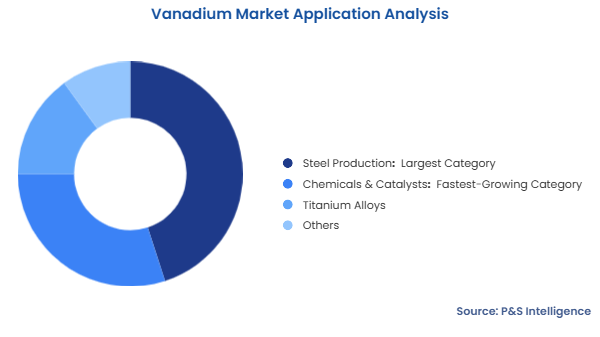
The steel production category dominated the vanadium market in 2025 with an 45% share of total consumption, reflecting vanadium's critical role in producing high-performance steels for construction, automotive, and industrial applications. The use of vanadium in steel manufacturing improves mechanical properties at relatively low addition levels, typically 0.05–0.15% for HSLA steels and up to 5% for high-speed tool steels, providing cost-effective performance enhancement compared to alternative alloying elements.
The chemicals & catalysts category is experiencing the fastest growth, during the forecast period, driven by expanding applications in chemical processing, emissions control, and specialty chemical production. Vanadium-based catalysts play crucial roles in producing sulfuric acid, maleic anhydride, and phthalic anhydride, essential chemicals for fertilizers, plastics, and pharmaceuticals industries. The implementation of stricter environmental regulations globally has increased demand for vanadium-based SCR catalysts in power plants and industrial facilities for NOx reduction.
These applications are covered:
Steel Production (Largest Category)
Chemicals & Catalysts (Fastest-Growing Category)
Titanium Alloys
Others
End-Use Industry Analysis
The construction industry represented the largest category in 2025, with 35% share, primarily through its use in reinforcing bars, structural steels, and high-strength fasteners. Modern construction practices increasingly specify vanadium-micro-alloyed steels for seismic-resistant structures, high-rise buildings, and critical infrastructure projects where enhanced strength and ductility are essential for safety and longevity.
The aerospace & defense category is projected to grow at the highest CAGR, during 2026–2032, driven by increasing aircraft production, space exploration programs, and defense modernization initiatives globally. Vanadium's use in titanium alloys (particularly Ti-6Al-4V) for aircraft engines, airframes, and landing gear components provides exceptional strength-to-weight ratios and high-temperature performance critical for aerospace applications. The development of next-generation aircraft and hypersonic vehicles requiring advanced materials capable of withstanding extreme conditions further accelerates vanadium demand in this sector.
These end-use industries are covered:
Construction (Largest Category)
Automotive
Aerospace & Defense (Fastest-Growing Category)
Energy & Power
Others
Drive strategic growth with comprehensive market analysis
Vanadium Market Geographical Analysis
APAC Vanadium Market Size
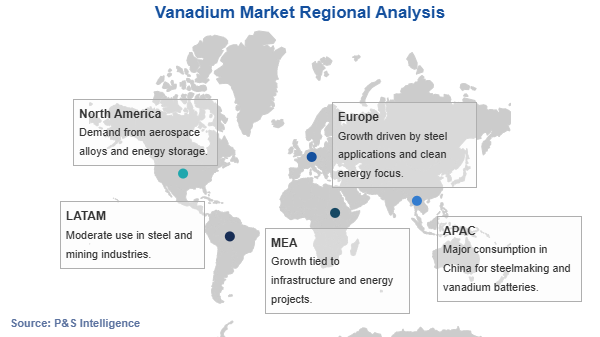
Asia-Pacific held the largest share of the global vanadium market in 2025, accounting for 40% of global consumption, driven by the region's dominant position in steel production and rapid infrastructure development.
China Vanadium Market Size
China was the biggest vanadium producer in 2024 from its vanadium-bearing titanomagnetite deposits and steel slag processing. The region's extensive steel industry, accounting for over 70% of the global crude steel output, creates substantial demand for vanadium as an alloying element. China's implementation of new national standards for construction steel in 2024, mandating higher strength requirements for rebar used in seismic zones and critical infrastructure, has increased vanadium consumption intensity per tonne of steel produced.
The country's dual role as the largest producer and consumer of vanadium provides supply chain advantages but also creates global market dependencies on Chinese production and trade policies. The development of large-scale vanadium redox flow battery projects in China, including grid-scale installations exceeding 100-MWh capacity, demonstrates the region's commitment to advanced energy storage technologies. Government support through subsidies, research funding, and favorable policies for energy storage deployment positions Asia-Pacific as the leading market for VRFB commercialization.
North America Vanadium Market Outlook
North America is expected to witness the fastest growth in the vanadium market, with a CAGR of approx. 9.5%, driven by reshoring initiatives in steel production, growing aerospace industry demand, and strategic mineral security policies. The U.S. designation of vanadium as a critical mineral has prompted government support for domestic production development and supply chain diversification away from import dependence.
U.S. Vanadium Market Size
The United States produced 79.5 million tonnes of steel in 2024, with specialty steel producers increasingly adopting vanadium microalloying to meet automotive lightweighting requirements and infrastructure durability standards. The implementation of the Infrastructure Investment and Jobs Act has increased demand for high-performance steels in bridge construction, rail infrastructure, and energy projects.
The development of domestic vanadium production projects, including the advancement of several vanadium recovery projects from oil refinery residues and uranium mining operations, aims to reduce North America's reliance on imports. Strategic stockpiling initiatives and long-term supply agreements with allied nations further strengthen the region's vanadium supply security.
Europe Vanadium Market Size
Europe accounted for 20% of the global vanadium market in 2025, with demand primarily driven by the automotive, aerospace, and specialty steel sectors. Germany's steel production increased by 5.2% year-on-year to 37.2 million tonnes in 2024, supporting steady vanadium consumption for high-quality automotive steels and tool steel production.
The European Union's Green Deal and decarbonization targets have increased focus on vanadium's role in enabling lighter, stronger materials that reduce carbon emissions in transportation and construction. European steel producers' emphasis on producing advanced high-strength steels for automotive applications, where vanadium microalloying provides superior formability and crash resistance, maintains regional demand growth.
The regions and countries analyzed in this report are:
North America (Fastest-Growing Regional Market)
U.S. (Larger Country Market)
Canada (Faster-Growing Country Market)
Europe
Germany (Largest Country Market)
U.K.
France (Fastest-Growing Country Market)
Italy
Spain
Rest of Europe
Asia-Pacific (Largest Regional Market)
Japan
China (Largest Country Market)
India (Fastest-Growing Country Market)
South Korea
Australia
Rest of APAC
Latin America
Brazil (Largest Country Market)
Mexico (Fastest-Growing Country Market)
Rest of LATAM
Middle East and Africa
Saudi Arabia (Largest Country Market)
South Africa
U.A.E. (Fastest-Growing Country Market)
Rest of MEA
Vanadium Market Share Analysis
The global vanadium market exhibits a consolidated structure, stemming from the capital-intensive nature of vanadium production, limited availability of vanadium-bearing resources, and the technical expertise required for efficient extraction and processing. Strategic partnerships and long-term supply agreements characterize the competitive landscape, with major producers establishing relationships with steel manufacturers and emerging battery companies.
Technology licensing and joint ventures for VRFB development have become increasingly important competitive strategies, as companies position themselves for the anticipated growth in energy storage applications. Environmental regulations and permitting requirements further challenge new entrants, particularly in developed markets where stricter emissions standards apply. However, opportunities exist for companies focusing on secondary vanadium recovery from petroleum residues, spent catalysts, and steel slag, where lower capital requirements and growing circular economy initiatives provide competitive advantages.
Key Vanadium Companies:
Pangang Group Vanadium & Titanium
Largo Resources Ltd.
Bushveld Minerals Limited
EVRAZ Plc
Glencore Plc
AMG Advanced Metallurgical Group N.V.
Ferro-Alloy Resources Limited
HBIS Group Co., Ltd.
Essel Mining & Industries Limited
Western Uranium & Vanadium Corp.
Australian Vanadium Limited
VanadiumCorp Resource Inc.
Atlantic Vanadium Pty Ltd.
China Vanadium Titano-Magnetite Mining Company Limited
Idemitsu Kosan Co., Ltd.
Vanadium Market News
In December 2024, Rongke Power Co. Ltd. commissioned a vanadium redox flow battery installation with a 175MW/700MWh capacity in China, demonstrating the commercial viability of grid-scale vanadium battery deployment and establishing new benchmarks for long-duration energy storage projects.
In November 2024, HBIS Co. Ltd. completed phase one of its vanadium flow battery energy storage production line with a 100-MW capacity. This is part of a broader plan for a 300-MW vanadium flow battery energy storage facility under a joint venture between its subsidiary Chengde Vanadium Titanium New Material and VRB Energy.
In July 2024, EVRAZ plc approved a significant investment of approximately USD 260 million to expand its vanadium production capabilities in the Tula region. The new plant, located in the Uzlovaya special economic zone, is expected to process up to 100,000 tonnes of raw materials annually and produce around 19,000 tonnes of vanadium pentoxide. The launch of production is scheduled for the summer of 2025. The project is being financed using EVRAZ's own funds.
In June 2024, VanadiumCorp Resource Inc. secured a patent in India for its hydrometallurgical process technology (VEPT) for recovering vanadium and iron from vanadiferous titanomagnetite. The technology is now patented in India, the U.S., South Africa, and Australia, with applications pending in the EU and Canada.
In September 2023, Australian Vanadium Limited announced a merger with Technology Metals Australia to consolidate their adjoining vanadium projects in Western Australia. The combined projects (Gabanintha) hold a proposed resource of about 239 million tonnes at ~0.7% Vâ‚‚Oâ‚….
Want a report tailored exactly to your business need?
Leading companies across industries trust us to deliver data-driven insights and innovative solutions for their most critical decisions. From data-driven strategies to actionable insights, we empower the decision-makers who shape industries and define the future. From Fortune 500 companies to innovative startups, we are proud to partner with organisations that drive progress in their industries.
Client Testimonials
Working with P&S Intelligence and their team was an absolute pleasure – their awareness of timelines and commitment to value greatly contributed to our project's success. Eagerly anticipating future collaborations.
McKinsey & Company
India
Unmatched Standards
Our insights into the minutest levels of the markets, including the latest trends and competitive landscape, give you all the answers you need to take your business to new heights
Complete Data Security
We take a cautious approach to protecting your personal and confidential information. Trust is the strongest bond that connects us and our clients, and trust we build by complying with all international and domestic data protection and privacy laws