This Report Provides In-Depth Analysis of the Vacuum Valve Market Report Prepared by P&S Intelligence, Segmented by Type (Isolation, Pressure Control, Transfer, Air Admittance, Check), Pressure Range (Low to Medium (>10.3 torr), High (10.3 to 10.8 torr), Very High (<10.8 torr)), Application (Analytical Instruments, Semiconductors, Flat-Panel Display Manufacturing, Thin-Film Coating, Paper & Pulp, Chemicals, Food & Beverages, Pharmaceuticals), and Geographical Outlook for the Period of 2021 to 2032
Explore the market potential with our data-driven report
Vacuum Valve Key Market Insights
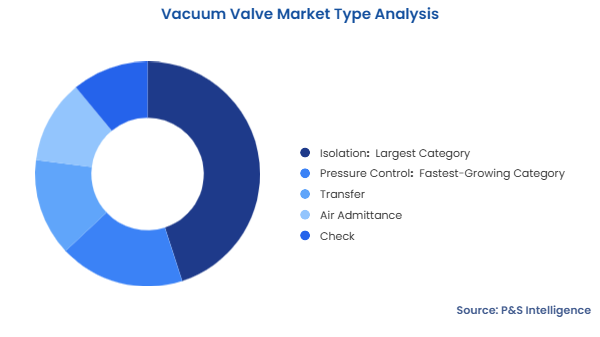
The isolation category holds the largest market share, of 45%, in 2025, driven by its critical role in separating different sections of vacuum systems during maintenance, leak detection, and process control.
The pressure control category will have the highest CAGR, of 9.2%, driven by the rising need for precise vacuum regulation in advanced manufacturing processes such as semiconductor etching and thin-film deposition.
The very high category will have the highest CAGR, of 9.4%, driven by increasing demand for ultra-clean environments in advanced semiconductor fabrication, nanotechnology, and precision research applications.
The semiconductors category holds the largest market share, of 25%, in 2025, due to extensive use of vacuum environments in fabrication processes such as etching, deposition, and lithography.
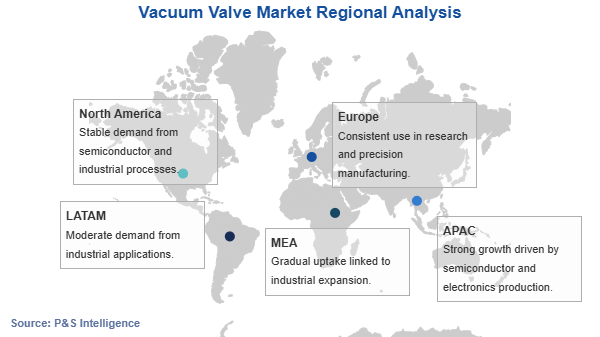
Asia-Pacific holds the largest market share, of 40%, in 2025, and it will have the highest CAGR, of 9.1%, driven by strong semiconductor, electronics, and display manufacturing across China, South Korea, Japan, and Australia.
Vacuum Valve Market Overview
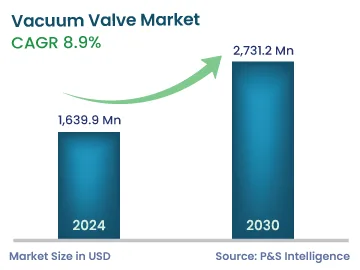
The vacuum valve market size was USD 1,769.5 million for 2025, and it will grow by 9.0% during 2026–2032, to reach USD 3,228.5 million by 2032.
This can be ascribed to the rise in the demand for semiconductors, flat-panel displays, pharmaceuticals, and thin-film coatings. The major market trends include the expanding use of IoT-integrated valves with the shift in the focus toward automation and improved maintenance, and usage of smart valves to replace out-of-date valves. Additionally, the rapid construction of new power plants, as well as the renovation of the existing ones, propels the demand for vacuum valves.
Vacuum systems need valves for isolation, pressure control, and gas flow direction. There are various types of vacuum valves, the choice of which depends on where and why they are needed. Their design differs as per the size, material, temperature limit, operational speed, actuation method, lifespan, pressure range, and outgassing. For instance, a solenoid is an electrically operated valve that creates a magnetic field through an electric current and uses this principle to open and close.
Integration of Smart and Automated Vacuum Valves Is Key Trend
The vacuum valve market is increasingly witnessing the integration of smart and automated systems, driven by the growing adoption of Industry 4.0 across manufacturing sectors. Modern vacuum valves are being equipped with sensors and digital control systems. Real-time monitoring and predictive maintenance capabilities are improving process efficiency across applications such as semiconductor fabrication and advanced electronics production. According to the International Federation of Robotics, global installations of industrial robots were around 542,000 units in 2024. This expansion of automation across manufacturing environments is making smart vacuum components an operational necessity.
In addition, manufacturers are focusing on developing electrically actuated and IoT-enabled vacuum valves that can be integrated into centralized control systems for enhanced operational precision. These systems reduce downtime and optimize energy consumption across critical processes while maintaining consistent vacuum conditions. Data from the SEMI indicates that global semiconductor equipment spending was USD 106.3 billion in 2023. This level of investment reflects the scale of highly automated fabrication facilities that rely on intelligent vacuum control technologies.
Burgeoning Demand for Consumer Electronics Is Biggest Driver
Flat-panel displays for consumer electronics are being produced at a higher rate than anticipated. In comparison to one containing cathode ray tubes (CRT), a flat-panel display is smaller, lighter, and uses less power. Vacuum and emission reduction equipment that can handle sizable processing chambers and supply high gas flow rates with good reliability is necessary for manufacturing flat-panel displays. Global consumer electronics demand remains strong, with annual smartphone shipments exceeding 1.2 billion units worldwide, supporting large-scale production of flat-panel displays and related components.
The surge in the global demand for semiconductors for electronic items is the key driver for the market in this regard. The semiconductor manufacturing process has multiple steps, one of which is vapor deposition. Moreover, there are different types of this process, each of which needs different degrees of vacuums. Deposition applications need high-vacuum turbo pumps and primary dry pumps, preferably those that have the lowest cost of ownership and longest process lifespan. The global semiconductor market exceeded USD 600 billion in 2024, driven by increasing demand for consumer electronics, artificial intelligence, and connected devices. Additionally, more than 70 new semiconductor fabrication facilities are planned or under development globally by 2030, further increasing the demand for advanced vacuum systems and valves used in fabrication processes.
Growing Adoption of Vacuum Technology in Emerging Industries Is Biggest Opportunity
The increasing application of vacuum technology across emerging industries such as electric vehicles, renewable energy, and advanced materials manufacturing is creating new growth opportunities for the vacuum valve market. Processes such as battery production, thin-film coating for solar panels, and advanced material processing require controlled vacuum environments to ensure product quality and efficiency. As these industries scale up globally, the demand for reliable and high-performance vacuum valves is expected to rise. According to the International Energy Agency, global electric car sales exceeded 14 million units in 2023. This rapid growth in electric vehicle production is expanding the application of vacuum-based processes in battery manufacturing.
In addition, the renewable energy sector is increasingly utilizing vacuum-based technologies, particularly in solar photovoltaic (PV) manufacturing, where thin-film deposition processes rely heavily on vacuum systems, supported by global clean energy transitions and investments in sustainable infrastructure. The International Renewable Energy Agency shows that global renewable power capacity increased by over 500 GW in 2023. This scale of expansion across industries that depend on vacuum processing technologies is opening new avenues for vacuum valve adoption.
High Cost and Maintenance Complexity of Vacuum Systems Is Key Restraint
The high cost associated with vacuum systems and their components poses a restraint on the growth of the vacuum valve market. Vacuum valves used in semiconductor, pharmaceutical, and advanced manufacturing applications are precision-engineered to operate under extreme pressure conditions. Specialized materials such as stainless steel and corrosion-resistant alloys are required in their construction. This material specification increases both initial investment and replacement costs. Small and medium-sized manufacturers face particular difficulty in adopting advanced vacuum systems at scale.
In addition, vacuum systems require ongoing maintenance, precision calibration, and skilled operation to sustain consistent performance and avoid contamination or system failure. According to Eurostat, electricity prices for non-household consumers in the European Union ranged between EUR 0.09-0.26 per kWh, depending on country and consumption levels, increasing operational costs for energy-intensive systems such as vacuum equipment. The complexity of maintaining ultra-high vacuum environments increases operational costs and downtime risks, particularly for industries with continuous production requirements. This level of operational expenditure reflects the cost of running and maintaining complex industrial systems, thereby constraining adoption in cost-sensitive markets.
Vacuum Valve Market Segmentation Analysis
Type Analysis
The isolation category holds the largest market share, of 45%, in 2025, driven by its critical role in separating different sections of vacuum systems during maintenance, leak detection, and process control. They are extensively used in semiconductor fabrication, pharmaceutical processing, and industrial vacuum systems, where maintaining system integrity is essential. Semiconductor and advanced manufacturing processes operate through multiple sequential stages under controlled vacuum conditions, where isolation valves are required to prevent contamination across different processing chambers. According to U.S. Department of Energy, advanced manufacturing processes increasingly rely on controlled vacuum environments to improve product quality and reduce contamination, reinforcing the importance of isolation mechanisms across production stages.
The pressure control category will have the highest CAGR, of 9.2%, driven by the rising need for precise vacuum regulation in advanced manufacturing processes such as semiconductor etching and thin-film deposition. These valves facilitate real-time pressure adjustments, enhancing process stability, production accuracy, and overall yield in high-tech industries.
The types analyzed in this report are:
Isolation (Largest Category)
Pressure Control (Fastest-Growing Category)
Transfer
Air Admittance
Check
Pressure Range Analysis
The high category holds the largest market share, of 60%, in 2025, due to its widespread use in semiconductor manufacturing, coating processes, and industrial vacuum systems. Applications such as deposition and etching operate predominantly within this pressure range, driving consistent demand for high vacuum valves.
The very high category will have the highest CAGR, of 9.4%, driven by increasing demand for ultra-clean environments in advanced semiconductor fabrication, nanotechnology, and precision research applications. As industries move toward smaller node sizes and high-precision manufacturing, the adoption of ultra-high vacuum systems is accelerating, supporting strong growth in this segment. According to the International Roadmap for Devices and Systems, semiconductor manufacturing is advancing toward sub-5 nm node technologies, which require ultra-high vacuum conditions to ensure atomic-level precision and defect control.
The pressure ranges analyzed in this report are:
Low to Medium (>10.3 torr)
High (10.3 to 10.8 torr) (Largest Category)
Very High (<10.8 torr) (Fastest-Growing Category)
Application Analysis
The semiconductors category holds the largest market share, of 25%, in 2025, due to the extensive use of vacuum environments across multiple fabrication processes, including etching, deposition, and lithography. Vacuum valves are critical in maintaining precise pressure conditions and contamination-free environments required for chip manufacturing.
The flat-panel display manufacturing category will have the highest CAGR, of 9.3%, driven by increasing demand for smartphones, televisions, and advanced display technologies such as OLED and LCD panels. These manufacturing processes rely heavily on vacuum systems for thin-film deposition and coating applications. Growing production volumes of OLED and LCD panels are directly increasing the use of vacuum-based deposition systems, resulting in higher demand for vacuum valves across display manufacturing facilities.
Drive strategic growth with comprehensive market analysis
Vacuum Valve Market Geographical Analysis
Asia-Pacific Vacuum Valve Market Size
Asia-Pacific holds the largest market share, of 40%, in 2025, and it will have the highest CAGR, of 9.1%, due to its strong concentration of semiconductor fabrication, electronics manufacturing, and display production across China, South Korea, Japan, and Australia. China alone contributes over 25% of global electronics exports, establishing it as the leading center for large-scale electronics production, where vacuum-based processes are extensively used across semiconductor and display manufacturing.
South Korea is accelerating growth through strong government-backed semiconductor initiatives. Under national strategies, the government is committing over 8.6 trillion won (≈USD 6.5 billion) in 2026 toward strategic technologies, including semiconductors, along with large-scale policy financing support for industry expansion. Additionally, Australia is strengthening its position through national semiconductor development plans, with proposals to stimulate around AUD 5 billion in semiconductor manufacturing activity supported by AUD 1.5 billion in government investment and incentives, focusing on building domestic capabilities and advanced manufacturing infrastructure.
China Vacuum Valve Market Size
China is the largest market for vacuum valves due to its dominant position in global electronics manufacturing and rapid expansion of semiconductor production capacity. The country serves as a major hub for consumer electronics, display panels, and industrial manufacturing, all of which rely heavily on vacuum-based processes such as deposition, etching, and coating. Strong domestic demand and export-oriented production further drive large-scale adoption of vacuum systems across industries.
The Chinese government continues to actively support semiconductor and advanced manufacturing growth through initiatives such as Made in China 2025, which prioritizes self-sufficiency in high-tech industries. China’s semiconductor industry generated approximately USD 179.5 billion in revenue in 2023, reflecting its large-scale manufacturing base. Additionally, the country has established a national semiconductor investment fund of about USD 47.5 billion, aimed at strengthening domestic chip production and supply chain capabilities.
India Vacuum Valve Market Size
India is emerging as one of the fastest-growing markets for vacuum valves due to rapid expansion in electronics manufacturing and the development of a domestic semiconductor ecosystem. Increasing demand for consumer electronics, automotive electronics, and data infrastructure is driving the need for advanced manufacturing processes that rely on vacuum systems. The Government of India is actively supporting this growth through initiatives such as the India Semiconductor Mission, which aims to strengthen local chip production and reduce import dependency. The mission has an approved outlay of INR 76,000 crore (approximately USD 10 billion) to support semiconductor and display manufacturing infrastructure.
In addition, rising investments in semiconductor fabrication, assembly, and testing facilities are accelerating industrial capacity expansion across the country. India’s semiconductor market is valued at around USD 45–50 billion in 2024–25 and is projected to grow at a strong pace, driven by increasing adoption of digital technologies and government-backed incentives. Furthermore, total approved investments in semiconductor-related projects have exceeded INR 1.6 lakh crore (around USD 19 billion), reflecting the scale of ongoing development. This expanding semiconductor and electronics manufacturing base is directly increasing the requirement for vacuum systems and associated valve technologies across new and upcoming facilities.
The regions and countries of the market are as follows:
North America
U.S. (Larger Country Market)
Canada (Faster-Growing Country Market)
Europe
Germany (Largest Country Market)
U.K. (Fastest-Growing Country Market)
France
Italy
Spain
Rest of Europe
Asia-Pacific (Largest and Fastest-Growing Regional Market)
China (Largest Country Market)
India (Fastest-Growing Country Market)
Japan
South Korea
Australia
Rest of APAC
Latin America
Brazil (Largest Country Market)
Mexico (Fastest-Growing Country Market)
Rest of LATAM
Middle East and Africa
Saudi Arabia (Largest Country Market)
South Africa
U.A.E. (Fastest-Growing Country Market)
Rest of MEA
Vacuum Valve Market Share Analysis
The market is semi-consolidated, reflecting a combination of concentrated and fragmented characteristics across different application areas. High-tech industries such as semiconductors and advanced electronics are dominated by a limited number of specialized players, primarily due to stringent precision requirements and high technological barriers. In contrast, broader industrial sectors, including chemicals, food processing, and general manufacturing, consist of numerous regional and mid-sized manufacturers, contributing to a more diverse competitive landscape. Additionally, variations in application requirements and cost sensitivity across industries further influence the presence of both global leaders and regional suppliers within the market.
Top Manufacturers in the Vacuum Valve Market:
HVA LLC
Pfeiffer Vacuum Technology AG
SMC Corporation
Agilent Technologies, Inc.
KITZ Corporation
Kurt J. Lesker Company
ULVAC, Inc.
VAT Group AG
MKS Instruments, Inc.
Atlas Copco AB
CKD Corporation
INFICON Holding AG
Vacuum Valve Market News
In March 2026, KITZ Corporation announced the acquisition of V TEX Corporation to strengthen its semiconductor-focused vacuum valve business and expand product competitiveness.
In February 2026, Atlas Copco AB announced the acquisition of LACO Technologies, a U.S.-based provider of vacuum systems and leak detection solutions, to enhance its vacuum technology offering and expand its presence in advanced applications.
In April 2024, Atlas Copco AB acquired Presys Co., Ltd., a manufacturer of vacuum valves, to strengthen its semiconductor portfolio and expand vacuum valve capabilities.
Frequently Asked Questions About This Report
What is the current size of the vacuum valve market?+
The vacuum valve market was valued at USD 1,769.5 million in 2025.
What is the growth rate of the vacuum valve market?+
The market is growing at a CAGR of 9.0% over the forecast period.
Which region dominates the vacuum valve market?+
Asia-Pacific dominates the vacuum valve market.
What is driving the growth of the vacuum valve market?+
Key growth drivers include rising semiconductor demand, expansion of pharmaceutical production, increasing use of vacuum systems in industrial processes, and technological advancements in precision control systems.
What are the key trends shaping the vacuum valve market?+
The market is being shaped by trends such as increasing adoption of smart and automated vacuum valves, integration of IoT for real-time monitoring, and growing demand for ultra-high vacuum systems.
Want a report tailored exactly to your business need?
Leading companies across industries trust us to deliver data-driven insights and innovative solutions for their most critical decisions. From data-driven strategies to actionable insights, we empower the decision-makers who shape industries and define the future. From Fortune 500 companies to innovative startups, we are proud to partner with organisations that drive progress in their industries.
Client Testimonials
Working with P&S Intelligence and their team was an absolute pleasure – their awareness of timelines and commitment to value greatly contributed to our project's success. Eagerly anticipating future collaborations.
McKinsey & Company
India
Unmatched Standards
Our insights into the minutest levels of the markets, including the latest trends and competitive landscape, give you all the answers you need to take your business to new heights
Complete Data Security
We take a cautious approach to protecting your personal and confidential information. Trust is the strongest bond that connects us and our clients, and trust we build by complying with all international and domestic data protection and privacy laws