Key Highlights
| Study Period | 2019 - 2032 |
| Market Size in 2024 | USD 31.9 Billion |
| Market Size in 2025 | USD 33.4 Billion |
| Market Size by 2032 | USD 49.7 Billion |
| Projected CAGR | 5.9% |
| Largest Region | South |
| Fastest Growing Region | West |
| Market Structure | Fragmented |

| Study Period | 2019 - 2032 |
| Market Size in 2024 | USD 31.9 Billion |
| Market Size in 2025 | USD 33.4 Billion |
| Market Size by 2032 | USD 49.7 Billion |
| Projected CAGR | 5.9% |
| Largest Region | South |
| Fastest Growing Region | West |
| Market Structure | Fragmented |
|
Explore the market potential with our data-driven report
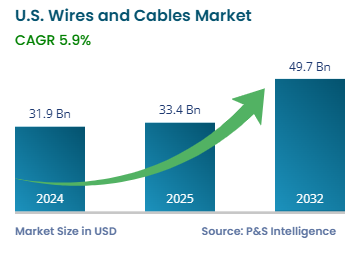
The U.S. wires and cables market size was USD 31.9 billion in 2024, and it will grow by 5.9% during 2025-2032, to reach USD 49.7 billion by 2032.
The market is driven by infrastructure development, improvement in communication technologies, and increasing demand for renewable energy. The growing trend of solar and wind energy sources is driving demand for power transmission capable of supporting high and ultra-high voltages. Moreover, the requirement for specialized cables, such as control cables and fiber-optic cables, is propelled by the growing demand for electric vehicles and expansion of EV charging infrastructure. The rise in population, along with suburban and commercial real estate growth, drives the demand for energy and telecom infrastructure. According to reports, in 2024, the U.S. population spent over USD 19 trillion, which raised the demand for smart home services, EVs, and internet-connected gadgets, requiring a strong cable network. Moreover, the government started various initiatives under the Infrastructure Investment and Jobs Act, where they issued USD 73 billion to upgrade the power grid and USD 65 billion for broadband expansion.
While developing safety and building codes are uplifting, the replacement of old cables and upgrading cables, many policies, including the Infrastructure Investments and Jobs Act and the Energy Policy Act and energy efficiency programs, encourage the use of advanced cabling systems.
The low category held the largest market share, of 45%, in 2024 due to their broad usage in light applications, such as buildings, lighting, small machinery, and household appliances. The continuous growth in urban infrastructure and construction increases the demand for this category. According to the U.S. Census Bureau, construction investments in the country totaled USD 2,196.1 billion in March 2025.
The extra-high category will have the highest CAGR, of 5.9%, because of the high investments in cross-border power T&D, grid enhancement, and integration of renewable resources. These cables are essential in transmitting a large volume of electricity over longer distances with minimal loss. The growing trend of UHVDC transmission is a key driver for the market in this category.
The voltages analyzed in this report are:
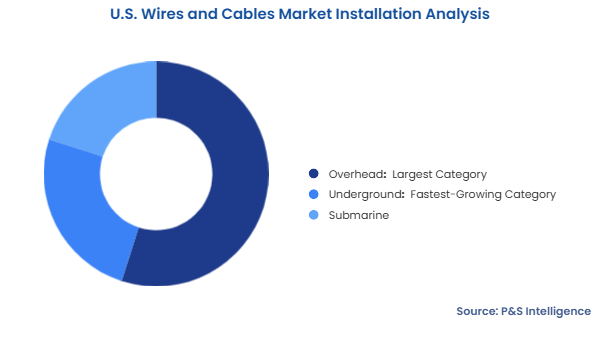
The overhead category held the largest market share, of 55%, in 2024, because they are cost-effective, easy to maintain, have lower installation costs, and preferred for high-voltage transmission. Overhead lines cost between USD 150,000 and USD 5 million per mile. Moreover, they are easier to install, inspect, and repair, leading to quicker outage recovery. They also support higher voltage levels and provide an extended lifespan of 80–100 years.
The underground category will have the highest CAGR, of 6%, due to the expansion of the 5G network and rising urban development needs. They are widely used in densely populated areas to reduce visual overload, enhance safety, and protect cables from adverse weather. The cost of underground lines can range from USD 1.1 million to USD 23 million per mile, which also justifies its fastest-growing nature in the market.
The installations analyzed in this report are:
The copper category held the largest market share, of 60%, in 2024, because of its strong thermal performance, electrical conductivity, durability, reliability, and low electrical resistance. These qualities make them perfect for high-efficiency applications, such as circuit boards, electric vehicles, buildings, power transmission, and consumer electronics.
The optical fiber category will have the highest CAGR, of 6.5%, due to the growing need for fast data transmission and the rising number of data centers. This conductor provides minimal signal loss and a high bandwidth, supports a wide range of frequencies, eliminates electrical interference, and maintains signal strength over long distances.
The conductor materials analyzed in this report are:
The polyvinyl chloride category held the largest market share, of 55%, in 2024, because of its affordability, flame resistance, and wide use in industrial, residential, and commercial sectors. Its adaptability for control cables, power cables, and telecom lines drives the demand for PVC insulation.
The cross-linked polyethylene category will have the highest CAGR, of 6.3%, because it provides strong resistance to impact, high temperatures, oil, acids, and alkalis. This makes them ideal for harsh environments, such as submarine installations, offshore applications, such as in oil rigs; and in the moist regions of the U.S.
The insulation materials analyzed in this report are:
The power transmission & distribution category held the largest market share, of 35%, in 2024, due to the growth of transmission projects, renewable integration, and rising energy demand in residential and commercial facilities. They are widely used for power distribution, low-voltage applications, building automation, HVAC and elevator systems, and EV charging readiness in residential and commercial areas.
The construction category will have the highest CAGR, of 6.2%, due to the rising commercial and residential infrastructure development activity, fueled by urbanization and public infrastructure initiatives. The growing use of low-voltage cables, smart infrastructure technologies, and electric systems, such as HVAC and EV chargers, is boosting the market growth in this category. Moreover, they are widely used for automating, securing, and powering buildings.
The end users analyzed in this report are:
Drive strategic growth with comprehensive market analysis
The South region held the largest market share, of 40%, in 2024 because of the rapid urbanization and large population in Florida and Texas. Moreover, the investments in oil, natural gas, and renewable energy projects and the expansion of the automotive, manufacturing, and power distribution sectors drive the market. For instance, in 2024, Texas added more than 560,000 people, reaching a population of over 31 million, which increases the need for energy and other kinds of infrastructure. Moreover, the fast industrial development in Miami and Houston is raising the demand for power and communication cables.
The West will have the highest CAGR, of 7%, because of the initiatives for renewable energy, such as wind and solar, which increase the demand for specialized cables. This region is also upgrading its power grids and telecommunication networks. CAISO, California’s grid operator, plans to invest USD 6.1 billion by 2035 to boost power supply and integrate over 38GW of new solar and 4.7 GW of offshore wind energy.
The geographical breakdown of the market is as follows:
The market is fragmented because of the existence of numerous players, such as Belden Inc., Amphenol, Southwire Company, and OFS. Many of them provide specialized products for the energy, telecommunications, and construction industries. Other factors contributing to the market fragmentation are the varying requirements in urban and rural areas, growing data networks, and expansion of 5G networks. Many companies focus on niche markets, such as smart infrastructure and renewable energy, which creates competition and prevents control by the big players.
Want a report tailored exactly to your business need?
Request CustomizationLeading companies across industries trust us to deliver data-driven insights and innovative solutions for their most critical decisions. From data-driven strategies to actionable insights, we empower the decision-makers who shape industries and define the future. From Fortune 500 companies to innovative startups, we are proud to partner with organisations that drive progress in their industries.

Working with P&S Intelligence and their team was an absolute pleasure – their awareness of timelines and commitment to value greatly contributed to our project's success. Eagerly anticipating future collaborations.
McKinsey & Company
India
Our insights into the minutest levels of the markets, including the latest trends and competitive landscape, give you all the answers you need to take your business to new heights

We take a cautious approach to protecting your personal and confidential information. Trust is the strongest bond that connects us and our clients, and trust we build by complying with all international and domestic data protection and privacy laws


Customize the Report to Align with Your Business Objectives

Request the Free Sample Pages