This Report Provides In-Depth Analysis of the U.S. Voice Recognition Software Market Report Prepared by P&S Intelligence, Segmented by Technology (Artificial Intelligence (AI) Based, Non-Artificial Intelligence Based), Deployment (On-Cloud, On-Premise), Function (Automatic Speech Recognition (ASR), Text-to-Speech (TTS), Speaker Identification and Verification), Industry (Automotive, Banking, Financial Services, & Insurance, Education, Enterprise, Government, Healthcare, Legal, Military, Retail & Consumer Goods), and Geographical Outlook for the Period of 2019 to 2032
U.S. Voice Recognition Software Market Revenue Scope
Key Highlights
Study Period
2019 - 2032
Market Size in 2024
USD 4.6 Billion
Market Size in 2025
USD 5.2 Billion
Market Size by 2032
USD 13.4 Billion
Projected CAGR
14.5%
Largest Region
West
Fastest Growing Region
Northeast
Market Structure
Fragmented
Market Size
Major Companies
Important Takeaways
Market Size and Forecast
Industry Trend
Regulatory Landscape
Demand Trend Analysis
Companies Recent Strategical Developments
Key Stakeholders
Voice of Industry Experts/KOLs
Future Opportunity
Explore the market potential with our data-driven report
U.S. Voice Recognition Software Market Overview
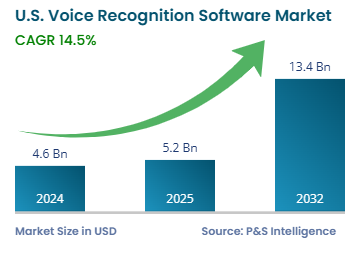
The size of the U.S. voice recognition software market in 2024 was USD 4.6 billion, and it will reach USD 13.4 billion by 2032 at a CAGR of 14.5% during 2025–2032.
This market demonstrates substantial growth because businesses and consumer sectors embrace voice-activated technologies across their operations. The popularity of voice recognition software is growing in mobile phones, smart speakers, and car audio systems. Market development has accelerated because people shifted to remote work while relying more heavily on devices like Amazon Alexa and Apple Siri and Google Assistant. The voice-enabled applications rising in customer service together with healthcare and education sectors will boost market growth since businesses seek automation technology that enables enhanced efficiency and user experience.
This market will get benefit in the future expansion because artificial intelligence and machine learning developments will help in improving the accuracy and functionality. The market will experience substantial growth mainly because enterprises alongside automotive manufacturers and healthcare organizations steadily increase their demand for hands-free technology. Voice data security continues to be a concern for consumers thus companies will dedicate resources to enhance protection mechanisms to preserve trust and regulatory compliance.
U.S. Voice Recognition Software Market Growth Factors
Rising Integration in Smart Vehicles Is Major Trend in Market
The growth in the sale of autonomous and connected vehicles creates rising demand for hands-free infotainment controls, as well as navigation systems and calling.
Voice recognition technology in connected cars across the U.S. is becoming increasingly mainstream, shifting from a premium feature to a standard component in many vehicles.
As per industry experts, more than 38 million vehicles in the U.S. were equipped with voice recognition systems by 2024.
This rise is driven by consumer demand for safer, hands-free control and seamless integration with smartphones.
Initially used for navigation and phone calls, voice commands are now expanding into secondary functions like adjusting climate controls, managing music playback, sending messages, and operating vehicle features such as windows and seat heaters.
There is a clear trend toward more conversational, natural language interfaces, reflecting user preference for intuitive interactions over rigid commands.
Younger drivers tend to use voice tech more broadly—especially for entertainment and communication—while older drivers focus on practical tasks.
At the same time, privacy concerns are growing as voice systems become more connected and data-reliant, prompting some users to disable always-on features.
Automakers are responding by partnering with tech firms to improve speech accuracy and enhance trust.
Expanding Application across Industries Drives Market
The technology of voice recognition continues to establish itself deeply inside different electronic devices, including mobile phones, smart home assistants, and fitness wearables.
As per studies, in 2024, over 120 million smart speakers were bought by U.S. households.
The development of artificial intelligence and natural language processing creates a strong voice recognition software, which performs more accurately and provide a better user experience.
The demand for voice recognition software solutions in security applications has increased because voice biometrics prove to be a more-secure authentication method.
Customer service companies have rapidly started using voice recognition technology as an integral part of their operations.
The increasing uptake of voice-activated chatbots and interactive voice response (IVR) systems drives the market.
Voice recognition technology finds expanding usage across multiple business sectors, such as finance, healthcare, automotive, and customer service, to produce operational enhancements and better user experiences and cut costs.
Call-center voice authentication can reduce average handling time by up to 50%.
Healthcare facilities use integration of hands-free voice recognition software to handle documentation as well as patient records while enabling voice-operated diagnostics which enhances productivity and decreases administrative work.
Roughly 72,000 healthcare providers in the U.S. had deployed voice-enabled electronic health record systems by 2024.
The rising adoption of accessible voice technologies receives support from regulatory bodies especially in banking and healthcare sectors thus creating market demand for voice authentication and compliance solutions.
Approximately 60 % of major U.S. contact centers had adopted voice authentication by 2023.
The fusion of e-commerce platforms with digital payments providers through voice recognition technology enables smooth secure payments which leads to more customers and greater market adoption.
Organizations use voice, facial, and gesture recognition features to develop intuitive touchless interfaces for retail, smart home, and gaming applications.
U.S. Voice Recognition Software Market Segmentation and Category Analysis
Insights by Technology
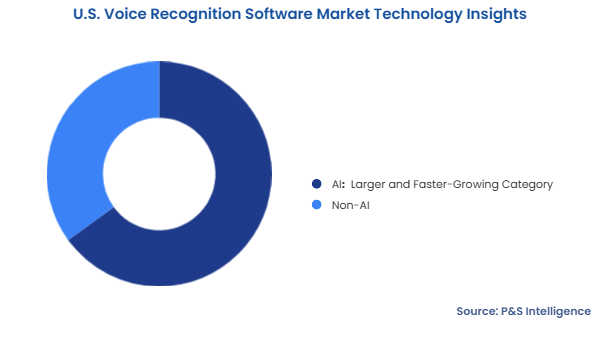
AI dominates the market with a share of 65%, and it has the higher CAGR, of 14.8%, led by the continuous advancements in machine learning and natural language processing. Artificial intelligence plays a crucial role in improving the accuracy, adaptability, and to provide good overall user experience. Computing systems that receive artificial intelligence power now show improved ability to recognize subtle speech characteristics and handle various speech patterns and intricate language patterns which drives widespread acceptance across different business fields. Voice recognition technology is widely used in automotive infotainment, healthcare documentation, and customer service chatbots.
The technologies analyzed here are:
AI (Larger and Faster-Growing Category)
Non-AI
Insights by Deployment
Cloud is the larger category, with 60% share, and also the faster-growing, with 14.9% CAGR. Modern organizations favor cloud-based solutions because they provide scalability and flexible services along with price effectiveness that enables remote access to voice recognition features without large on-site facilities. The solutions offer real-time processing capabilities with seamless integration into existing systems from any location which makes them very suitable for medical and customer service institutions and educational settings. Research indicates that the cloud-based segment will grow at a faster compound annual growth rate than on-premise solutions because businesses need AI applications and multilingual functions and voice command automation in multiple sectors.
The deployments analyzed here are:
Cloud (Larger and Faster-Growing Category)
On-Premises
Insights by Function
Automatic speech recognition dominates the market with a share of 70%, and it has the higher CAGR, of 14.9%. It allows users to interact with computers through speech recognition while converting vocal commands into written text because this functionality drives virtual assistants and both transcription systems and devices activated by voice commands. The market expands quickly because companies increasingly integrate ASR into smart devices, IoT systems, and hands-free applications. The recent advancements in AI and NLP also drive the market. Due to its capability to improve production and user satisfaction across different fields ASR functions as a fundamental element of voice recognition market technology.
The functions analyzed here are:
Automatic Speech Recognition (ASR) (Largest and Fastest-Growing Category)
Text-to-Speech (TTS)
Speaker Identification and Verification
Insights by Industry
Healthcare dominates the market with a share of 25%. Healthcare institutions have dramatically increased their adoption of voice recognition systems mainly because of three key requirements which include electronic health record management efficiency and voice-based clinical documentation together with virtual health assistant solutions. Doctors and medical professionals now adopt voice recognition software to complete administrative processes as well as provide enhanced healthcare management in addition to reducing their manual entry workloads.
Voice-enabled interfaces enable hands-free operations that specifically benefit medical staff who require continuous attention to patient care needs. These technologies help advance telemedicine and remote patient monitoring through their function of enhancing available communication channels for medical professionals to assist patients from different locations. Approximately 72,000 healthcare providers have integrated voice-enabled EHR systems to streamline clinical documentation and diagnostics.
Drive strategic growth with comprehensive market analysis
U.S. Voice Recognition Software Market Regional Growth Dynamics
The West region had the largest revenue share in 2024, of 35%, due to the presence of various technology cluster in Silicon Valley and Los Angeles. A significant number of technology organizations along with emerging businesses operate in this area which consistently develops advanced capabilities in AI artificial intelligence as well as machine learning and voice recognition systems. Rapid development in voice recognition software occurs within Western technology centers because major companies, particularly Google, Apple, and Amazon advance the industry through their innovative voice-activated products.
The regions analyzed here are:
Northeast (Fastest-Growing Region)
Midwest
West (Largest Region)
South
U.S. Voice Recognition Software Market Share
The market is fragmented due to the diversity of applications, technologies, and end-user industries involved. Multiple players—ranging from large tech firms to specialized startups—compete across sectors like healthcare, automotive, finance, and smart homes. Additionally, voice technologies vary in complexity, from basic speech-to-text systems to advanced AI-powered natural language processing and biometrics. Each vertical demands tailored solutions, leading to a wide spread of vendors targeting niche needs. The rapid pace of innovation, open-source frameworks, and frequent partnerships between hardware and software providers further contribute to a decentralized market landscape with no dominant single player.
Key U.S. Voice Recognition Software Companies:
Nuance Communications
Microsoft Corporation
Google LCC
Amazon.com, Inc.
Apple Inc.
International Business Machines Corporation
Speechmatics, Ltd.
Sensory, Inc.
SoundHound AI, Inc.
Verint Systems, Inc.
Pindrop, Inc.
Voci Technologies, Inc.
U.S. Voice Recognition Software Market News & Updates
In July 2025, Amplify, a publisher of school curricula and assessments, introduced of a tailored ASR system to enhance voice-enabled speech education products. It transforms spoken language into written text, enabling users to engage with educational software through voice commands, while providing comprehensive feedback on pronunciation, prosody, and additional aspects.
In March 2025, Northeastern University announced that it was developing an AI-integrated mobile application that will enable people with speech impairment issues to use personalized text-to-speech and speech recognition features.
In August 2024, SoundHound AI Inc. acquired Amelia to expand its scale and reach in conversational AI across new verticals and hundreds of enterprise brands.
In June 20, 2024 – SoundHound AI Inc. purchased several key assets from Allset, an online food ordering platform.
Want a report tailored exactly to your business need?
Leading companies across industries trust us to deliver data-driven insights and innovative solutions for their most critical decisions. From data-driven strategies to actionable insights, we empower the decision-makers who shape industries and define the future. From Fortune 500 companies to innovative startups, we are proud to partner with organisations that drive progress in their industries.
Client Testimonials
Working with P&S Intelligence and their team was an absolute pleasure – their awareness of timelines and commitment to value greatly contributed to our project's success. Eagerly anticipating future collaborations.
McKinsey & Company
India
Unmatched Standards
Our insights into the minutest levels of the markets, including the latest trends and competitive landscape, give you all the answers you need to take your business to new heights
Complete Data Security
We take a cautious approach to protecting your personal and confidential information. Trust is the strongest bond that connects us and our clients, and trust we build by complying with all international and domestic data protection and privacy laws