U.S. Synthetic Fiber Market Size & Share Analysis - Trends, Drivers, Competitive Landscape, and Forecasts (2025 - 2032)
This Report Provides In-Depth Analysis of the U.S. Synthetic Fiber Market Report Prepared by P&S Intelligence, Segmented by Product (Polyester, Nylon, Polyolefin, Acrylics, Carbon, Aramid, UHMWPE), Application (Clothing, Construction, Automotive, Filtration, Healthcare, Aerospace & Defense, Home Furnishing, Agriculture), and Geographical Outlook for the Period of 2019 to 2032
Explore the market potential with our data-driven report
U.S. Synthetic Fiber Market Overview
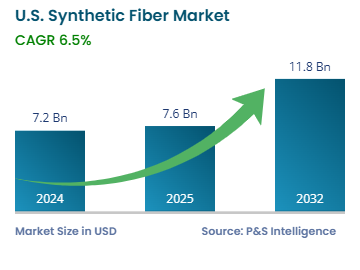
The U.S. synthetic fiber market size was USD 7.2 billion in 2024, and it will grow by 6.5% during 2025–2032, to reach USD 11.8 billion by 2032.
The market is primarily propelled by the increasing adoption of adaptive materials in multiple industries. These fibers offer higher strength, durability, and environment-friendliness, which drives their adoption in several applications, such as textile, automotive, packaging, and manufacturing, where performance and price are prime concerns.
In the automobile industry, fibers are playing an increasingly important part in reducing the weight and, therefore, the fuel efficiency of vehicles. These materials are used in seat covers and airbags, where lightweight yet strong materials are a necessity. As per the Department of Energy, a 10-kg reduction in the vehicle weight can raise fuel economy by up to 8%.
The increasing demand for protective and efficient packaging due to the boom in online shopping also propels the market. There is an immense push for sustainable alternatives, such as bioplastics and recycled fibers, with the tightening regulations on single-use plastic and foam products.
U.S. Synthetic Fiber Market Dynamics
Growing Attention to Sustainability Is Key Trend
The increasing concern for the environment and strict restrictions on plastic waste and emissions compel producers to adopt more-sustainable alternatives.
This factor drives the production and consumption of recycled fibers, such as rPET, also known as recycled polyester.
Bio-based alternatives are seeing a growing interest across industries owing to their potential to lower the reliance on fossil fuels.
Players are investing in new solutions, including closed-loop recycling systems and low-ecological-impact manufacturing technologies, to meet consumer needs for greener products.
Producers of synthetic fibers are partnering with clothing and automotive manufacturers to boost the adoption of sustainable materials.
Synthetic fibers are finding widespread attention in the packaging, automotive, and textile industries owing to their green and sustainable characteristics.
As per the Environmental Protection Agency (EPA), the automotive sector is the largest GHG emitter in the country, with a share of 31% in 2023, and A typical car emits 4.6 tonnes of CO2 annually.
According to the Energy Information Administration (EIA), total emissions from motor gasoline and diesel consumption stood at 1,489 million tonnes in 2023.
Customers are now demanding recycled or biodegradable fibers, causing companies to shift toward post-consumer recycled and bio-based fibers.
New green polymers, specifically PLA and bio-nylon, are synthesized employing renewable sources, such as corn and sugarcane, as the feedstock, to reduce carbon footprints.
Post-consumer recycled PET and other synthetic fibers from textiles and packaging are recycled in substantial amounts, cutting the demand for virgin plastic feedstock.
Rising Demand for Lightweight and Durable Materials Are Key Driver
Nowadays, the automotive, aerospace, construction, and sportswear sectors are focusing on higher strength without additional weight.
Synthetic fibers, including polyester and nylon, are preferred in these sectors as they are strong, flexible, and resistant to wear and tear due to stretching and extreme environments.
In addition, lightweight synthetic fibers are becoming popular in seat covers, airbags, and other internal parts of automobiles for greater fuel efficiency and lower emissions.
In packaging and construction, synthetic fibers are increasingly substituting traditional materials, providing higher affordability and long-term benefits.
The demand for active and performance clothing raises the usage of synthetic fibers that can endure heavy physical exertions and weight yet are comfortable and light.
This trend is driven by the large number of people regularly engaging in sports or going to the gym.
Studies say that over 64 million people, or around 20% of the country’s population have an active gym membership.
Over 242 million people, which was 80% of the country’s population in the age group of 6 and above, participated in at least one sport in 2023.
Kevlar, Twaron, and ultra-high-molecular-weight polyethylene are among the most-widely used synthetic fibers in bulletproof vests, which are characteristics of the U.S. military and law enforcement sectors.
U.S. Synthetic Fiber Market Segmentation Analysis
Product Analysis
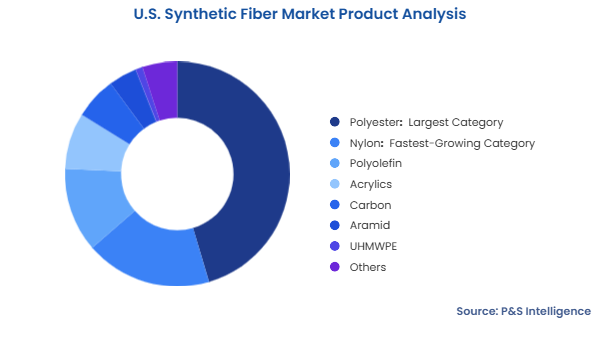
The polyester category held the largest market share, of 45%, in 2024, because of its cost-effectiveness and recyclability. With single-use plastic and foam product legislation becoming stricter, there is pressure to develop environment-friendlier alternatives, including bioplastics and recycled fibers.
The nylon category will have the highest CAGR, of 6.8%, during the forecast period because of its high abrasion resistance, flexibility, and hardness. Nylon consumption is burgeoning in the textile, industrial, and automotive industries for tire cords, airbags, and carpets. Nylon fits several environmental trends, and the advancements in bio-based substitutes further boost its growth in the market.
The products analyzed in this report are:
Polyester (Largest Category)
Nylon (Fastest-Growing Category)
Polyolefin
Acrylics
Carbon
Aramid
UHMWPE
Others
Application Analysis
The clothing category held the largest market share, of 40%, in 2024, as a result of the economy, resilience, and adaptability of man-made materials, such as polyester and nylon. They are utilized in all kinds of clothing since they can be processed to withstand shrinking, stretching, and wrinkling, thereby making them ideal for regular use. They aid in replicating the appearance of natural fibers at a lower expense, which makes them popular among manufacturers and users. Additionally, the growth in the trend of athleisure and fast fashion increases the demand for apparel made from synthetic fibers in the U.S.
The healthcare category will have the highest CAGR, of 6.5%, because of the growing application of synthetic fibers in biomedical devices, surgical gowns, face masks, implants, and filters. This is credited to the expanding spending on healthcare, improving technology for manufacturing textiles, and strengthening focus on sanitation and infection management. As per the Centers for Medicare and Medicaid Services (CMS), healthcare expenditure in the U.S. reached USD 4.9 trillion, or USD 14,570 per capita in 2023, rising by 7.5% YoY.
The applications analyzed in this report are:
Clothing (Largest Category)
Construction (Fastest-Growing Category)
Automotive
Filtration
Healthcare
Aerospace & Defense
Home Furnishing
Agriculture
Others
Drive strategic growth with comprehensive market analysis
U.S. Synthetic Fiber Market Regional Outlook
The South held the largest market share, of 45%, in 2024, because of the strong textile manufacturing base, good climate for agriculture-based raw materials, and easy access to major transportation points. North Carolina, Georgia, and Texas have been traditional textile hubs, while their huge populations drive the demand for textiles, construction materials, healthcare apparel, and auto furnishings.
The West will have the highest CAGR, of 7%, during the forecast period, due to the strong focus on technological innovation, green practices, and the location of large clothing and outdoor equipment companies. The rising demand for environment-friendly and high-performance fabrics in California and Oregon fuels the use of advanced synthetic fibers.
The geographical breakdown of the market is as follows:
Northeast
Midwest
South (Largest Category)
West (Fastest-Growing Category)
U.S. Synthetic Fiber Market Share
The market is fragmented because large firms, such as Koch Industries Inc., Indorama Ventures, and Reliance Industries, hold large shares, but still, numerous small-scale producers and local contenders influence the market dynamics. Fragmentation is essentially due to the diversity of synthetic fibers for clothing, automotive, healthcare, and industrial applications. This encourages specialized contestants to concentrate on certain segments. Technological development, particularly in bio-based and green synthetic fibers, has opened up multiple avenues for new entrants and niche players. The presence of local players, especially in the South and Midwest, adds to this fragmentation.
Key U.S. Synthetic Fiber Companies:
DuPont
Americhem, Inc.
Unifi, Inc.
Consolidated Fibers
Wellman Advanced Materials
Kraemer Textiles Inc.
Albany International Corp.
Celanese Corporation
Glen Raven, Inc
Natural Fiber Welding
Ambercycle
Milliken & Company
U.S. Synthetic Fiber Market News
In June 2025, Teijin Frontier Co. Ltd. announced the development of a next-generation stretch fabric with an extra-fine 3D structure with crimps of random sizes. Designed for sports and outdoor applications, the fabric is set to be launched in the fall/winter of 2026.
In Jun 2025, Dupont de Nemours Inc. announced that it has expanded its factory in Heredia, Costa Rica, by 16,000 square feet. The new production lines and extrusion equipment are aimed at meeting the growing demand for medical packaging, such as pouches, lids, and headers, made from Tyvek in the Americas.
In June 2025, Toyobo Co. Ltd. entered into a partnership with DMC Biotechnologies Inc. to conduct R&D on biomanufacturing technologies for plastics. The collaboration aims to create new compounds to create bioplastics by applying synthetic biology principles to microorganisms.
In April 2025, Toray Chemical Korea Inc. announced the use of its bio-circular carbon fibers by HEAD Sport GmbH to create its new BOOM RAW tennis racquets.
In March 2025, news surfaced that India was looking to source more apples and synthetic fibers from the U.S. amidst the efforts of both the countries to reach a trade deal.
In January 2025, The Lenzing Group expanded its LENZING Lyocell Fill portfolio, which is part of the TENCEL fiber family, announcing the launch at Heimtextil, held in Frankfurt, Germany, on January 14–17.
In June 2023, Ambercycle Inc. and Shinkong Synthetic Fibers entered into a partnership to increase the production of regenerated polyester yarns on a commercial scale with Ambercycle's Cycora technology.
Want a report tailored exactly to your business need?
Leading companies across industries trust us to deliver data-driven insights and innovative solutions for their most critical decisions. From data-driven strategies to actionable insights, we empower the decision-makers who shape industries and define the future. From Fortune 500 companies to innovative startups, we are proud to partner with organisations that drive progress in their industries.
Client Testimonials
Working with P&S Intelligence and their team was an absolute pleasure – their awareness of timelines and commitment to value greatly contributed to our project's success. Eagerly anticipating future collaborations.
McKinsey & Company
India
Unmatched Standards
Our insights into the minutest levels of the markets, including the latest trends and competitive landscape, give you all the answers you need to take your business to new heights
Complete Data Security
We take a cautious approach to protecting your personal and confidential information. Trust is the strongest bond that connects us and our clients, and trust we build by complying with all international and domestic data protection and privacy laws