U.S. Steel Rolling & Drawing Market Size & Opportunities Analysis - Growth Strategies, Competitiveness, and Forecasts (2025 - 2032)
This Report Provides In-Depth Analysis of the U.S. Steel Rolling & Drawing Market Report Prepared by P&S Intelligence, Segmented by Process Type (Hot Rolling, Cold Rolling, Drawing), Product Type (Flat Rolled Steel, Long Rolled Steel, Steel Tubes & Pipes, Steel Wire & Wire Rods, Specialty Shapes), Distribution channel (Distributors & Wholesalers, Fabricators & Wholesalers, Direct Sales), End-Use (Construction & Infrastructure, Automotive & Transportation, Oil & Gas, Manufacturing & Heavy Machinery, Electrical & Electronics, Aerospace & Defense), and Geographical Outlook for the Period of 2019 to 2032
U.S. Steel Rolling & Drawing Market Growth Potential
Key Highlights
Study Period
2019 - 2032
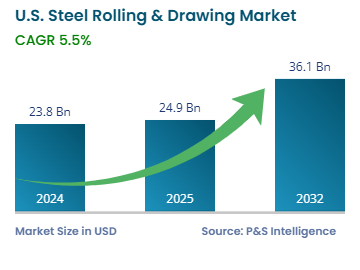
Market Size in 2024
USD 23.8 Billion
Market Size in 2025
USD 24.9 Billion
Market Size by 2032
USD 36.1 Billion
Projected CAGR
5.5%
Largest Region
Midwest
Fastest Growing Region
South
Market Structure
Consolidated
Market Size
Major Companies
Important Takeaways
Market Size and Forecast
Industry Trend
Regulatory Landscape
Demand Trend Analysis
Companies Recent Strategical Developments
Key Stakeholders
Voice of Industry Experts/KOLs
Future Opportunity
Explore the market potential with our data-driven report
U.S. Steel Rolling & Drawing Market Outlook
The U.S. steel rolling & drawing market size was USD 23.8 billion in 2024, and it will grow by 5.5% during 2025–2032, to reach USD 36.1 billion by 2032.
The market is driven by the growth in construction projects, advances in automotive lightweighting technologies, and increase in the demand for high-strength, durable steel in industrial applications. Government spending on creating domestic manufacturing and improving infrastructure in areas in the Infrastructure Investment and Jobs Act has also boosted the market. But challenges such as volatile raw materials prices, global trade dynamics and environmental regulatory framework do influence production and price trends.
The U.S. market for rolled and drawn steel is being driven by surging infrastructure investment including USD 550 billion from the Bipartisan Infrastructure Law targeting roads, bridges, transit, ports, and grid enhancements and by the CHIPS and Inflation Reduction Acts, which are boosting manufacturing construction and renewables deployment, as noted by the U.S. Department of Transportation and Department of Energy. Automotive remains another major consumer; rolled and specialty bar steels constitute roughly 40–50% of U.S. automotive steel usage, with annual light-duty vehicle production exceeding 15 million units according to the U.S. Energy Information Administration. Industrial manufacturing, energy projects, and shipbuilding also sustain robust demand.
The changes emerging within the U.S. steel sector in responding to economic and environmental imperatives involve advancements made in innovations for sustainable steel production and increasing adoption of the EAF technology. The segmentation of the market, important trends, the competitive landscape, and outlook are discussed in this report which seeks to identify and bring insights about opportunities and challenges shaping steel rolling and drawing in the Market.
U.S. Steel Rolling & Drawing Market Trends and Growth Drivers
Government Investments in Infrastructure Development Is Key Trend
The Steel Rolling and Drawing Market in the U.S. is growing at a phenomenal rate, especially with increasing infrastructure development through favoring governmental policies.
Indispensable legislative measures have really brightened the chances of funding the monumental rebuilding of the transportation networks, roads, bridges, and rail systems that the nation can fondly refer to.
This paves the way towards sustained demand for structural steel products.
Such initiatives have all that is required to call for large quantities of rolled steel sections, reinforcing bars, and heavy plates, to construct durable frameworks that modernize these various types of transport.
U.S. construction spending has surpassed a USD 2.1 trillion annual pace, with nonresidential outlays nearing USD 1.22 trillion in late 2024, expanding by roughly 5% year-over-year, according to the U.S. Census Bureau.
Manufacturing facility construction surged—up around 71% from 2022 to late 2023—driven by new semiconductor fabs, EV battery plants, and data centers.
Structural steel, including rolled beams and drawn bar products, is integral to these industrial megaprojects and key infrastructure initiatives such as bridge replacements and grid upgrades.
This robust industrial and infrastructure activity underpins strong demand for steel-intensive construction in the U.S. across the public and private sectors.
Metal product consumption continues to surge as distribution centers, technology campuses, and industrial facilities spring up at a frenetic pace in urban and suburban locales.
New opportunities in switch toward renewable energy infrastructure arise, with wind energy projects needing specialty steel plates for turbine towers and solar farms relying heavily on steel supports and framing systems.
Government investments aimed at revitalizing domestic manufacturing also played a very key role.
Policy initiatives to strengthen the industrial base of America lead to construction of advanced manufacturing facilities where substantial amounts of rolled and drawn steel components are used in their constructional and operational activities.
The synthesis of government investment with private sector development enables steel processors to reap maximum benefits, ensuring uninterrupted demand through various construction and industrial sectors.
The revived focus on the modernization of infrastructure and industrial development indicates that such drivers will continue to exist for some time to come.
Rising Demand from Automotive and Aerospace Industries Drives Market
The main industries that are promoting growth in the U.S. market for rolling and drawing steel are the automotive and aerospace industries.
Over 50% of a typical U.S.-built vehicle’s weight is steel, much of it supplied as rolled and drawn products.
The American Iron and Steel Institute notes automotive accounts for roughly 54% of sheet steel consumption and nearly half of specialty bar steel demand.
Advanced high-strength steel grades now comprise most structural components.
The use of rolled and drawn steels for lightweight and high-strength parts in manufacturing chassis frames, body panels, and reinforcements, has increased in the automotive industry.
There was a further increase in demand on the part of manufacturers to roll and draw steel to produce components with lightweight designs when the focus switched toward electric vehicles.
Use of high-performance steel products will also be pushed by stricter safety and emission regulations.
In the aerospace industry, critical structural components, including the landing gear, engine parts, or airframe reinforcements, necessitated the application of precision heat-treated steels.
In U.S. aerospace production, rolled steel (and especially aluminum‑lithium and titanium sheets/plates) forms over 70% of metallic airframe structures.
These products are critical for fuselage skins, wing spars, and bulkheads.
OEMs rely on certified rolled and drawn materials for structural integrity and fatigue resistance.
After the pandemic, with renewed travel and intensified defense spending, these production rates for the manufacture of aircraft are helping steel rolling and drawing suppliers.
High-value steel is of utmost priority for these two industries that is free from all sorts of defects and endowed with the most desirable mechanical properties so that the U.S. steel rolling and drawing market manufacturers continue innovations that meet these stringent requirements.
Hence, the collaboration of steel producers and automotive/aerospace companies is becoming increasingly strategic and supports sustainable long-term growth in this segment.
U.S. Steel Rolling & Drawing Market Segmentation Analysis
Process Type Analysis
The hot rolling category held the largest market share, of 55%, in 2024, due to the production process of primary steel products. It is used to shape steel under high temperatures for making structural components, such as I-beams, railroad tracks, and heavy plates, used in construction and the heavy industries. It is used for mass production because it processes bulk slabs of steel into standard forms efficiently. Currently, hot-rolled steel is used extensively for construction purposes, from bridges to energy pipelines, since its strength and durability are impressive.
The cold rolling category will grow at the highest CAGR, of 6%, due to the increasing demand for high-precision value-added steel products which drive this process. Unlike hot rolling, the process is conducted at room temperature, yielding steel that has much tighter tolerances, smoother surfaces, and superior mechanical properties the features of utmost importance in the automotive, appliance, and technology fields. The EV manufacturing boom has been one of the most significant contributors to growth as more and more automakers adopt cold-rolled advanced high-strength steel (AHSS) to decrease vehicle weight without compromising safety standards.
The process types analyzed in this report are:
Hot Rolling (Largest Category)
Steel
Plates
Rails
Cold Rolling (Fastest-Growing Category)
Precision sheets
Automotive Steel
Drawing
Wires
Tubes
Product Types Analysis
The flat rolled steel category held the largest market share, of 45%, in 2024. This is because the automotive industry requires extensive amounts of cold-rolled and galvanized steel sheets for the body, chassis, and other parts, to resist corrosion. Another major demand source is construction, where hot-rolled plates are used for erecting structures and coiled sheets for roofing and cladding applications. Their use covers versatile applications in consumer appliances; thinner gauges of steel are used in refrigerators, washing machines, and other domestic appliances; industrial equipment manufacturing, and infrastructure projects.
The steel tubes & pipes category will grow at the highest CAGR, during the forecast period. Developments in the energy sector have warranted some very strong demands for production traditional oil & gas pipeline projects and emerging clean-energy infrastructure need specialized tubular products. Renewable energy booms necessitate wind turbine support structures and solar farm mounting systems, while the modernization of water distribution networks and utility channels warrants the further growth of the market.
The materials analyzed in this report are:
Flat Rolled Steel (Largest Category)
Long Rolled Steel
Steel Tubes & Pipes (Faster-Growing Category)
Steel Wire & Wire Rods
Specialty Shapes
Distribution Channel Analysis
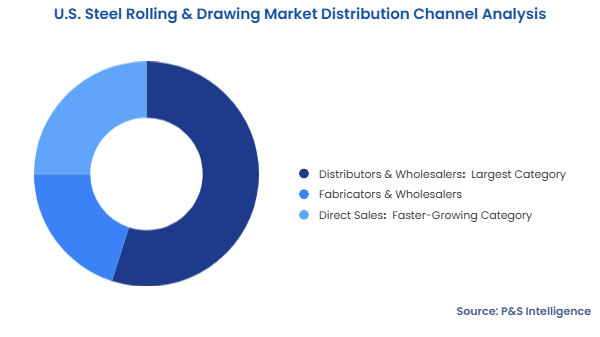
The distributors & wholesalers category held the largest market share, of 55%, in 2024, due to this critical role that the distributors link steel producers to the end customers. This channel has the ability to maintain large, diversified inventories of steel products sheets and coils, bars, and structural sections serving some sort of disparate demand across the construction, manufacturers, and small industrial customers. Value-added services like cutting, slitting, and just-in-time delivery have conferred some degree of convenience and flexibility that the mills are unwilling to directly offer for smaller orders.
The direct sales category will grow at the highest CAGR, of 6.5%, during the forecast period. This is because of the emergence of digital procurement platforms, where bulk transactions are conducted and the growing trend of needing personalized, higher-specification steel-e.g., advanced high-strength steel for EVs or corrosion-resistant alloys for infrastructure. Direct contracts with mills are preferred by tier-one manufacturers for ensuring supply chain reliability and technical collaboration on specialized products.
The distribution channels analyzed in this report are:
Distributors & Wholesalers (Largest Category)
Fabricators & Wholesalers
Direct Sales (Faster-Growing Category)
End Use Analysis
The construction & infrastructure category held the largest market share, of 35%, in 2024, because it enables the construction of new infrastructure from skyscrapers to bridges and highways, steel forms the fabric on which any developmental process takes place. Despite the slowdown in other industrial and market sectors, construction demand is always strong owing to the urbanization process, the need to replace aging infrastructure, and the absence of any slowdown in the promise of government public works projects. These all point to a very basic need in building and maintaining cities, meaning steel will always be in demand for construction applications. As per the U.S. Census Bureau, the May 2025 construction spending in the country stood at USD 2,138.2 billion.
The automotive & transportation category will grow to the highest CAGR, because the transition to electric vehicles will also require new steel components. At the same time, advanced high-strength steels are being developed to make vehicles lighter and safer. The development of new needs for steel has created opportunities with rolling and drawing mills that make this the most dynamic segment in the market as automakers build new plants and retool their existing plants around the country. U.S. automotive production remains over 10 million light vehicles assembled annually, according to the U.S. Energy Information Administration.
Drive strategic growth with comprehensive market analysis
U.S. Steel Rolling & Drawing Market Regional Growth Dynamics
The Midwest held the largest market share, of 35%, in 2024, of its vibrant industrial culture and concentration of steel-making infrastructure. Often called the "Steel Belt", plays host to major integrated steel mills and mini-mills from renowned steelmakers such as Cleveland-Cliffs and Nucor. Indiana, Ohio, and Pennsylvania are therefore the main states critical for steel production, feeding rolled and drawn products into many different sectors.
The south category will grow at the highest CAGR, during the forecast period, because of the industrial development with favorable economic conditions constituting the unique nourishment for this growth. The growth in automotive manufacturing in Alabama, Tennessee, and Texas, massive investments in energy infrastructure along the Gulf Coast, and increasing commercial and residential construction in fast-growing metropolitan areas drive the market. A business-friendly environment, low operating costs, and favorable work laws attract considerable foreign direct investment for manufacturing plants here.
The geographical breakdown of the market is as follows:
Northeast
West
Midwest (Largest Category)
South (Fastest-Growing Category)
U.S. Steel Rolling & Drawing Market Competitive Landscape
The market share is consolidated because of several very simple economic and industrial issues. Quite clearly, steel is a capital-intensive industry, so entry is prohibitively expensive for almost any large player, let alone the average company that could afford a billion-dollar match. The integrated producers are getting huge economies of scale because such a kind of economy enables them to decouple fixed costs into enormous volumes of output, which gives them such a competitive advantage compared to small-scale manufacturers. Hot-rolled coils are basically basic steel commodities, with competition coming from price and production efficiencies, so consolidation is reinforced.
Key U.S. Steel Rolling & Drawing Companies:
Nucor Corporation
Cleveland-Cliffs
Steel Dynamics, Inc.
U.S. Steel
Insteel Industries
Davis Wire Corporation
Ryerson Holding Corporation
EMJ Corporation
Webco Industries
American Piping Products
Hanna Steel Corporation
Maverick Tube Corporation
U.S. Steel Rolling & Drawing Market News
In May 2025, American Steel Products announced the receipt of a contract from the U.S. Department of Defense to set up a hot reversing rolling mill to produce high-strength alloys capable of witnessing temperatures of up to 2,500 °F.
In March 2025, Kyoei Steel Ltd., through its U.S.-based subsidiary Vinton Steel LLC, contracted POMINI Long Rolling Mills to set up a new bar rolling mill in the city of El Paso, in Texas.
In June 2024, JSW Steel USA Inc., the U.S.-based subsidiary of India’s JSW Steel Ltd., announced plans to invest USD 110 million in steel plate mill modernization in Baytown, Texas.
In December 2023, Nippon Steel Corporation agreed to acquire U.S. Steel for US 14.9 billion.
In December 2023, Ryerson Holding Corporation acquired Hudson Tool Steel Corporation, a supplier of tool steels, high-speed steels, carbon steels, and alloy steels. Through this acquisition, Ryerson hoped to strengthen its presence in the tool-steel market and add to its range of tool steels.
Want a report tailored exactly to your business need?
Leading companies across industries trust us to deliver data-driven insights and innovative solutions for their most critical decisions. From data-driven strategies to actionable insights, we empower the decision-makers who shape industries and define the future. From Fortune 500 companies to innovative startups, we are proud to partner with organisations that drive progress in their industries.
Client Testimonials
Working with P&S Intelligence and their team was an absolute pleasure – their awareness of timelines and commitment to value greatly contributed to our project's success. Eagerly anticipating future collaborations.
McKinsey & Company
India
Unmatched Standards
Our insights into the minutest levels of the markets, including the latest trends and competitive landscape, give you all the answers you need to take your business to new heights
Complete Data Security
We take a cautious approach to protecting your personal and confidential information. Trust is the strongest bond that connects us and our clients, and trust we build by complying with all international and domestic data protection and privacy laws