Key Highlights
| Study Period | 2019 - 2032 |
| Market Size in 2024 | USD 2.2 Billion |
| Market Size in 2025 | USD 2.4 Billion |
| Market Size by 2032 | USD 5.5 Billion |
| Projected CAGR | 12.2% |
| Largest Region | West |
| Fastest Growing Region | South |
| Market Structure | Fragmented |

| Study Period | 2019 - 2032 |
| Market Size in 2024 | USD 2.2 Billion |
| Market Size in 2025 | USD 2.4 Billion |
| Market Size by 2032 | USD 5.5 Billion |
| Projected CAGR | 12.2% |
| Largest Region | West |
| Fastest Growing Region | South |
| Market Structure | Fragmented |
|
Explore the market potential with our data-driven report
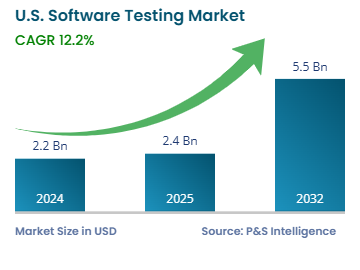
The U.S. software testing market size stood at USD 2.2 billion in 2024, and it is expected to grow at a CAGR of 12.2% during 2025–2032, to reach USD 5.5 billion by 2032.
This growth occurs because of the increased requirement to enhance software quality and security as companies carry out digital transformation at an accelerated pace. Businesses across various sectors require rigorous testing techniques such as DevOps to ensure that their software functions well and offers good security with robust performance. Organizations are employing various types of test methodologies and test automation to create software at a quicker pace while operating CI/CD processes. Most organizations employ cloud testing services to facilitate hybrid and multi-cloud environments since these systems offer scalable and flexible testing capacities. Motivated companies choose managed and crowdsourced testing methods as a way to spend their quality assurance funds wisely. Companies specializing in BFSI healthcare e-commerce and automotive benefit market progress because they must follow strict rules and handle advanced software applications.
AI-based test automation solutions are making software testing faster and more accurate, decreasing human effort and time-to-market. With growing incidence of cyberattacks and tight regulatory standards, organizations are making investments in effective security testing to protect applications and data. Increased cloud computing and SaaS adoption requires cloud testing for maximum performance, scalability, and security. Ongoing growth in mobile apps and IoT devices has promoted the demand for full-fledged mobile application testing to improve user experience and reliability.
The majority of companies put more than half of their workloads into cloud environments. Around 80% of organizations report improved operational efficiency, and roughly 94% of SMBs recognize enhanced security as a benefit of cloud usage.
Software is the larger category, with 55% value share in 2024, because companies embrace automated testing to boost software quality while minimizing market delivery times. Organizations from different business sectors allocate resources to acquire functional testing tools which include system testing unit testing and regression testing to provide smooth software delivery and user satisfaction. The demand for sophisticated testing solutions continues to rise because of complex software development and agile or DevOps practices and the requirement for non-stop testing cycles. Businesses now favor cloud-based and AI-driven testing platforms and software testing tools remain the market leader since they offer efficiency, scalability, and reliability in the software development lifecycle.
These components were analyzed:
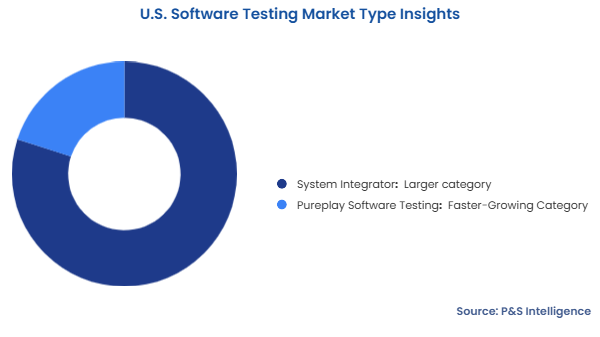
The system integrator category is the larger, with a revenue share of 80% in 2024. System integrators serve the market most critically by delivering complete testing solutions that include diverse testing areas across functional and performance and security as well as compliance testing. System integrators combine different testing instruments with methodological approaches to build integrated frameworks that guarantee software applications maintain the best possible quality standards. System integrators work hand-in-hand with businesses through close assessment of their requirements to develop testing solutions that match development approaches and organizational targets.
The types covered in this report are:
The web-based category dominates the market with a revenue share of 75% in 2024. Because Industrial organizations operating across sectors such as finance, healthcare, and retail as well as education heavily rely on web-based applications therefore testing must focus on security alongside functionality as well as performance assessment. Testing web-based applications requires in-depth examination of different user environments because users confront various platforms which leads to essential testing for compatibility resolution and smooth user interfaces. The increasing need for dependable web applications has spurred organizations to embrace sophisticated testing methods and tools that verify applications match the specifications of the industry as well as user requirements.
These are the industries that were analyzed:
B2B accounted for the larger revenue share, of around 55%, in 2024, and this category is further expected to maintain its position during the forecast period. Business operations benefit from B2B software testing services, which supply organizations and enterprises with thorough testing solutions for assuring application quality while maintaining reliability and security. These services deliver multiple testing types which include functional testing together with performance testing security testing and compliance testing. Businesses that use B2B testing providers receive specialized testing solutions by working together to customize them according to their development processes with alignment to their organizational objectives. The demand for high-quality software in important business applications such as ERP, CRM, and financial software drives the need for regular testing.
Here are the type categories covered in the report:
The male category holds the larger share, of 70%. Software testing as well as the overall tech sector traditionally employed more male professionals so this category emerged as dominant. Several factors supported the high prevalence of males in technical work including initial STEM exposure as well as cultural attitudes and professional openings. The software testing industry's existing practices, methodologies, and innovations have greatly developed due to the active male involvement in this sector.
The following are the genders studied in the report:
The IT sector accounted for the larger revenue share, of around 35%, in 2024, and this category is further expected to maintain its position during the forecast period. This is because of ongoing advances in software development along with cloud computing and digital transformation programs. The implementation of DevOps, along with agile methodologies and automation by businesses, makes software testing an indispensable element for IT operations that delivers seamless performance and security with scalable features.
Types of applications covered in the report are:
Drive strategic growth with comprehensive market analysis
The Western region dominates the market with 35% share. The technology hubs located in Silicon Valley drive a technology-oriented and wealthy user population to perform extensive software testing activities. The Western region dominates the marketplace through its computerized structure along with its high number of smartphone users and central location of technological organizations. Leading software firms operating alongside a culture of digital communication make the Western part of the U.S. the strongest revenue generator among all regions of the U.S. software testing market.
The Western U.S., particularly California, is a global tech powerhouse led by Silicon Valley. It hosts major software firms, innovative startups, and cloud infrastructure leaders. The region emphasizes AI, cybersecurity, SaaS, and automation, driving rapid adoption of advanced software testing tools across diverse sectors like fintech, HIT, and e-commerce. All major tech companies have their headquarters or major offices here, including Apple, Google, Meta, Salesforce, Oracle, NVIDIA, Adobe, Uber, Netflix, and Cisco.
These regions were analyzed:
Want a report tailored exactly to your business need?
Request CustomizationLeading companies across industries trust us to deliver data-driven insights and innovative solutions for their most critical decisions. From data-driven strategies to actionable insights, we empower the decision-makers who shape industries and define the future. From Fortune 500 companies to innovative startups, we are proud to partner with organisations that drive progress in their industries.

Working with P&S Intelligence and their team was an absolute pleasure – their awareness of timelines and commitment to value greatly contributed to our project's success. Eagerly anticipating future collaborations.
McKinsey & Company
India
Our insights into the minutest levels of the markets, including the latest trends and competitive landscape, give you all the answers you need to take your business to new heights

We take a cautious approach to protecting your personal and confidential information. Trust is the strongest bond that connects us and our clients, and trust we build by complying with all international and domestic data protection and privacy laws


Customize the Report to Align with Your Business Objectives

Request the Free Sample Pages