U.S. Soft Drinks Market Size & Share Analysis - Trends, Drivers, Competitive Landscape, and Forecasts (2025 - 2032)
This Report Provides In-Depth Analysis of the U.S. Soft Drinks Market Report Prepared by P&S Intelligence, Segmented by Product (Carbonated Soft Drinks, Non-Carbonated Beverages, Bottled Water, Energy Drinks, Sports Drinks, Functional & Health Drinks), Distribution Channel (Supermarkets & Hypermarkets, Convenience Stores & Gas Stations, Online Retail, Vending Machines, Foodservice & Fast Food, Direct-to-consumer), Packaging (Single-Serve, Multipack, Sustainable), Application (On-the-go, Social Gatherings, Everyday Hydration, Workouts & Sports, Meal Paring), and Geographical Outlook for the Period of 2019 to 2032
Explore the market potential with our data-driven report
U.S. Soft Drinks Market Overview
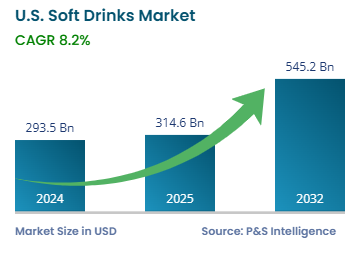
The U.S. soft drinks market size was USD 293.5 billion in 2024, and it will grow by 8.2% during 2025-2032, to reach USD 545.2 billion by 2032.
The market growth is driven by the increasing health consciousness, demand for low-sugar and functional drinks, sustained product development, growing online retail sector and DTC platforms, and surging preference for sustainable products. Consumers are moving toward sodas and drinks with more health benefits, such as adaptogens and prebiotics, from conventional sodas. This major shift results in a strong demand for brands providing sparkling water, low-calorie drinks, and vitamin-based drinks. For instance, in 2023, The Coca-Cola Company introduced Y3000, which was a futuristic soft drink created by AI to satisfy modern consumer needs.
Moreover, the rising urbanization rate is increasing the demand for ready-to-drink, convenient beverages among young and urban consumers. Exposure to global trends, the influence of social media, and the rising number of young consumers further propel the market.
U.S. Soft Drinks Market Dynamics
Sustainability and Eco-Friendly Packaging Are Biggest Trends
The rising demand for clean-label products, such as plant-based packaging, recyclable cans, and glass bottles, is a key trend in the market.
Consumers are choosing drinks with sustainable packaging, further pushing companies to use plant-based materials.
This major shift is due to environmental awareness and government regulations.
For instance, in 2024, the FDA banned brominated vegetable oil due to the rising health concerns.
The rise in the popularity of subscription drink services and online shopping is increasing the demand for eco-friendly packaging, which supports both convenience and green choices.
As per reports, in 2023, nearly 50% of the plastic packaging in the U.S. was reusable, recyclable, and compostable.
According to a survey, 60% of the consumers in the U.S. see glass as a sustainable material.
The rise in the popularity of prepaid drink services has increased the demand for flexible and clean packaging that is practical and also sustainable.
Rising Health-consciousness among Consumers Is Key Driver
The rising consumer preference for low-sugar, organic, and functional beverages over traditional beverages is a key trend in the market.
Brands are manufacturing products by using natural sweeteners, plant extracts, and with minimum artificial additives.
Over 40% of the country’s population is obese, and around 10% is severely obese.
More than 38 million people in the U.S. have diabetes, while over 28 million suffer from strokes, heart attacks, ischemic heart disease, and other CVDs.
Functional beverages, infused water, and nootropic drinks are becoming more and more popular in the U.S.
Many companies are heavily investing in alternative ingredients, new formulations, and hybrid drinks to support the consumer demand.
Consumers are becoming more health-conscious and opting for probiotic and super drinks, which provide health benefits.
Furthermore, they are demanding prebiotic soda, electrolyte-enhanced beverages, and immunity boosters, all considered wellness-enhancing beverages.
The recent trend of drinks that enhance energy, mental focus, digestion, and stress relief suggests changing lifestyle needs.
Functional beverages are now becoming a premium product, and customers are prepared to pay extra for goods that deliver performance and wellness.
Functional drinks have emerged as a leading source of business growth in the U.S. non-alcoholic beverages market due to consumers’ increasing demand for products that provide refreshment as well as health benefits.
As per a survey, 65% of the consumers prefer low-sugar drinks, monk fruit, and natural sweeteners, such as stevia, to artificial ones.
U.S. Soft Drinks Market Segmentation Analysis
Product Analysis
The bottled water category held the largest market share of around 40% in 2024 due to the increase in health and wellness trends. People are increasingly focusing on hydration with little or no additives and calories, which bottled water provides. It is rising in demand as it is convenient, portable, and comes in different flavors, such as sparkling and fruity.
The functional & health drinks category will have the highest CAGR due to the increasing demand for probiotics, adaptogens, vitamins, electrolytes, and superfood content to enhance wellbeing. Niche beverage, such as kombucha, have now became mainstream with big brands getting into this market. Consumers are willingly paying a premium for functional drinks that align with their active and healthy lifestyles.
The products analyzed in this report are:
Carbonated
Non-Carbonated
Bottled Water (Largest Category)
Energy
Sports
Functional and Health (Fastest-Growing Category)
Others
Distribution Channel Analysis
The supermarkets & hypermarkets category held the largest market share of around 40% in 2024 because they provide a wide product range, competitive prices, and bulk purchases. They are easily accessible, consumers often visit them, and they are the preferred channel for households. Moreover, promotional discounts, brand exposure, and strategic shelf positions lead to the high sales volumes under this category.
The online retail category will have the highest CAGR due to the growing consumer demand for convenience, doorstep delivery, and 24/7 shopping. Direct-to-consumer models, subscription-based purchases, and e-commerce platforms drive online growth. The availability of customized beverages, discounts, and fast ordering options on online platforms support consumers with busy lifestyles and those in remote locations. As per the Census Bureau, e-commerce retail sales in the U.S. grew by 0.4% from the fourth quarter of 2024, reaching USD 1,858.5 billion in the first quarter of 2025.
The distribution channels analyzed in this report are:
Supermarkets & Hypermarkets (Largest Category)
Convenience Stores & Gas Stations
Online Retail (Fastest-Growing Category)
Vending Machines
Foodservice & Fast food
Direct-to-consumer
Packaging Analysis
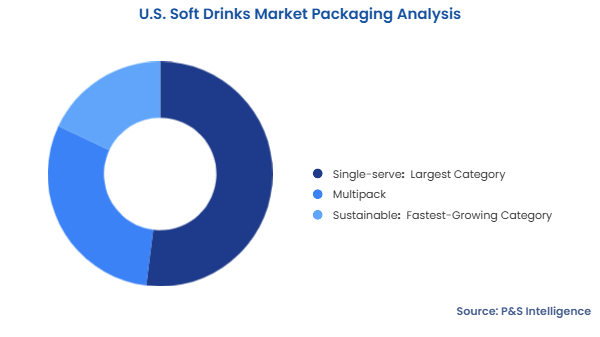
The single-serve category held the largest market share in 2024, as it is more convenient and preferred by consumers for traveling. Due to their increasingly busy lives, they prefer portability, portion control, and convenience in disposal. It also helps in increasing the sales of ready-to-drink (RTD) beverages, as well as vending machine sales.
The sustainable category will have the highest CAGR due to the increasing consumer awareness of environmental issues and enforcement of stricter regulations on plastic waste by the government. Major brands are using recyclable, biodegradable, or plant-based packaging materials to minimize plastic usage as they are not strongly focused on priority. Such innovation appeals to green consumers, making sustainability a solid investment.
The packaging analyzed in this report is:
Single-serve (Largest Category)
Multipack
Sustainable (Fastest-Growing Category)
Application Analysis
The everyday hydration category held the largest market share of approx. 55% in 2024, because consumers value regular fluid consumption for general wellbeing and health. With the increasing awareness of the benefits of hydration, bottled water and functional drinks continue to be a daily necessity. The shifting preferences, increasing wellness awareness, busy working styles, and social engagements also drive the demand for easy-to-consume, on-the-go beverages that fit into daily routines.
The workouts & sports category will have the highest CAGR because of the growing fitness awareness and active lifestyles. The consumption of sports drinks, electrolyte-fortified drinks, and protein drinks is on the rise as consumers look for hydration and performance. As per estimates, almost 65 million Americans have an active gym membership, while over 240 million regularly engage in sports.
The applications analyzed in this report are:
On-the-go
Social gatherings
Everyday hydration (Largest Category)
Workouts & Sports (Fastest-Growing Category)
Meal Pairing
Drive strategic growth with comprehensive market analysis
U.S. Soft Drinks Market Regional Outlook
The South held the largest market share of around 40% in 2024 due to its hot climate, high population density, and rising consumer demand for carbonated soft drinks, iced tea, and bottled water. Moreover, cultural considerations and regional beverage brands play a major role in increasing the consumption. According to a CDC report, nearly 67% of the consumers consume sweetened beverages daily. Moreover, Arkansas has a high soda consumption rate, with 74% of the consumers consuming on a daily basis, while Georgia has a 68% and South Carolina a 70% rate.
The West will have the highest CAGR due to the growing demand for health-oriented drinks, eco-friendly packaging, and premium soft drinks. As per reports, around 61% of the adult consumers consume SSB daily. Moreover, Washington, with 55%; Oregon, with 51%; and California, with 62%, report some of the lowest daily sugar consumption, showing a strong demand for healthy and smart drinks.
The geographical breakdown of the market is as follows:
Northeast
Midwest
South (Largest Category)
West (Fastest-Growing Category)
U.S. Soft Drinks Market Competitive Landscape
The market is moderately fragmented due to the presence of large and small companies, including Coca-Cola, PepsiCo, and Keurig Dr Pepper, which lead in the traditional soda segment. Moreover, niche and emerging brands are innovating new products, such as functional drinks, vegan drinks, and less-sugar drinks, to meet the consumer demand for healthier and more clean products. As a result, no single company dominates in all segments, making it highly competitive.
Key U.S. Soft Drinks Companies:
The Coca-Cola Company
PepsiCo, Inc.
Keurig Dr Pepper Inc.
Dublin Bottling Works
Avery's Beverages
National Beverage Corp.
Jones Soda Co.
Reed
Faygo Beverages, Inc.
National Beverage Corp.
Big Red, Inc.
Boylan Bottling Co.
U.S. Soft Drinks Market News
In May 2025, PepsiCo Inc. partnered with Formula One Group, making Sting Energy Drink, Gatorade, and Doritos official partners with event activations and trackside ads at 21 race venues.
In May 2025, PepsiCo Inc. and Amazon Web Services (AWS) collaborated to boost the use of AI in customer experience, innovation of products, and supply chain.
In March 2025, PepsiCo Inc., Madison Square Garden Entertainment Corp., and Madison Square Garden Sports Corp. extended their multi-year partnership, under which PepsiCo became the Beverage Partner for the Radio City Music Hall, Madison Square Garden, and Sphere Las Vegas.
In April 2024, The Coca-Cola Company and Microsoft Corporation signed a USD 1.1-billion deal to use Microsoft Azure Cloud and generative AI to improve Coca-Cola’s supply chain and manufacturing.
Want a report tailored exactly to your business need?
Leading companies across industries trust us to deliver data-driven insights and innovative solutions for their most critical decisions. From data-driven strategies to actionable insights, we empower the decision-makers who shape industries and define the future. From Fortune 500 companies to innovative startups, we are proud to partner with organisations that drive progress in their industries.
Client Testimonials
Working with P&S Intelligence and their team was an absolute pleasure – their awareness of timelines and commitment to value greatly contributed to our project's success. Eagerly anticipating future collaborations.
McKinsey & Company
India
Unmatched Standards
Our insights into the minutest levels of the markets, including the latest trends and competitive landscape, give you all the answers you need to take your business to new heights
Complete Data Security
We take a cautious approach to protecting your personal and confidential information. Trust is the strongest bond that connects us and our clients, and trust we build by complying with all international and domestic data protection and privacy laws